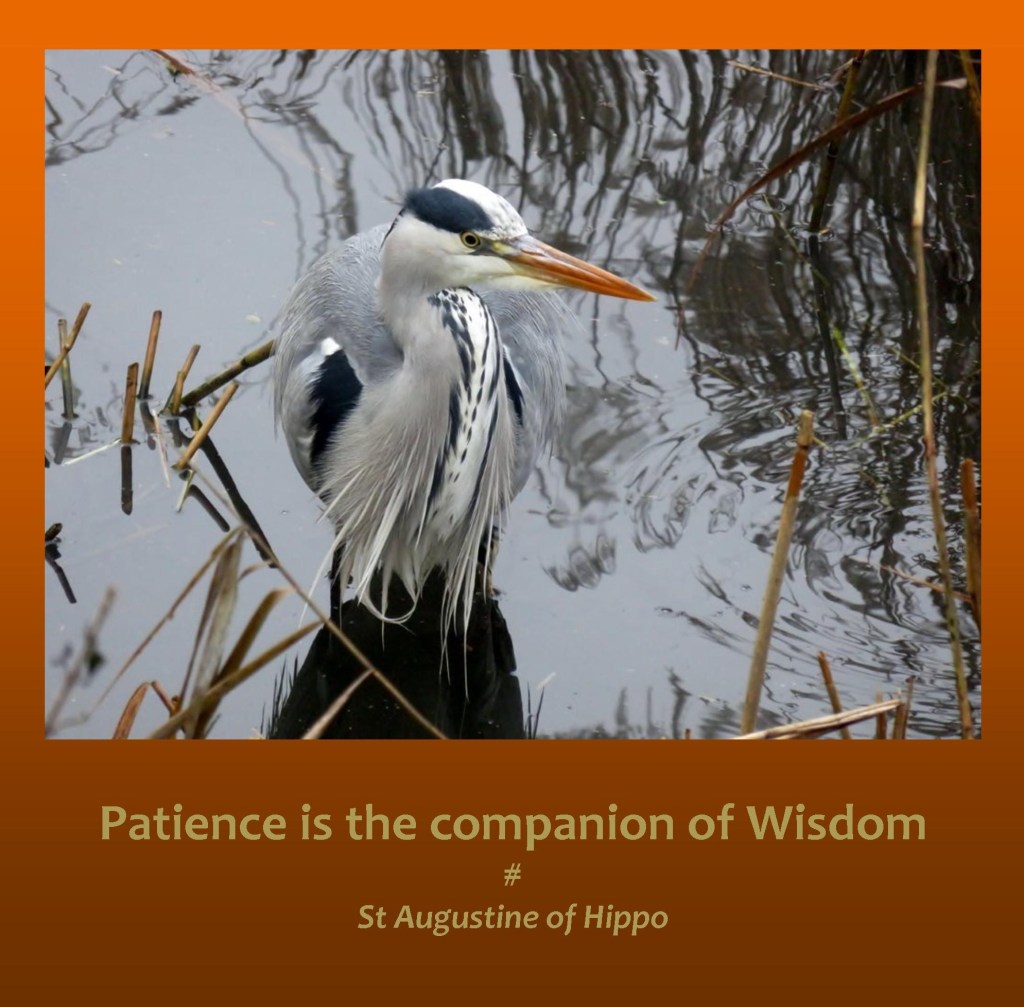
Another picture relection from my friend Joyce Smith
Dear Friends, As this heron patiently waits for a fish, it reminds me to be patient and look at what I can appreciate now, rather than always looking for the elusive bittern! With my love and prayers, God bless, Joyce
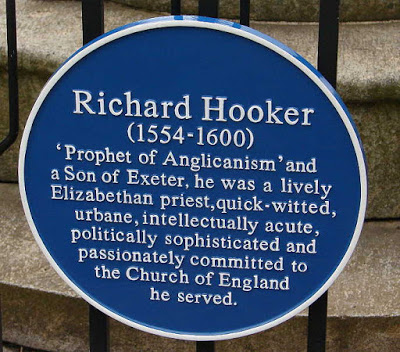
Richard Hooker was an English priest who died in 1600, and we remember him today as a theologian who defended the Church of England and its choice of “the middle way” between Roman Catholic and Puritan ideologies.
Hooker entered Oxford University in 1567 and for eighteen years devoted himself to scholarship and reflection on the subtle points of theology. He became deputy professor of Hebrew, was ordained to the priesthood, and appeared to be set on a purely academic career. But his learning, moderation, and commitment to the Church of England brought him to the attention of the authorities, and he was appointed Master of the Temple, an office of great prestige because it made him the chief preacher to the legal community of London. He held this post for six years, then resigned to become the rector of a parish near Salisbury. A few years later he moved to a rectory in the diocese of Canterbury, where he died at the age of forty-six.
He was a quiet man, loving to his wife and children, glad in his piety, and happy in his ministry.
But the Church remembers him primarily for the one great work that he wrote — a majestic study entitled Of the Laws of Ecclesiastical Polity. It was published in 8 volumes though the final 3 were published posthumously. It was addressed to a group of English protestants who were nicknamed Puritans because they sought to purify the Church of England according to their own narrow reading of the Bible. Against this movement Hooker argued for a more liberal outlook, which coordinated the testimony of Scripture, the course of Christian history, and the values of human reason, in order to defend the English Church as a communion for all the people, not just a small group of “saints.” The experience of The Anglican Communion has confirmed his teaching, and today we honour his work as a true cornerstone of Anglican history.
(from: For All the Saints: Episcopal Church of Canada)
Richard Hooker has rightly been called one of the Fathers of Anglicanism. Our Church is deeply influenced by Hooker’s teaching that our authority as a church is founded on what has come to be known as a Three-Legged stool of Scripture, Tradition and Reason. Our knowledge of God and His purpose for humanity and all creation is based on these three.
Scripture: We seek to discover the word of God through reading the Bible. There are different understandings about the Bible’s authority in our lives. We need to use resources like different Bible translations, commentaries and Bible reading notes to help us understand this but Anglicanism has a deep commitment to the authority of Scripture as God’s Holy Word to us.
Tradition: We often hear talk of Apostolic Succession which has been narrowed down to the Episcopal succession of Bishops, priests and deacons—the ‘order’ of the church’s ministry – but its wider application is that of handing on the teaching of the Apostles. From them the doctrine of the church passed on through the early church to every generation since as teaching and doctrine which is added to and refined as our knowledge of God is deepened and enriched. This theological richness and diversity includes inspirational material like hymns, songs, prayers, poetry, Christian art and devotional books.There are also formally agreed teachings as found in the creeds and the ‘Liturgy’ – the orders of services such as Common Worship (Church of England) and the Book of Common Prayer, and their equivalents in the Scottish Episcopal Church, The Churches of Wales and Ireland and throughout the Anglican Communion. These are primary sources of our Theology. It is rightly said that we believe what we pray. All true theology is rooted in prayer. The Orthodox Church puts it like this: A theologian is one whose prayer is true.
Reason: We are called to love God with our minds as well as with our hearts. To the best of our ability we need to think things through in the light of reason. This means becoming aware of different points of view, and using our own critical thinking to make sense of God’s world.
(an insight from the Methodist Church)
Hooker expressed these fundamental tenets of Anglicanism in Volume 5 of his Laws of Ecclesiastical Polity. It became the essence of what is distinctive about Anglicanism. It became known as the Via Media, The Middle way between Roman Catholicism and Protestantism and led to the Anglican church being known as as both Catholic & Reformed.
The Anglican balancing of the sources of authority has been criticized as clumsy or muddled. It is hard to live between two powerful and divergent views – Catholicism & Protestantism whilst seeking to incorporate the best of both.
Seeking the best means being willing to tolerate, comprehend and embrace opposing viewpoints and practices. This results in the Anglican Church having a wide inclusivity even though at times this could be disputed and lead to musunderstandings. At the heart however it is the importance of worshipping and praying together and a pursuit of what is described today as generous orthodoxy.
To Scripture, Tradition and Reason, we have recently added Experience. This stresses the importance of our own experience of God’s grace working in our lives. We gain wisdom and maturity from life experience, especially when we pray and reflect about our story with other Christians not just within Anglicanism but Ecumenically and even through engagement with the secular world.
One thing that Anglicanism seeks to uphold is the Inclusivity mentioned above. After all we are all One in Christ Jesus. We are all equal in the eyes and heart of God. We are all enlivened by the Holy Spirit. We are all held together in the corporate love of the Trinity. Anything narrower than that takes us, I would argue, away from God.
At the end of Richard Adams’ book, ‘Watership Down’ – Hazel, the Buck Rabbit who is the hero of the story is resting in his burrow. Like Moses he had led his rabbits from their old home which was threatened by destruction to a new and safer place. His work is done and he was very old. Dozing in and out of sleep he wakes to find another rabbit lying quietly beside him.
“Do you want to talk to me?” Hazel asked.
“Yes, that’s what I’ve come for,” replied the other, “You know me don’t you?”
Hazel, though he searched hard to remember his name, mumbled ‘Yes, of course’ and then he saw the silver light around the strangers ears.
“Yes, my lord” he said more confident now, “Yes, I know you.”
The stranger told Hazel that he had come to take him to a new home. “If you’re ready, we might go now.”
They went out into the shining sun and as Hazel went along, he decided he wouldn’t need his body anymore, so he left it lying on the edge of the ditch, but stopped for a moment to watch his rabbits and to try and get used to the extraordinary feeling that strength and speed were flowing inexhaustibly out of him into their sleek young bodies and healthy senses. “You needn’t worry about them” said his companion, “They’ll be all right, and thousands like them. If you’ll just come along, I’ll show you what I mean.” He reached the top of the bank in a single, powerful leap. Hazel followed; and together they slipped away, running easily down through the wood where the first primroses were beginning to bloom.
Unlike birth which is surrounded by people – especially the mother, the midwife and increasingly the father, death is often thought of as the loneliest of experiences as the loved one slips away – to what? to where? Yet this story of Hazel’s death suggests something much more vibrant. Frail and tired, Hazel follows the one who has come for him and as he sheds his body, he is filled with a new power, a new life. We get the sense that as one journey ends, he is embarking on another, more exciting journey.
It’s only a story, of course but it came to mind soon after my mother’s death.
Sitting at her bedside that last night, I watched her slip away. At first, after I arrived, she nagged me for being out so late (it was the early hours of the morning) but gradually I became less important. Her last conversation was not with me but with long-dead people – significant people in her own life – who had, like the stranger coming to Hazel, come for her. The lonely figure in the hospital bed was suddenly transformed. She became animated as she saw what I couldn’t see; people who would be taking care of her – people, if I dare say it, who had been sent to her by God. In that moment, the veil which separates us here from those who have gone beyond death seemed very thin.
My mother slipped away from me but not into oblivion. There was, without doubt, something beyond this physical death I was witnessing and as I left the hospital I had an overwhelming feeling that, like Hazel in the story, she had left her useless body behind and leapt into a new life.
My faith tells me something of that life and we are given plenty of clues by Jesus and by the New Testament writers. I love the Proper Preface that we slip into the All Souls day Eucharistic Prayer which talks of the ‘hope of a glorious resurrection’ and assures us that though death comes to us all, ‘yet we rejoice in the promise of eternal life’ and then those vitally important words: ‘ for to your faithful people life is changed not taken away, and when our mortal flesh is laid aside, an everlasting dwelling place is made ready for us in heaven.”
That is what our faith tells us. It all sounds very exciting and if, as I believe, it is true, then I cannot be sad for those who have left us here on earth to embrace the eternal life given to us by our eternally loving God. They’re all right but then I have to deal with those words the Lord Rabbit said to Hazel, that we too will be all right. It doesn’t always feel like that as we go through the process of mourning with its sense of loss and loneliness, emptiness and sadness. I’m sure it isn’t feeling all right for those mourning loved ones. Yet strangely, it is. The Lord Rabbit spoke a great truth.
Of course we miss our loved ones in the sense that we are denied their physical presence and those intimate sharings of life on earth. There will always be that void within us which no one can occupy – and which no one should because if it were otherwise, our feelings, our love for them would be diminished.
But it needn’t be such a lonely sad place. ‘Life is changed, not taken away’ – there is a glorious resurrection; there is an eternal promise. And inasmuch as we live a life of faith then there will always be that interconnection, that bond which death cannot break. “Therefore with angels and archangels and all the company of heaven…” The veil is lifted between us and them – we are together, in the Eucharist gathered with them and the whole company of heaven. All is eternal. We are all held in the love of God. We meet each other around the altar of our Lord.
We who mourn and are sad will be all right. Dare we believe it? Dare we give thanks?
All Souls day is not a morbid introspective sad day but a day of joy and thanksgiving that, in God, we are all together, held in his love.
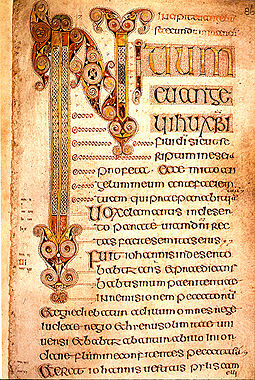
Book of Durrow, beginning of the Gospel of Matthew
Vellum, parchment, stone, wood and skin all marked by writers to convey the word of God. Yet God, in mystery, appears to fleshly hearts, made pure, writing upon these the very Word of God; that they can be read of men and women – true icons of Christ.

 Mr G's Ponderings