Each Year we keep a time of special Remembrance for those who served and gave their life for their country in wars and conflicts.
This remembrance encompasses not only those who died in World War 1 and World War 2. Other wars and conflicts have claimed many more lives in Aden, Iraq, Afghanistan to name but a few. We also increasingly remember those civilians who have died fleeing from their homelands in the middle East countries such as Iran, Syria, Yemen, Lebanon and Africa. Places which today have left the rest of us with the care and safety of refugees. Every war has victims, many quite innocent like the Jewish people who suffered and died at the hands of the Nazis.
Throughout the United Kingdom and in our Commonwealth countries there is a solemn observance and a quiet thanksgiving for all who died and for those who were injured, many with life-changing injuries.
Names of the fallen are prayed in their local communities or on foreign fields away from home.
Today, as we might stand before War Graves in churchyards or in War Cemeteries, many names are just that. We know little about them. Of those who died in the First World War, the youngest graves are now 103 years old.
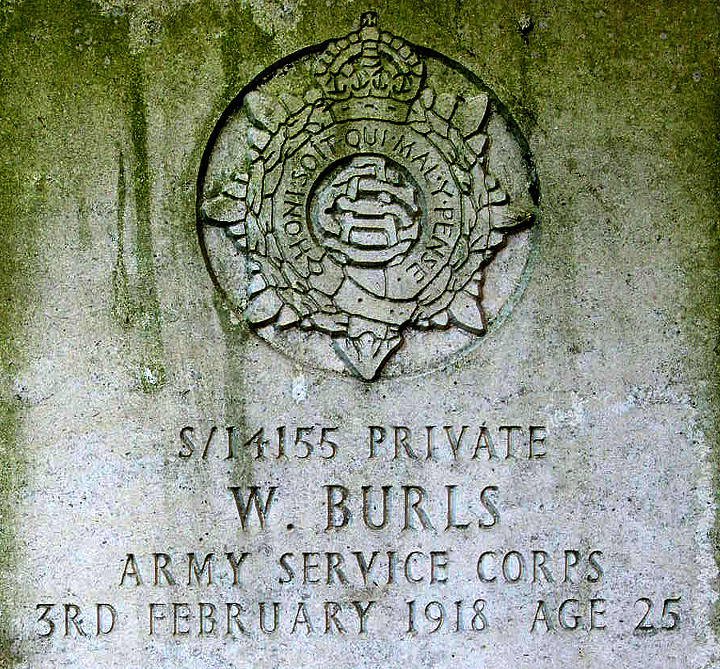
Often the Christian names are not recorded. So for them I have written this poem – inspired by the grave of Private Burls, buried in the churchyard at St. Mary-at-Latton.
A Military Man
You lie almost hidden one of Latton churchyard’s quiet secrets. You are a private, military man. One quarter of a century spans your life. We do not even know your name. The name which belongs to you alone. What did they call you Private W Burls, Died 3rd February 1918 ?
You almost escaped but your destiny was to die a military man. You have lain here for one hundred and three years and still we do not know your name, Private W Burls.
You gave your life, like so many, for the cause of peace , a peace in which you now lie. The peace of God. God knows your Name. It’s all that matters.
Rest in the Lord, Private W Burls. A military man.
Born in about 315, he was a native of Pannonia in Hungary and he began to follow the Christian faith at the age of 10. For 25 years or so he served in Roman army as his father had done before him. He was stationed in Milan and Germany. In Worms he struggled with the clash between his occupation as a soldier and his faith. He refused to fight and was imprisoned for a time. When the enemy surrendered he was released from the army.
It was around this time that probably the most famous story about him took place.
Riding into Amiens he came across a poor beggar who was almost naked, and he cut his soldier’s cloak in half in order to clothe the man. The following night he had a dream in which he saw Christ himself wrapped in half of a soldier’s cloak and saying, “Martin, a mere catechumen, covered me with his garment.”
After Baptism he spent time in Milan and then settled in Poitiers where he was influenced by St. Hilary. He then became a hermit for a time as he dedicated his life to God. He then set up a religious community in Legugé and from there moved to Tours.
He lived through a turbulent time for the Church as it overcame a number of heresies and wrestled with the most important struggle ever of the Christian Church – whether Jesus was both truly divine and truly human. It was a period when the Emperor Constantine declared Christianity to be the official Religion of the Empire. Various Councils of the Church followed and, in Martin’s lifetime that,at Nicea in 325 led to a Creed affirming our Lord’s divinity and humanity – true God and true Man. This was strengthened at the Council of Constantinople in 381AD. (The final Council on this subject was in 451AD at Chalcedon after Martin’s death)
His holiness became known and the Christians at Tours in France elected him to be their new bishop. When they went to find him he had fled into hiding because he did not believe he had the qualities and gifts to be their bishop. However, one might say that, his goose was cooked, when a gaggle of geese honked so loudly that they drew attention to his hiding place! Despite his own reservations. he became Bishop of Tours and served his Lord and the people with humility and devotion. He was especially concerned for the poor.
The Geese however were not forgotten and legends grew up about them.
Amongst several customs and practices which became associated with St. Martin’s Day the cooking and eating of a goose was, and, in many parts of Europe, still is, part of the celebration of a Saint who gave his name to a season – Martinmass. This was accompanied by Fairs, street celebrations with lighted lanterns, and the cooking of geese and sometimes ducks.Amongst several customs and practices which became associated with St. Martin’s Day the cooking and eating of a goose was, and, in many parts of Europe, still is, part of the celebration of a Saint who gave his name to a season – Martinmass. This was accompanied by Fairs, street celebrations with lighted lanterns, and the cooking of geese and sometimes ducks. It’s popularity as a season is also bound up with the final ending of the Harvest when animals were slaughtered and salted for the dark winter months ahead. In religious observance it was linked with Advent to signal a period of preparation for Christmas. So the festivities at St Martin’s tide were especially observed. A Martinmass Fair in Nottingham used to last for 8 days. It’s popularity as a season is also bound up with the final ending of the Harvest when animals were slaughtered and salted for the dark winter months ahead. In religious observance it was linked with Advent to signal a period of preparation for Christmas. So the festivities at St Martin’s tide were especially observed.
Today the feast in the UK is associated with Remembrance, being linked with the signing of the World War 1 Armistice on St Martin’s Day in 1918. It is therefore a more solemn day.
However, it is still kept in Hungary, Germany and Scandinavia, especially southern Sweden. In Britain there are a few Lantern Walks in Scotland and Wales.
Of course, there is always the Goose! There are many delicious recipes linked to this fest. In Germany, for example it is always served with braised red cabbage and bread or potato dumplings. St Martin is toasted with a glass of matured new wine which is known as ‘Martin’s glass’.
There is always plenty of Goose fat leftover for Christmas cooking.
Some may think that the poor Goose got its come uppance for revealing Martin’s hiding place but perhaps we should toast it too. After all, by honking away, it gave the church one of its most loving and holy bishops, whose heart for the poor may have made him a little surprised that his day is associated with rich food, One hopes that some portion of these meals might be given to the poor, or a monetary equivalent! Dare I even suggest that we might be kind to geese.
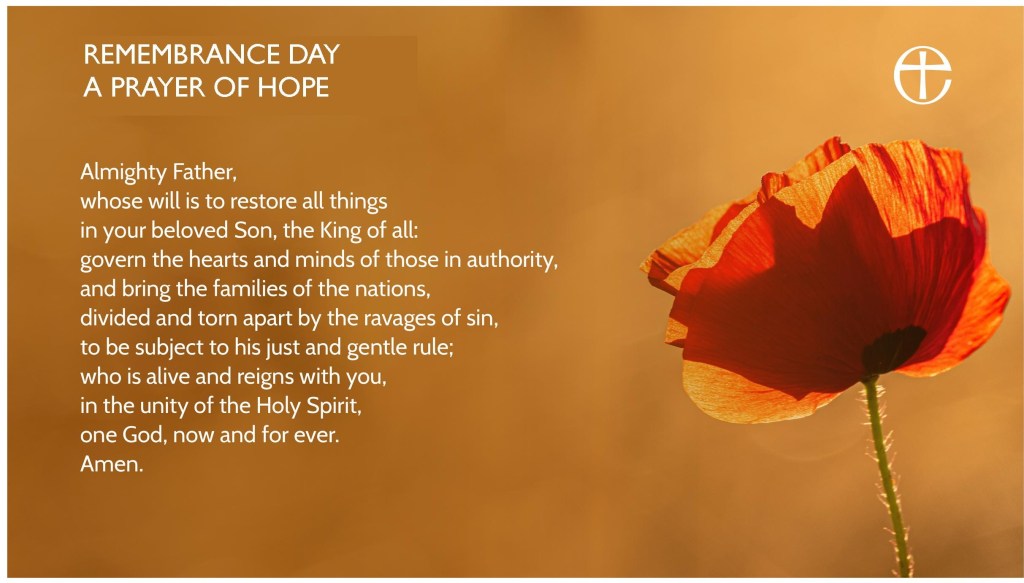
Photo by Piers Northam : Poppies at Newhall, Harlow.
Today, Thursday November 11th is Remembrance Day. Further official commemorations will take place over the weekend. Here is a prayer from the Church of England expressing hope and trust in God.
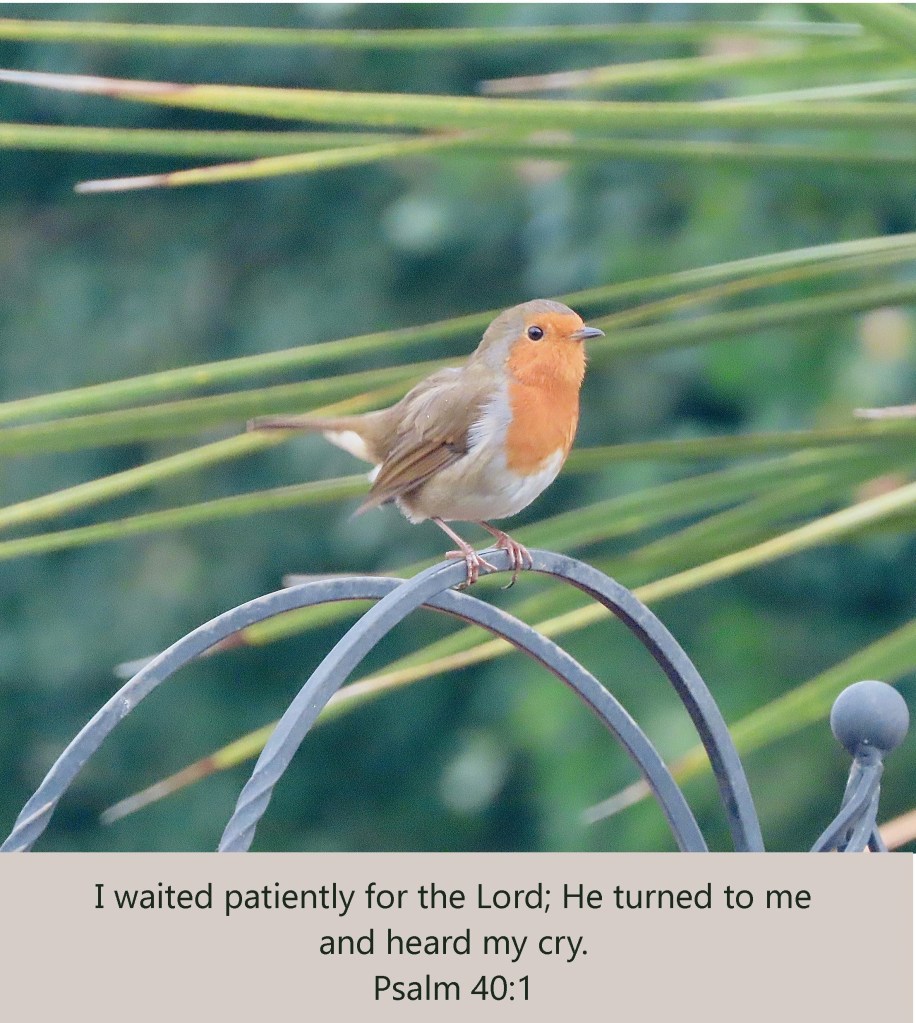
My friend Joyce has sent me another lovely Tweet of a Robin who visited her garden recently and brightened up her day.
TURNING BACK TO GOD
We live in an ‘instant’ world where Internet technology has made it possible to find answers to many questions and seek information about many things. Social Media is both a blessing and a curse. People find it so easy to wage war on others without any sense of responsibility. It is hard to seek and find redress when things have gone ‘viral’. Glib comments which pour from news media and gossip papers that masquerade as newspapers, damage lives. Also, in our instant world, it is so easy to make decisions without pondering the consequences. Governments sometimes do this and regret it later! Whereas, in a genuinely civilized and democratic society ideas are celebrated, debated, refined and honed, before becoming offered and accepted, we tend to rush in where, as they say, angels fear to tread.
One hopes that those in conference in Glasgow at COP26, may be more restrained and shy away from instant decisions which may lack substance. A Conference which is seeking solutions to the problems besetting the world needs to be considerate, filled with kindness, respectful of all participants, including (and perhaps especially) those witnessing on the fringe of the Conference. Many are very knowledgeable including David Attenborough, Prince Charles and Greta Thunberg. There’s a lot of expertise around which must be heard. We must be encouraged in our hope for a better world, a safer planet and a deeper understanding of Creation, how it works; how it can’t work, and, most importantly who our Planet is for.
We have much to pray about right now.
So what has this all to do with the little Robin?
Well, first of all, it has no seat at the Conference table, yet it is representative of the whole of Creation. Though it has a beautiful and melodious voice, it will not be heard at COP26, nor will other parts of Creation. When God made us ‘Stewards’ of the earth, He had a hope that we wouldn’t exploit our beautiful Planet nor the lovely and diverse people who populate it along with the amazing and vast varieties of creatures, plants and all that makes our world so tremendous.
The Conference in Glasgow will hardly celebrate that because it is gathered to make reparation for all the destruction each generation has made. At least, in theory! I doubt there will be much Penitence, which brings me back to the Robin. Who is apologizing to him/her for what we are doing to his/her habitation and freedom? Who will admit to the creatures the Robin represents that we have been sucking the life out of Nature, the world they inhabit alongside us.
So the other reason the Robin is important to us is in the words Joyce has chosen from Psalm 40.
“I waited patiently for the Lord, He turned to me and heard my cry.”
R.S. Thomas, in one of his poems said, The meaning is in the waiting.’ The late Rabbi Jonathan Sacks, said that it is important to distinguish between what is ‘urgent’ and what is ‘important’. That takes patience and discernment.
If at COP26 we only deal with the Urgent – and all our proposed solutions deal just with that, then we may miss what is important. What will change our world is if we get the Important right.
And what might this Important be?
I am going to say that it is rooted in returning to the One who is the Creator of the world and the Universe. Too vast a concept? Then how about this to meditate on:
He drew me up from the desolate pit, out of the miry bog, and set my feet upon a rock, making my steps secure. He put a new song in my mouth, a song of praise to our God.
The moment we step away from the mess we are making and turn again to the Lord for help, we are moving from despair to hope and from blame to Praise. We turn towards our Loving God and try to put our Trust in him.
Happy are those who make the Lord their Trust. Says the psalmist.
The Robin may well teach us how to Trust It trusts that God in Creation will sustain it. It sings for all of the Natural World (of which, actually we are part). It knows its need of God.
What really worries me is – how true is that of the human race? Does humanity know its need for God. The important work is for us who do know our need of God to open others to trust in Him and in His love for the Earth and all in and on it. It really will make a difference.
This is how the Psalm ends. With a slight amendment, I offer it as a prayer.
May all who seek you rejoice and be glad in you; may those who love your salvation say continually, ‘Great is the Lord!”
For truly, you are our help and our deliverer Come to us and help us, O Lord our God.


 Mr G's Ponderings