Month: February 2022

Delightful Collared Doves

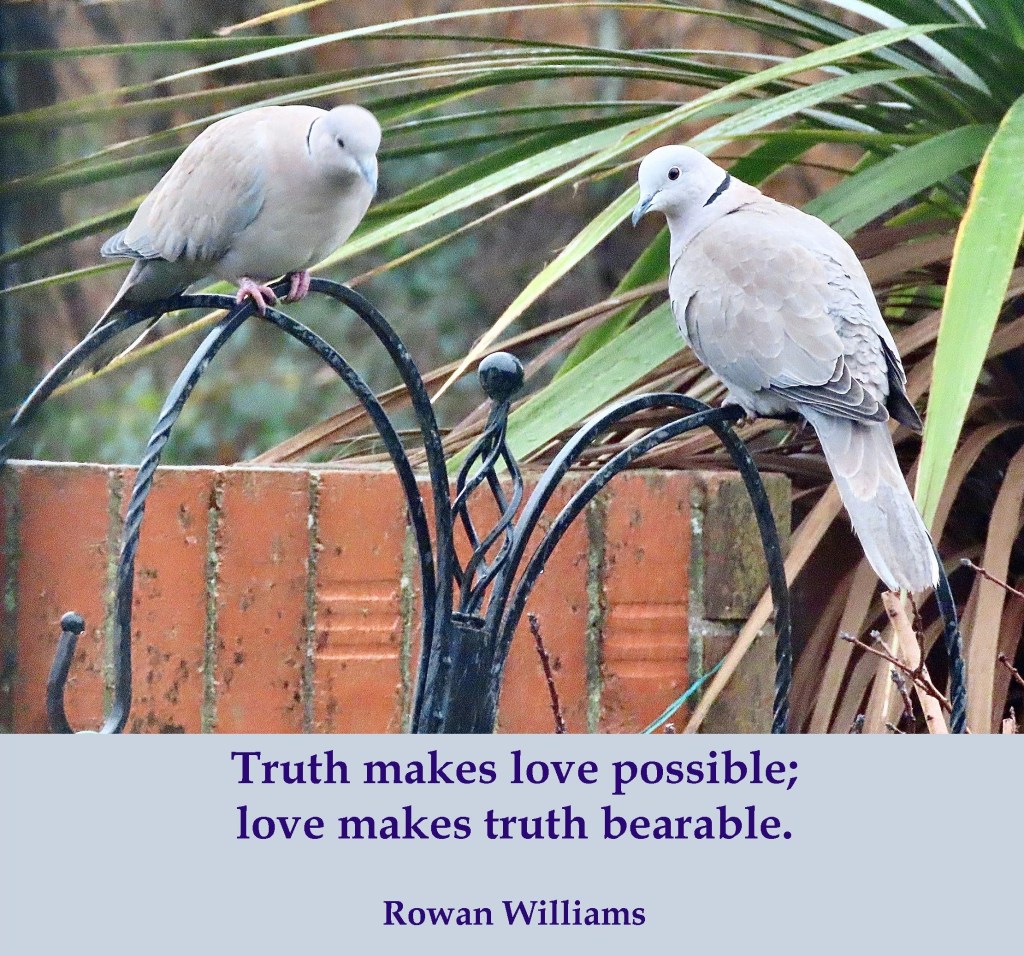
Delightful Collared Doves. A photo tweet sent to me recently by my friend, Joyce Smith.

Collared doves can be seen just about anywhere, but often around towns and villages. They’re common visitors to gardens. But collared doves only came to the UK in the 1950s, after a rapid spread across Europe from the Middle East          [RSPB]

The Eurasian Collared Dove first bred in England in the 1950’s, in Norfolk.
Because their young like to wander, they could soon be found in more widespread places. It is said that they can travel over 600km from where they were born.

One lovely fact about them is that they are monogamous. Barring accident they keep their partner for life. They also share in bringing up their young equally so they are an example of real partnership.

The Dove, of course, has a deep spiritual meaning and in Christianity is a symbol of the Holy Spirit, the third person of the Holy Trinity.
In the Old Testament, it was the Dove sent out across the waters by Noah which returned with the Olive Branch as a sign of God’s forgiveness and love.
We use the phrase ‘holding out an olive branch’ whenever we seek reconciliation between people and nations who are at loggerheads with each other.
As a result the Dove has come to be known for its gentleness but it has a reputation for being tough and often seen in places of danger and where human striving is failing. The Dove is a much loved symbol of Peace.

It is also a symbol of love, which makes the quotation, chosen by Joyce, from Rowan Williams (former Archbishop of Canterbury) very apt.
For me, it is the partnership of collared doves which speak particularly of relationship and commitment and sharing together which are symbols of love.
Rowan Williams speaks of ‘truth making love possible and Love making truth bearable.  Rowan always puts things beautifully but also in a way that makes us ponder the depth of meaning. So to help me work out what he is saying, I turn to the image of the little Collared Doves. They are true to each other and they are together in a relationship which feels like love to me. That is what sustains them and should sustain us.
In a world of shifting relationships between people but also nations and within nations, where truth and love seem to be trivialized and discarded, the collared doves may well remind us of the vitality of truth and love, of comittment and the joy of friendship which makes our lives so rich. We have to work at it!

Where chaos longs to reign,
Descend, O Holy Dove,
and free us all to work again
the miracles of love. Amen

[Mr.G]
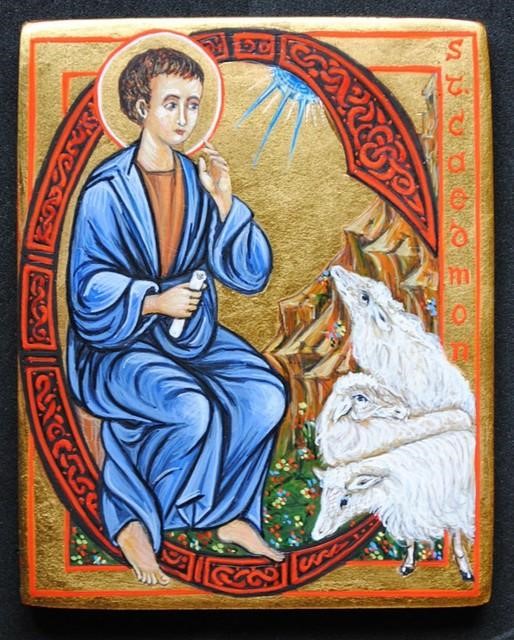
CAEDMON, herder of cows and stirrer of souls

Icon of Caedmon as used by Juan Alejandro Forrest de Sloper on his Book of Days site

CAEDMON, herder of cows and stirrer of souls

I cannot speak, unless You loose my tongue;
I only stammer, and I speak uncertainly;
but if You touch my mouth, my Lord,
then I will sing the story of Your wonders!

(Words from the Northumbrian Community)

Today (February 11th) we remember Caedmon of Whitby.

He was encouraged in faith by St. Hilda (Hild) who,whilst she was a player on the big stage of England of its time, was also a discerner of almost unknown individuals. She was to them an encourager and one who awakened and nourished the gifts of God in others. This was especially true of Caedmon.

We owe the story to the Venerable Bede, the monk of Jarrow .

Caedmon, according to Bede, was an illiterate cowherd at Hild’s Abbey in Whitby. Beyond tending the cows he  thought that he had little to offer and when those who farmed beside him would gather for an early form of Karaoke, taking turns to perform songs and poetry, Caedmon would often find an excuse to absent himself. One night, as he slipped away to be with his cows instead, he fell asleep in the cowshed. During his sleep he dreamt of a mysterious stranger who urged him to sing a song about the Creation of the world.

At first Caedmon resisted but the man in the vision persuaded him and Caedmon sang praise to God.

When he awoke  he remembered his dream and told the steward. Immediately he was taken to the Abbey and Hild. She recognized that God had worked a special miracle in Caedmon. She was entranced by his singing not least because he had, hitherto, led a life in which no poetry had a part.

Hild knew that she must encourage the gift shown to him.

She called scholars and learned men to meet with him and to them he explained his dream. They then opened to him a piece of Scripture and invited him to turn it into a poem. Next morning he returned and sang a poem which captured the bible passage in verse.

Hild was thrilled and persuaded him to become a monk at the Abbey where he soon became a companion of the others. He was instructed in the bible, sacred history and tales. Like a cow chewing its cud, Caedmon ruminated and turned what he learned into beautiful music and song. The book of Genesis and the flight of God’s people from Egypt to the promised land were followed by other Old Testament tales leading to songs of Christ’s Incarnation, His Passion and Ascension.

So, Caedmon enlightened people with the Holy Word of God and enriched others not only by his compositions but also by the beauty with which he sang.

He became the first English Poet and his extraordinary story became a reminder that God often takes what seems ordinary and makes it extraordinary – or rather takes ordinary people and reveals in them (in us) extraordinary gifts. All it took was a visitation from God and a Holy woman who knew that God was up to something and encouraged the development of a vocation and of a soul who enriched the church.

Though little remains of Caedmon’s poetry, most of it being oral, we have a few lines, thanks to Bede but also he began a poetic tradition which others took on board and developed. His poetry and singing was destined to lead to  the growth of a deep and lasting Anglo-Saxon / Old English poetic tradition.

Caedmon’s poem

Now we must honour the guardian of heaven
the might of the architect and his purpose,
the work of the father of glory as he, the eternal Lord,
established the beginning of wonders.
He first created for the children of men
heaven as a roof, the holy creator.
Then the guardian of mankind, the eternal Lord,
afterwards appointed the middle earth,
the lands of men, the Lord Almighty

Caedmon’s memorial in Westminster Abbey

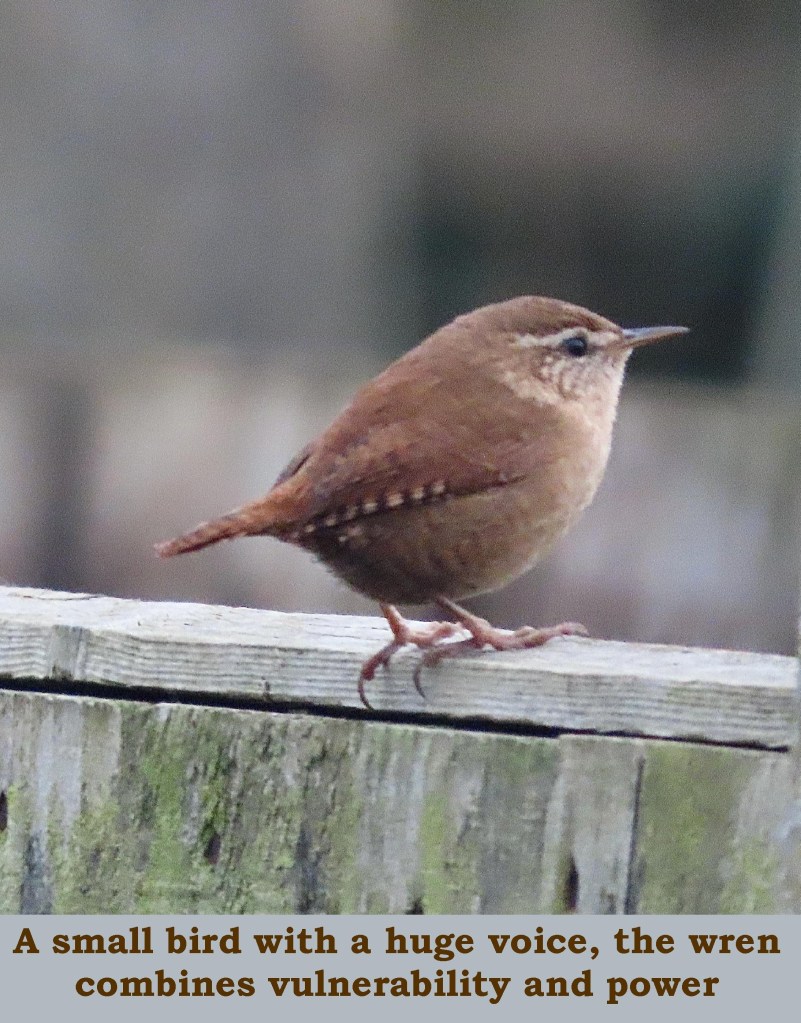
A bundle of delight.

Another picture reflection from my friend, Joyce Smith.

The  Wren is a sign to us of the joy of Creation. Thank you Joyce for sharing your Picture Tweet!

This tiny bird is often overlooked even though it has, as Joyce reminds us, a loud voice! Because they dart about, hopping from place to place, we may only become aware of them as a blur of motion. Yet, it is our most common bird. I’m told that there are about 8 million breeding pairs and you can find them everywhere in the British Isles.
Without realising it, we are rarely far from a wren.

Maybe we miss them because they aren’t flashy birds like the Robin Redbreast or the sleek blackbird or the woodpecker. Though noisy they aren’t raucous like the magpie! The wren appears unassuming and almost bashful except for its call.

Perhaps, too, the wren has learned to be elusive because history has not always been kind to it. Though in folklore, 13th century Jewish writing and among North American tribes, the wren was regarded as the king of birds which symbolized wisdom and divinity it was not always treated so.

My friend, Lynn Hurry, did a little research about the wren and discovered that Early Christians believed the wren had a pagan association and, in Ireland and on the Isle of Man, it was hunted on December 26. This was because it was said that St Stephen was betrayed to his persecutors by a noisy wren when he was hiding in the bushes. Dead or alive, a captured wren was put on top of a decorated pole and paraded round the community – the date was known as Wren Day. Live ones were stoned to death.

There are stories that even to this day on ‘Wren’s Day’ 26th Dec, a number of countries across Europe have a tradition consisting of hunting a fake wren and putting it on top of a decorated pole. Then crowds of mummers, or strawboys, celebrate the wren by dressing up in masks, straw suits, and colourful motley clothing. They form music bands and parade through towns and villages. These crowds are sometimes called wrenboys.

A rather nicer story from Ireland is that one day, all the birds gathered in a secret green valley on the south coast to discuss which one should be king. They agreed the one who could fly the highest would wear the crown. It was the eagle soared way above all the other birds – only to discover that a wren had ridden on its back and launched itself above him at the last moment!

In Wales the bird is considered sacred and in Scotland it was the Lady of Heaven’s Hen and killing it was considered extremely unlucky. Heed, therefore, that whoever tries to steal wren’s eggs or baby wrens could find their house struck by lightning and their hands shrivelled up!

Another warning comes from the poet, William Blake who in Auguries of innocence’ wrote:
He who shall hurt the little wren
shall never be belov’d  of men.

In an increasing dark world Joyce’s photo invites you to look to the natural world and discover a new delight and a new hope. God gives us glimpses of both these constantly. We just have to tune our hearts and truly open our eyes and see the signs. Often these are in little things and little creatures. It is so easy to miss what the poet, Frances Thompson, calls ‘the many splendoured  thing’.
Amongst which is most certainly  the little Wren!

[Mr G, with notes from Lynn Hurry and photo reflection from Joyce Smith]

A life of dedicated service

Her Majesty the Queen

Her Majesty’s Platinum Jubilee Statement

February 5, 2022.

Tomorrow, 6th February, marks the 70th anniversary of my Accession in 1952. It is a day that, even after 70 years, I still remember as much for the death of my father, King George VI, as for the start of my reign.As we mark this anniversary, it gives me pleasure to renew to you the pledge I gave in 1947 that my life will always be devoted to your service.

As I look ahead with a sense of hope and optimism to the year of my Platinum Jubilee, I am reminded of how much we can be thankful for. These last seven decades have seen extraordinary progress socially, technologically and culturally that have benefitted us all; and I am confident that the future will offer similar opportunities to us and especially to the younger generations in the United Kingdom and throughout the Commonwealth.

I am fortunate to have had the steadfast and loving support of my family. I was blessed that in Prince Philip I had a partner willing to carry out the role of consort and unselfishly make the sacrifices that go with it. It is a role I saw my own mother perform during my father’s reign.

This anniversary also affords me a time to reflect on the goodwill shown to me by people of all nationalities, faiths and ages in this country and around the world over these years. I would like to express my thanks to you all for your support. I remain eternally grateful for, and humbled by, the loyalty and affection that you continue to give me. And when, in the fullness of time, my son Charles becomes King, I know you will give him and his wife Camilla the same support that you have given me; and it is my sincere wish that, when that time comes, Camilla will be known as Queen Consort as she continues her own loyal service.

And so as I look forward to continuing to serve you with all my heart, I hope this Jubilee will bring together families and friends, neighbours and communities – after some difficult times for so many of us – in order to enjoy the celebrations and to reflect on the positive developments in our day-to-day lives that have so happily coincided with my reign.

Your Servant

Elizabeth R.

Almighty God,
whose Son Jesus Christ exchanged the glory of a heavenly throne for the form of a servant,
we thank you that you have given Elizabeth our Queen a heart to serve her people,
and have kept her devoted in this service beyond all who were before her:
encourage us by her example to serve one another, and to seek the common good,
until you call us all to reign with Christ in your eternal kingdom.
Amen.