The painting above is by a Ukrainian Contemporary artist, Olesya Hudyma and is titled ‘Woman with Dove Angel of Peace’. It is available to download digitally to help fund her work in Ukraine. It has been painted as a prayer in this time of warfare in her country.
She began painting in 2007 and she is self taught
Speaking about her artworks, she says that they have an emotionally evocative style of painting which is characterized by an opulent colour palette and the texture of her work.
“All the paintings are imbued with emotions and special images, outlined by quick brushstrokes. According to the topics, the paintings are systematized in series: «Sleepwalker», «Steps», «Angels of Peace for Ukraine», «Ukrainian Madonna», «Flowers» that are combined in different artistic ways : abstract art, expressionism, symbolism, magic realism and contemporary postmodernism. “
She also says of her work; “I love that state of clarity which is like a prayer. All the noise, emotions, and thoughts calm down and I melt into the world full of colours and fantastic flowers.”
Her artworks are in private collections in Ukraine, United States, Canada, Armenia, England, France, Germany, Switzerland, Italy, Spain, Poland.
In August 2018 Ukrainian Postal Service issued a postage stamp with O. Hudyma’s picture «Bride», as a part of «Love is Life» series. Another picture «Tree of Life» was used for a First Day Cover.
You can see more about her and her work by going to her website:
We pray for the people of Ukraine. We pray for peace and the laying down of weapons. We pray for all those who fear for tomorrow, that your Spirit of comfort would draw near to them. We pray for those with power over war or peace, for wisdom, discernment and compassion to guide their decisions. Above all, we pray for all your precious children, at risk and in fear, that you would hold and protect them. We pray in the name of Jesus, the Prince of Peace.
A Reflection on “Love one another” (The Gospel of John 13: 34-35) from Malcolm Green
I recently came across this story which, coming as it does from a reliable source, I believe to be true.
This all took place in a small village in France in 1943. The village was occupied by the Germans, but the local people felt sorry for these enemy soldiers. They were young men, far from home, on short rations, and quite probably conscripts, so we could say that like some many others of the time: they were reluctant participants in a gruesome and horrific war. In an attempt to try and help these young men, each day the local priest would go from door to door with two large baskets asking for food for them. The villagers responded with sharing what they could – a few eggs, perhaps, or some bread and vegetables. Then one day the local resistance movement blew up a strategic bridge. The commander of the occupying forces demanded reprisals and ordered that every man in the village between the ages of sixteen and sixty-five be taken to the village square. There, in front of family and friends – wives, mothers, girlfriends, sisters and their own children, they were shot. Besides themselves with grief, anger and torment, the villagers turned on the priest: “If you come again asking for food for these murderers, we shall kill you.”
On the day of the funerals the little church was overflowing, because every family in the village had lost someone. The old priest stood up and read from John’s Gospel , “I give you a new commandment, that you love one another. Just as I have loved you, you also should love one another. By this everyone will know that you are my disciples.” Later that day the priest stood in the village square – totally amazed and with tears in his eyes – as he watched the local people filling the baskets he had placed at his feet, with food to feed the enemy soldiers.
Now when I read that story of an event that took place in 1943, I couldn’t help but think of the atrocities happening in the small town of Bucha, and elsewhere in Ukraine today. We read the stories, and we see the pictures, but I don’t think any of us have an idea of what it’s like witnessing the realities of these kind of situations. If I’m totally honest, I can’t even begin to imagine how I would be able to start knowing how to love someone who had caused me such indescribable pain and hurt. And for me it doesn’t even have to go to such extremes for me to be tested. People can say things, do things – or not do things – and they can grate. It’s not easy to love someone who rubs you up the wrong way!
“Love one another as I have loved you” This most simple-sounding commandment is probably the most difficult to carry out. Yes, it’s easy to just nod your head and agree it’s a very good commandment. It’s fairly easy to recognise the wisdom of it. However, it requires a great deal of courage to put it into practice, and let’s not forget, it cost Christ his life.
Jesus died because he continued to remain true to this fundamental precept – this fundamental way of being – the very essence of what God is all about – to love each and every one of us, whoever we are, and no matter what we might or might not have done – regardless of how, or even if, we respond to him. Jesus was hated and treated unjustly by his enemies and yet he still loved them. Not an emotional or sentimental love, but a love that understands them. A love that is prepared to absorb the fear which made them react against him. He loved them out of his concern for their well-being, in spite of their actions. He loved them by recognising the basic humanity of each one which makes them precious in God’s eyes. And loving one another as Jesus loves us is the calling of the Christian. By the time the Apostles had begun the work of carrying on Jesus’ mission they had come to understand that Jesus is for everyone – not just a select few who believed they were the chosen ones.
It’s interesting that we tend to think of the Inclusive Church organisation as a fairly recent initiative. In fact, the early Church were inclusive from the very beginning! Like those early Christians, we believe in a church that celebrates and affirms every person, and does not discriminate. The enthusiasm of the early Church in the Acts of the Apostles speaks of the generosity of those followers who dedicated their lives to spreading this universal message of love and forgiveness. And if we have any concerns about not being good because we find it difficult to love everyone equally, no matter our best intentions and how much we try, we can be reassured in that Jesus did not say it would be easy. Jesus simply set out how important and necessary it is for us to keep at the front of our minds the commandment to love, and to use our very best endeavours to try and achieve that. We should be praying for those we find it hardest to love, and we should be asking for God’s blessing on them as well as on us.
In loving each other in the same way that Jesus loves us, it is the only way in which the world can come to reflect the kingdom of God – and after all – isn’t that something we often pray for – thy kingdom come, on earth as it is in heaven?
We may think that what we might consider to be our meagre efforts in showing Jesus’ inclusive love will make no difference, that it will pass by unnoticed. But it is in the struggle to love that we draw closest to Jesus and, together with him, we may affect our world more than we think possible. Let’s not underestimate God!
Our present society would often have us believe that it is easy to love. But that is a different “brand” of love from Jesus’. To love like Jesus is to surrender our own needs and desires to make space for, and to ensure that, the needs and desires of others are met, regardless of whether or not they are considered “worthy” by our own standards. Remembering always that we too, despite our own failings, are precious to God, is a gift worth giving. For, ‘God so loved the world that he gave his only Son, that we should have eternal life’. As children of the same God, should we not also surrender ourselves in love to the needs of others?
This is the challenge of the Gospel, both simple and profound. It is as fresh a call today as it was when it came from the lips of Jesus: “Love one another… just as I have loved you.”
And let us not be concerned or fearful of the reaction we may receive, for remember – he’s always walking alongside us, to the end of the age.
The Revd Malcolm Green is a member of the Ministry Team at St. Mary-at-Latton, Harlow
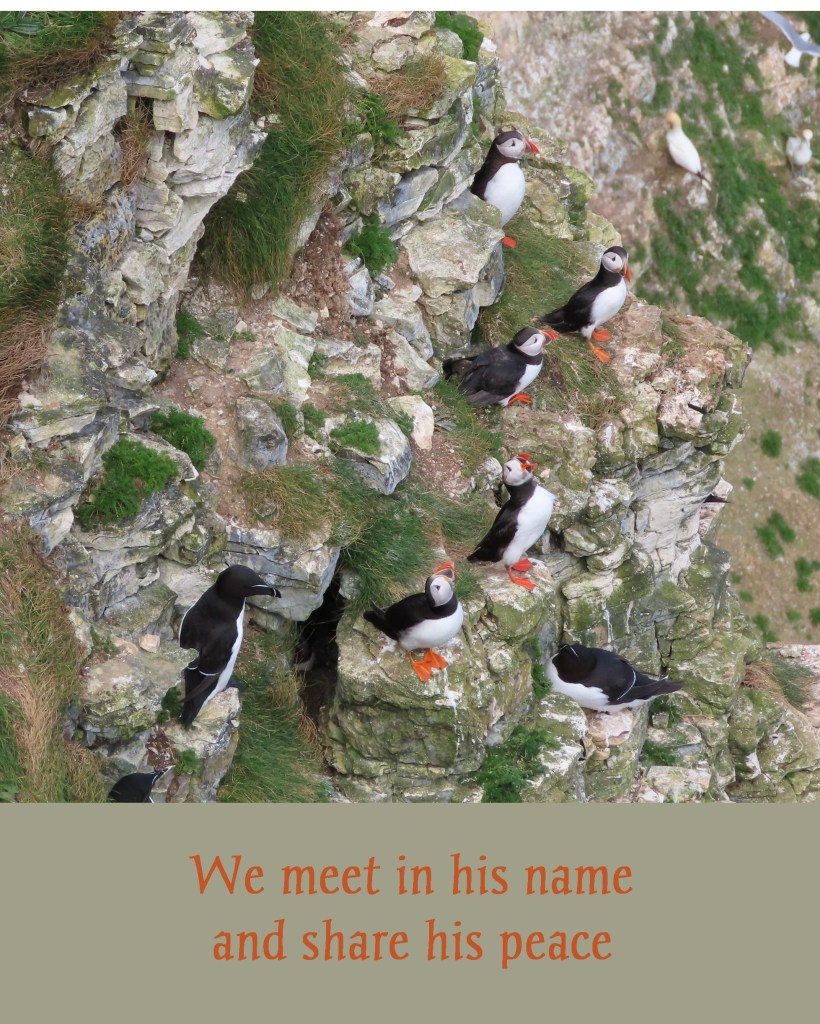
My friend Joyce has recently visited ‘her’ puffins on the East coast. Here’s a glimpse of what she saw.
We meet in his name and share his peace.
Joyce has captured a moment of ecumenical unity in the bird world. The puffins are gathered with the razorbills, sharing a common rock. It could almost mirror a religious gathering. At least two of the puffins are engaged in leading the hymns, or perhaps even an Anthem. One of the birds may have tried to avoid the sermon by burying its head in the rock.
However you view it, there is a sense of harmony, a coming together in fellowship.
The longing for peace is at the heart of all religions. Sharing peace together is one of the joys of worship. It is more than a nod of greeting. In the Jewish faith, Shalom expresses something far deeper. It is “a feeling of contentment, completeness, wholeness, well-being, and harmony.” These are all the things we hope for each other and which we are to strive for.
In order for our ‘peace’ to be real and authentic it must begin in our hearts and it must come from God through us and others. So respect for each other is essential if our care and love is to grow. In the eyes and heart of God we are all equal. Followers of Jesus Christ are encouraged to follow a rule of St. Benedict which bids us to see Jesus in all we meet. We are all made in God’s image and likeness.
In the Muslim faith this is understood by the greeting Muslims use on meeting. As-salamu alaikum. This greeting recognizes the worth of the other because they are important. The greeting receives the response Wa alaikum assalaam, and upon you be peace. One of the values of this is that it helps bind Muslims together as one family and also establish strong relationships with each other.
The Christian Greeting Joyce has chosen for her little ones on the rock is a central moment in the Eucharist, often called Holy Communion. That itself tells us that, together, we are gathered with our Lord Jesus Christ and because we are in communion (fellowship, with Him we are drawn to each other. We express this in The Peace.This greeting often includes the words Joyce has chosen : We meet in his name and share his peace. Again, this roots our relationships with each other in the Peace Jesus gives to us. We may wave and smile but it goes much deeper. A word for our fellowship is Koinonia and it has a meaning that we are all drawn into a fellowship not only with each other but, and most importantly, with God. The Spirit of God fills our hearts and in so doing calls us into a ‘holy’ fellowship. Holiness, God’s gift to us, enfolds us into the very being and love of God. When we are ‘holy’ we belong to God and to each other and we are filled with God. We meet together in His name and share His peace and His love. We are to shine with it.
So why is it, then, that Mr Putin, a supposed Christian, and those who are led astray by him cannot practice this?
There may be a clue in these thoughts by Lao-Tze, a Chinese philosopher of the 6th Century BC. It applies to Putin and to all who are destroying Ukraine; and to the Taliban who are destroying the women of Afghanistan; and the leaders of Israel & Palestine who destroy each other. And it applies to us because war and violence begin much nearer home.
It’s a long time since 6th century BC but we can pray these words and apply them to our world today, starting with ourself.
If there is to be peace in the world, There must be peace in the nations. If there is to be peace in the nations, There must be peace in the cities. If there is to be peace in the cities, There must be peace between neighbours. If there is to be peace between neighbours, There must be peace in the home. If there is to be peace in the home, There must be peace in the heart.



 Mr G's Ponderings