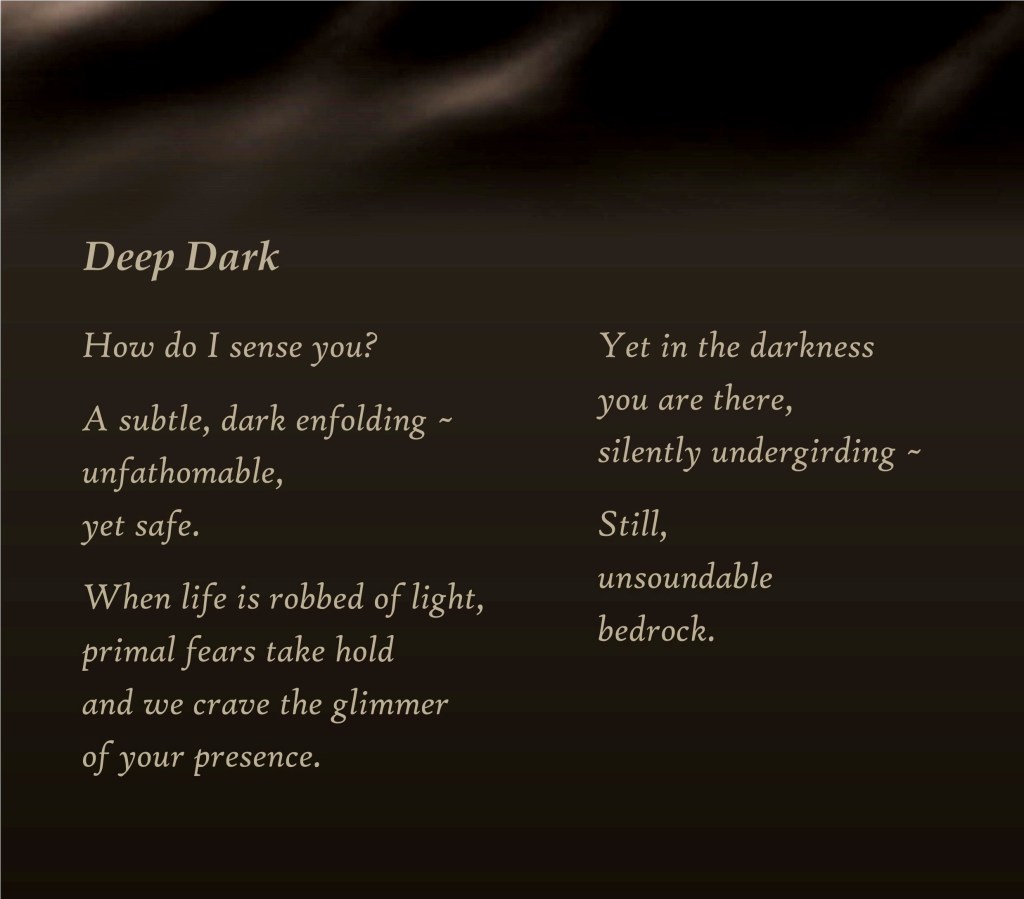
In response to Mr G’s earlier piece, Dispelling darkness with light came this. When asked how I imagine God, the sensation that always forms within me is of deep, rich, velvety darkness – an enfolding – and a profound sense of safety. There’s something a bit imperceptible about it: neither warm nor cool, but at blood heat, meaning that at times you have to pay attention to notice God’s presence. A bit like a second skin…. It’s strange in a way that this image or feeling should have formed for me because as a child I was scared of the dark – but maybe that’s telling too – something about trust, perhaps.
And at times, when things seem bleak and dark and starved of light, it feels as though God might be absent too. That primal fear of the dark night and what it might contain surfaces in us and leaves us feeling alone and anxious.
So much of our language revolves around the notion of light countering the darkness. Yet it was God who said ‘Let there be light’ – God, who existed before the light came into being. So seek and know God in the darkness too…
On July 14th, in our Church Calendar, we commemorate John Keble, priest and poet, who was born in 1792 and who became a leader of the revival of Anglicanism known as the Oxford Movement.
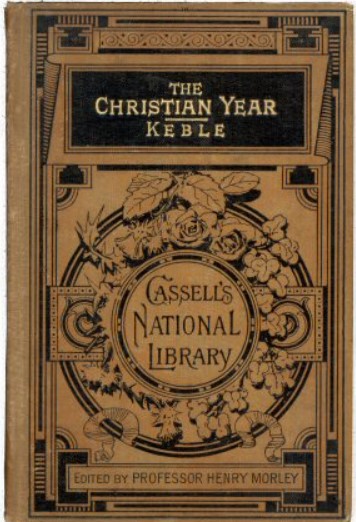
Keble was a scholarly man who became a fellow of Oriel College, Oxford at the age of 19. He was the dutiful son of a country parson. He was a man of deep and constant prayer and after his ordination he was much sought after as a spiritual guide. In 1827 he published a book of poems called The Christian Year which took as its theme the festivals of the Christian year. To date over 158 editions of the book have been published and it has fed the meditations of countless Christians. We sing a number of the poems as hymns including, New every morning is the love and Blest are the pure in heart. One consequence of the book was that he was elected Professor of Poetry in Oxford in 1831
It was in 1833 that he was called upon to preach the Assize Sermon before the Judges in Oxford. It was at the time when the Government of the day had decided to amalgamate Dioceses in Ireland, known as the ‘suppression of the bishoprics.’ Keble objected to the interference of the State in church matters and the subject of his sermon, National Apostasy, became a clarion call not only against the Government but against a church that had grown lax and had lost its way.
John Henry Newman, arriving back from Italy in 1833 after being becalmed in Rome. (His hymn Lead Kindly Light was a result.) He joined forces with Keble and other studious and pious men and the Oxford Movement was born. It was to sweep the nation and it called people back to a purer form of Christianity and Christian practice. Because the means of doing this was through pamphlets, they become known as ‘Tractarians.’ The Tracts ended with Tract 90, and they resulted in a growth of Theological understanding underpinned by scholarly learning.
Later some of the leading lights left the Church of England for the Roman Catholic Church but Keble remained steadfast in his conviction that the Anglican Church offered a better way to God for him and for the people he served. He is a fine example of that high calling which has been the bedrock of the Church of England – the Parochial Ministry. He eschewed the limelight and the controversy of the other leaders and sought nothing more than to serve his Lord and His Lord’s church as a Parson.
In every movement for change and growth, there will always be those to whom it falls to bring the vision to fruition. The leaders were scholars, theologically trained and well versed in Scripture and Church history. Keble was also a poet. The leading lights of the Oxford Movement were great men but as enthusiasm grew there was also divergence of opinion as to how things should grow and transform. The Bishops of the Church of England were hardly welcoming and tried to thwart what the Oxford Movement was trying to achieve. Eventually leaders such as John Henry Newman (recently canonized by the Pope) felt a pull towards the Roman Catholic Church, whilst others stayed in the Anglican Church, such as Dr. Pusey. This moment is sometimes referred to as the parting of friends’, for such it was. Amidst all the turmoil, John Keble, whose words had become the clarion call for the Movement, remained steadfast and true to his roots in Anglicanism.
All Renewal movements in the Church need one vital element to keep them focussed on, and rooted in, God. Through his poetry and his devoted service to the people of his Parish, John Keble provided this. Important and vital changes in the Church always produce exciting ways of growing closer to God but unless these are undergirded, and nourished by prayer, they will inevitably fail. John Keble and the spirituality which ruled his life, expressed in the poems of The Christian Year, provided a focus which took people to the heart of the reason for the Oxford Movement. It enriched the Church by a renewed emphasis on prayer and worship, on God and on His transforming love. It renewed the relationship Christians had with Jesus and it allowed for enlivening inspration by the Holy Spirit. Keble was instrumental in bringing these renewed spiritual insights to the Church.
His was a heart pure with love for God. He was indeed truly blessed and in God’s Name and through God’s love, his life blessed the church.
[Mr G]
From the Dedication of his poetry
DEDICATION.
When in my silent solitary walk, I sought a strain not all unworthy Thee, My heart, still ringing with wild worldly talk, Gave forth no note of holier minstrelsy.
Prayer is the secret, to myself I said, Strong supplication must call down the charm, And thus with untuned heart I feebly prayed, Knocking at Heaven’s gate with earth-palsied arm.
Fountain of Harmony! Thou Spirit blest, By whom the troubled waves of earthly sound Are gathered into order, such as best Some high-souled bard in his enchanted round
May compass, Power divine! Oh, spread Thy wing, Thy dovelike wing that makes confusion fly, Over my dark, void spirit, summoning New worlds of music, strains that may not die.
Oh, happiest who before thine altar wait, With pure hands ever holding up on high The guiding Star of all who seek Thy gate, The undying lamp of heavenly Poesy.
Too weak, too wavering, for such holy task Is my frail arm, O Lord; but I would fain Track to its source the brightness, I would bask In the clear ray that makes Thy pathway plain.
I dare not hope with David’s harp to chase The evil spirit from the troubled breast; Enough for me if I can find such grace To listen to the strain, and be at rest.
My friend Gill Henwood sent me a thought to ponder over. It was about how the light of God’s love wraps itself around both the dark places of our world and also the darkness which afflicts most of us from time to time. This is what she wrote:
“Secular leadership techniques and management may have led the churches astray from the pastoral care and self-emptying service of the gospels’ witness to Jesus. The presence of God’s Spirit may have been squeezed out by our institutions – yet is still searching our hearts and calling people to God’s Love given in Jesus. I wonder if the world’s gathering darkness will be a time of deep testing and eventually renewal – when through hardships we remember God is Love and turn from our human preoccupations with power and competition… Just a thought, but maybe a recognition that in the darkness Gods light burns clearly, bringing hope, calling us to love and filling us with the Spirit’s power in our human frailty.“
After reading what Gill had written, I was in conversation with another friend, Sister Rosemary SLG . She suggested that when we find difficulty sensing the presence of God because we are in a dark place, that is when, often, God is nearer to us than ever.
This reminded me that, hopefully, this applies to the dark situations in our world at present. It may not be easy to see God’s love at work in the darkness of Ukraine, or Yemen, Afghanistan, the Holy Land and so many other places but it is a truth to which we should cling. That can be hard to do. I don’t doubt God’s existence but in the face of all the demonic wickedness in our world , it is easy to feel a sense of futility; of powerlessness, darkness, emptiness. And it hurts because I love God and I am loved by God but I also wonder whether God is letting us down somehow.
Where is God in all this?
It’s a question to which I have found an answer from an unusual source but which is, for me, very helpful. It comes in a book by Elie Wiesel. Many know of him and of his story. He managed to survive Auschwitz but not without the marks of the trauma remaining with him all his life. He wrote a book which he named Night. A clear reference to both the outer and inner darkness which the Nazi’s created in everyone held captive by them, not least the Jews, Gays and Gypsies.
In his book, Elie Wiesel told of a day when some prisoners had tried to escape. Though they were recaptured, reprisals took place. A group of men and a boy about Elie’s age, were strung up on Cross-like gallows. All the camp were forced to watch as the men died before them. And the boy? He was too light for the rope to end his agony and he hung there a long time. The question was murmured around the camp – Where is God? Where is God?
Where was God as this dreadful agony unfolded before them?
Elie Weisel, just a boy himself, then pointed at the child. He said movingly, Where is God? He is there, hanging on the Cross with that boy!
It was a deep and insightful answer. For Christians it has a profound meaning and Elie was a Jew. Francois Mauriac, the French novelist, wrote in his introduction that when Elie came to him with his manuscript, he wanted to draw out the similarity between the child and the young Jew who, as a demonstration and sign of the love of God, died on a cross. But all he could do was to embrace Elie, weeping. As we try to come to some kind of meaning about all the things that are afflicting our world, it isn’t always easy to see much hope. However, the story Elie Weisel told contains a truth which I want to hold on to. God’s love will never leave us and is embedded in our souls as we struggle, either personally or globally.
Where is God?
He is in each one of us. He suffers with us and yet he also transforms that suffering with costly, self-sacrificial love.
The Lord will light my candle so That it shall shine full bright; The Lord for me shall also turn My darkness into light
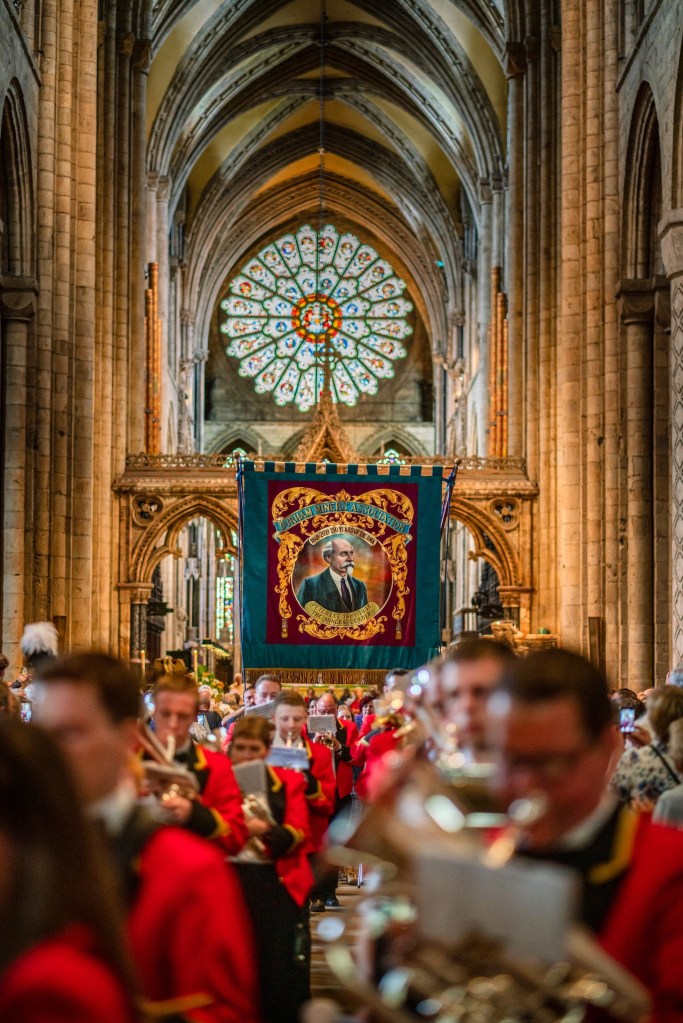
Miners’ Band & Banner leaving Durham Cathedral today. image copyright Friends of Durham Miners’ Gala
Durham 1985
(Inspired by the end of the Miners’ strike leading to the closure of mines in the North East)
They marched proudly, those broken men who broke the coal that fuelled the Nation. The bowels of the earth are silent now as are the spirits within. Yet, entering their Cathedral they filled that ancient space with music. Even in brokenness they transcended actions of Powers who would have preferred them to be silent.
… and Bishop Jenkins wept.
[Mr G]
(the miners’ strike lasted from 1984-5. At the end the Government got its way and closed a lot of pits, throwing over 25,000 out of work. Many communities suffered and bear the scars still. For his love, care and support Bishop David Jenkins was called, the Miners’ Bishop’. During his sermon at the Gala Service, he broke down in tears for his beloved mining communities and for those who were desperate with need) Today (July 9th) the Miner’s Gala, normally an annual event, has returned to Durham, after Covid. 5 new Banners (a feature of the Gala) were dedicated and blessed by the present Bishop of Durham, during the service in the Cathedral.


 Mr G's Ponderings