Month: April 2024

There was darkness …

And darkness came over the whole land….. whilst the sun’s light failed…

That quotation from St Luke’s Gospel refers, of course, to the crucifixion of Jesus. As darkness removed light from the earth, we are told that the curtain of the temple was torn in two.
Jesus breathed his last and died.

The darkness was more than a physical one.It was a symbol of something much deeper; more profound. There was another darkness which had more to do with the human soul; with a kind of death of humanity or rather that part of us which had turned away from God.

Religion, however it manifests itself, has always understood the dichotomy of darkness and light. This has a personal application as each one of us must face and try to deal with, the inadequacies in our human nature. For many of us this involves a belief in a higher deity and in a way of life which takes its inspiration from God. I am using the word ‘inspire’ in its  most truthful meaning. We aspire to be filled with the Spirit of God. The breath of God fills us and so we can seek the light which transforms our darkness.
This is an aspiration of individuals who seek God but, of course, it is about a transformed world, in which all are enlivened by love.

Two things related to this occurred  this week.

The first bore a literal connection to the event of the Crucifixion. For some there was an experience of total darkness as the moon eclipsed the sun, cutting off light to the earth. Even those who could not experience it physically and who did not live on the Mexican, American and Canadian trajectory, still sense that something awesome was happening.

For all of us who thought about it, the eclipse was a reminder that, despite what some would have us believe, we have no control whatsoever over the planet where we have temporary accommodation and where humanity shares with other parts of creation which occupy the world. I recall something Mr Ramsay said in Virginia Wolf’s novel, To the Lighthouse. He was the head of the family and in one sentence he put us all into context. The very stone one kicks with one’s boot will outlast Shakespeare.
The eclipse, whilst thrilling and phenomenal, is also, like God, beyond our comprehension.

The second kind of darkness ought to be a celebration of joy and light and peace – namely the festival of Eid-al-Fitr. Because of what is happening in Gaza, the Holy Land, and Israel, Eid is a troubled time; a dark time this year, for many.

As Muslims mark the holy month of Ramadan, many of them, especially in Gaza, are observing a more reflective celebration. One Muslim said, “We do not feel any joy. People marked the day with prayers and some sweet treats for children, but the heavy air of loss a devastation made for a subdued holiday.”

Obviously this devastation is felt most keenly in Gaza and the West Bank but all Muslims are affected by the human tragedy being wrought there. Every human being is involved. Darkness is affecting the whole land; the whole earth.
The eclipse took about 7 minutes in some places. The next such total eclipse is due in 2186! It will happen whether humanity is still around!
But it is totally possible to rid our world of human darkness before then. It does rely on us to a great extent but even more, it relies on a ‘Godly’ us’, working and praying together for peace over the whole earth.

Here’s a prayer from the World Council of Churches:

… and there is yet hope .

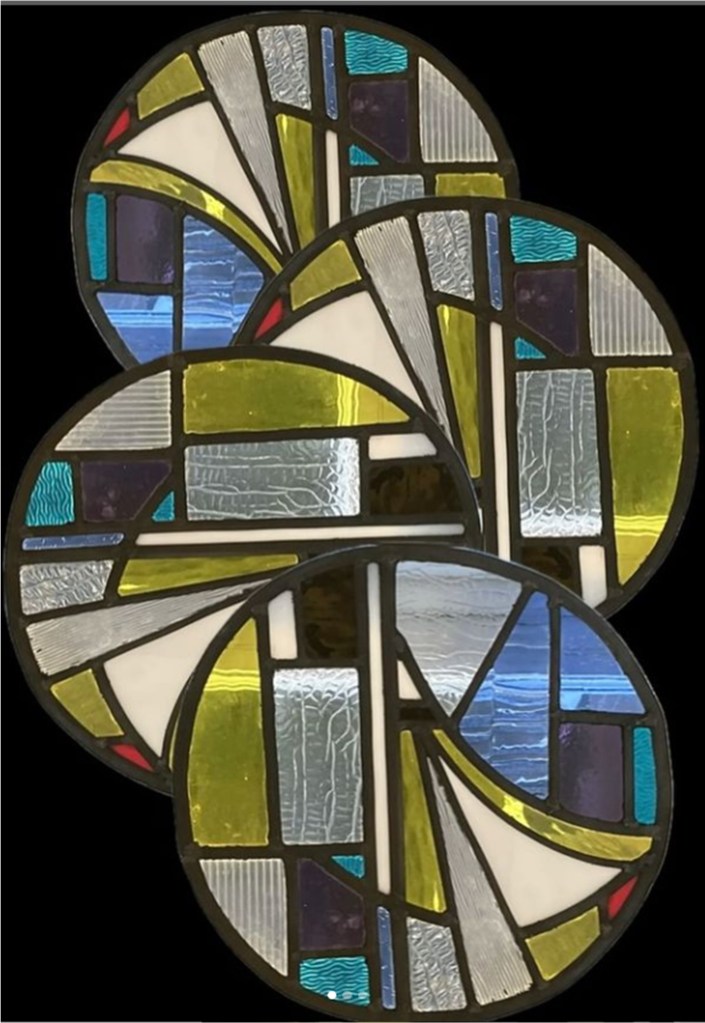
‘She smiles into corners …’

Art/glass sculpture by Kay Gibbons, photo by Kay

Kay muses on the moon
…’She smiles into corners…’

Half-past three,
The lamp sputtered,
The lamp muttered in the dark.
The lamp hummed:
‘Regard the moon,
La lune ne garde aucune rancune,
She winks a feeble eye,She smiles into corners.
She smoothes the hair of the grass.
The moon has lost her memory.

from ‘Rhapsody on a windy night, by T S Eliot.
[Poetry Society version]

Last year my Artweeks theme was lunar imagery in TSEliots poem ‘Rhapsody on a Windy Night’.
This piece is titled ‘She smiles into corners….’
I imagined the moon traversing the night sky and illuminating the dark landscape beneath…patchwork fields , spines of mountain ridges, outstretched branches reaching skyward to stroke the face of the moon , ripples in the sand on the shoreline ..
..hidden corners on the dark canvas awaiting the radiant moon to dispel shadows and ‘smile into corners..’
Through colour and abstract form , through cornered shapes and spaces I have attempted to curate Eliot’s words into a glass recreation.

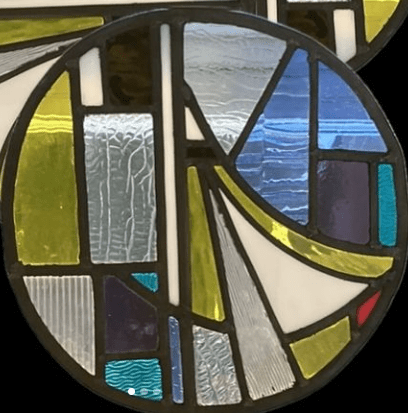
(detail)

{for more from Kay visit her instagram site – kaygibbons_art.glass.sculpture

The Sun Dances

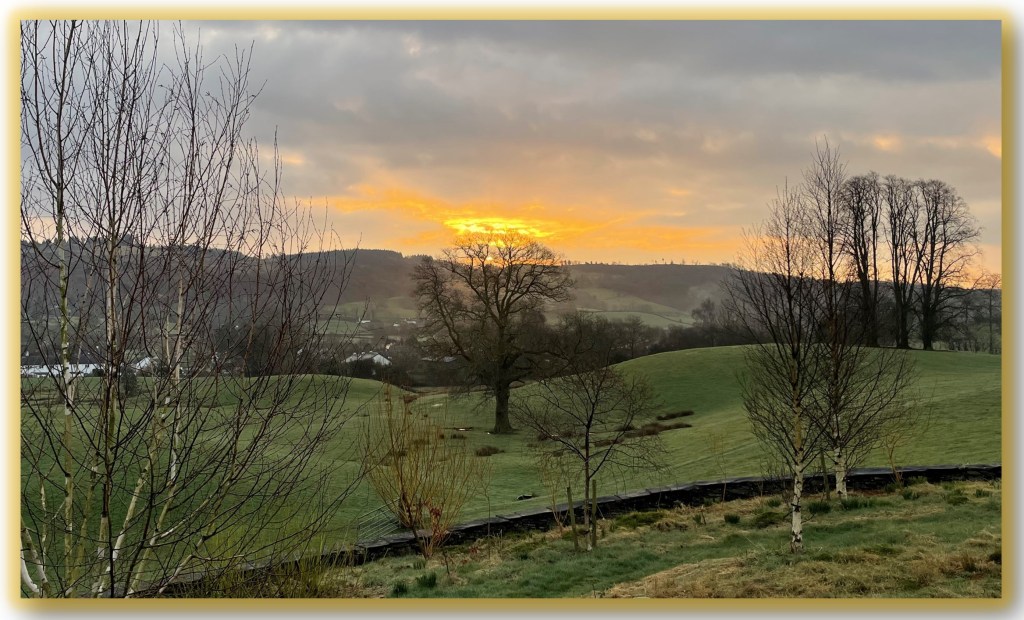
Sunrise on Easter Morning in the Lake District. Photographed by my friend, Gill Henwood.

The dancing Sun on Easter Morn
Some while ago, I came across a film made by an English visual artist, Tacita Dean. It was of a sunset filmed off the coast of Madagascar. It’s purpose was to catch the final ray of the sun as it disappeared over the horizon. The final ray is not red or orange but green and it lasts for less than a second. It has been described as a green flash, which occurs more commonly at sunset is a phenomenon in which part of the sun can be observed suddenly and briefly changing colour. It usually lasts only a second or two — which is why it is referred a flash — as the sun changes from red or orange at sunset, for example. The green flash is viewable because refraction bends the light of the sun. 

Tacita Dean managed to capture this moment and the flash is just visible. Mostly it has eluded her attempts to film it but then, just once, she was rewarded. She described the filming as an act of looking. It’s about faith and belief in what you see.

Remembering the film and what Tacita said, brought to mind the story of the sun’s action on another occasion at the other end of the day—the dawn on Easter morning.

There is an old Irish and Gaelic belief that when the Sun rises on Easter morning, it dances with joy that the Saviour has risen.
A version of this was recorded by Andrew Carmichael in his monumental work Carmina Gadelica. A woman, he met, in the Outer Hebrides, Barbara Macphie, describes her experience: She tells of climbing the highest hill on Easter morn and seeing the sun dancing in delight:
“The glorious gold-bright sun was rising on the crests of the great hills, and it was changing colour—green, purple, red, blood-red, intense white, and gold-white, like the glory of the God of the elements to the children of men. It was dancing up and down in exultation at the joyous resurrection of the beloved Saviour of victory. To be thus privileged, a person must ascend to the top of the highest hill before sunrise and believe that the God who makes the small blade of grass to grow is the same God who makes the large, massive sun to move.”

This belief is widely held in Ireland but it is a much wider custom than that.
In the Middle Ages it was held that at the hour of sunrise, this legend was fulfilled when the sun was said to make ‘Three cheerful jumps” as it rose from the sky. This was said to be in honour of Christ’s Resurrection. Some even suggested that the rays penetrating the clouds were the angels, dancing for joy.
I read somewhere that some people would put a pan of water in the east window and so watch the dancing sun mirrored in it.

Sir John Suckling. An English poet of the 17th century refers to this in his Ballad upon a Wedding.
In a very long poem, one stanza reads:

Her feet beneath her petticoat,
Like little mice, stole in and out,
As if they fear’d the light:
But oh! she dances such a way
No sun upon an Easter-day
Is half so fine a sight.

Resurrection morning customs are still common in parts of Europe, America and until this year, in Bethlehem.
No doubt some so-called rational thinking people may suggest that this is fanciful but we need to remember that God communicates Himself to us in many ways and through many mediums. 
We just have to have faith and belief in what we see.

Closing our minds and our hearts to such religious insights and experiences might well result in our missing the many splendoured thing which God wants to show us if we but look with the eyes of faith.
As Frances Thompson puts it in a cautionary note in his poem, In no strange land;

The angels keep their ancient places;—
Turn but a stone and start a wing!
’Tis ye, ’tis your estrangèd faces,
That miss the many-splendoured thing.

[Mr G]

++ The versions of the two poems are those by the Poetry Society.
Barbara Macphies’ words are those recorded by Alexander Carmichael in his Carmina Gadelica

[I haven’t quite mastered receiving comments except from WordPress subscribers. I’ll get there eventually!
Meanwhile please feel free to use my email address: geoffrey_connor@priest.com.