Once a month I take myself out of the fast flowing stream of life and go to a quiet space . Like being a still eddy near to the waters edge . In this place I seek and rest in ‘the still point at the centre’….
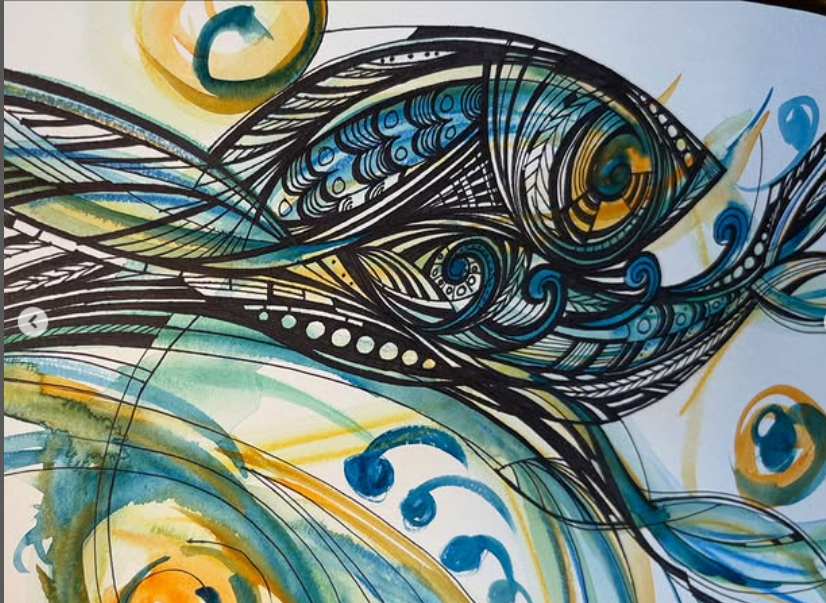
Of late I have done little spontaneous painting and drawing – making marks on paper , letting the brush go free fall and the pen trail behind on a journey of exploration … scroll through and you will see the development from blank page , paint , pen and ink …..
Initially I imagined the painting was a selection of leaves , a joyous expression ‘of being’ and as my pen drew a line here, another there the shapes of the leaves turned into fish , akin to a much earlier style of work by @kaygibbons_art.glass.sculpture
This maybe a work in progress on many levels- I can envisage loose brush strokes of paint on glass with the fish swimming vertically within a larger panel of clear textured and coloured glass; I can also see more fish with the drawing becoming a playful gathering joining me in the still waters of the eddy at the edge of the stream ….
Swimming in Silence in my Quiet eddy at the edge , bringing it into the centre…..
On October 2nd, it was National Poetry Day in the UK. Even the Archbishop of York took part by reciting a poem on his internet postings. Wisely, he chose to recite a poem by our Poet Laureat, Simon Armitage, who is a Yorkshireman.
The day was observed just a few days after the death of one of my favourite and influential poets, Brian Patten. He died on September 29th. We shared the same birthday year and month and I was privileged to meet him in the 1970’s not long after his first published poems, Little Johnny’s Confession. I have my signed copy along with several others he also signed. He had already made a name for himself through an anthology of poems which he shared with Roger McGough and Adrian Henri. ‘The Mersey Sound’ earned them the title, The Liverpool Poets, and it keyed into a remarkable time in that city’s life which began with The Beatles, Cilla Black and all who played at the Cavern Club. The vibrancy of Liverpool is legendary, especially because so much emerged from characters formed from hardship, poverty and in the face of an under-dog mentality conferred upon it from elsewhere. It is a city of broad culture, amazing architecture and deep humour. The Liverpool poets captured all that and their stated aim to make poetry accessible to all bore great fruit.
Brian Patten was to go on to write poetry which addressed the human condition with humour and with a sense that, at heart, it is love which holds things together. Sometimes this love is mixed with loss and with a searching that gives impetus to our exploring. So, Brian would say that it is often in times of stress people turn to poetry, including many who have dismissed it as, ‘not for them’. He also said that “poetry helps us to understand what we’ve forgotten to remember. It reminds us of things that are important to us when the world overtakes us emotionally.”
In the 1970’s when I was attempting to deal with what direction my life was seeking to take, including wrestling with what my vocation might be and who I am as a person, it was the poetry of Brian Patten which became one of the anchors in a time of uncertainty. So I discovered in his collection, The Irrelevant Song, a poem which told me that It is time to tidy up my life! At a pivotal time of personal change I read:
Into your body has leaked this message. No conscious actions, no broodings have brought the thought upon you. It is time to take into account what has gone and what has replaced it. Living your life according to no plan, The decisions are numerous and The ways to go are one.
The whole poem contained a huge message for me as it addressed inner thoughts, issues and feelings that I had deliberately not dealt with. At the end of the poem I was directed that You must withdraw your love from that which would kill your love. That came to mean for me the distractions, the claims on me that was wasted in Irrelevance! Time to get serious in my intentions. Otherwise I would discover the power of hurt which leads to self-hate. I was reminded that tenderness is the weapon of one whose love is neither perfect nor complete. The way forward then was to cultivate that tenderness and kindness, that would set me on a journey towards discovering more and more the power of love. It didn’t take long for me to discover that seeking perfection in love leads to God.
What I discovered in the poetry of Brian Patten was really two things. One was that poetry has a way of reaching into the heart and soul of life and revealing new meaning. Brian’s style was partly playful and hints of Liverpool humour abound but there is a seriousness which I cannot ignore. It directly touches my very being with challenge and with a call to become more true to oneself. The other thing I discovered was the power of words and, in their use, the responsibility that brings. So much pain is caused by the misuse of words! Deliberate hurts thrown into peoples’ lives. There is a warning in Brian’s poem, Having taken to necessary precautions, (Notes to the Hurrying Man p.23) “Flowers won’t cover the hurts, the half-inch deaths we pile up; a rose the size of two fists won’t cover a pinprick of hating. Dreams larger than ourselves we killed, not wanting our smallness measured against them…”
So, in another poem, “The Astronaut,” (Little Johnny’s Confession) he suggests, We will take a trip to the planets inside us where love is the astronaut.”
It is this profound insight, which takes me towards an understanding of a poet who began life in poverty and turned loneliness into aloneness and who through experience used words to express the almost inexpressible, which has drawn me to him and helped me on life’s journey.
I do not know where he has gone now. There are hints in some later poetry of a kind of searching for faith, particularly in Storm Damage. Or maybe he still believed what he wrote in a poem in Little Johnny’s Confession, that “death is the only grammatically correct full stop.! I rather hope not. A poem he wrote is often used as a reading at funerals. So many different lengths of time:
How long does a man live after all? A thousand days or only one? One week or a few centuries? How long does a man spend living or dying and what do we mean when we say gone forever?
Adrift in such preoccupations, we seek clarification. We can go to the philosophers but they will weary of our questions. We can go to the priests and rabbis but they might be busy with administrations.
So, how long does a man live after all? And how much does he live while he lives? We fret and ask so many questions – then when it comes to us the answer is so simple after all.
A man lives for as long as we carry him inside us, for as long as we carry the harvest of his dreams, for as long as we ourselves live, holding memories in common, a man lives.
His lover will carry his man’s scent, his touch: his children will carry the weight of his love. One friend will carry his arguments, another will hum his favourite tunes, another will still share his terrors.
And the days will pass with baffled faces, then the weeks, then the months, then there will be a day when no question is asked, and the knots of grief will loosen in the stomach and the puffed faces will calm. And on that day he will not have ceased but will have ceased to be separated by death.
Photo: National Gallery
Not separated by death…Roger McGough spoke of being laid low by his friend’s death adding, “RIP – Rest in Poetry” May he find love and joy in the poetry of heaven and in God who gave him the words.

 Mr G's Ponderings