
Iran, a prayer
Month: January 2026
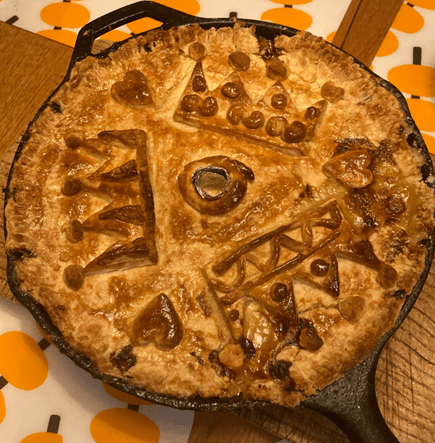
This photo of an amazing and mouth-watering cake was sent to me by my friend Gill Henwood. It was made by her daughter Kathleen for the delectation of her two sons.
The cake is known as Galette des Rois, literally the Kings’ Cake. The name derives from the Kings or Wise Men who visited the infant Jesus in Bethlehem, having seen a bright star in the East. These Magi (Wise Men) travelled taking their bearings from the Star. The Gospel account recorded by Matthew in Chapter 2, verses 2 to 12, tells us of their journey, their visit to King Herod and then the arrival at the home of Jesus. Here, they knelt to pay Jesus homage and presented Him with three gifts ~ Gold, Frankincense and Myrrh.
Each of the gifts had a significance. Gold was given because Jesus is worshipped as a King; Incense to celebrate His Divinity (God) and Myrrh which is used to embalm the dead. It was a foretelling of the Crucifixion when the Son of God died for the well-being of humanity and opened the way for us to turn aside from sin and so live for God and in the depth of God’s love for us.
The feast of the visit of the Wise Men is known as the Epiphany – the showing forth of God’s Glory. There are other Epiphanies during this extended Christmas season to Candlemass (February 2nd). The Epiphany to the Magi is kept on January 6th, which coincides with Christmas Day in the Eastern Orthodox Churches.
Because the Wise Men brought three gifts it is commonly held that there were 3 of them and because they travelled from the East over desert lands, it is believed that they rode on three camels.
Later documents increased the number of kings – St John Chrysostom even suggested that there were 12 of them!
The Venerable Bede, writing in the 7th Century named them and that has become fairly definitive – Balthazar, Gaspar (Caspar) and Melchior.
Many other legends and customs grew up around them.
The Galette des Rois is one of them.
In many places on the night before the feast of Epiphany, a special cake would be served with three beans hidden inside, two white beans and one black one. Whoever found the beans would be the King at the Epiphany feast. Dressed in fine robes, they would preside over the feast and before leaving would hand out small gifts, equivalents of gold, frankincense and myrrh. In the royal courts of the Middle Ages, Epiphany Cakes would contain a bean for the king and a pea for the Queen. Whoever found the bean and the pea would be the King and Queen of the feast. A more recent variation is that the figure baked into the cake (especially in France) is a tiny plastic or ceramic statue of Christ. An alternative name for the Cake is therefore Christ cake. Whoever found the statue would be especially blessed throughout the coming year.
There are many recipes available for making the cake, especially in France, from where it takes its name. It is as popular in France as the Christmas Cake or Pudding are in Great Britain. The cake itself can be made with puff pastry, though often it is brioche. It is often filled with frangipane, an almond paste. As you will see on Kathleen’s cake, it is decorated with crowns and small figures of the kings. There are hearts representing God’s love and in the centre, a circle of pastry which tells me about this love of God which is eternal.
Though we are beyond January 6th it is not too late to bake a Galette des Rois. In France it is quite common to eat this cake throughout January.
A Prayer for the Galette des Rois
O God, guiding light of the world,
As we share this Galette des Rois, we remember the journey of the Magi,
Who followed a star to find Your Son, Jesus,.
Bless this cake, a symbol of our gathering,
And bless each person who shares it with us today,
May we find the hidden bean, and in that simple joy,
Find a reminder of Your grace,.
May we be guided by Your light through the darkness,
May we share our blessings and our love,
And may the sweetness of this moment bring us closer to You,
And to one another.
[Mr G. 9th January 2026]
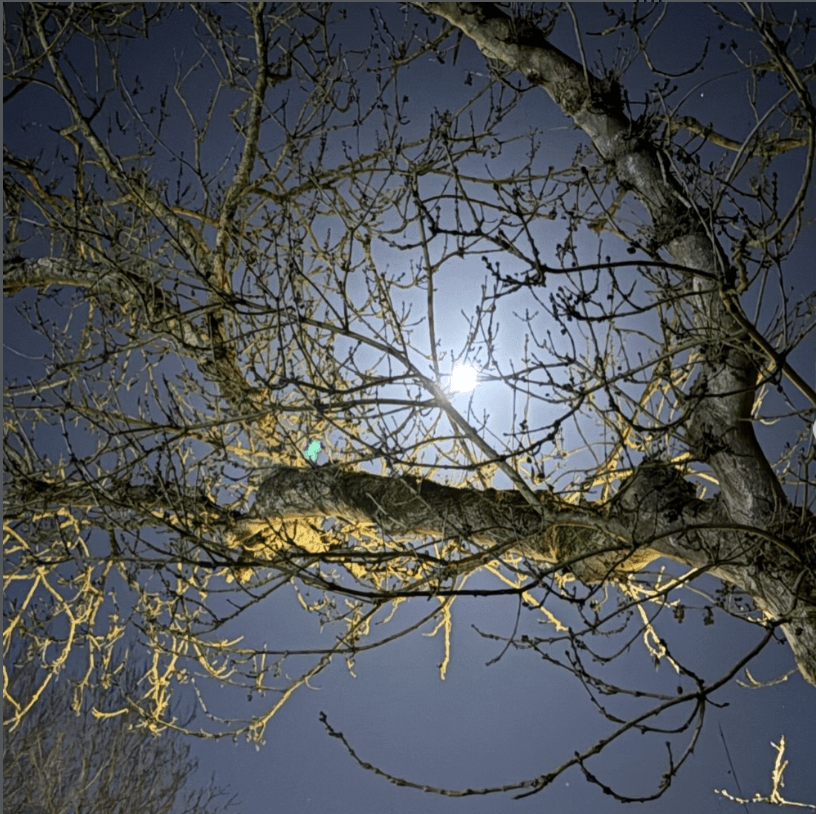
My artist friend, Kay Gibbons, caught up with the Super (Wolf **) Moon last evening.
Driving home last night I watched the tree reaching up to catch the moon …. but the moon carried on her journey to return another night and I was the only one to catch the Moon -stopped suddenly in its tracks by the click of a button on a screen in the palm of my hand .
I was reminded of an early painting which was inspired by the Wolf Moon in January 2022.
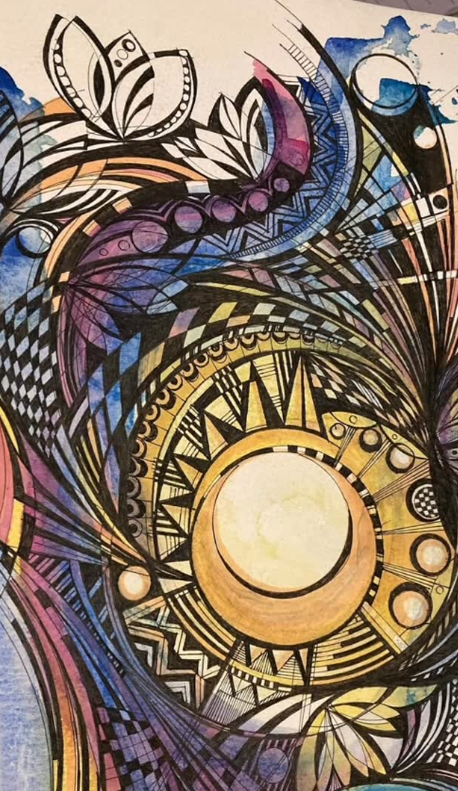
**The January Full Moon is often called the Wolf Moon from the howling of hungry wolves in the winter.
This name is thought to have a Celtic and Old English origin.
Other traditions may also know it as: Celtic: Quiet Moon
North American: Old Moon Cherokee: Cold Moon
In the S. Hemisphere it is known as the Hay Moon, Buck, Thunder or Mead Moon
A Prayer of the Moon
O Lord God,
you called me to be a light to shine from the heavens,
to lighten the earth.
You fashioned me, as an instrument of creation,
as your Sun became the great light to rule the day,
so I became his refracted light.
Reflecting the brightness of my brother,
set in the canvas of night where you fixed the stars.
There will never be a time nor a place
where your light won’t shine upon earth,
a reminder that even when humanity is at its darkest point,
Your light penetrates, is always present,
a divine presence waiting for the clamour
of human vice and voice to be stilled and emptied of meaning.
Your Sun, Stars and Moon, we are a trinity of light,
reflecting your majesty.
Part of your cosmic desire for your love to penetrate the density
of human sin; sadness; selfishness
and so bring hope, light and true life to a world you have created
to be aglow with the joy of creation.
May your People be reminded of the Light of your dear Son,
who converts all hearts, no matter how dark and dim,
to sing your praises.
May they be good and responsible stewards of your earth
and allow your love to penetrate the whole of creation
so that with us, Sun, Moon and Stars, they may glorify you!
Mr G.
3rd January 2026
[][][][] Photograph & painting by Kay Gibbons.
If you would like to see more of Kay’s art, it’s on Instagram:
kaygibbons_art.glass.sculpture
 Mr G's Ponderings