Author: mrgsponderings

A Prayer for Advent

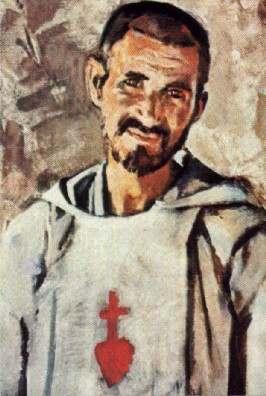
On December 1st,  the Church commemorates Charles de Foucauld. He was the inspiration for the religious order of the Little Brothers and Sisters of Jesus. They live in small communities in ordinary houses amongst ordinary people and their witness to Jesus is to share in everyday life and consecrate it by prayer and service.

Charles de Foucauld lived as a hermit in the Sahara desert amongst the Tuareg tribe. He believed that it was his mission to share the life of the poor and bring the love of Jesus to them. He taught the Gospel, translated the scriptures into the Tuareg native tongue and through silence and prayer, built up friendship. He dreamt of a community of like-minded little brothers and sisters of Jesus who would embrace the world with Christ’s love. Sadly, he never saw his dream come true because he was shot dead accidentally by French soldiers on December 1st 1916 during World War I.
However, his vision became a reality and the community he longed for now carries out his dream.

Charles was not always religious and his early life, as a French Legionnaire was one of debauchery.
Then, one day,  sick in his soul, he visited a priest in Paris, Fr Huvelin,  and told him that he needed ‘instruction’. ‘What you need’ said the wise priest, ‘is repentance’.  He was then 28. Guided by this holy man he came to embrace Christ. He said, “As soon as I believed in God, I understood that I could not do otherwise than to live for Him alone.”
From the most unpromising material God fashioned a vessel to pour out the Gospel.  
This reminds us that no one is beyond God’s redemption and love.
From the depth of Charles’ heart comes this prayer.

Father, I abandon myself into Your hands;
do with me what You will.
Whatever You do, I thank You.
I am ready for all, I accept all.
Let only Your will be done in me,
as in all your creatures,
I ask no more than this, my Lord.
Into Your hands I commend my soul;

I offer it to You, O Lord,
with all the love of my heart,

for I love you, Lord, and so need to give myself –
to surrender myself into Your hands,

without reserve and with total confidence,
For you are my Father.

Through Jesus Christ, our Lord.

This beautiful prayer of self-giving to God is an excellent  prayer for us to pray and meditate on during  Advent. It is not, however, an easy prayer.

[Mr.G]

Pope Francis is intending to declare Charles  a Saint next May.

If you would like to read more about Brother Charles, a lovely book by Little Sister Kathleen of Jesus, would be a good choice:

“The Universal Brother, Charle de Foucauld speaks to us today”
Listen to Silence

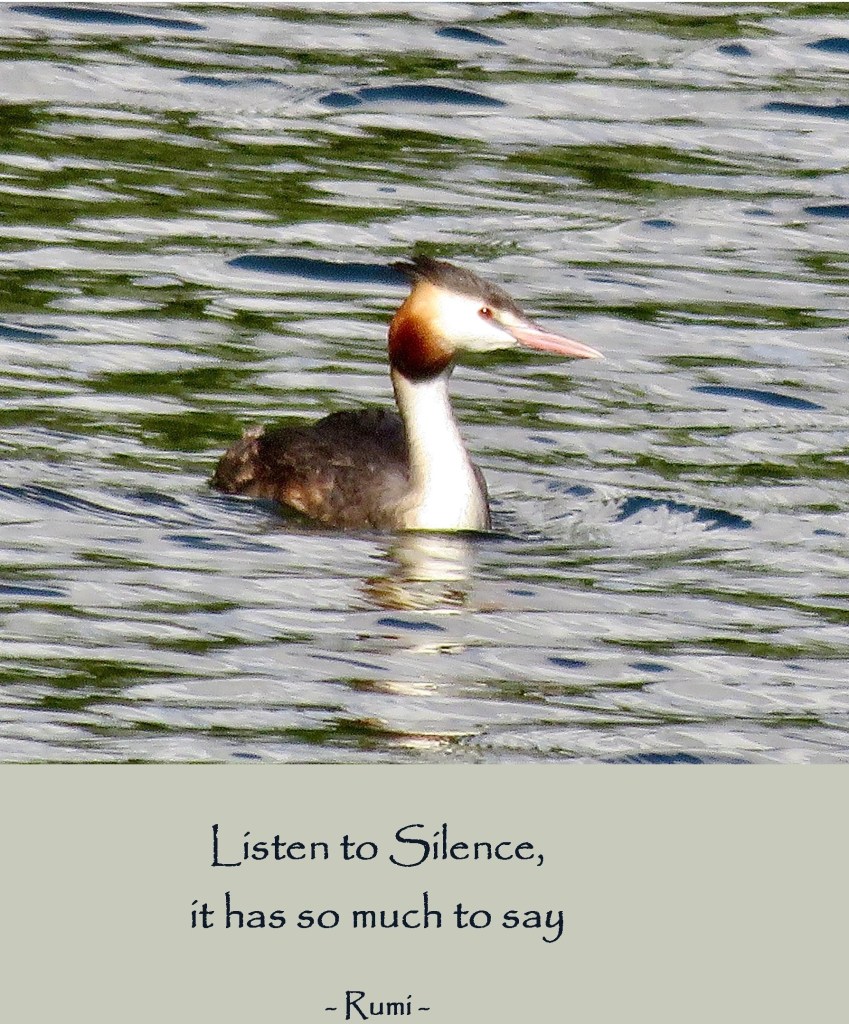
 My friend Joyce’s latest Tweet is of a Great Crested Grebe enjoying the silent stillness at Fishers Green.

The quotation she has chosen is by the Poet, Rumi – Listen to the Silence, it has much to say. As Christians enter the season of Advent once again, this is an appropriate prayer.

Jalaludin RUMI (1207-1273) was born in Balkh, Afghanistan which was then on the edge of the Persian Empire. In what sounds familar, the family was forced to flee from the invasion of the Mongol armies led by Genghis Khan. They settled in Turkey, at Konya, where Rumi lived for the rest of his life.

Here he began to write the poetry which was to influence so many, not least today. It is said that he is the most widely read poet in the English language.

God and Love are major themes in his work and combined with that is the communication we have with the Divine through Silence.
Many of his poems end with reference to silence. Coleman Banks, a scholar, poet and author of a number of works about Rumi says:
Rumi devotes a lot of attention to silence, especially at the end of poems, where he gives the words back into the silence they came from.

Rumi once wrote:

Close the door of words
that the window of your heart may open.
To see what cannot be seen
turn your eyes inward
and listen, in silence.

He maintained that Silence is the language of God. All else is poor imitation.

At the beginning of Advent we are invited to reflect and pray about the coming of God, as Rowan Williams puts it, as child, at Christmas. We do it liturgically through the Advent season by thinking in turn about the expectations of the Patriarchs, the Patriarchs, Prophets, John the Baptist and Mary but our reflections are bound up with our own expectations too. Advent is a time when we are invited to ponder God’s loving meaning for us. This is an invitation into silence. Being still so that we may know more truly and more personally who God is.

The problem is that we have to try and do this in a conflicting world which has differing values.

At the moment we are being assured by our Government and certain parts of the press, that Christmas is being saved. What I think that means is that the myth of a Christmas, driven by capitalism and the manufacture of a feel good factor, is being saved. I have considerable doubt that our Prime Minister and Government are the right people to bring any kind of salvation let alone a Christian one. (I also await the headlines that the Government is also saving Hannukah, Diwali, and Eid !)
I prefer to keep Salvation as a prerogative of God, in His Incarnate Son.

Another theme of Advent is that of Waiting. This brings excitement to the expectation. We are looking forward to celebrating the absolute joy of God’s  love which pours over us in the Christ-child of Bethlehem.

And our waiting is essential for our understanding of what that means for our world, our christian communities, ourselves. It is the poet R. S. Thomas who gave us the phrase: The meaning is in the waiting.

As the story of the birth of Jesus unfolds once again, we have to wait and watch and be still in case we miss what God is trying to say to us. We have to take Rumi’s words and act on them, Listen to the Silence – it has much to say.

In our busy, madly self-absorbed world, the Holy Family slip in at the silent pinnacle of the night. The stillness contrasts so much with the clamour of all those who speak but don’t listen; of those who write without thinking; of those who hurt and anger others into a position of mistrust. Our country and society are full of empty words and ill thought out solutions which change frequently and which endanger the world’s vulnerable.
Too many words!  Too little reflection!

So follow Rumi:

Close the door of words
that the window of your heart may open.
To see what cannot be seen
turn your eyes inward
and listen, in silence.

Those who listen and are still, even by snatching a few minutes, will hear the loving whisper of God. He has much love to share with us.

The Great Crested Grebe understands this. That is why she is still.

[Mr.G.]

As ever, Thank You, Joyce.

For those who would like to hear more from Rumi, try Rumi, Bridge of the Soul.’
(journeys into the music and silence of the heart poems translated by Coleman Bark with an introduction by him) published by HarperOne

They came to you in hope

And the Lord said to us:
‘Come and I will separate you and judge you
for how much or how little you have loved’.

I put before you the suffering ones, the desperate ones.
the hungry; the thirsty; the homeless ones.
Some cast from their homes when despots, shadows of men,
ruthless power-seekers moved against their own people:
those they had pledged to care for.
Instead they sucked the life from their souls,
souls that belong to me.

You left them ruined, afraid, unwanted, empty –
but you could not take away their dignity.
You tried to rob them of the one gift that I gave them
which you cannot touch:
their humanity –  
made in my image.
An image that dazzles ever brighter,
the more you try to stamp it out.

Despairing bodies shuffle, clutching rags and children
and anxiously walk the Indo-European Way
– that trek which your ancestors made long ago.

They come to you in hope.
They come as refugees and seekers of shelter.
You utter your political platitudes.
You blame it on the traffickers.
But you fail to look in a mirror.

For these people are your test.
How much do you love?
How much do you care?
Do you see them for the glorious humanity they are?

They come to you simply, humbly, hopefully;
Looking for baptism into a new life through your love.

And you, what do you do?
You allow them to drown in the deep, chill waters of death.
Where others have failed,
you succeed in taking their lives after all.

You must leave me now.
There is little room for you in God’s heart.

[Mr G]

Helping each other

My friend Joyce sent me this tweet.

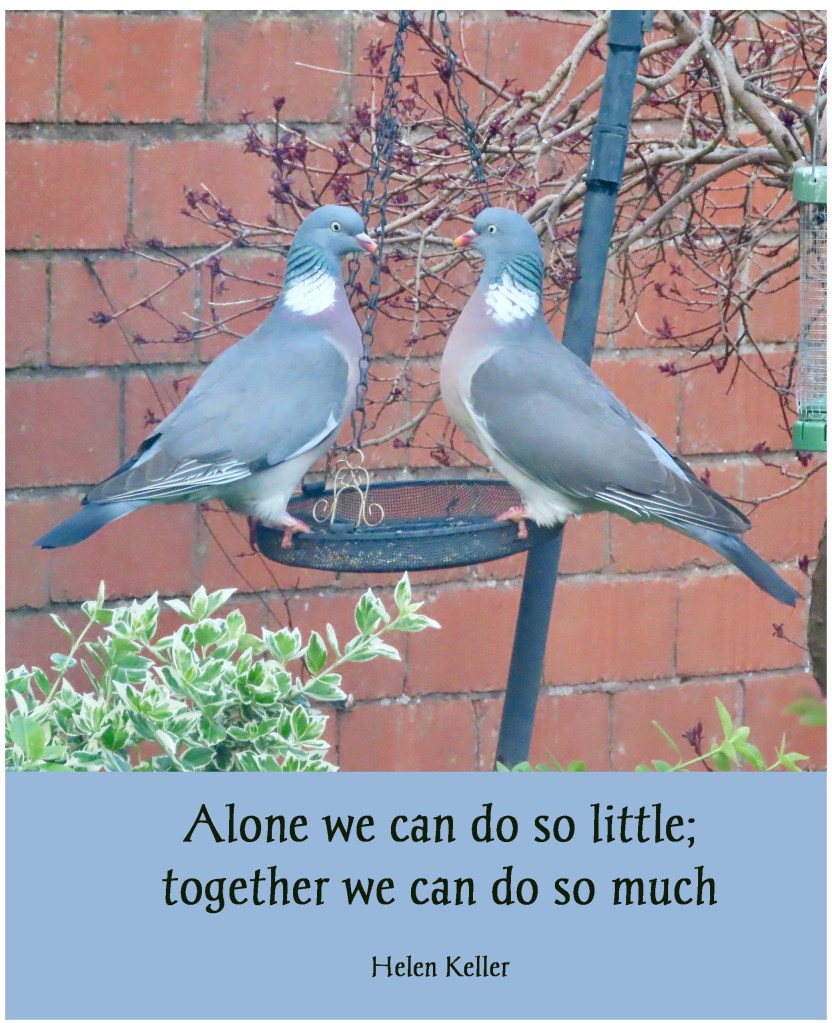
I came across this little story recently and when Joyce sent me her tweet of the two pigeons I thought it had a message.

What Joyce observed was that One of these wood pigeons landed on the bird feeder tray and tried to eat, but was having difficulty because the tray became unbalanced and was lopsided. When the second pigeon arrived, however, the tray was perfectly balanced and they could feed together!”

Here’s the story:
Once there was a small boy who belonged to a poor family. One day, he was crossing through the forest carrying some wood. He saw an old man who was very hungry.  The boy wanted to give him some food, but he didn’t have any food of his own.  So he continued sadly on his way.  Further on, he saw a deer who was very thirsty.  He wanted to give it some water, but he didn’t have water for himself.  So once again, he went on his way ahead.

Then he saw a man who wanted to make a camp but he did not have wood. The  boy asked his problem and realized that this time he could help. He gave the wood he was carrying to the man. In return, the man gave him some food and water.  Quickly, he went back to the old man and gave him some food and gave some water to the deer. The old man and the deer were very happy.  The boy then went happily on his way.

However, one day the boy was in the forest again and fell down a hill.  He was in pain but he couldn’t move and there seemed no one there to help him.  But, the old man who he had helped before saw him and quickly came and pulled him up the hill.  He had many wounds on his legs.  The deer, to whom the boy had given water, came and saw his wounds. She quickly went into the forest and brought some herbs.  After some time his wounds were covered.   All were very happy that they were able to help each other.

Acts of kindness and care have a way of making the world a better place. A place where, by helping and sharing with each other, becomes a more caring and happy place. Let’s learn from the pigeons, the boy, the old man and the deer. That would, I am sure gladden God’s heart.

[Mr G]