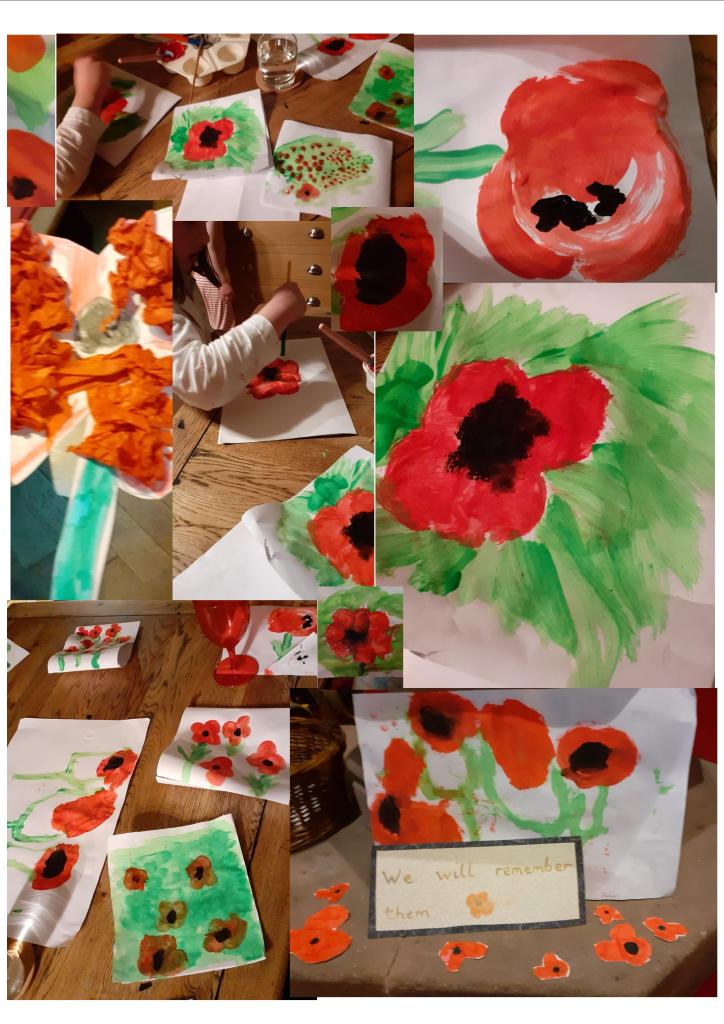
The beautiful village of Whitechapel near Garstang, in the Bowland Area of Outstanding Natural Beauty, has recently been the home of a special Poppy Factory. In this strange time of muted celebration of Remembrance, a group of children have been extremely busy creating poppies to decorate the church.
My friend Helen is one of the leaders and her own children aged 8 and 4 have kept Helen on her toes with their creative skills, They have been joined by other children of Messy Church at St. James’, where I had the privilege of being Vicar some years ago.
Helen sent copies of the Poppy paintings to The Royal British Legion and received an immediate response: “Thank you, on behalf of the Royal British Legion for your support. We appreciate it.I would also like to pass a message on to your children. What wonderful drawings! So talented! I will make sure that the staff see these so that a smile can be brought to them as it did for me. Stay safe.”
The children not only loved making the poppy paintings but they also learned more about Remembrance Day. Helen was able to share with her children stories about their great-great grandfather who was a soldier in the First World War . Being a Lancastrian of farming stock he looked after some of the horses. The children were fascinated to hear about how his horses pulled cannons into battle.
These remembrance stories, handed on from generation to generation help us to engage continually with Remembrance as a witness not only to the overcoming of violence and conflict but also as a celebration of the human spirit which strives for the victory of love and goodness over darkness and evil.
This is a continuous struggle made all the more poignant in this time of Covid.
Jesus of the Scars If we have never sought, we seek thee now; Thine eyes burn through the dark, our only stars; We must have sight of thorn-pricks on Thy brow,
We must have Thee, O Jesu of the scars. The heavens frighten us; they are too calm; In all the universe we have no place. Our wounds are hurting us; where is thy balm?
Lord Jesus, by Thy scars, we claim Thy grace. The other gods were strong; but thou wast weak; They rode, but Thou didst stumble to a throne; But to our wounds only God’s wounds can speak, And not a God has wounds, but thou alone.
Edward Shillito
This is one of the War poems that I treasure. It was written by the Revd Edward Shillito, a congregational minister. In 1919, after the First World War had ended, Shillito tried to make sense of its horrors by contemplating the Wounded Christ who through His Crucifixion offered to all a way of making sense of the insensible, or, at least putting the carnage, death and deep suffering into some sort of context. The God who in the Crucifixion of Jesus shows that the scars of war, as with all human suffering, ultimately finds it healing in the self -sacrificial love of Jesus.
There ia a fourth verse, which was the penultimate one but which is rarely quoted in Remembrance services today.
If when the doors are shut, Thou drawest near, Only reveal those hands, that side of Thine; We know today what wounds are; have no fear; Show us Thy Scars; we know the countersign.
It alludes to the appearance of Jesus after the Resurrection to his disciples. Its poignancy lies in the words “We know today what wounds are.” In the remembrance of all who gave their lives and suffered in wars and conflicts and those who have faced the darkness of incurable illnesses, we know today the bitterness of pain but, as Shillito reminds us, we also know the countersign – the Love of God stretched out for us on the Cross. A love that is not and cannot ever be defeated.
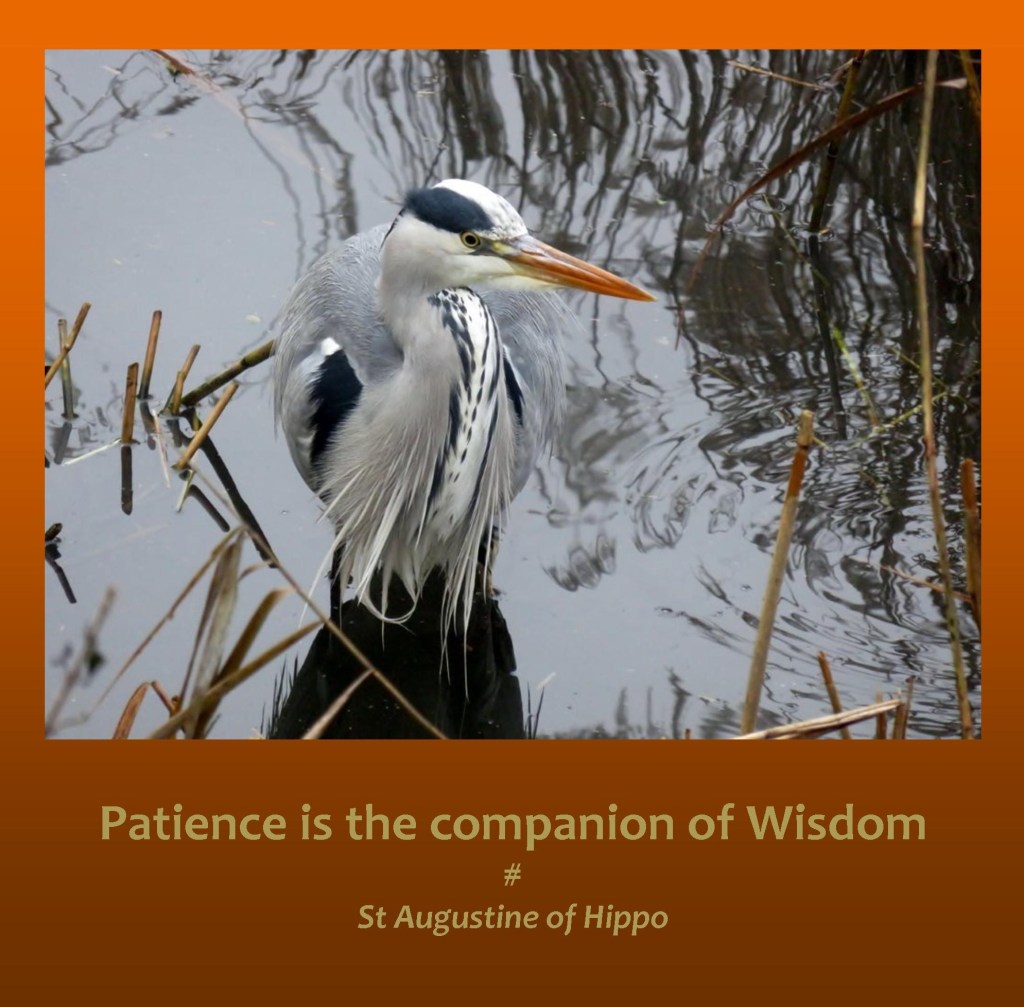
Another picture relection from my friend Joyce Smith
Dear Friends, As this heron patiently waits for a fish, it reminds me to be patient and look at what I can appreciate now, rather than always looking for the elusive bittern! With my love and prayers, God bless, Joyce
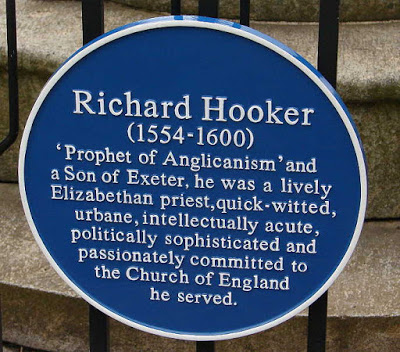
Richard Hooker was an English priest who died in 1600, and we remember him today as a theologian who defended the Church of England and its choice of “the middle way” between Roman Catholic and Puritan ideologies.
Hooker entered Oxford University in 1567 and for eighteen years devoted himself to scholarship and reflection on the subtle points of theology. He became deputy professor of Hebrew, was ordained to the priesthood, and appeared to be set on a purely academic career. But his learning, moderation, and commitment to the Church of England brought him to the attention of the authorities, and he was appointed Master of the Temple, an office of great prestige because it made him the chief preacher to the legal community of London. He held this post for six years, then resigned to become the rector of a parish near Salisbury. A few years later he moved to a rectory in the diocese of Canterbury, where he died at the age of forty-six.
He was a quiet man, loving to his wife and children, glad in his piety, and happy in his ministry.
But the Church remembers him primarily for the one great work that he wrote — a majestic study entitled Of the Laws of Ecclesiastical Polity. It was published in 8 volumes though the final 3 were published posthumously. It was addressed to a group of English protestants who were nicknamed Puritans because they sought to purify the Church of England according to their own narrow reading of the Bible. Against this movement Hooker argued for a more liberal outlook, which coordinated the testimony of Scripture, the course of Christian history, and the values of human reason, in order to defend the English Church as a communion for all the people, not just a small group of “saints.” The experience of The Anglican Communion has confirmed his teaching, and today we honour his work as a true cornerstone of Anglican history.
(from: For All the Saints: Episcopal Church of Canada)
Richard Hooker has rightly been called one of the Fathers of Anglicanism. Our Church is deeply influenced by Hooker’s teaching that our authority as a church is founded on what has come to be known as a Three-Legged stool of Scripture, Tradition and Reason. Our knowledge of God and His purpose for humanity and all creation is based on these three.
Scripture: We seek to discover the word of God through reading the Bible. There are different understandings about the Bible’s authority in our lives. We need to use resources like different Bible translations, commentaries and Bible reading notes to help us understand this but Anglicanism has a deep commitment to the authority of Scripture as God’s Holy Word to us.
Tradition: We often hear talk of Apostolic Succession which has been narrowed down to the Episcopal succession of Bishops, priests and deacons—the ‘order’ of the church’s ministry – but its wider application is that of handing on the teaching of the Apostles. From them the doctrine of the church passed on through the early church to every generation since as teaching and doctrine which is added to and refined as our knowledge of God is deepened and enriched. This theological richness and diversity includes inspirational material like hymns, songs, prayers, poetry, Christian art and devotional books.There are also formally agreed teachings as found in the creeds and the ‘Liturgy’ – the orders of services such as Common Worship (Church of England) and the Book of Common Prayer, and their equivalents in the Scottish Episcopal Church, The Churches of Wales and Ireland and throughout the Anglican Communion. These are primary sources of our Theology. It is rightly said that we believe what we pray. All true theology is rooted in prayer. The Orthodox Church puts it like this: A theologian is one whose prayer is true.
Reason: We are called to love God with our minds as well as with our hearts. To the best of our ability we need to think things through in the light of reason. This means becoming aware of different points of view, and using our own critical thinking to make sense of God’s world.
(an insight from the Methodist Church)
Hooker expressed these fundamental tenets of Anglicanism in Volume 5 of his Laws of Ecclesiastical Polity. It became the essence of what is distinctive about Anglicanism. It became known as the Via Media, The Middle way between Roman Catholicism and Protestantism and led to the Anglican church being known as as both Catholic & Reformed.
The Anglican balancing of the sources of authority has been criticized as clumsy or muddled. It is hard to live between two powerful and divergent views – Catholicism & Protestantism whilst seeking to incorporate the best of both.
Seeking the best means being willing to tolerate, comprehend and embrace opposing viewpoints and practices. This results in the Anglican Church having a wide inclusivity even though at times this could be disputed and lead to musunderstandings. At the heart however it is the importance of worshipping and praying together and a pursuit of what is described today as generous orthodoxy.
To Scripture, Tradition and Reason, we have recently added Experience. This stresses the importance of our own experience of God’s grace working in our lives. We gain wisdom and maturity from life experience, especially when we pray and reflect about our story with other Christians not just within Anglicanism but Ecumenically and even through engagement with the secular world.
One thing that Anglicanism seeks to uphold is the Inclusivity mentioned above. After all we are all One in Christ Jesus. We are all equal in the eyes and heart of God. We are all enlivened by the Holy Spirit. We are all held together in the corporate love of the Trinity. Anything narrower than that takes us, I would argue, away from God.


 Mr G's Ponderings