St Thomas’ hospital, London with Statue of Mary Seacole by sculptor Martin Jennings in the ground of St. Thomas’s. Mary Seacole was a pioneer of Nursing care. Photos by Mr G.
I wrote this poem whilst sitting in the reception area of St. Thomas’s Hospital, London, after receiving some treatment. The word ‘Hospital’ has its roots in both hospitality and the monastic word, ‘Hospitium’ the ‘guest house’ where all are treated kindly’ and with concern for their well-being. Each visitor is held and welcomed. St Benedict says that all should be greeted and cared for as if they were Jesus Christ. In different forms, this is not unlike a hospital today.
Hospitium thoughts in a hospital reception area.
People walking with purpose, others more hesitantly, faces clear or blank or etched with anxiety. Some in uniform wearing lanyards of authority.
Squirming children in prams pass quiet ones, carefully steered on beds; some in pain, others relieved – on the way to recovery. Elderly folk, clutching arms or balanced on sticks, shuffle along uncertainly.
Visitors smile and greet, lives intertwine. Some, sad or worried, seek news-givers yet fear their words.
Hustle, bustle of humanity, hand-holding, reassuring, realistic, caring energy – often drained in service.
All humanity is present, represented – ethnic beauty, language burble, generations and races sharing this space of hope.
All life is gathered where people seek healing, are held, guided, directed, hugged by walking crosses of dedication. All, from cleaners to consultants, playing their part in being Christ-bearers to others.
I gather that I have become very important! A recent survey by the Royal Society for the Protection of Birds – known as the Big Garden Birdwatch Chart –came up with some important news. Amongst all the birds watched in the United Kingdom, I topped the Chart for the 21st consecutive time! Isn’t that marvellous. Let the Blue Tits, Starlings, Wood Pigeons and Blackbirds chirp away to their hearts content. They won’t beat the House Sparrow. I was not, however, quite so pleased to read that my own chirp was not as melodious as some. One of the reviewers actually referred to it as slightly tuneless. Of course, I may be driven to take singing lessons. I think it will be with a Nightingale. They have such lovely, spell-binding voices. Not everything about we birds is good news. I was especially sorry to hear that the lovely Starling is now on the UK Red List, joining others in the most threatened breeding birds category.
It reminds me of the importance of providing garden habitats for we birds. By keeping open invitation to birds, including providing the right kind of sustenance, such as seeds. Insects, fruit and berries, peanuts and regular well-stocked drinking areas, you can make all the difference to solving the ongoing nature crisis. Gardens, green spaces are crucial lifelines for birds like me who are struggling. It’s a bit like providing an oasis in the desert, a sign of life where nature can grow.
One other thing; DID YOU KNOW? that we sparrows get a little mention in the Bible New Testament. I had to ask a human to point this out to me. It seems that in Matthew 10, Jesus tells the people not to be afraid of the evil folk who would turn them away from God. He said that if we are afraid we should remember: are not two sparrows sold for a penny? Yet not one of them will fall to the ground unseen by your heavenly Father. Even the hairs of your head are all counted. So do not be afraid; you are more value than many sparrows… (see also St Luke 12:6-7). Of course, let the reader understand that Jesus is not disparaging sparrows. He loves us very much and there were lots of us in the Holy Land when Jesus was there. What he is saying , I think, is that human beings who try to live close to Jesus are loved even more. I think, when he said this, some of my fellow sparrows saw him give a little wink towards us!
So, there we are – be nice to sparrows and all birds and you will be filled with joy and be rewarded because we shall dance and sing for you and soar around your garden or local park or fields and maybe drop some surprise seeds for you.I expect you know this little poem, but in case you need reminding, take note of it in view of what Jesus said. It’s by Elizabeth Cheney and I’m sure she would be delighted if you take it to heart. As you look at the birds around you, I hope you might let them remind you how much your heavenly Father cares for you and will provide for you. Do the same for the birds.
Said the robin to the sparrow, ‘I should really like to know, Why these anxious human beings Rush about and worry so.’
Said the sparrow to the robin, ‘Friend I think that it must be, That they have no Heavenly Father, Such as cares for you and me.
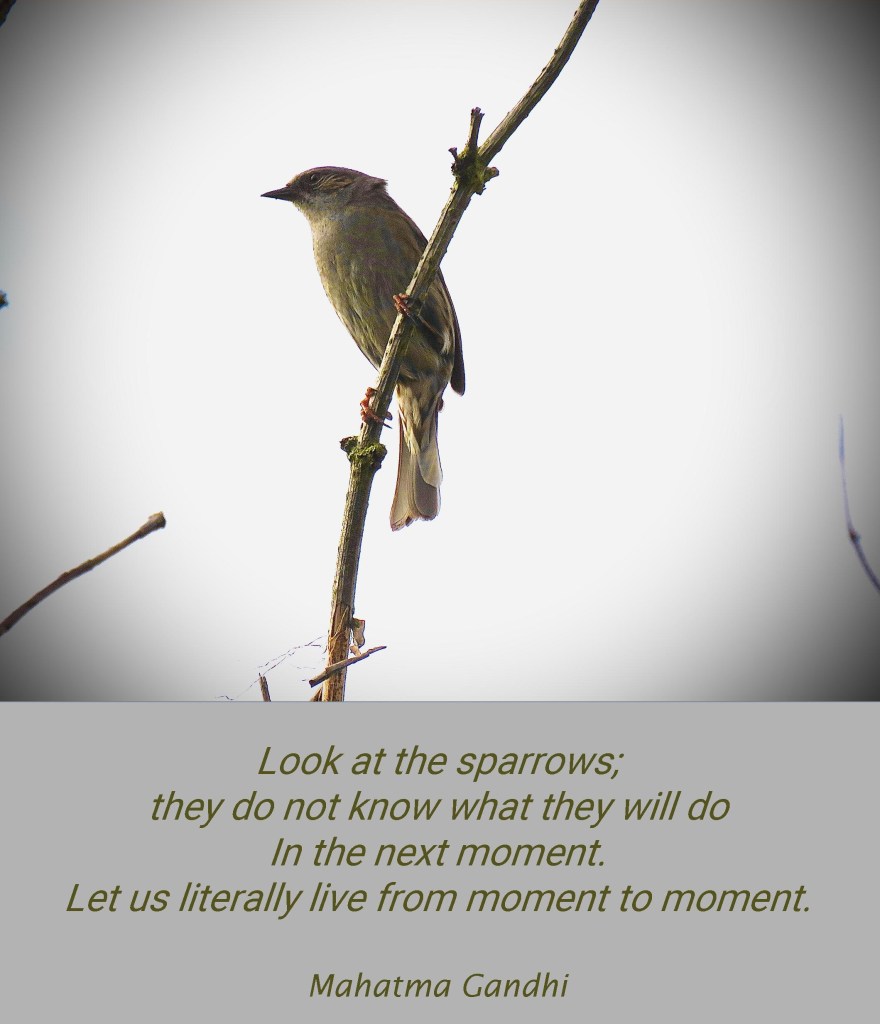
[The photo poster heading this article is by my friend Joyce Smith, who lives now close to God and to redeemed creation in heaven,] [Mr G]
And darkness came over the whole land….. whilst the sun’s light failed…
That quotation from St Luke’s Gospel refers, of course, to the crucifixion of Jesus. As darkness removed light from the earth, we are told that the curtain of the temple was torn in two. Jesus breathed his last and died.
The darkness was more than a physical one.It was a symbol of something much deeper; more profound. There was another darkness which had more to do with the human soul; with a kind of death of humanity or rather that part of us which had turned away from God.
Religion, however it manifests itself, has always understood the dichotomy of darkness and light. This has a personal application as each one of us must face and try to deal with, the inadequacies in our human nature. For many of us this involves a belief in a higher deity and in a way of life which takes its inspiration from God. I am using the word ‘inspire’ in its most truthful meaning. We aspire to be filled with the Spirit of God. The breath of God fills us and so we can seek the light which transforms our darkness. This is an aspiration of individuals who seek God but, of course, it is about a transformed world, in which all are enlivened by love.
Two things related to this occurred this week.
The first bore a literal connection to the event of the Crucifixion. For some there was an experience of total darkness as the moon eclipsed the sun, cutting off light to the earth. Even those who could not experience it physically and who did not live on the Mexican, American and Canadian trajectory, still sense that something awesome was happening.
For all of us who thought about it, the eclipse was a reminder that, despite what some would have us believe, we have no control whatsoever over the planet where we have temporary accommodation and where humanity shares with other parts of creation which occupy the world. I recall something Mr Ramsay said in Virginia Wolf’s novel, To the Lighthouse. He was the head of the family and in one sentence he put us all into context. The very stone one kicks with one’s boot will outlast Shakespeare. The eclipse, whilst thrilling and phenomenal, is also, like God, beyond our comprehension.
The second kind of darkness ought to be a celebration of joy and light and peace – namely the festival of Eid-al-Fitr. Because of what is happening in Gaza, the Holy Land, and Israel, Eid is a troubled time; a dark time this year, for many.
As Muslims mark the holy month of Ramadan, many of them, especially in Gaza, are observing a more reflective celebration. One Muslim said, “We do not feel any joy. People marked the day with prayers and some sweet treats for children, but the heavy air of loss a devastation made for a subdued holiday.”
Obviously this devastation is felt most keenly in Gaza and the West Bank but all Muslims are affected by the human tragedy being wrought there. Every human being is involved. Darkness is affecting the whole land; the whole earth. The eclipse took about 7 minutes in some places. The next such total eclipse is due in 2186! It will happen whether humanity is still around! But it is totally possible to rid our world of human darkness before then. It does rely on us to a great extent but even more, it relies on a ‘Godly’ us’, working and praying together for peace over the whole earth.
Here’s a prayer from the World Council of Churches:
Eternal God, Creator of the universe, there is no God but You. Great and wonderful are Your works, wondrous are your ways. Thank You for the many splendoured variety of Your creation. Thank You for the many ways we affirm Your presence and purpose, and the freedom to do so. Forgive our violation of Your creation. Forgive our violence toward each other. We stand in awe and gratitude for Your persistent love for each and all of Your children: Christian, Jew, Muslim, Hindu, as well as those with other faiths. Grant to all and our leaders attributes of the strong; mutual respect in words and deed, restraint in the exercise of power, and the will for peace with justice, for all. Eternal God, Creator of the universe, there is no God but You. Amen.
Half-past three, The lamp sputtered, The lamp muttered in the dark. The lamp hummed: ‘Regard the moon, La lune ne garde aucune rancune, She winks a feeble eye,She smiles into corners. She smoothes the hair of the grass. The moon has lost her memory.
from ‘Rhapsody on a windy night, by T S Eliot. [Poetry Society version]
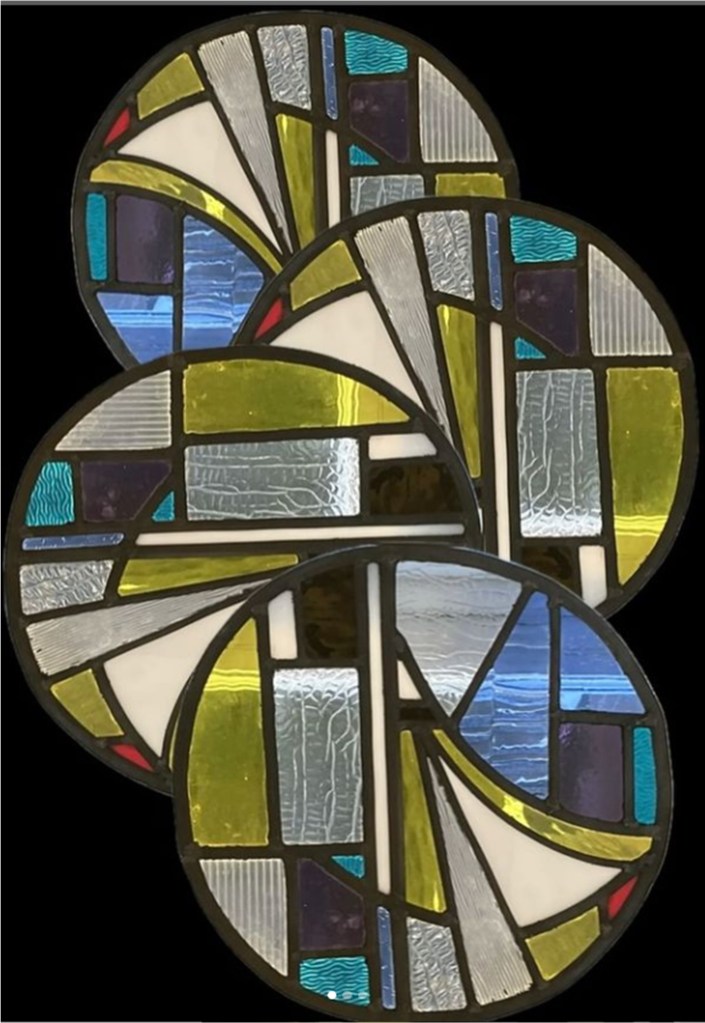
Last year my Artweeks theme was lunar imagery in TSEliots poem ‘Rhapsody on a Windy Night’. This piece is titled ‘She smiles into corners….’ I imagined the moon traversing the night sky and illuminating the dark landscape beneath…patchwork fields , spines of mountain ridges, outstretched branches reaching skyward to stroke the face of the moon , ripples in the sand on the shoreline .. ..hidden corners on the dark canvas awaiting the radiant moon to dispel shadows and ‘smile into corners..’ Through colour and abstract form , through cornered shapes and spaces I have attempted to curate Eliot’s words into a glass recreation.
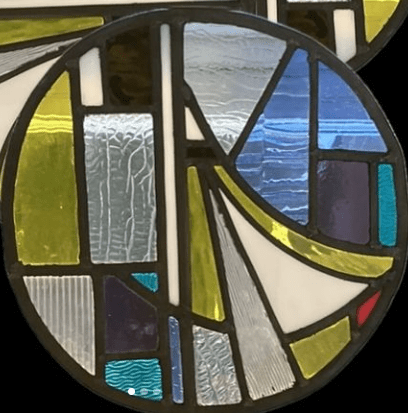
(detail)
{for more from Kay visit her instagram site – kaygibbons_art.glass.sculpture



 Mr G's Ponderings