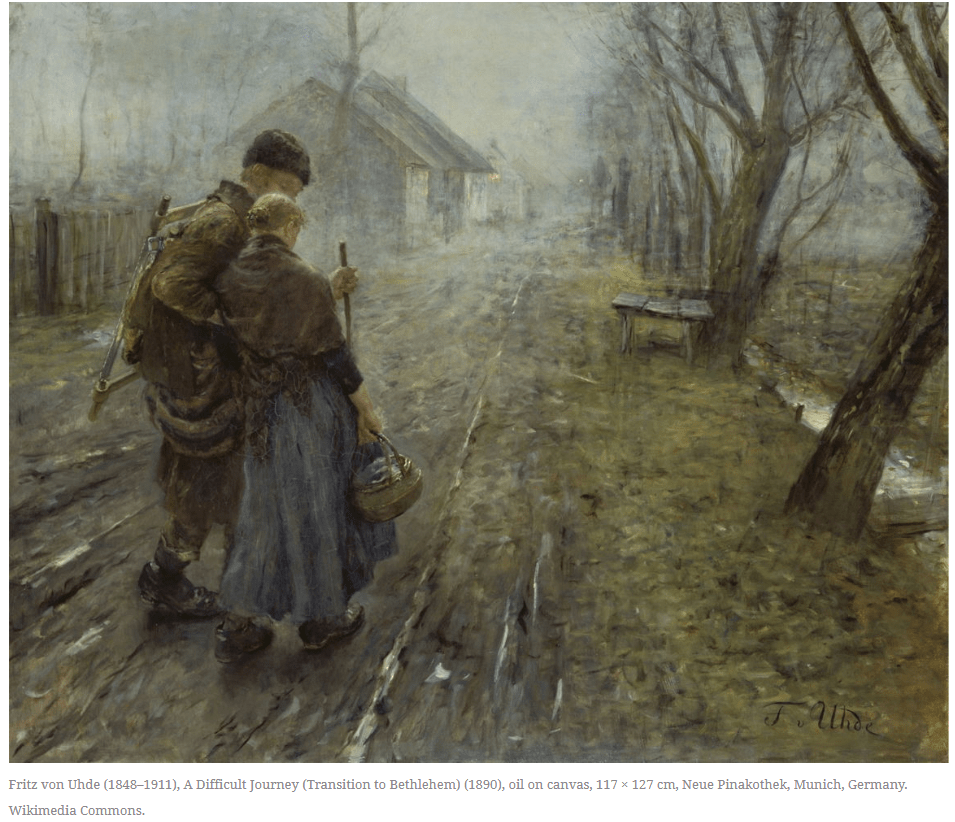
Fritz von Uhde was a German painter who lived between 1848 and 1911.
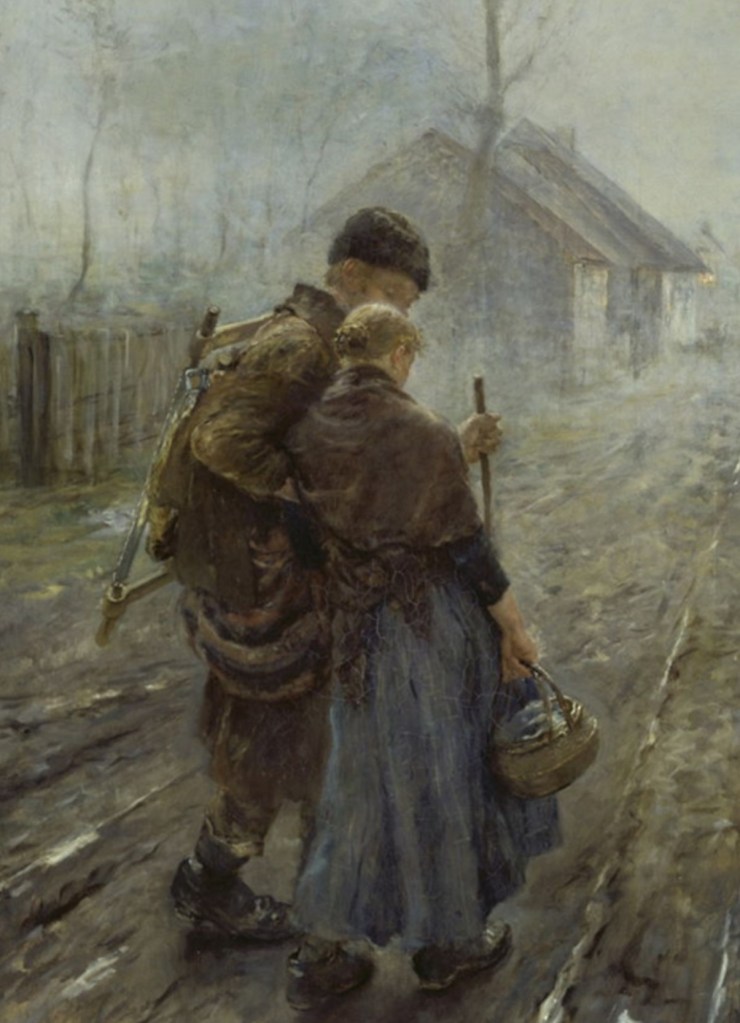
This particular painting belongs to his religious period and he painted it in oil on canvas in 1890. Originally it was titled Transition to Bethlehem’ but it was later come to be known as The Difficult Journey. It is about the journey of Joseph and Mary to Bethlehem for the Census. It depicts something of the difficulties they had in bringing Jesus into the world. Ever since I came across it, I have felt a draw to it, particularly when approaching the Christmas season. Last December I wrote about this in the Blog and I have come back to it again this year. If you are looking for more information on the artist, please look at my Blog entry for Christmas Eve 2022. As then, I have reflected on the scene Von Uhde painted and offer a different reflection / poem.
A winter journey.
It was a difficult journey.
She, carrying her pregnancy, leaning on him. He, with protective arm, enfolding her. Two needy people, both exhausted, longing for rest.
There is no welcome here. Villagers hide in their cottages, seeking heat and shelter from bitter wind. They are unaware of their visitors traipsing along mud-crowned lane.
Had they opened their doors what might they have made of the two young people seeking a respite from their weary way?
Yet the couple must travel on, sustained by love, he for her, she for him, the child already alive and eager within her. All loved by He who loves all.
Shuffling along the track, they pass unnoticed, to another place of uncertain welcome, where, in an outbuilding, strange things were destined to happen.
But of all this, the villagers were none-the-wiser. Not then. One day, in the future, they would hear the fuller story. The womb-enclosed child, now a grown man, would send signs of his presence.
The villagers would recall how they twitched their curtains, sensing a shadow of blessing pass by on that Winter’s day. Hearing of what they baby had become, they would fling open their windows with joy.
“He came amongst us”, they would cry. “He is with us still!”
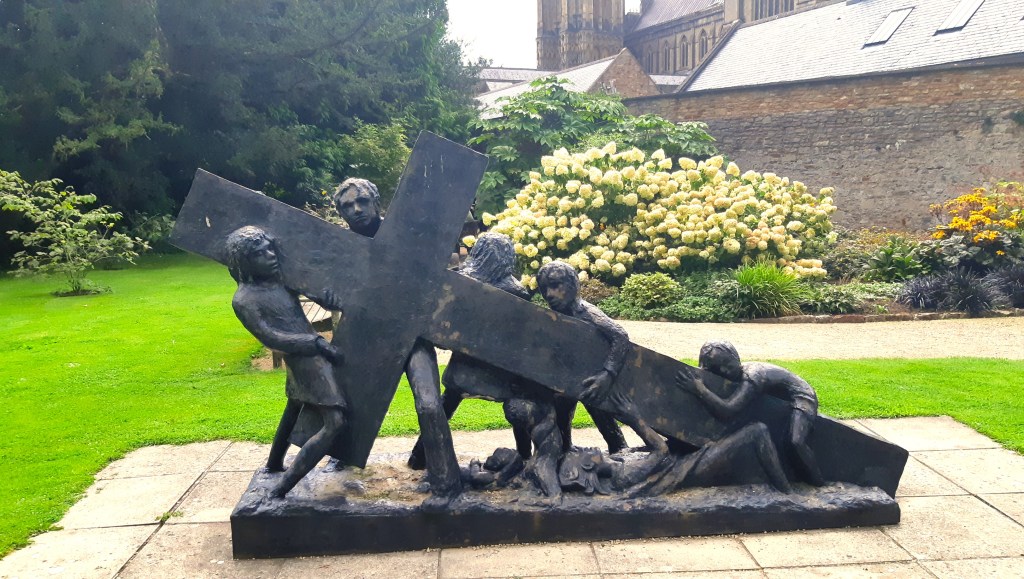
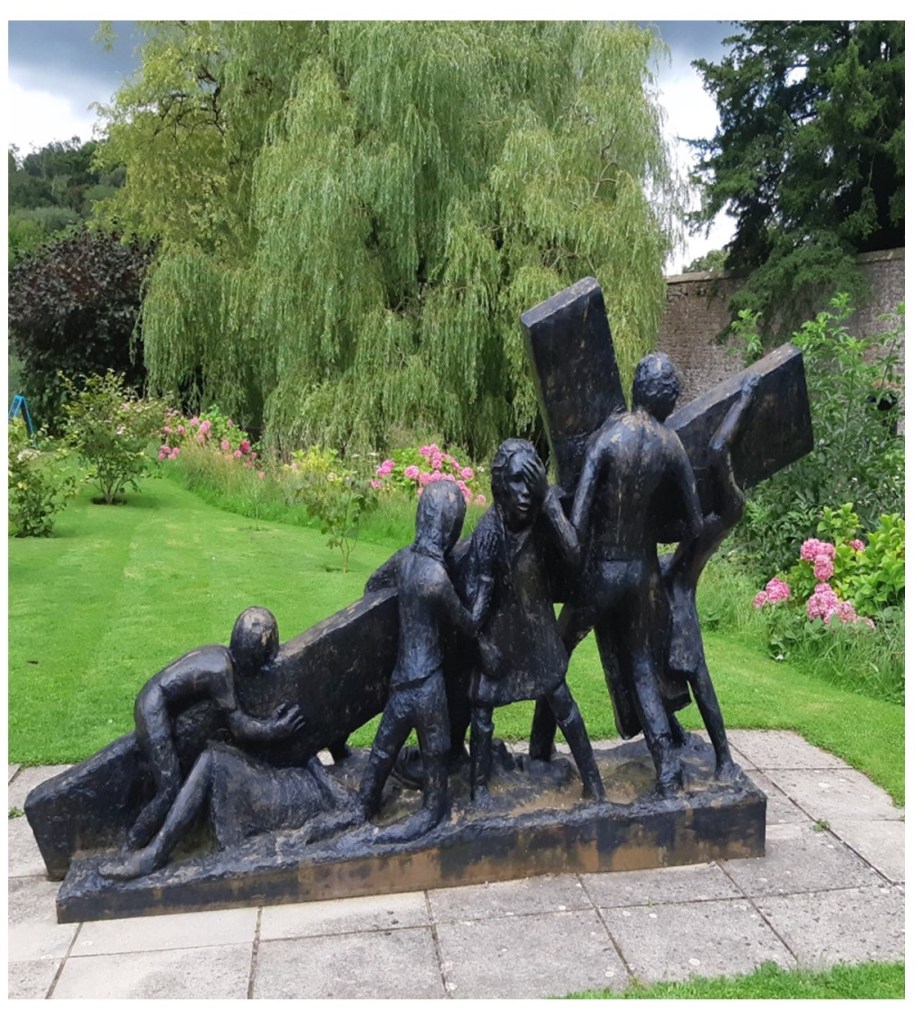
Josefina de Vasconcellos ~ The Weight of our Sins. Bishop’s Garden, Wells Cathedral. Photo by Piers Northam
The Weight of our Sins.
In the Bishop’s Palace Gardens next to Wells Cathedral, there is an amazing and disturbing statue by Josefina de Vasconcellos. It is called, The weight of our Sins. It was carved in 1999. It centres on a Cross which eight children are holding up. They are bearing its weight and each is symbolic of a crime against children today. There is young person suffering from AIDS; a teenage boy who is a drug addict; a child blinded by a land-mine; another child represents the homeless; a baby who is victim of genocide; a girl is dying after experiencing serial sexual abuse. Poverty, deprivation and pain are also part of the message. Josefina had a deep compassion for disadvantaged and damaged children. She was also inspired by her belief that loving God led people to love one another and therefore help build a peaceful world. Josefina’s concern was for so many in our world who suffer because of cruelty and inhumanity. She had a particular sadness and love for the most vulnerable in our society. Unable to have children, she had a special concern for them. Though she died in 2005 the meaning of the statue couldn’t be more pertinent than today.
Children are suffering appalling life conditions and not just in placers like Gaza, the Ukraine, Syria, Yemen and South Sudan. The tragedy of those forced from their homeland to live as refugees seeking the basic human need of shelter, food, water and warmth is something Josefina’s statue holds before us. Without doubt, one of the children clinging to the Cross would be representative of the boat people in the Mediterranean and the English Channel. Another would possibly represent the children living in poverty and hunger in our own country. Having been brought up in the post war deprivation era it is hard to think that for many the conditions of that time are also still with us in the 21st century. Food Banks, substandard accommodation, debt and a sense that they don’t matter, is a scandal in a time when the divide between the ‘haves’ and ‘have not’s’ feels closer to Victorian England. I think Josefina would have wept to see what is happening today.
Her concern for the well-being of children was expressed through her art, but together with her husband, Delmar, she took it further. Her faith in God and her devotion to the beauty of art and music, together with Delmar’s involvement as a Lay Reader in the Church of England’s ministry, led them to put their faith into action. They adopted two boys made orphaned by the Blitz on London; they opened their home to borstal boys whom she tried to encourage to express themselves through art and nature; they bought an old trawler and, after renovation and adaptation, moored it off the Cumbrian coast to provide an holiday experience for children coping with physical disability. She also created space, complete with appropriate sculptures for people whose children were stillborn.After her death, an Arts Trust was set up in her name which included the education and care of young people.
She named her Sculpture, The Weight of our Sins. It is a charge she laid against all who harm and destroy children and childhood, but it is also a plea for a more “ethical reflection on the issues of the modern world, the meaning of childhood and what part we need to have in producing change and as a source of inspiration for word, art and music” The message is clear in the sculpture in Wells. We cannot ignore our responsibility to change things for the world’s young ones, suffering because of what the so-called adult world is doing to them. It is human sin which is crushing the vulnerable and innocent victims because of what we are doing. It isn’t enough to say it’s too vast a problem for us to have any effect or change. Of course it requires international and national solutions but we can all play our part. We can pray and believe that prayer changes things, not least our own perceptions. We can help to relieve poverty. I have friends involved in running Food Banks. All of these Banks need donation of food; The lady who sells me Big Issue magazine has a baby. Just buying the magazine, perhaps even giving more, helps her. Supporting charities such as the Big Issue Foundation, Abraham’s Children in Crisis, Embrace the Middle East and a host of others is a good place to start. Small things bring big results. As Josefina said, loving God and caring for each other , can bring peace and love.
We can, if we accept our part in all this, move from being part of the burden which weighs down children to become those who help to raise them up with the weight of our love.
God of love, We pray for peace in our world, and an end to war. Instead of hatred, let there be love. Shelter your children and protect us. Guide us and keep us from harm, so we can build a world of love and live our lives in peace.