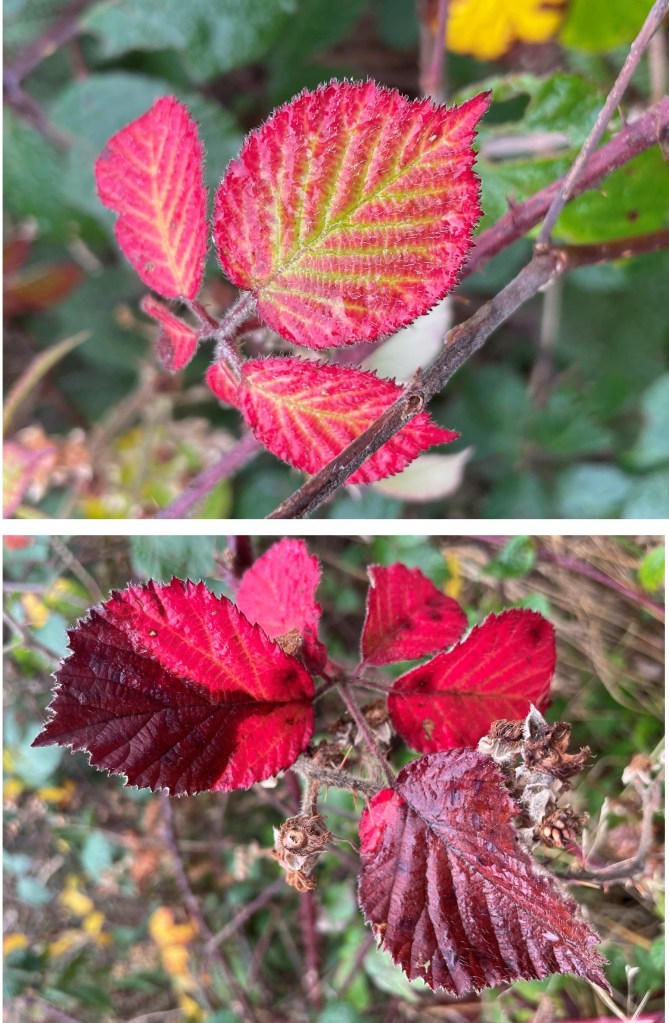
Mid Autumn Reflection by my friend Gill Henwood who took the photos.
Brambles along the ridge track, Grizedale Forest, are aflame in the pyrrhic victory of autumnal mid-November.
I’m reflecting along the way about glory in the natural world as leaves fulfil their task of nurturing the trees for this season, of sheltering wildlife and shading the forest floor. Trees and their undergrowth are gradually withdrawing their summer lush greens, through autumn russets to the stark beauty of their varied branches.
The brambles arch and scramble below, creating spiny sanctuaries for creatures to nestle down out of danger. Birds and mice have mostly taken the blackberries and carried their seeds further along the forest edges and field hedgerows.
Creation is readying for the burst of life starting after midwinter in only a few weeks’ time. Primroses are flowering already in sunny spots, unseasonally warmed. Bulbs are waiting, biding their time, just below the leaf litter.
Advent is not far from us – our time to get ready, to prepare for the explosion of new life into the world at Christmas, the coming of the Christ Child as the new era dawns and continues…
Gill Henwood
Stir up, O Lord, the wills of your faithful people; that they, plenteously bringing forth the fruit of good works, may by you beplenteously rewarded; through Jesus Christ our Lord.
The Remembrance ceremony at the London Cenotaph is always a moving occasion. So too the Royal British Legion Celebration at the Royal Albert Hall the previous evening.
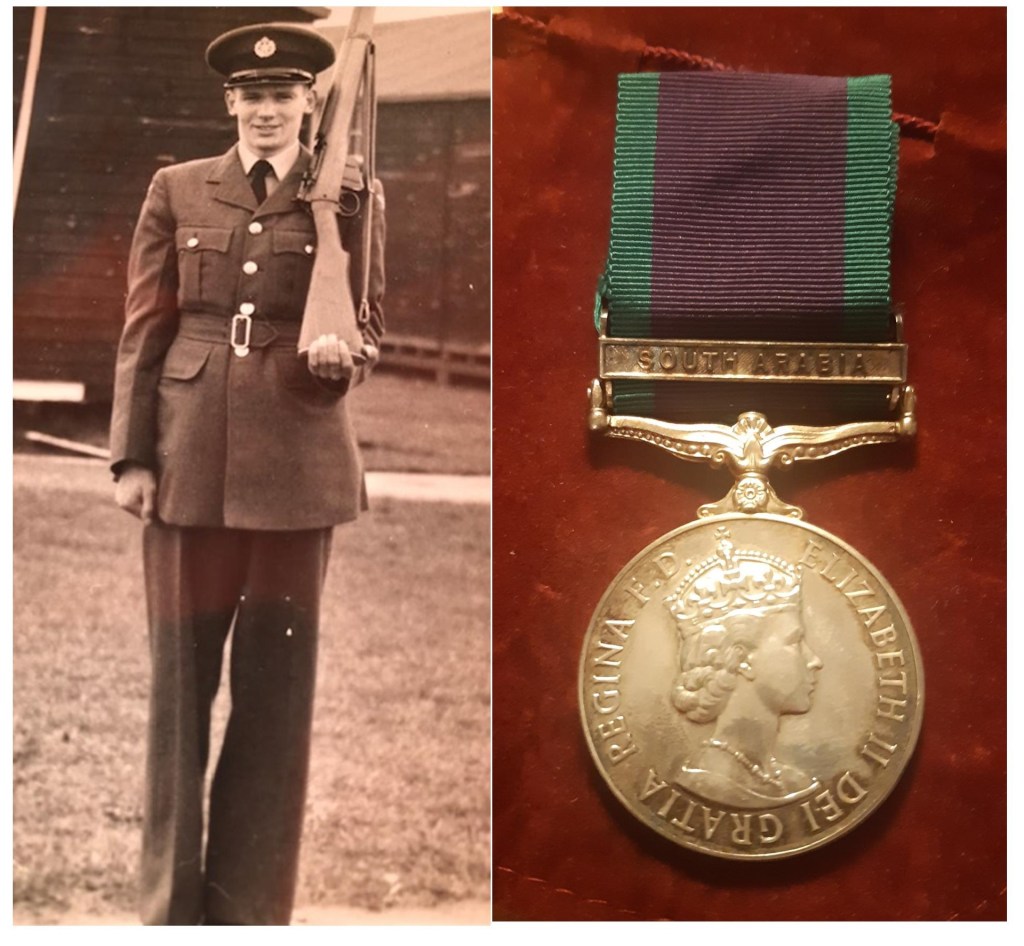
For me there are personal elements. Grandfather Tommy served in the First World War and was wounded when British troops were sent in to the Dardanelles Straights in Turkey whilst an attempt was made to secure a bridgehead at Gallipoli. My parents served in the Second World War and I was brought up during the austerities of the post-war years. Also, I had a cousin who was more like a brother to me, who served in the Royal Air Force, and for a period he was in Aden in South Yemen (of which it is now part). Aden was a British Crown colony from 1839 to 1967 and the Conflict between 1963 and 1967 was between the British Armed Forces and insurgents who wanted to claim it back from us. That is a very simplistic view of it but it is not a conflict that gets much mention. Those who fought there call it the forgotten war. When at Remembrance-tide the many conflicts and wars the United Kingdom has been involved in, are mentioned, you would have to strain your ears to hear the word ‘Aden’!
Yet, for those who fought in the conflict between 1963 and 1967, it was real. Some were wounded, some died, including British school children, and many were mentally scarred. The Insurrectionists did quite a job on those who went in fear of their lives. When my cousin Peter came back home, I saw a change in him. He was unsettled and nervous. I think some of that stays with those involved in such conflicts.
A year ago today, he died of Alzheimers so it has been a particularly challenging day.
I decided to write a poem because Peter, like so many, did his duty and put service before self. There is always a consequence even if it isn’t always obvious.
Our Peter (An Anniversary poem)
When our Peter, escorted home by a bobby of the local constabulary, face blackened by wood smoke, eyes bright with mischief, spoke his signature tune, ‘guess what Mar?’, his twelve-year- old self did not know that his twenty-two-year-old self would face a different smoke of acrid bombs, firecracker bullets, rifle shots.
He cared for aircraft and people and Khormaksar in Aden became an indelible memory of danger, of innocent children whose party fun went up in flames – little-ones facing a violence they had not sought. Airmen and soldiers watched for insurgents, who slinked in shadows, hid in souks, ready to strike at any moment and pick off their victims.
Well-trained and ever-watchful, our Peter came home. Behind, mounded in foreign soil, friends, comrades remained. They died serving Queen and country.
He served too but he was one of the lucky ones. Or was he? Something inside him perished or festered. Secured in a pocket of Remembrance, all he had witnessed endured. Wherever he was, wherever he worked, lived, settled, that wallet of reminding was in his heart. ‘Home’ would always be where he had served his Queen and done duty for his country.
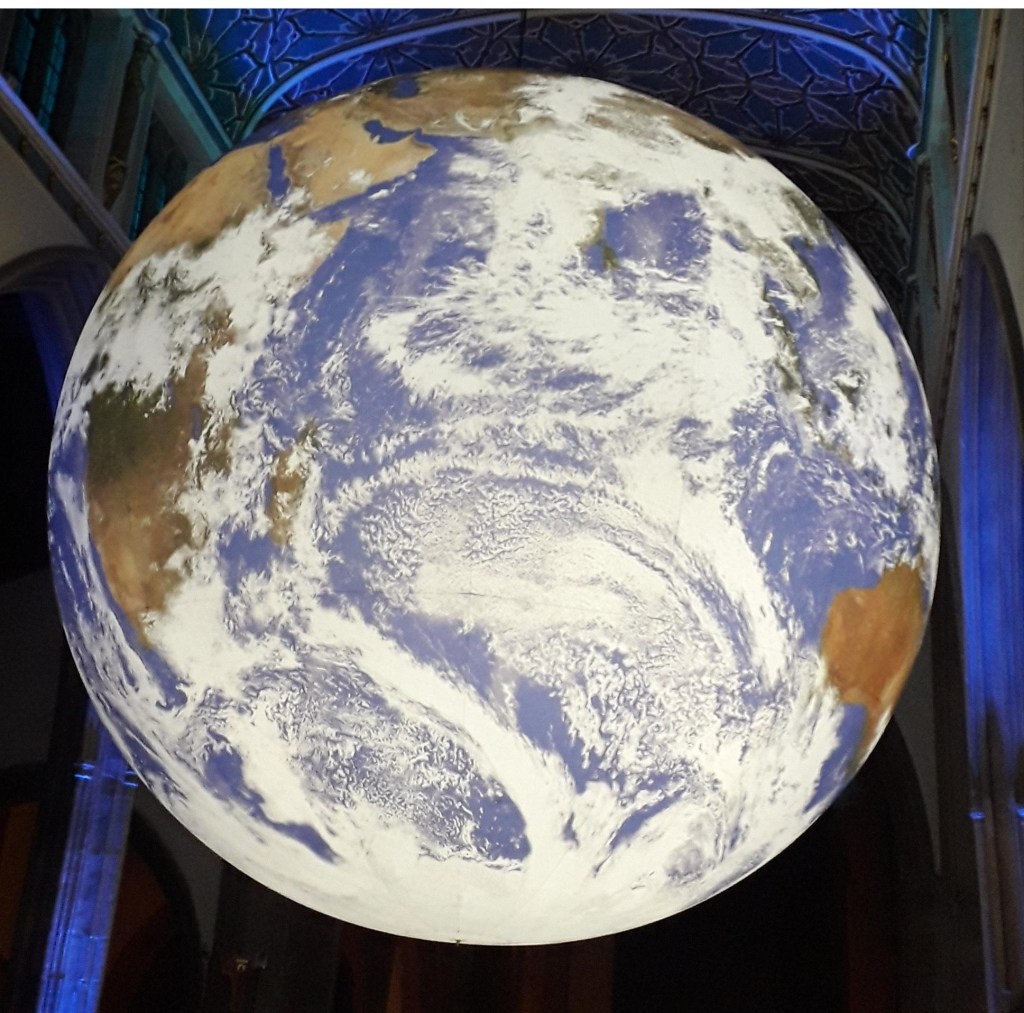
Visitors to Chelmsford Cathedral this autumn were able to experience an astronaut’s view of the world when the stunning ‘Gaia’ artwork came to Essex.
Measuring six metres in diameter and created from 120dpi detailed NASA imagery of the Earth’s surface, ‘Gaia’ provided the opportunity to see the planet in its entirety as it slowly revolved in the nave of Chelmsford Cathedral, accompanied by a surround-sound composition by BAFTA award winning composer Dan Jones.
The Exhibition was held in conjunction with an inaugural Science Festival, providing an opportunity for people of all ages to be inspired and to discover the fascinating world of science. This had the support of Essex County Council’s Climate Action Fund and Anglia Ruskin University.
The Exhibition was attended by large numbers if people including many children and young people. It provided an opportunity for people of all ages to be inspired and to discover the fascinating world of science.
The context of the Cathedral lent another dimension which by nature of the faith professed within and outside the walls of the building is a visible reminder of the things of God, His care, love and compassion holds us all close to His heart.
The concern for the earth God has created is something many of us are sharing in the face of climate change and the many unusual weather and climate events which are afflicting us. As I looked quietly at the globe, lit from within and suspended two metres above our heads (more if like many children you lay on your back looking up.), I saw the immensity of our planet, poised in space. It is the vulnerability of both it and us which struck me forcibly. This fragile earth and gift of God needs our responsible care and deep stewardship. I saw more. Seeing the planet in this way it struck me just how much water covers the surface and, by comparison, how little land. On what is quite obviously, a finite and limited area, there is no room for warfare, exploitation, Nimbyism, selfishness and greed. We don’t own any of it. We share the earth with everyone and every creature. We share it all with Nature. So,we have got to change the way we see everything and everyone. We can no longer leave it to a few, often incompetent, Governments. We certainly cannot allow a handful of less than a dozen dictators to impose their will on millions of others and destroy livelihoods, homes and habitats at will. How dare we allow that to happen and do nothing!
As I write COP27 is in progress in Egypt. Whether it will actually make progress remains to be seen. Yet we all have a part to play in this process. We cannot allow them to destroy innicent livesThose of us who serve God as our Creator, Lord and Spiritual guide – however we express that – can and must pray. Prayer is not a last resort but a first Resource.
Below is a prayer written by Pope Francis, to start us off.
A Prayer for our Earth
All-powerful God, you are present in the whole universe and in the smallest of your creatures. You embrace with your tenderness all that exists. Pour out upon us the power of your love, that we may protect life and beauty. Fill us with peace, that we may live as brothers and sisters, harming no one.
O God of the poor, help us to rescue the abandoned and forgotten of this earth, so precious in your eyes. Bring healing to our lives, that we may protect the world and not prey on it, that we may sow beauty, not pollution and destruction.
Touch the hearts of those who look only for gain at the expense of the poor and the earth. Teach us to discover the worth of each thing, to be filled with awe and contemplation, to recognize that we are profoundly united with every creature as we journey towards your infinite light.
We thank you for being with us each day. Encourage us, we pray, in our struggle for justice, love and peace.
Amen
Prayer of Pope Francis, Laudato Si’
#####
The words in italics at the beginning of this article is drawn from Chelmsford Cathedral’s website. Below is an explanation of Gaia
Since the 1970s James Lovelock developed the Gaia hypothesis, named after the ancient Greek goddess of the Earth (See GAIA). As originally conceived the ‘Gaia’ concept envisages the Earth as a super-organism that operates to regulate its own environment, principally temperature, to keep it habitable for the biosphere.
Many years ago I was tutored by Fr. Hugh Maycock, who was probably one of the most interesting and intriguing people I have ever met. One day, he gave me two pieces of Basildon Bond azure paper on which were typed two poems. One, which I have called Robes won by dying, is about the way autumn leaves change colour and an explanation of why they must. (You can read this as my blog for September 25th) The second poem I lost long ago but, oddly, it came to light recently amongst some old papers. It deserves to be read by others so I publish it below. Both poems have an interesting, if brief, story behind them.
Father Hugh told me that they were written by a young man he knew who had been diagnosed with an incurable illness. In his physical and spiritual pain he had two battles to endure and engage with. One, of course, was the battle with the bodily and mental pain of his illness. The other was with the test of his faith and the making sense of what was happening to him. No doubt, like many in that position, there was a sense of ‘Why Me?’ and ‘Why is God allowing me to suffer?’
Father Hugh told me that the poems where born out of that struggle. In the Sea, The Sea, he is wrestling with his faith whilst enduring pain and, more importantly, his coming death. After struggle, the poem ends at a point where faith has been answered by love. Father Hugh told me that the young man died peacefully.
I think he gave me the poems at a point when my own faith was being tested but I also like to think that, in some way, he thought I might preserve them for others. I have often reproduced the other poem. It is now time for me to do my duty towards this one.
The Sea, The Sea
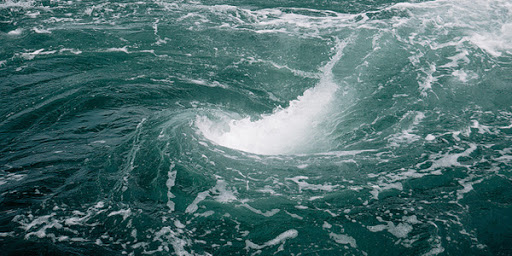
White foam splashes over bow of soul lying storm-tossed in the waves of life, unable to find that safe anchor which breathes of peace and tranquillity.
Cast adrift, facing furious headwinds of uncertainty, pain and doubt, the boat of the soul plunges deep, is cast high on crest of storm, blind to that land where love dwells waiting to hold still.
Is all lost? Will hell’s fury stake her claim on all that is you? Frozen by white horses ripping over surface of cold, deep water.
You think so, yet in that moment when ending seems to come and mariner abandons all of hope, there – walking on the water, radiant, bright, He comes whom wind and wave obey and fury spent spreads calm.
In that sweet moment of stillness Following storm, through your eyes he looks and says, What faith have you that makes you fear and doubt?
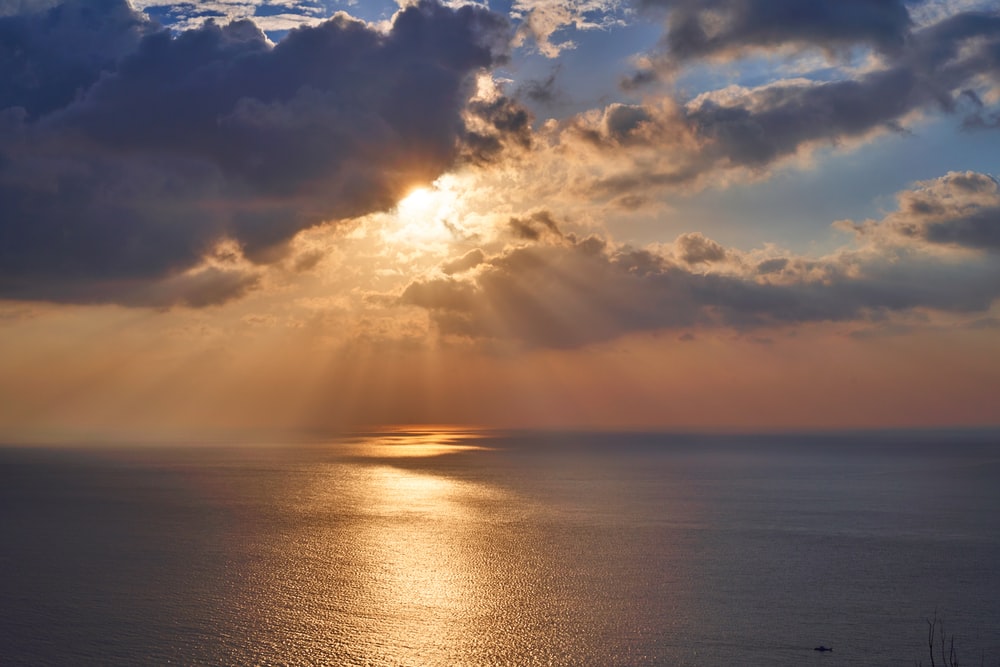
You, suddenly becalmed and safe from storm sink instead, into those arms that hold you fast and look through eyes that see no storm but glorious sunrise shimmering over gentle waves, sparkling with a new found love.

 Mr G's Ponderings