Author: mrgsponderings

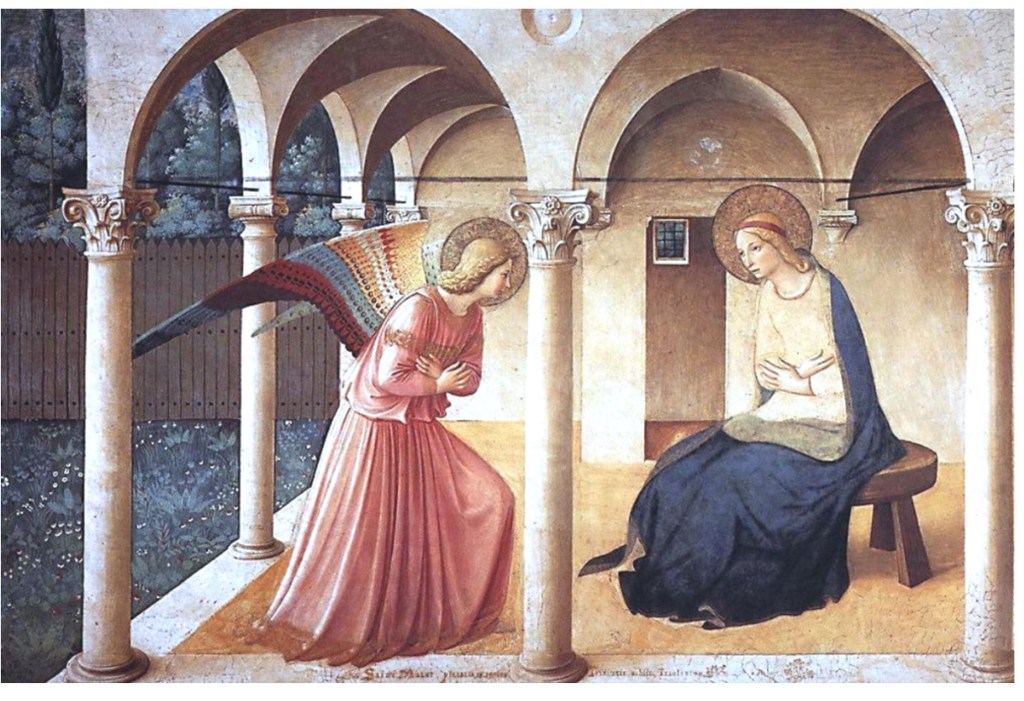
Fra Angelico, Annunciation

Annunciation to Mary by Fra Angelico

Fra Angelico shows us something of the message that Gabriel brought from God to Mary.

I have never been a great artist, despite all the best efforts of my art teacher at grammar school. He did, however, inspire me to appreciate art and that has become an important part of my life. Amongst the paintings we studied was Fra Angelico’s The Annunciation, painted about 1450. It is a fresco painting in the Convent of San Marco in Florence. Fra Angelico was a Dominican monk who was a master of Renaissance art but his purpose was always to teach. His paintings were always to illustrate the message of God.

Fra Angelico’s painting of the Annunciation to the Blessed Virgin Mary (the feast day we celebrate today) is one of the most moving and well-known of this event in St. Luke’s Gospel. There is a quiet stillness and a sense of gentle conversation and attentiveness; of revelation and eventual acceptance of God’s plan for the salvation of the world. A plan which needed Mary’s ‘Yes’. Though Fra Angelco’s scene captures very little of the surprise and turmoil the Angel’s message brought to Mary there is a sense that something deeply significant is going on in the quietness of the scene.

We are told by St. Luke that she was deeply troubled  and like many who are called by God to some action and service, she thought of reasons this could not be. After reassurance by God through the angel, she then offered herself to God’s plan. This was not the submissive meekness usually associated with this moment.

It is significant, perhaps, that Luke begins his Passion story with a similar struggle leading to an acceptance. In the Garden of Gethsemane Jesus too tried desperately to avoid His Crucifixion. Out of His anguish, his sweat fell like ‘drops of blood,’ yet, as with His Mother he finally allowed The Divine Plan to go forward with His ‘Yet your wil, not mine be done.’

In both cases, Son and Mother  gave themselves fuly and completely to the work of claiming the world back to God. For both it was a real giving requiring from them an active sharing in the Plan of God.

In painting his Annunciation, I see Fra Angelico choosing to paint that moment after Mary’s acceptance,just before the angel left her. The vocation, or call, of God to Mary had been made and acceptance eventually given and after that, as is so often the case when we have strggled with God’s will and our own, a godly peace descends.

I like to think that Fra Angelico wanted to show that. He wanted those who looked at his painting to know that when we meld our wills with God’s there is an amazing outpouring of Grace. That’s when real vocations happen. It is not surprising therefore that we might say, Hail Mary, full of Grace…

Almighty God,
so fill us with your grace
that we may accept you will in all things
and with the Virgin Mary, full of grace
rejoice in your salvation through Jesus Christ our Lord.

Man in background

Josefina de Vasconcellos. Holy Family, Liverpool Cathedral

Man in the background

The Sculptor, Josefina de Vasconcellos  was commissioned on a  number of occasions to carve large statues of the Holy Family.  What never fails to strike me is that always Joseph is central to the scene.  He does not lurk in the background or act like some kind of bystander.  Josefina shows him as a strong fatherly figure who is a protector of both Mary and Jesus.  It is clear that Josefina had a soft spot for the shadowy figure from the Christmas story and was determind to give him the prominence he deserves.  Perhaps it was because she was graced with the female form of his name.

One particular statue of the Holy Family that she carved was very different.  It can be seen in Cartmel Priory in the Lake District.  It is called They fled by night and it is inspired by the flight into Egypt taken by the Holy Family to escape the threat of King Herod.

It is a very powerful statue.  Mary is shown to be exhausted with her head leaning backwards as she rests in Jospeh’s arms.  Joseph is holding her and and looking down with loving compassion.  Meanwhile in the foreground of the composition, Jesus is leaping forward as he embraces the future.

Photo : Mr.G They fled by night. Cartmel Priory

What I like about Josefina’s portrayal of Joseph is that he is not the shadow figure that we find in the Gospel.  Apart from Matthew’s ‘dream’ sequence when an angel tells Joseph it is all right to take Mary as his wife because it is all according to God’s plan, and an incident when Jesus was 12, Joseph plays no further part in the Gospel story.  There is a reference to him when Jesus is called the carpenter’s son.  But we are left wondering – what happened to Joseph?

We can invent our own story but I like to think that Joseph was content with his role in making the Incarnation possible.   In a world like ours which celebrates status and fame it isn’t a bad thing to be background people.  Those with a quiet but firm faith are the bedrock of the Church. They seek nothing more than to proclaim Jesus, not necessarily in words or spectacular deeds but with a fidelity towards Him which simply shouts faith in all they do and are.  In Josefina’s statues Joseph comes across as a dependable, caring and protective parent.  If I could choose a guardian angel, it would be like him.

The Church celebrates Joseph today  It is good to think of him as the dependable one who may be in the background but whose care of Jesus and Mary is truly godly.  Someone who can be relied upon come what may.  Is that you?

[Mr.G.]

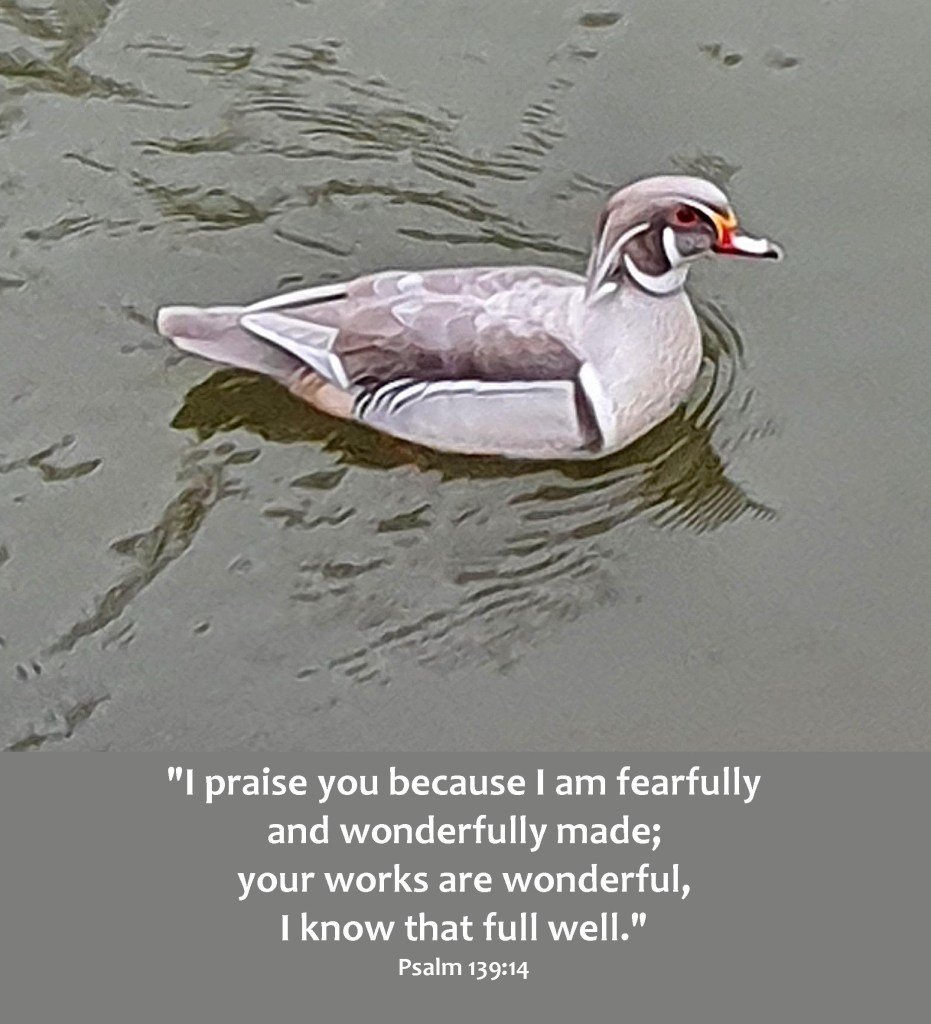
Warmth of God’s Love

Tweet Number 72 from my friend Joyce Smith

This week, Joyce has sent some words to go with her photograph.
At this difficult time, what Joyce has written says all that needs to be said.

Dear Friends,

Another day when the sunshine and colours of spring remind us of
the warmth of God’s love and give us and all people hope,
that the darkness of war will end and a new day dawn.

With my love and prayers.

God bless,

Joyce

Mamre

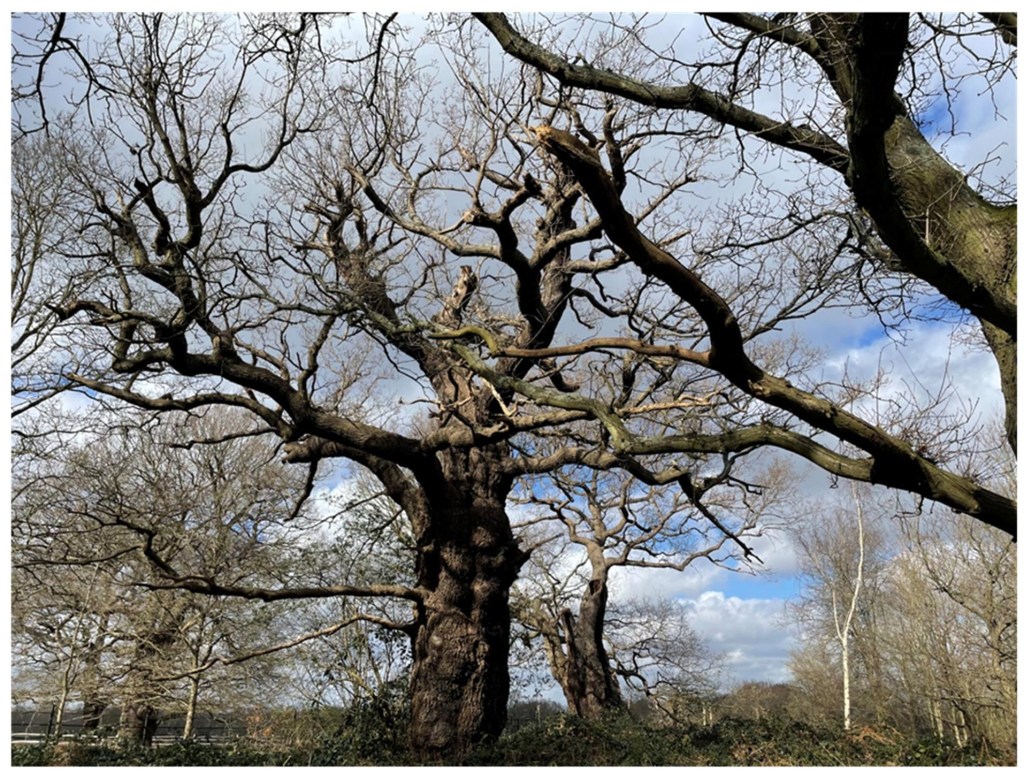
Oak Trees wintering in Richmond Park, London. Photograph by Gill Henwood.

This little poem has a double inspiration.
My friend Gill sent me photographs of majestic oak trees in Richmond Park, waiting for Spring to burst open their new buds.
The other inspiration is Genesis 18 verses 1 – 8. Here Abraham also waited under the oaks of Mamre, for God to reveal to him the promise of new life and new purpose.

The poem includes another ‘waiting’; for those on a Lenten Pilgrimage to open their hearts afresh to God.

MAMRE

By the oaks of Mamre
Abraham sat in quiet contemplation

seeking solace in the heat of the day.
Waiting, though he knew not what for.

Expectation seemed to dust the winter tree over him.
Branches dormant, dead?
They waited too for a new life promised
by the whispering of God.

Abraham’s moment came.
Visited by the Three, he rose,
with hospitality bubbling in his heart,

receiving them as if they were God
– because they were God!

And us?
We wait too as the Three approach us
in quietness,
inviting us to open our Lenten hearts.

It’s different somehow for us.
Abraham fed God and received God’s promise.
God feeds us and, in the breeze of Mamre,

becomes the Promise.

Expect it!

Mr G. 16th March 2022

(inspired by Genesis 18: 1-3 & by Gill Henwood)