Category: Uncategorized

Holocaust Memorial Day

The 27th of January is the day for everyone to remember the six million Jews’, Romanies, Homosexuals, Handicapped, Jehovahs Winesses , Christian ministers,  murdered in the Holocaust, the millions of people killed under Nazi persecution, and in the genocides which followed in Cambodia, Rwanda, Bosnia, and Darfur.
The 27th of January marks the liberation of Auschwitz-Birkenau, the largest Nazi death camp.

Elie Wiesel was both a survivor of the Holocaust and yet its victim too because everything changed for him. He became one of the most well known people to bear witness to what happened in the evil camps and his biography of his time in Buchenwald was also a kind of biography of the Nazi ‘final solution.’ He was born on the 30th of September 1928, and passed away on the 2nd of July 2016 at the age of 87.He was a noble peace prize winner and his biography during the holocaust called ‘Night’ is available still along with other writings.

Below is something about the struggle he was having after his ‘liberation’, which he tried to come to terms with in ‘Night’. I wrote about a meeting he had with the French novelist Francois Mauriac, who had agreed to write a preface. Much of what follows is based on what Mauriac said.

Elie Wiesel was a young Jew who was thrown into a concentration camp by the Nazi’s when he was just 15. He witnessed many horrors and he experienced the dereliction of feeling abandoned by God.
By some miracle he survived and he went on to write his experiences in a powerful book which he entitled Night.
It is not a long book but to read it is extremely moving and left this reader with a profound sadness.
Elie Wiesel’s faith was deeply shaken and after the war he was sent to interview a Roman Catholic novelist, Francoise Mauriac.

Mauriac wrote a foreword to ‘Night’.
There he tells of Wiesel’s bitterness at God.

“I no longer pleaded for anything. I was no longer able to lament”, said Wiesel to him, On the contrary, “I felt very strong. I was the accuser, God the accused. My eyes had opened and I was alone, terribly alone in a world without God..”

Mauriac, spoke of his reaction to this.
From the depth of his own faith he wanted to speak to Wiesel of “that other Jew, this crucified brother who perhaps resembled him and whose cross conquered the world.

Mauriac wanted to say that the connection between the cross and human suffering “remains the key to the unfathomable mystery in which the faith of his childhood was lost.”
He wanted to say: “We do not know the worth of one single drop of blood, one single tear. All is grace. If the Almighty is the Almighty, the last word for each of us belongs to Him.”

But as Mauriac thought this, he sensed that his words would have appeared empty to this young Jew, who in his own way was carrying a Cross on a journey that was uncharted and which defied explanation.
So Mauriac said nothing but what he did would speak volumes.
“All I could do,” he said,” was embrace him and weep.”
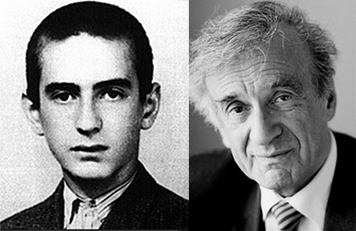
Elie Wiesel at 15 and later in life.

‘Never Shall I Forget’ by Elie Wiesel is a harrowing passage recounting the first night he spent at Birkenau, from Wiesel’s famous memoir Night

Never shall I forget that night, the first night in camp,
that turned my life into one
long night seven times sealed.
Never shall I forget that smoke.
Never shall I forget the small faces of the children
whose bodies I saw transformed
into smoke under a silent sky.
Never shall I forget those flames
that consumed my faith for ever.
Never shall I forget the nocturnal silence
that deprived me for all eternity
of the desire to live.
Never shall I forget those moments
that murdered my God and my soul
and turned my dreams to ashes.
Never shall I forget those things,
even were I condemned to live
as long as God Himself.

Never.

Elie Wiesel
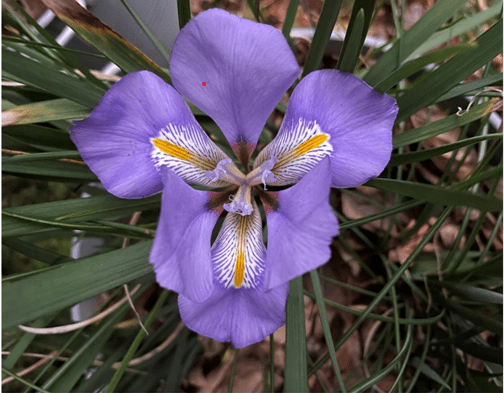
Winter Iris

Photo : Gill Henwood

My friend Gill has shared with me photos of the Winter Iris, Iris Unguicularis, growing in her Cumbrian garden at this time of year. This clump forming iris has tiny rhizomes and long, narrow, sword shaped evergreen leaves. It grows wild throughout the Mediterranean area where it is naturally winter flowering. It is extremely variable both in flower colour and size. It is native to dry, sunny soils and flowers best against a sunny wall where it can be left to form large clumps. Ideal then for the Lake District at this time of year! The Iris in Gill’s garden is, however, unaware of the restrictions on its growth and just gets on with it anyway! Which brings joy to us.

Winter Iris

Nature never sleeps.
It just rests awhile drawing breath.
Look around you,
see the green shoots pushing at the hardened ground.

Ah, we might sigh,  beauty is a pinprick of light in the cold earth.
Our ancient ones saw this time as hovering
between darkness and light.
Earth is poised between Winter and the journey towards Spring.
The sky begins to lighten.
Soil gives birth to snowdrop,
aconite, hellebore; crocus; daffodil,
all puncture the seemingly sleeping ground.
Early budding of trees as
nature yawns, stretching its arms,
drawing us into the embrace of renewing life.

There among the signs is Iris unguicularis,
Winter Iris.
She brings to our attention her warm history,
Infancy spent in North Africa, Syria, Mediterranean climes
Holy Land perhaps.

We sense the warmth of her hope that
nature will dust away all dregs of human darkness,
pointing us to the light and the beauty
the wisdom, passion and purity of faith,
which transforms.

[Mr G]

Photo: Gill Henwood

Conversation

Held in the lamplight glow
of another’s attention
time slows…
space for a shared unfolding:
the creases, rucks and pleats
of story and experience,
passion and sorrow
carefully laid open.

In the cradle of this shared moment
we are free to wander and explore:
huddled close as we walk in step;
or running free after fresh vistas;
or simply sitting in easy company –
pondering together
and drinking in the view.

Scudding brightness pinpricks details
to be pointed at and revelled in.
Notions, like skylarks, twist and turn;
cloud-pictures drifting
and shifting,
to crystallize when they are named.

And afterwards,
the joy of sacrament:
the recognition of new knowings…
and the sense that we have been seen
and heard
and cherished –
and that together, we have grown.

Piers Northam
14 January 2022
(with thanks to Ros, Susan, Julia, Lynn and Marion)

Thank you for making me, me

Thank you to Joyce Smith forTweet 63 the little blue-tit turning up increasingly in our gardens.

The daily reflections by the Church of England this week were by The Rt Revd John Inge,
Bishop of Worcester.

On Friday he reflected on Matthew 22: 15-22. It was the encounter between Jesus and the Pharisees who were trying to entrap him. The meeting centred on the place of Caesar in the scheme of things and whether paying taxes to him went against one’s loyalty to God. Who was greater?

Jesus knew their hearts and so called them hypocrites but he willingly took up their challenge. Calling for a coin, he asked whose head was on it and whose title. ‘Caesar’s’ they answered. So, said Jesus, give back to Caesar what is Caesar’s  and to God what is God’s.

As ever there is more depths to Jesus’s answer and I thought about that when I received Joyce’s tweet this week. The caption has something very important to tell us and it begins its message in Jesus’s response to the Pharisees.

John Inge said that Jesus was able to assert the sovereignty of God over all things, while appearing superficially to support the emperor.

At another level, there is an unspoken message. John Inge went on to say that Caesar’s head is that of a human being. Human beings are made in the image of God.  Citing Genesis 1:27 : “In the image of God, he created them; male and female he created them and God blessed them.”

Thus, in a very subtle way Jesus told the Pharisees that all things (even them!) were God’s.
This important message reminds all of us that we reflect the image of God. Each one of us is ‘stamped’ with God’s image and likeness – even if sometimes we are not shining with that image as brightly as we could!

There is however, another implication. If we are all stamped with the image and likeness of God, we are all equal in God’s sight. He loves everyone, everything, that he has made.

According to the Genesis poem of Creation, God saw everything that he made and makes as very good. That’s very important for us to know. Of course, we don’t always believe nor act as if it is true. Life’s experience and circumstance can tarnish us and the goodness can fade. But it never goes completely away. It can be burnished very easily into brightness but we have to go to the maker to see to that. He has the polish to do it. It is called Love. We are rubbed by it in prayer, through conversation and study of His word and through the actions of Jesus and the Spirit. Also, we can polish each other with mutual love and encouragement. The image of God in us never goes away. God sees to that, though we do have to reach out to Him.

One of the great joys of the Gospel is that it’s about God being good to us.

So what’s this got to do with the little Blue-Tit?  Well, it seems she knows that she is secure in the love of God and, like all Nature and Creation reflects the beauty and love of God. This is why she’s not too bothered about comparing herself with others.
She’s just content with God loving her as she is.

Some of you will know the Butterfly Song which begins – If I were a butterfly.
The Chorus is worth turning into a little prayer.

For you gave me a heart and you gave me a smile
You gave me Jesus and you made me your child
And I just thank you Father for making me, me

[Mr G]