Category: Uncategorized

Our Common Humanity

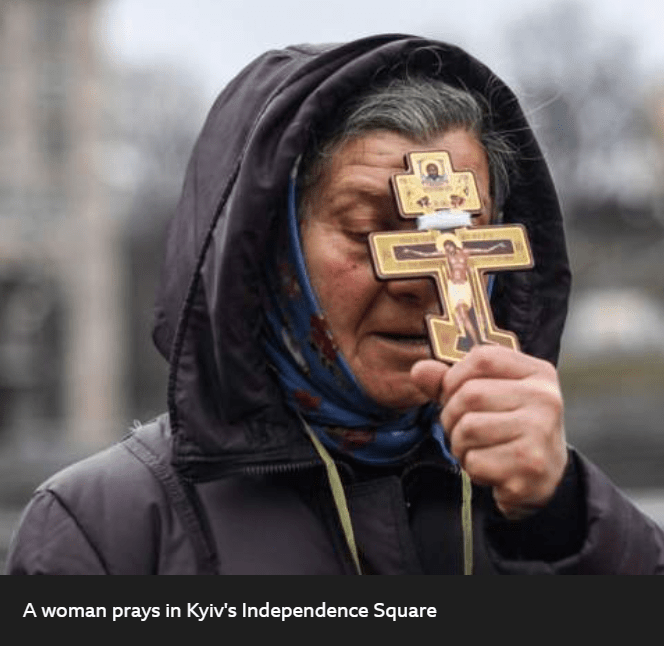
(photo source: Radio Free Europe)

Our Common Humanity

 I’ve just been telephoned by my friend Andris who lives with his family in Riga, the capital of Latvia. ). He told me of his anxiety about the situation in Ukraine.

What is happening there may well have implications for the three Baltic States of Latvia, Lithuania and Estonia. In comparison to Ukraine they are small countries and therefore, possibly more vulnerable. They are however,  part of the EU which gives them added support and a sense of belonging to something which brings its own strength. They are also members of NATO which affords them some protection. However, Andris was still worried about what Putin will do after Ukraine and about the way he is destabilising the region.

So, alongside prayer for Ukraine (and Russia – especially those opposed to Putin), prayer for the Baltic countries and Poland is vital at this time.

As I listened to Andris It occurred to me that I will not be praying for a country but for a people.
For me, Latvia is Andris and his wife, 3 daughters and his mother. They are people I know and  have shared hospitality with here in England. Andris works in Healthcare and a few years ago he spent some time with the NHS in our area. He worshipped with us and prayed with us. Over time I have got to know his family. They are real people. They lead good and quiet lives. They do not wage war on anyone.

I do not know anyone at present in the Ukraine, though I have known people previously. I do know people from Poland, the Czech Republic and other East European countries.
Many of us have links with people in other countries throughout the world, including some of our own families.

They are people, human beings like us. We share with them the time we are on Planet Earth. It doesn’t belong to any one of us and any rights we might have are ’common’ rights; ’allowed rights’. We are custodians of the earth and, other tenants in the Natural world of animals and fish and birds of the air, look to us for care of creation and not exploitation.

When we pray we hold all this fragility and vulnerability up to our Loving God, our Creator, Redeemer, Sustainer.

So for me therefore, Latvia is not just a land mass but a place where people I know and love, live.

That is true for many of us. So whatever the conflict in the Ukraine will ultimately teach us, we can learn an important lesson straight away. Hold people and their countries in your love. And please remember that even if you don’t know anyone in The Ukraine, you do know that they are fellow humans with you and you are related to them in a common humanity under the care and love of God.

[Mr G]

The International Prayer for Peace,.

Lead us from death to life,
from falsehood to truth.
Lead us from despair to hope,
from fear to trust.
Lead us from hate to love,
from war to peace,
Let peace fill our hearts,
our world, our universe.
Let us dream together, pray together, work together
to build one world of peace and justice for all.


We pray this in your Name, Lord God.

Pray for Ukraine

May God’s Divine Spirit look after the people of Ukraine during these trying times. We pray that a peaceful resolution be achieved for them and their nation.

Conference of European Churches General Secretary Dr Jørgen Skov Sørensen, on behalf of CEC Member Churches, offers a prayer for peace in Ukraine amid recently escalating tension in the country.

“The role of churches is to offer hope. Prayer offers hope. Therefore, we pray for peace in Ukraine, thinking of all communities, who can directly get affected by the armed conflict,” he said.  

Lord God,
We ask you to hold the people of Ukraine deep in your heart.
Protect them, we pray;
from violence,
from political gamesmanship,
from being used and abused.
Give, we pray,
the nations of the world the courage
and the wisdom
to stand up for justice
and the courage too,
to dare to care – generously.
Lord in your mercy,
Take from us all,
the tendencies in us
that seek to lord it over others:
take from us those traits
that see us pursuing our own needs and wants
before those of others.
Teach us how to live in love
and dignity
and respect – following your example.
In your name, Lord Jesus, and for your sake,
Amen

 prayer, Ukraine

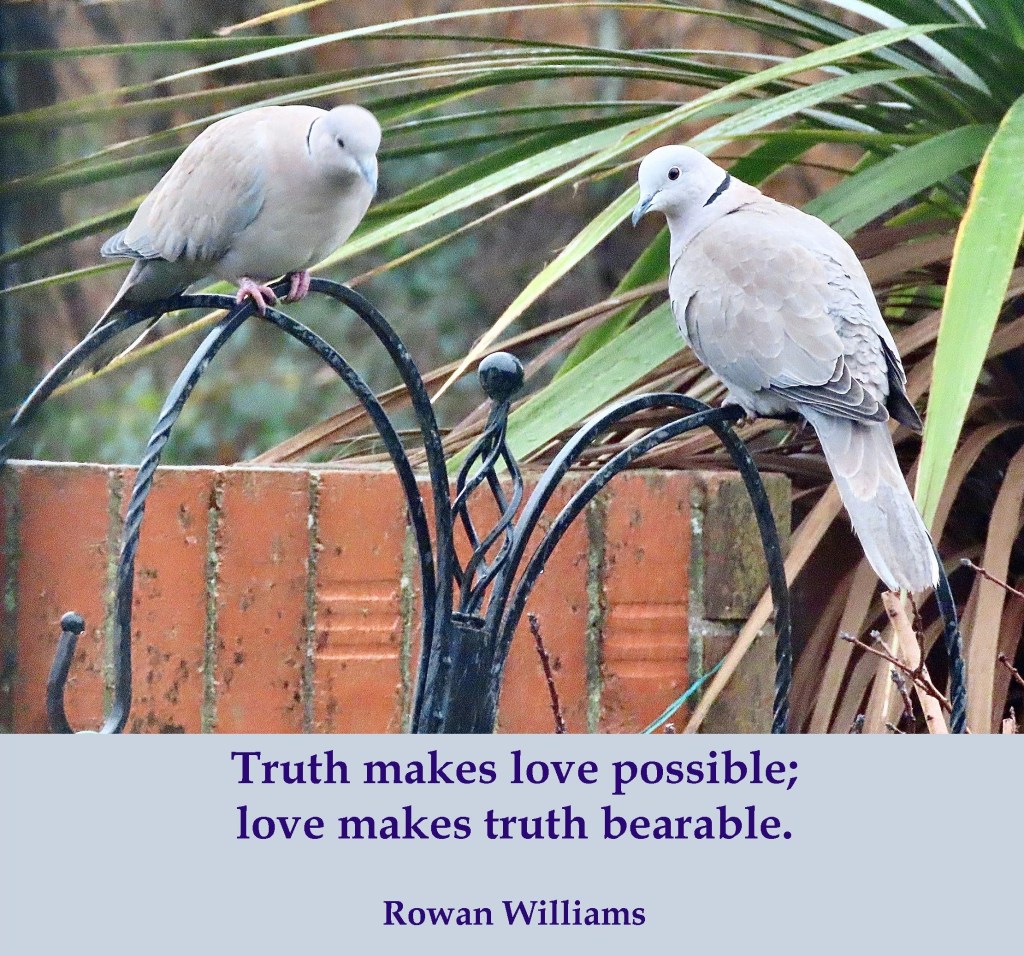
Delightful Collared Doves

Delightful Collared Doves. A photo tweet sent to me recently by my friend, Joyce Smith.

Collared doves can be seen just about anywhere, but often around towns and villages. They’re common visitors to gardens. But collared doves only came to the UK in the 1950s, after a rapid spread across Europe from the Middle East          [RSPB]

The Eurasian Collared Dove first bred in England in the 1950’s, in Norfolk.
Because their young like to wander, they could soon be found in more widespread places. It is said that they can travel over 600km from where they were born.

One lovely fact about them is that they are monogamous. Barring accident they keep their partner for life. They also share in bringing up their young equally so they are an example of real partnership.

The Dove, of course, has a deep spiritual meaning and in Christianity is a symbol of the Holy Spirit, the third person of the Holy Trinity.
In the Old Testament, it was the Dove sent out across the waters by Noah which returned with the Olive Branch as a sign of God’s forgiveness and love.
We use the phrase ‘holding out an olive branch’ whenever we seek reconciliation between people and nations who are at loggerheads with each other.
As a result the Dove has come to be known for its gentleness but it has a reputation for being tough and often seen in places of danger and where human striving is failing. The Dove is a much loved symbol of Peace.

It is also a symbol of love, which makes the quotation, chosen by Joyce, from Rowan Williams (former Archbishop of Canterbury) very apt.
For me, it is the partnership of collared doves which speak particularly of relationship and commitment and sharing together which are symbols of love.
Rowan Williams speaks of ‘truth making love possible and Love making truth bearable.  Rowan always puts things beautifully but also in a way that makes us ponder the depth of meaning. So to help me work out what he is saying, I turn to the image of the little Collared Doves. They are true to each other and they are together in a relationship which feels like love to me. That is what sustains them and should sustain us.
In a world of shifting relationships between people but also nations and within nations, where truth and love seem to be trivialized and discarded, the collared doves may well remind us of the vitality of truth and love, of comittment and the joy of friendship which makes our lives so rich. We have to work at it!

Where chaos longs to reign,
Descend, O Holy Dove,
and free us all to work again
the miracles of love. Amen

[Mr.G]

CAEDMON, herder of cows and stirrer of souls

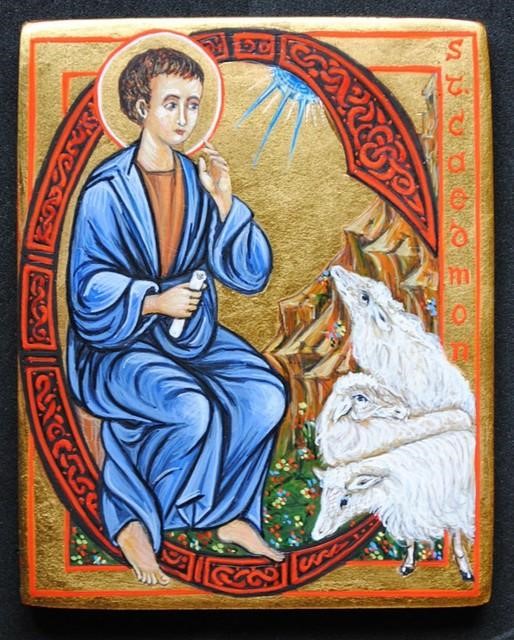
Icon of Caedmon as used by Juan Alejandro Forrest de Sloper on his Book of Days site

CAEDMON, herder of cows and stirrer of souls

I cannot speak, unless You loose my tongue;
I only stammer, and I speak uncertainly;
but if You touch my mouth, my Lord,
then I will sing the story of Your wonders!

(Words from the Northumbrian Community)

Today (February 11th) we remember Caedmon of Whitby.

He was encouraged in faith by St. Hilda (Hild) who,whilst she was a player on the big stage of England of its time, was also a discerner of almost unknown individuals. She was to them an encourager and one who awakened and nourished the gifts of God in others. This was especially true of Caedmon.

We owe the story to the Venerable Bede, the monk of Jarrow .

Caedmon, according to Bede, was an illiterate cowherd at Hild’s Abbey in Whitby. Beyond tending the cows he  thought that he had little to offer and when those who farmed beside him would gather for an early form of Karaoke, taking turns to perform songs and poetry, Caedmon would often find an excuse to absent himself. One night, as he slipped away to be with his cows instead, he fell asleep in the cowshed. During his sleep he dreamt of a mysterious stranger who urged him to sing a song about the Creation of the world.

At first Caedmon resisted but the man in the vision persuaded him and Caedmon sang praise to God.

When he awoke  he remembered his dream and told the steward. Immediately he was taken to the Abbey and Hild. She recognized that God had worked a special miracle in Caedmon. She was entranced by his singing not least because he had, hitherto, led a life in which no poetry had a part.

Hild knew that she must encourage the gift shown to him.

She called scholars and learned men to meet with him and to them he explained his dream. They then opened to him a piece of Scripture and invited him to turn it into a poem. Next morning he returned and sang a poem which captured the bible passage in verse.

Hild was thrilled and persuaded him to become a monk at the Abbey where he soon became a companion of the others. He was instructed in the bible, sacred history and tales. Like a cow chewing its cud, Caedmon ruminated and turned what he learned into beautiful music and song. The book of Genesis and the flight of God’s people from Egypt to the promised land were followed by other Old Testament tales leading to songs of Christ’s Incarnation, His Passion and Ascension.

So, Caedmon enlightened people with the Holy Word of God and enriched others not only by his compositions but also by the beauty with which he sang.

He became the first English Poet and his extraordinary story became a reminder that God often takes what seems ordinary and makes it extraordinary – or rather takes ordinary people and reveals in them (in us) extraordinary gifts. All it took was a visitation from God and a Holy woman who knew that God was up to something and encouraged the development of a vocation and of a soul who enriched the church.

Though little remains of Caedmon’s poetry, most of it being oral, we have a few lines, thanks to Bede but also he began a poetic tradition which others took on board and developed. His poetry and singing was destined to lead to  the growth of a deep and lasting Anglo-Saxon / Old English poetic tradition.

Caedmon’s poem

Now we must honour the guardian of heaven
the might of the architect and his purpose,
the work of the father of glory as he, the eternal Lord,
established the beginning of wonders.
He first created for the children of men
heaven as a roof, the holy creator.
Then the guardian of mankind, the eternal Lord,
afterwards appointed the middle earth,
the lands of men, the Lord Almighty

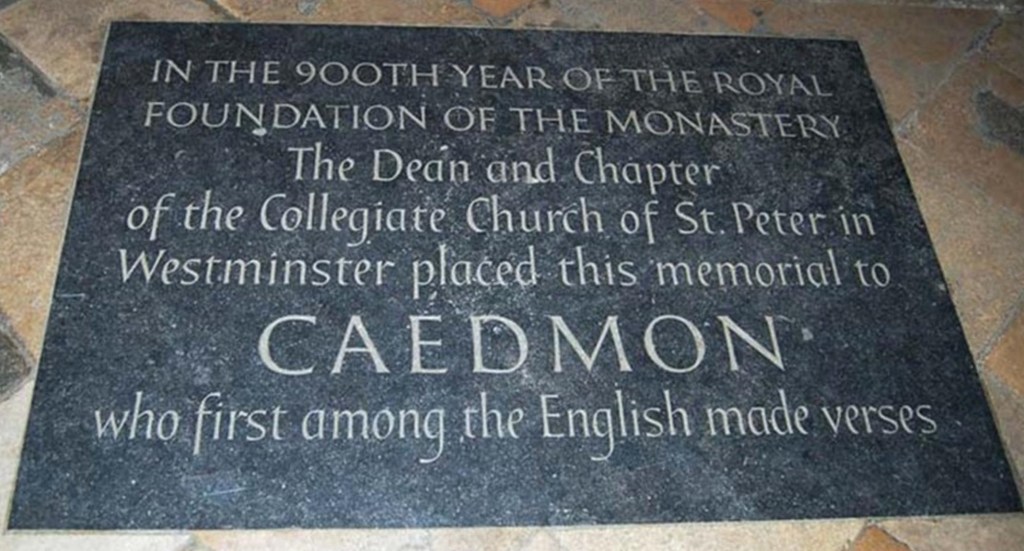
Caedmon’s memorial in Westminster Abbey