Category: Uncategorized

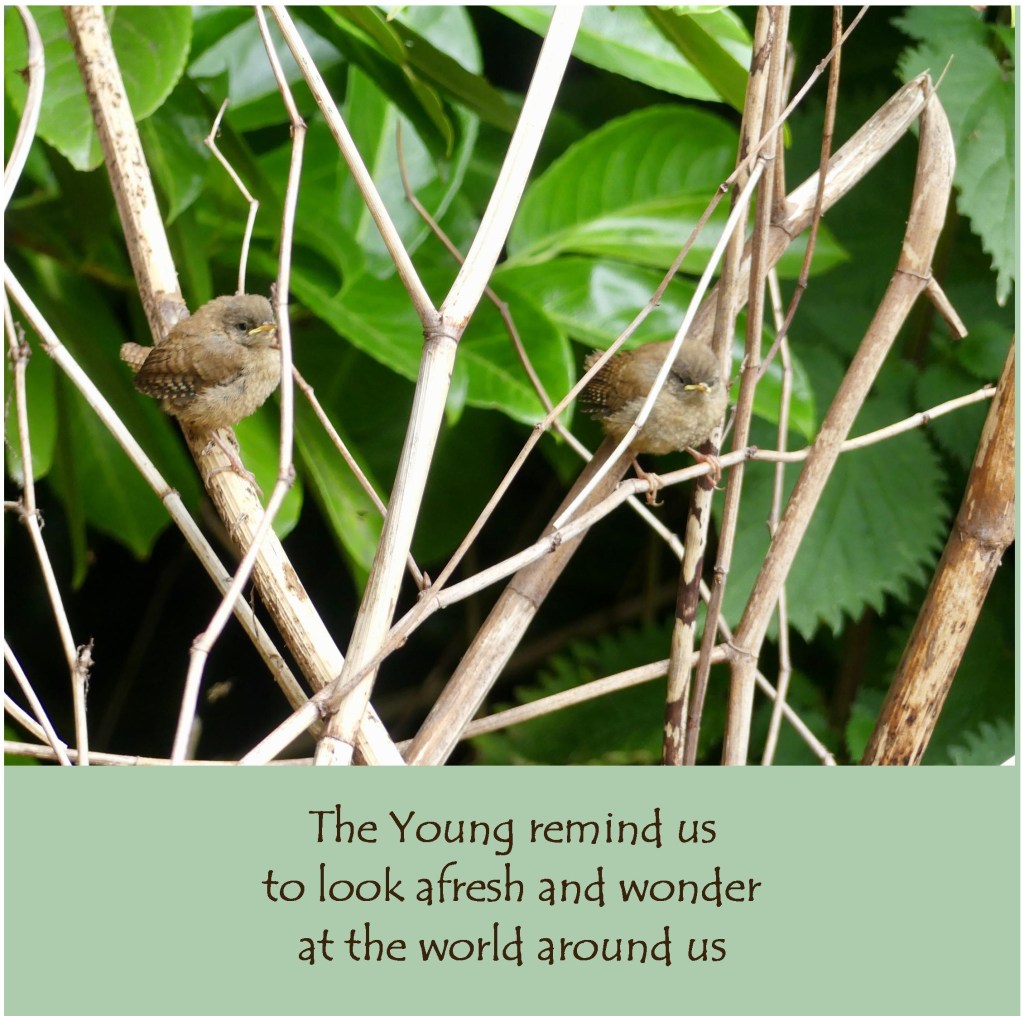
Looking afresh at the world

newly fledged wrens at a small reserve in Scarborough! Photographed by Joyce Smith

My friend Joyce has sent me her latest Tweet.

These baby Wrens are signs to us of the joy of Creation.

They demonstrate to us that God is constantly renewing the earth despite all that we are doing to destroy it. As we continue to exploit the planet and refuse to heed all the warnings, which may well include mysterious diseases like Covid, one dominant and deeply self-centred species which has, supposedly, intelligence, fails to use the gifts and exercise stewardship responsibly. Ironically our actions demonstrate how extremely stupid we are!

So to be remind that there is an alternative, more innocent vision of creation is also to be given an invitation to see our world with new and more responsible eyes.

We are invited to see things with joy, exuberance, and vision.  We are being invited to be re-born as little children (or in a way, as new born fledgling birds). We are being encouraged to fill our lives with hope, wonder and awe.

 Jesus had a view that this requires humility and simplicity and thanksgiving. So, for example in Matthew 18 2-4 he said this:

Jesus called a child, whom he put among them, and said, ‘Truly I tell you, unless you change and become like children, you will never enter the kingdom of heaven. Whoever becomes humble like this child is the greatest in the kingdom of heaven

Why we need to re-think this is caught up in a saying from the book, The Little Prince:
All grown-ups were once children … but only a few remember it!

We need the kind of vision which believes that, with determination, we can see bigger and better and more amazing things in a world which belongs equally to all, because if we don’t then Jesus’ words will show us that we are going about things the wrong way.

A boy was once drawing a picture. He was transfixed with concentration as he worked carefully and with determination.

His father asked him what he was drawing.

“A picture of God”, the boy replied.

“But nobody knows what God looks like” said his father.

“They will soon” replied the boy, “I’ve nearly finished.”

The little wrens are a picture of God’s making. They reflect God so we can see a little bit more what God is like. They are drawing us a picture!
Maybe we can be encouraged to  find a way of showing a bit more of God in us, so that we reflect his glory and beauty a little better.


Farmer’s son reaps a great harvest

Statue of the Curé d’Ars photographed in Falaise by Mr G.

A Faithful Priest

The  Curé d’Ars feast day 4th August

One of my most treasured possessions is a plain plaster statue of a French parish priest known universally as the Curé d’Ars —so named because for over 40 years he served the parish of Ars-en-Dombes in France. 
John-Marie Baptiste Vianney (whose feast day is today) was brought up in a peasant farming family near Lyons. He was born in 1786 and as a child of farmers he was given very little formal education.  Yet, by the time he was 20 he had heard God’s call to ordination and had begun to study for the priesthood. He found study very hard and on more than one occasion his superiors thought to end his time in the seminary. However, they noted his devotion to God and a quality of holiness which far outweighed academic ability. They saw a young man whose heart God had touched.

He was ordained and after a curacy he was appointed the Parish Priest of a backwater village—Ars. He went there in 1818 and remained until his death in 1859 on August 4th.  Very quickly he gained a reputation for being a preacher and people began to flock to hear him. At the same time he became known as a priest who could give wise and gentle counsel to souls in distress. Very soon people began to consult him and to bare their souls to him. The trickle of people became a stream and then a torrent. Countless numbers of people would come to see him.  Each day, after his own time of personal prayer and devotion, he would preach a sermon daily at 11am and then spend many hours  hearing confessions and giving spiritual direction. He was often moved to tears by the things people told him and he brought to them the comfort born out of someone who understood human weakness and the power of God’s love.

As time went on he was offered more important jobs in the Church and he also struggled with a call to the monastic life but he stayed put and in so doing put the little village of Ars on the map—not only in his own day but for all time.

Not surprisingly, after his death, he was declared a Saint and he became known as the Patron Saint of parish priests. As an example of the devotion and service priests are called to emulate, this is hardly surprising. The simple statue I have, unadorned by paint, reminds me that at the heart of all service in God’s Name there must be humility.
Here’s one of my favourite sayings of his:
Speaking of the difference between private and public prayer, he said:

“Private prayer is like straw scattered here and there : if you set it on fire it makes a lot of little flames. But gather these straws into a bundle and light them and you get a mighty fire, rising like a column into the sky. Public prayer is like that.”

The Compassion of God

modern day slaves

Wilberforce and abolition of slavery

Yesterday we commemorated William Wilberforce, Thomas Clarkson and Olauthah Equalano, all of whom were involved in anti-slavery campaigns and social reform.

William Wilberforce’s battle to abolish slavery is well chronicled in the biography of him by William Hague. It is rather too bulky for bedtime reading. There is, however a very good film, available on DVD, called Amazing Grace.– starring Ioan Gruffodd.
It tells of Wilberforce’s battle against strong vested interests, not least within Parliament itself. Year after Year, Wilberforce presented his Bill only to be rebuffed until very near to his death when he finally succeeded. By then, the toll on his health was a reminder that struggle for justice can often be costly.

What comes across most strongly is that he was driven by his faith in God. This led him to have a deep compassion for his fellow-man, and particularly for those who have no one to speak for them; no one to champion their cause. This was especially true of the many, many thousands who were transported from Africa to the West Indies to become slaves living under the most appalling conditions and treated as sub-human.
Wilberforce saw that slavery was a denial of humanity – not just of human rights – but of  fundamental humanity. He believed that we are all equal in God’s sight.

Knowing nothing personally about these slaves, apart from one he met who had become free, he acted with a passion that consumed him all his life – a passion that he showed in other social areas of British life too.
He was not just consumed with passion – he was filled with com-passion.  But it was a compassion that had a double edge.

In freeing the slaves, he also freed the slave-traders who were deeply sinful in what they were doing. Even Christian people, at the time, thought that slavery was acceptable. By abolishing slavery, Wilberforce hoped to abolish ownership of slaves and so freeing those owners of a misguided and sinful way of treating others.
Despite their failure to see this, he acted, year after year, for abolition until all were free – slaves and slave-traders.

It was an iconic victory and it remains a beacon for all who in this world of ours today are striving for the same freedom for the millions who still live in slavery of many kinds. These include those who are forced to be refugees. Enslaved by despotic rulers and those who support them, they are often deprived of their freedom, livelihood, homes. They are oppressed by stress, anxiety and rejection.
Also from oppressive conditions imposed by owners of sweatshops in Far East (and recently, as we discovered in Leicester), who, in making clothes cheaply for the British market, treat their workers as slaves and with no regard for their working conditions or their safety, and paying them little.

Wilberforce’s victory is a beacon too for those who are engaged in the great struggle for equality of all people today, especially for black people but for so many others who in our world who are treated as slaves.

emblems of the Abolition Movement

Slavery comes in many forms but even those who seek to enslave others are, as Wilberforce recognized, themselves enslaved. We need to pray for them too – those who are enslaved by their homophobia, misogyny, prejudice, bullying of others, racial intolerance, behave unjustly towards others, to name but a few!

All perpetrators of hate against others need our prayers. They need to face up to the darkness within which creates their enslavement and be led to repentance so that love and healing can grow within them.All things can be cured by God’s compassionate Grace.

Wilberforce achieved a great thing and it converted lives.

People like John Newton, a former slave ship captain who, sick in his soul, turned away from his vile trade and embraced God and became a minister in God’s Church, recognized the power of this grace in the wonderful hymn  – Amazing Grace.
A contemporary of William Wilberforce he wrote from his own personal experience of God’s compassion, grace and mercy which he found in Jesus.

But we are all too aware that what Wilberforce began, we must continue until all are free and all are equal.

Against all this, Jesus stands as our compassionate God who knows and loves each of us which is why He confronts everything that enslaves us; all the things that prevent the love of God working in our lives and which stops Grace from transforming us. He especially does this on the Cross where he confronts evil finally and destroys it with Love.

The Cross is the ultimate statement of God that His compassion for us is eternal.
He would love it if we too showed compassion and thirst for justice for others, as Wilberforce did.

[Mr. G]

Sanctuary in the midst of storm

My friend Joyce Smith has recently returned from the Northumberland Coast where she visited her beloved Puffins.

She sent me this evocative photo and caption

The photo and caption first made me think of Elijah hiding in the cave as the Lord passes by but the Puffin is sheltering from a storm at sea, so my thoughts turned to the Gospel  where in Mark 4 we read of Jesus stilling the storm.

Many will  know the story. Jesus was in the boat with his disciples and a great storm arose. As the waves beat into the boat the disciples began to panic—even those who were fishermen who were surely used to rough seas.  Jesus was oblivious to it all as he quietly slept in the stern of the boat.  The frantic disciples woke him up and shouted, “Teacher, do you not care that we are perishing!”

Rubbing the sleep from his eyes, Jesus turned towards the raging sea and said, “Peace! Be still!”  A sudden calm descended.

Jesus turned to his friends and said, “Why are you afraid?  Have you still no faith?”

The poor disciples had got it wrong again.  Incredibly, they went on to ask who he was, that even the wind and sea obey him.  Didn’t they know who he was?  Who did they think they were following?  Well, it’s an easy question for us to ask because we know, don’t we, just who Jesus is?  We know too that he has power to still the storm because he is Lord not just of humanity but of all Creation.  But if we were in the disciples place might we too have panicked? I suppose it partly depends on what sort of sailor we are. Or how strong our trust and faith in God is.

There are all sorts of storms in our life and some of the things that happen to us, and to those we love, can overwhelm us. That has been especially true over the past year or so. There are times when we are up against it and we just give in to despair or depression.  It’s at such times that we have to look for the Jesus in our midst—the Jesus who is constantly with us.  The Jesus who, when the going gets tough, simply holds us—be still!  be at peace!  Think of that famous story called ‘Footsteps’ – the one with the two sets of prints in the sand most of the time and then just the single set.  When the writer of the story accuses Jesus of abandoning him, Jesus simply replies that there is only one set of prints because that’s when Jesus carried him.  What we are going through may not magically go away though perhaps that’s what we expect should happen if we think about the storm at sea.  What really happens is that when life is hard for us, it is Jesus who holds us, carries us through, stills the storm within us and breathes his peace upon us. God never leaves us. But we do have to have faith to know that.

[Joyce & Mr G]