Category: Uncategorized

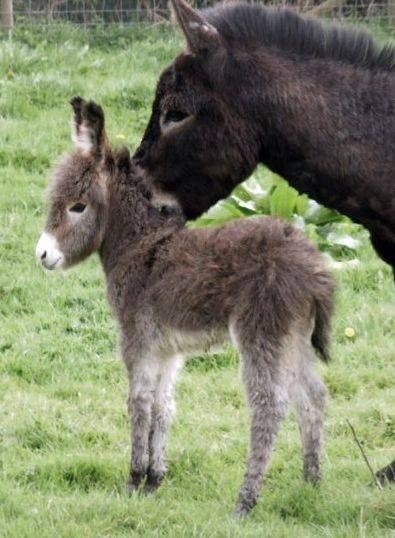
Benji, the Palm Sunday donkey.

The Story Of The Palm Sunday Donkey by Joyce Smith

Two years ago, my friend Joyce wrote a little story about the Palm Sunday Donkey. It was specifically for the children of Ninefields Church of England School, near Waltham Abbey in Essex. Each child got a printed copy as a gift from Joyce. One or two others of us also got one. With Joyce’s permission, I was able to Blog it as an entry for March 28th 2021. Last year, sadly Joyce died unexpectedly and though some will have read the story, I want to share it again with you, so here it is. I hope you will spare a thought or pray a prayer for a delightful person who understood more than most, what it means to be child-like.

[Mr G]

It promised to be a hot and sunny day as the early morning sunlight played on the little donkey’s face. Benji lazily opened first one eye and then the other, but although the sunshine was warm on his face, he shivered a little and huddled closer to his mother.  It was, after all, only yesterday that he had seen the old donkey who lived along the road being cruelly beaten by his master.
Benji’s mother gently nuzzled her son’s face and slowly licked one long ear followed by the other. Then, at the sound of their master’s voice, they trotted over to the edge of their field and had a long drink from the bucket of water he had brought for them, before turning to munch the hay which was piled up in the corner.

Even though their master was a kind man, Benji was still very frightened of the world outside his field and the scar on his mother’s back would always remind him of how cruel some people could be even to a donkey who had done nothing wrong. Sometimes, as Benji watched his mother carrying a person down the hill to the big city of Jerusalem, he could almost feel the pain of her scar and he longed to do something to help her. But the trouble was, whenever anybody asked for a ride on Benji, he was so frightened that he would begin to shake all over and no one wanted to ride him when he was like that. And so, in his short life, nobody had ever ridden on Benji’s back. But perhaps, just perhaps, today would be different……….

When Benji and his mother had finished eating, their master returned and, as he gently tickled their ears, he began to speak softly to them:

‘There will be lots of people going down to Jerusalem today
to celebrate the Feast of the Passover’ he said ‘and I think that
someone will need you to carry him today,  Benji, so I’m going
to get you both ready and I want you to stand quietly for me by
the house.’

Then, using a long length of rope so that the donkeys could still graze from the grass, their master tied them to the trunk of a tree and they began to wait to see who might come by.  They hadn’t been waiting long, however, when two men hurried towards the donkeys and, turning to their owner they said:

‘The Lord needs them’‘
That’s just fine’  said their master and as he untied Benji and his mother he whispered in their ears,
‘today will be your special day.’

The two men led the donkeys to the end of a dusty path and as they stood there, waiting, Benji turned his head and from where he was standing he could see right to the bottom of the big hill and all of the city of Jerusalem surrounded by big stone walls and lots of people, who looked as small as ants, hurrying around. Just then Benji’s gaze was arrested by a pile of rubbish outside the walls of the city and he began to tremble. He had often seen donkeys carrying rotting rubbish down to the tip and, sometimes, his mother told him, bad people were hung on crosses and killed there.  At that thought, Benji shook even more, but just as he was beginning to feel so weak that he thought he would fall over, he felt a hand on his head and a gentle voice saying:

‘Not today, little donkey, not today; the rubbish tip’s not for today.
Don’t be afraid little donkey, today I want you to carry me.’

Benji turned his head and found himself looking into the most understanding man’s face he had ever seen and suddenly his shaking stopped and he felt strangely calm.  Yes, he would be able to carry this man because he knew he understood and he gently nuzzled Jesus’ hand.  While his friends put their coats on Benji’s back, Jesus gently patted the scar on the older donkey’s back and this time she didn’t wince as she normally did, but she too, gently rubbed her head against him.

When they were ready, Jesus climbed on Benji’s back and began to ride down the hill towards Jerusalem.  To his surprise, with this man on his back, Benji suddenly felt quite strong and sure of himself. Somehow, being with Jesus, had taken away his scary feelings and now he really did feel that he could carry him all the way to Jerusalem. And Benji’s mother was just a few paces behind trotting along quite contentedly.
They hadn’t gone very far, however, when people started to come to the edge of the road and they began to cheer and wave palm branches as Jesus rode by on the little donkey.  People even spread their cloaks and more palm branches on the ground so that Benji had a very soft road to walk on. People then began to shout:

‘Hosanna to the Son of David!
Blessed is he who comes in the name of the Lord

Hosanna in the highest’

‘Yes, Jesus must be very special’ thought Benji, ‘ but I could have told all these people that from the moment he first spoke to me.’  And as he continued to trot down the road he, too, felt special and so happy.

But as we know, donkeys are very sensitive and after a little while, amidst all the cheering, Benji’s long ears began to pick up some whispers from people at the back of the crowd, people who said they didn’t like Jesus and even that they wanted to kill him.  When he heard this, Benji began to shake again, but the man on his back gently patted him and said again; ‘Not today little donkey, not today.’
So, reassured once more, Benji trotted on right through a gate in the wall and into the city of Jerusalem, right up to the temple.

When they arrived there, Jesus jumped off Benji’s back, ‘ thank you, little donkey’ he said, ‘now you go back home with your mother and rest – well done little donkey, well done.’
Benji was so happy, he didn’t want to leave, but after rubbing Jesus’ arm with his muzzle one more, he turned and trotted back up the hill with his mother.

When he got home, he turned his head and looked at the city of Jerusalem once more and he wondered what Jesus was doing now. Then, as his gaze again took in the rubbish tip, a big tear rolled down his face and he heard that gentle voice saying ‘not today, not today, little donkey’ and he wondered what tomorrow might bring……

This story forms part of a series of reflections written by Joyce , ‘A Journey through Lent and Holy Week.’

Copyright Joyce M Smith 2021 (but I know she wouldn’t if you wanted to sjare it with others. – Just tell them Joyce wrote it)
Living Manuscripts

A long time ago now, I picked up a copy of St. John’s Gospel which had on the cover: Remember, you may be the only copy of the Gospel someone will ever read.
There is such truth in that.
We receive the Good News of God in many ways, but we learn the story, the ‘adventure of God in Jesus’,often by being introduced to it by someone for whom the words of the Gospel have become ‘real’. As the words above suggest, we are copies of that Gospel.
The New Testament is an open-ended book. We are still writing it with our lives.

Christians are just observing, once again, Holy Week, the time when we refresh our lives with all that Jesus means to us and all the love of God he shows to us. It is also a time of re-offering our own lives back to God so that we can be used in the service of the Gospel.
In that re-offering we are, as it were, taking up our pen of faith and dipping it into the love of God.

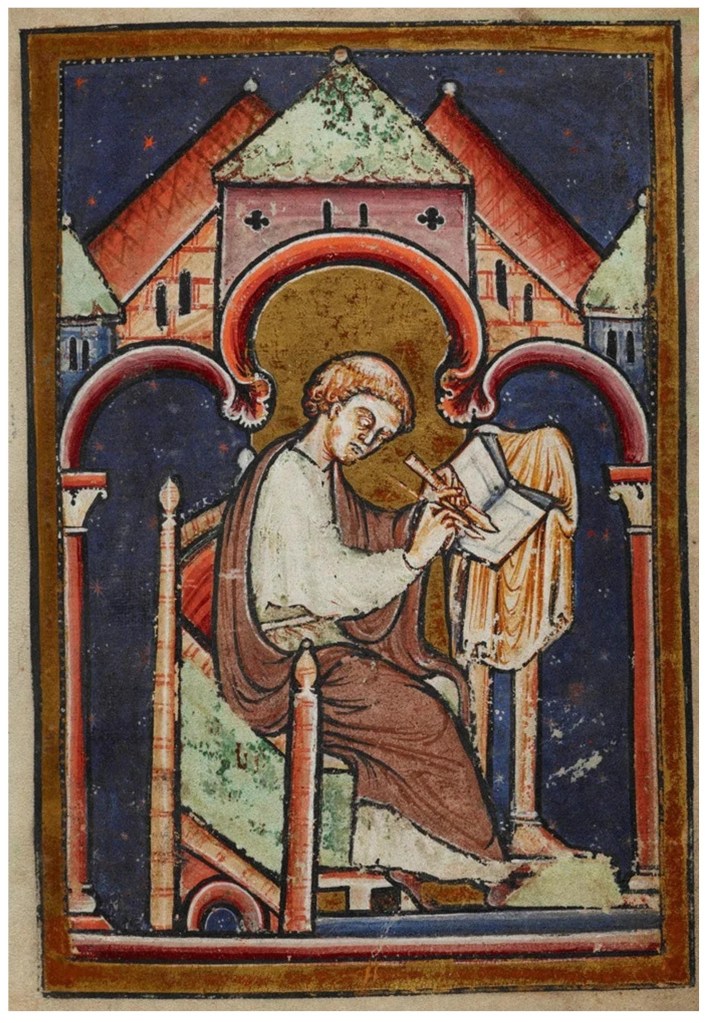
Manuscripts of the Bible, and especially the Gospel accounts were beautifully produced in the early Church. The Book of Kells in Dublin; the Gospel made at Lindisfarne and so many others are examples of how the Good News of Jesus was celebrated in written form. Missionary monks in Britain would usually travel with a copy of the Gospel. This was their preaching book. The more embellished and wonderfully decorated copies were written because of a deep love of a saint. The Lindisfarne Gospel was made in honour of St. Cuthbert. Of course, most of all, they were signs of a deep love for God, for Jesus.
As with Icon writing, (painting), they were deeply instilled with prayer.
Through prayer and skill the manuscripts became expression of the faith of those who made them.
All acts of love for God are truly genuine when we put our whole being into them.

A medieval monk preached a sermon in Durham Cathedral in which he used the tools that are needed to make a manuscript as spiritual aids to help us put ourselves into our witness to God.
This is part of what he said:

“The Parchment on which the manuscripts are written is pure conscience;  The knife that scrapes the skin making it smooth for writing is likened to the love of God, the awe with which we hold him as he, like the knife in the hand of the skilled manuscript writer, scrapes away all that is within us which turns us away from God and prevents us truly loving him.  The pumice that smoothes the skin is the discipline of heavenly desire and the chalk which whitens it signifies an unbroken meditation of holy thoughts.  The ruler for the lines of text is the will of God and the straightedge is devotion to the holy task.  The quill with its end split in two for writing represents the love of God and love of neighbour and the ink is humility itself.  The colours used by the illuminator is a reminder of God’s grace and wisdom which colours our lives. The writing desk is the tranquillity of the heart and the writing place is a contempt of worldly things as the holy work lifts us to a desire for heaven.  The model or exemplar for the work is Jesus Christ.

The monk who wrote this allegory used the everyday things needed to produce a beautiful manuscript for God’s glory as aids for his spiritual journey in copying the Gospel for others to read it.
It is a reminder to us that it is in the ordinary things that we can find God.  Teresa of Avila called this, God walking among the pots and pans.  Making connections between the ordinary things in our lives and Gods  can help us in our praying. 

This prayer written by a lady on a Celtic Retreat I led, makes this connection between the material and spiritual:
 
Vellum, parchment, stone, wood and skin
all marked by the writer to convey the word of God.
Yet God, in mystery, appears to fleshly hearts, made pure,
writing upon these the very word of God,

that they can be read of human –
true icons of Christ.
The Word, made flesh, dwells with us.

The Christian Holy Week pilgrimage brings us closer to the love God shows us through Jesus.
As we pray through our journey we are being invited by God to become living Manuscripts of His love for the World.
It certainly needs to read it.

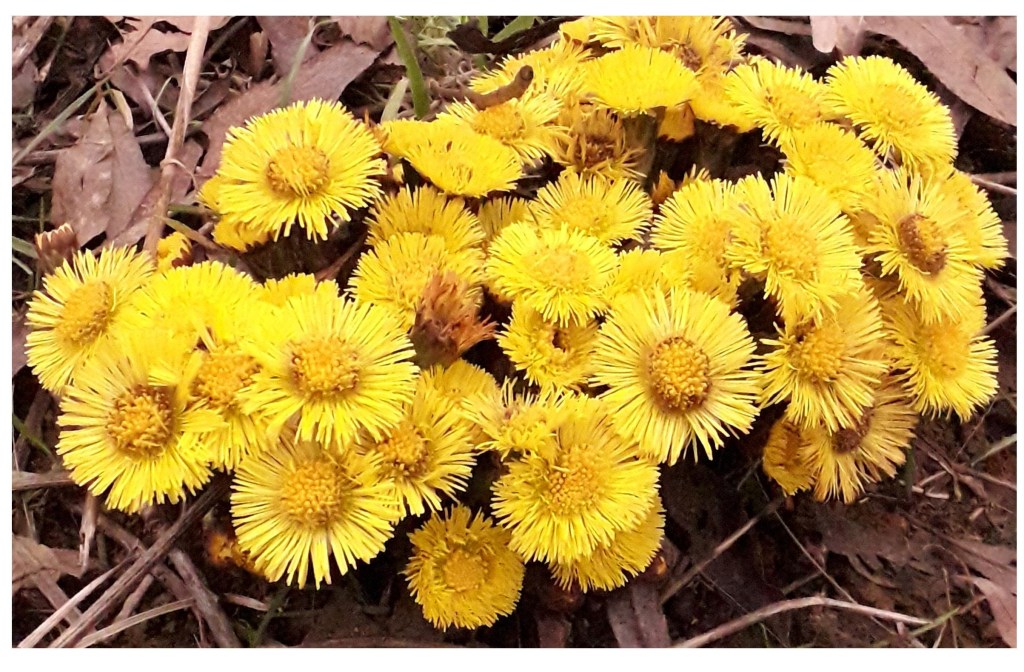
Simple Coltsfoot touching the soul

(Photo. Coltsfoot at Newhall. Mr G)

Reminder of Coltsfoot

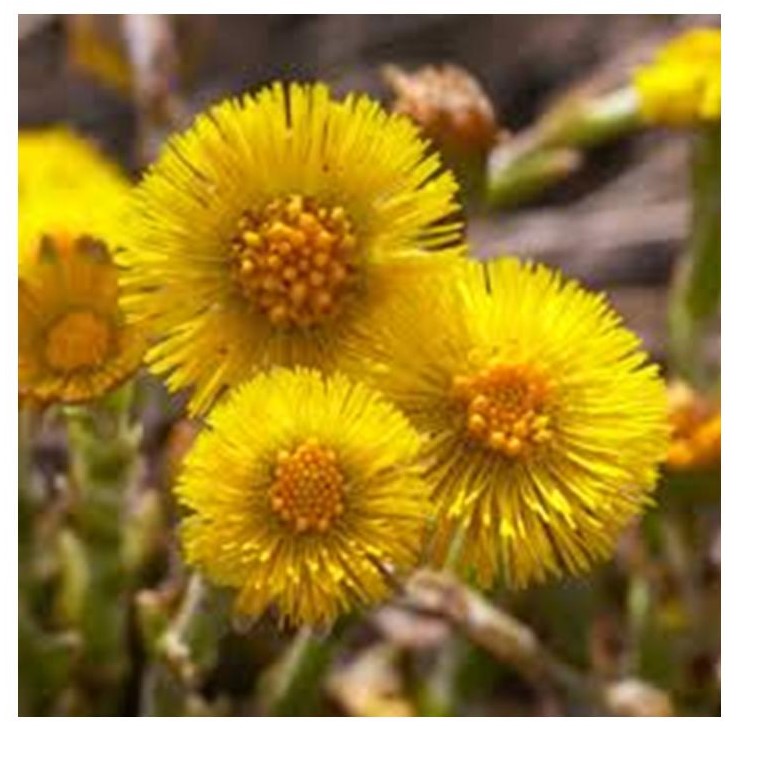
The other day walking around the pond in woodland near my home, I was attracted by a clump of yellow, hugging the ground.Early flowering spring, the Coltsfoot.
Immediately I was taken back to the time of boyhood.

Life in the austere aftermath of World War II was far from easy.
In the Industrial North of England, children had few toys of their own though they shared what they had with others. We also had places for play including a side street containing 3 terraced houses where the occupants acted as street wardens. Cars rarely ever came along this street. It was the play street for children. Here we held our running  and skipping and jumping games. Footballs vied with tennis balls. We made makeshift go-carts out of old pram axels and rope, using wooden fruit boxes for the cart body. We staged plays and shows and entertained the adults who kept watch of us. It was often a joyful and very noisy place!

Nearby, the old Ruby Mill provided the best Adventure Playground you could ever find. This old cotton mill alongside its neighbour the Longfield,(always shortened to ‘Longy’) had served giant King Cotton until the decline of its production.
The mill, opened in 1889, was demolished in 1946, though had closed in 1930. All that survived where 4 concrete mounds of varying heights, which were the ‘engine beds’ from where was generated all the energy to power the mill.
By the time we children took them over they were renamed ‘Indian beds’, the perfect place to either catch Indians or lure cowboys into danger!
The way Mother Nature had taken over the ground of the former mill, we were gifted with a great area to enjoy the open air. From Spring to Autumn we hid in dens in the earth, ran hospitals to cater for budding doctors and nurses, ran buses along imaginary routes, waged war on cowboys, made camps as RedIndians, built dams so that spring water could flood the area. Occasionally we fought mock battles between the ‘Ruby gang and the ‘Longy gang’. We always made sure that our troops were far enough away to prevent real harm happening.
In a time of austerity we found amazing things with which to feed our imaginations and develop a sense of fun and working together,. We developed our social skills in a natural way. Sometimes we moved into commercial ventures!
My friend Michael and I would gather bunches of Coltsfoot and Dandelions. We would then arranged them into ‘bouquets’ wrapped in copies of the Daily Despatch newspaper and tried to sell them on the streets of our area. If it wasn’t a fruitful day we always had the fall back position of granny and various local ‘aunties and uncles’. They could be relied on to put a halfpenny or penny into our pockets.

In our adventure playground we saw so much nature taking over everything and we were introduced to wild flowers, grasses, insects and all that nature had to offer and which educated us in permanent and exciting ways.
Amongst the flowers which came to our attention were Coltsfoot.
There were lots of dandelions, buttercups, daisy and two colours of clover.
However, the little Coltsfoot was my favourite. The poem I have written below tries to say why.

When I saw that little drift of Coltsfoot, this memory came flooding back and with it, the remembrance of how, as children with little material resource, we found a wealth of gift to us on our own Ruby ground and a way of sharing it together which taught us friendship, kindness, care of others and occasionally how to have a very good ‘row’ which dealt with some of the tensions of childhood.
I was also taught that nature has so much to reveal about what I came later to know as creation and Creator God.

Finally, in the beautiful little, gloriously yellow/gold coltsfoot, I learned that in little, sometimes overlooked things, there is a joy and beauty which enriches life. The end of my poem is my comment on that.

Coltsfoot

Did you notice me
as you walked by,
a splash of yellow,
a jewel hugging the soil
brightly.
I have gnarled fingers
but not yet.
My flower needs no leafy announcement.
Yet I am not showy
like others who herald springtime.
I am not like cousin Dandelion
and share nothing with blousy,
trumpeting daffodil!
Tiny, I am easily overlooked.
But often it is simple things
which touch the soul
with colour and warmth.

[Mr G 27th March 2023]

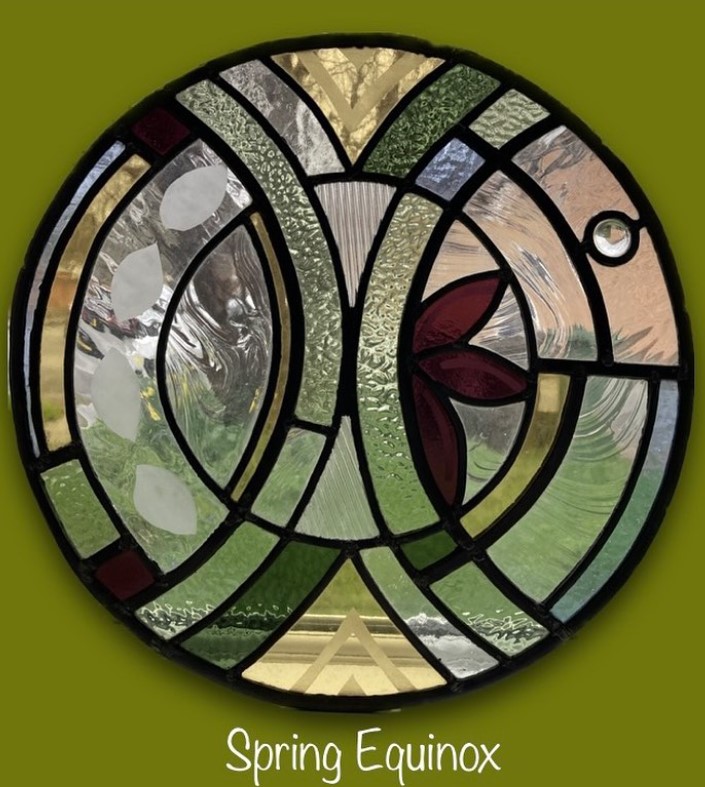
Spring Equinox

Spring Equinox. creation in glass by my artist friend, Kay Gibbons. 2023

My friend Julia has sent me the following article reflecting on yesterday’s Spring Equinox. It was written by her friend Jane Upchurch, one of a monthly series she sends out on the eve of every new moon. I am pleased to pass it on, with Jane’s permission.  For more information and further writings by her, Google her on http://janeupchurch.co.uk/category/praying-for-the-planet/

Dear friends,

Tuesday March 21st was the new moon, the time we particularly remember our beautiful planet in prayer, meditation, awareness or involvement, with love, hope and gratitude. 

This is the time of the Spring equinox.  We are moving from winter to spring, from dark to light, from cold to warmth, from bareness to the vibrant flush of spring flowers and new-born leaves.  Let us also move from anxiety and dismay at world events and the state of our planet to love and hope.  Let us sow these seeds into the thirsty soil.

Equinox

This is it, the official beginning of spring.  Oh, the long awaited date and season and sun.  The sun is white, sitting over the tops of the houses to the East, diffused through the thin cloud that heralds the start of a glorious day.   It is still cold from early evening to early morning marking the hours of the sun’s absence, but it builds to a warmth you can live in during the day.

I love this day, the changeover from winter to the early train of summer.  I love that everywhere today is the same, we all have twelve hours of day and night, equal night, equinox.  And as we sail smoothly into our opening light and new season of warmth, so the south tilts into its fall, into darkness and the call of winter.  Today is a magic day, yet most people won’t notice it save perhaps a smile at the new-found warmth of the sun.  We live on our planet like strangers, not recognising its journeys or its moods, sheltered from the weather and with a ready light to hide the dark. 

Celebrating an equinox or solstice acknowledges the birthdays of our home, enjoying the relationship we have with the earth on which we live all our days.  It is also enjoying our relationship with  the Divine, whatever that means for us, seeing God in all things – the new sun rising, the hazy air sharpening, the primroses covering the lawn in gentle yellow welcome, the quickening of spring awakening the buds, calling the call to life that echoes in our blood.

I desire to be out here today but I cannot, so can I take these elements of earth, air, fire and water and hold them in a burning cauldron safe in my heart?  Can I trust as trees do, or will I always bother and fuss before I find the path?  Is it part of the human condition, part of my makeup, a jigsaw dance between the bother and the bliss, learning to carry all the bits equally well, living in memory and faith at the same time, trusting as trees dig roots into deep soil, trying to enjoy all parts of the journey and not just the destination.  Today I have things to do that will call me away.  Today I hang my needs on the wheel of the sun and let it turn me. 

Jane Upchurch

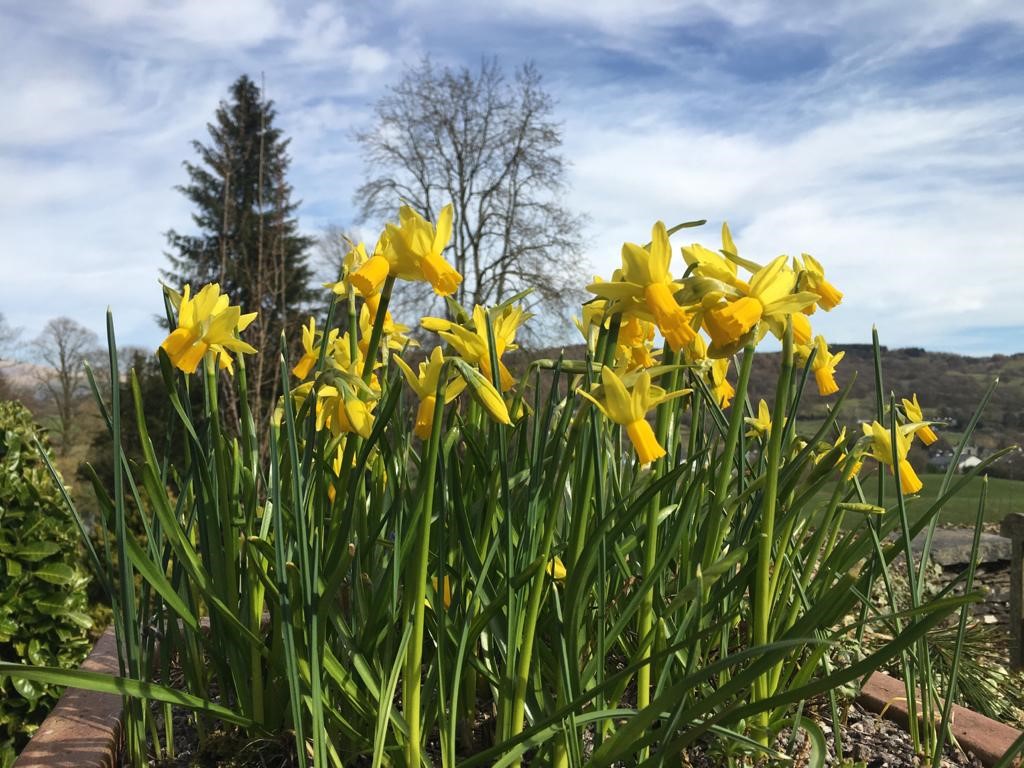
Daffodils of Spring. Photo: Gill Henwood

O GOD,

we thank you for this earth, our home;
for the wide sky and the blessed sun,
for the ocean and streams,
for the towering hills and the whispering wind,
for the trees and green grass.

We thank you for our senses by which we hear the songs of birds,
and see the splendour of fields of golden wheat,
and taste autumn’s fruit,
and rejoice in the feel of snow,
and smell the breath of spring flowers.

GRANT US a heart opened wide to all this beauty;
and save us from being so blind that we pass unseeing
when even the common thorn bush is aflame with your glory.

Amen