Category: Uncategorized

“Enlighten the darkness of my heart”

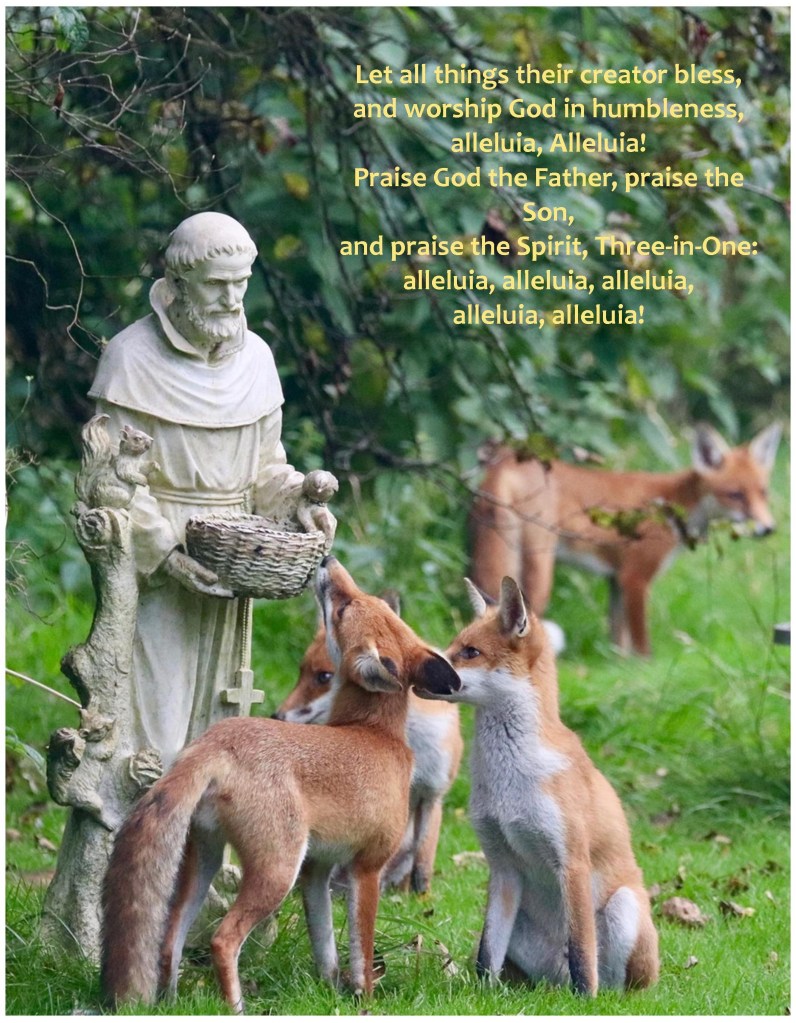
Latton foxes gather around St Francis. Photo by The Revd Lynn Hurry

When St Francis gave up his life as a kind of lad-about in Assisi – when he turned away from drinking, fighting, leading a pack of rebels, it was because he had been brought up sharp by Jesus.
Not for the first time or the last, God had visited the soul of one whose life was going in entirely the wrong direction. Francis’s soul was sick and needed healing.
So God drew him away to a derelict church of St. Damiano on the edge of Assisi. There he knelt in prayer and looked at the faded crucifix still hanging over the altar. Francis insists that the voice of Christ came to him from that crucifix, at that moment. The words he heard were: Francis, rebuild my church, which you see is falling down.
The derelict Church certainly needed repairing, just as Francis’s soul needed rebuilding. Francis was about to begin his ministry and service for God.

First, though, he had to get to know the One who called him to this service and to know the love of God flowing into him and through him to others. Francis opened his heart to God in Holy conversation.
As  he knelt in that place of meeting with Jesus, the first prayer he said was one that was to remain with him throughout the rest of his life.

The Prayer before the Crucifix

Most High, glorious God,
enlighten the darkness of my heart
and give me
true faith,
certain hope,
and perfect charity,
sense and knowledge,
Lord, that I may carry out
Your holy and true command

Another prayer is this which was to become food for his soul, in which he prays that the love of the Lord Jesus should enter his heart and absorb him with its fire and sweetness. It is known as the Absorbeat because God’s loving Spirit possesses him.

May the power of your love, Lord Christ,
fiery and sweet as honey,
so absorb our hearts
as to withdraw them from all that is under heaven.
Grant that we may be ready
to die for love of your love,
as you died for love of our love.
Amen

Francis certainly used this prayer often , and it is characteristic of his spirituality.

A simple, yet deeply profound prayer was one that he is said to have dictated as he lay dying.
It was a prayer which he had used often and wasn’t original, but it was so important to him that it was his deathbed prayer. Many will know it in some form.

We adore you, most holy Lord Jesus Christ,
here, and in all your churches throughout all the world;
and we bless you,
because, by your holy cross,
you have redeemed the world.

Francis grew quickly and deeply in love with God and this spurred on his eagerness and zeal to serve others in God’s Name.

Richard Rohr, a much loved Franciscan brother who lives in America and teaches Franciscan spirituality wrote this week that the only way we can truly know how to love God is to love what God loves. Only then do we love with divine love and allow it to flow through us.

It is not always easy to do that because such love has to be stripped of anything that  makes demands or is tinged with our desire for them to be what we want.
A Franciscan theologian, Duns Scotus, put it this way.

“we are to love things in and as themselves, to love things for what they are, not for what they do for us. That’s when we really begin to love our spouses, our children, our neighbours, and others. When we free them from our agendas, then we can truly love them without concern for what they do for us, or how they make us look, or what they can get us. We begin to love them in themselves and for themselves, as living images of God. Now that takes real work!”

Through Prayer and especially time alone with and for God, this spirituality of loving what God loves, simply because God does so, became central to St Francis’s own spirituality and way of life. It became the driving force for his work with the poor, the sick, the lepers, animals, birds and all of nature.
It was how he came to love and honour God.

So he came to Praise God  above all else.
This he expressed in another Prayer poem

Praises of God.


You alone are holy,
you who work wonders!.
You are strong, you are great,
you are the Most High,
you are the almighty King,
you, holy Father, King of heaven and earth.

Lord God: you are Three and you are One,
you are goodness, all goodness,
you are the highest Good,
Lord God, living and true.

You are love and charity, you are wisdom,
you are humility, you are patience,
you are beauty, you are sweetness,
you are safety, you are rest, you are joy,
you are our hope
and our delight,
you are justice, you are moderation
you are all our wealth
and riches overflowing.

You are beauty, you are gentleness,
you are our shelter, our guard
and our defender,
you are strength, you are refreshment,
you are our hope.
you are our faith.
you are our love,
you are our complete consolation,
you are our life everlasting,
great and wonderful Lord,
all powerful God, merciful Saviour!

Amen.

Of course, we are probably all familiar with the poem/song  Make me a channel of your peace. It is known as the Prayer of St. Francis but it was not written by him. Indeed in was probably written in the 1920’s but who could read, pray or sing it, without acknowledging that it is marinated in St. Francis’s own spirituality.

There is so much in his sayings, these prayers, and canticles I haven’t referred to, but if we are to understand the witness and service of St. Francis, these prayers above are a good place to start.
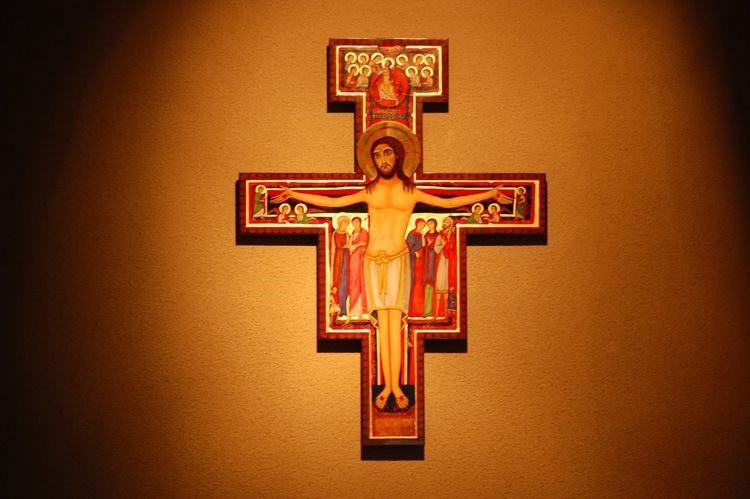
The San Damiano Cross from Fr. Michael Scanlan

[Mr G]

Mellow Fruitfulness

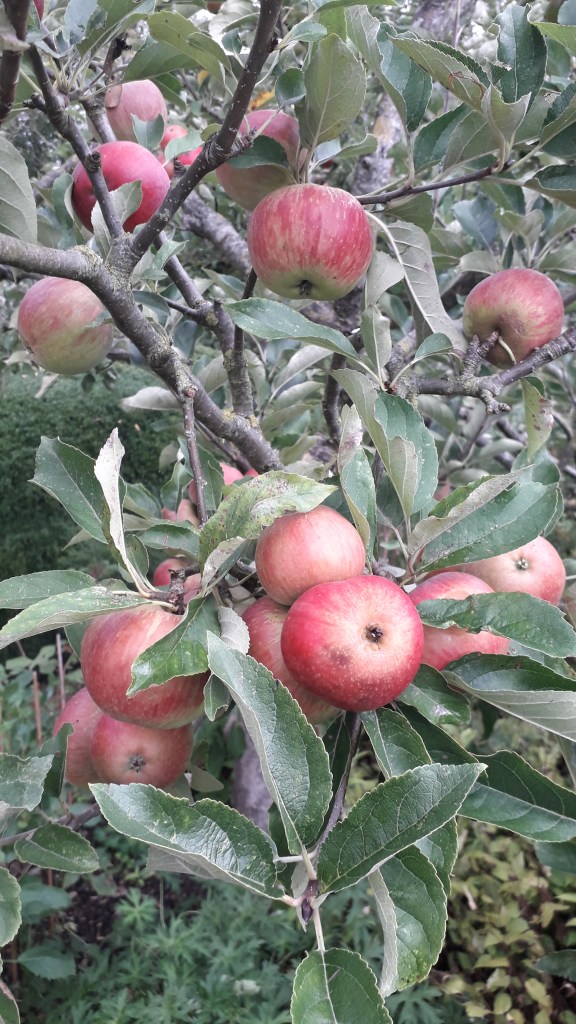
{Autumn apples at Charleston. photograph Mr. G}

On the last day of September, some thoughts naturally turn to Autumn. This was true this morning as I took a companion to the local railway station. As tends to happen on such occasions, this led to poetry!

Of all the poems about Autumn, the one most well known is probably Ode to Autumn, beginning with the words, Season of mists  and mellow fruitfulness …
It was composed by the English Romantic Poet, John Keats, in 1819 and published first in 1820.
Many can quote the beginning and others know it by heart. Some may know snatches and others simply are just aware of it. For some it may be time to remake its acquaintance!
This beginning of Autumn could be a good time for this. It is such a beautifully descriptive poem which draws people into the depth of its richness and to a delightful meaning.
Though many have written and reflected about this, it really doesn’t need a commentary. Just a walk in the countryside, woods, park or any place where nature reveals herself.

Let the poem quietly and even thrillingly, soak into your being.
My hope is then you will come to appreciate Creation more wonderfully and, of course, that it will lead you to a more thankful blessing of your Creator God in all his loveliness and providence.

[Mr]

Season of mists and mellow fruitfulness,
    Close bosom-friend of the maturing sun;
Conspiring with him how to load and bless
    With fruit the vines that round the thatch-eves run;
To bend with apples the moss’d cottage-trees,
    And fill all fruit with ripeness to the core;
        To swell the gourd, and plump the hazel shells
    With a sweet kernel; to set budding more,
And still more, later flowers for the bees,
Until they think warm days will never cease,
        For Summer has o’er-brimm’d their clammy cells.

Who hath not seen thee oft amid thy store?
    Sometimes whoever seeks abroad may find
Thee sitting careless on a granary floor,
    Thy hair soft-lifted by the winnowing wind;
Or on a half-reap’d furrow sound asleep,
    Drows’d with the fume of poppies, while thy hook
        Spares the next swath and all its twined flowers:
And sometimes like a gleaner thou dost keep
    Steady thy laden head across a brook;
    Or by a cyder-press, with patient look,
        Thou watchest the last oozings hours by hours.

Where are the songs of Spring? Ay, where are they?
    Think not of them, thou hast thy music too,—
While barred clouds bloom the soft-dying day,
    And touch the stubble-plains with rosy hue;
Then in a wailful choir the small gnats mourn
    Among the river sallows, borne aloft
        Or sinking as the light wind lives or dies;
And full-grown lambs loud bleat from hilly bourn;
    Hedge-crickets sing; and now with treble soft
    The red-breast whistles from a garden-croft;
        And gathering swallows twitter in the skies.

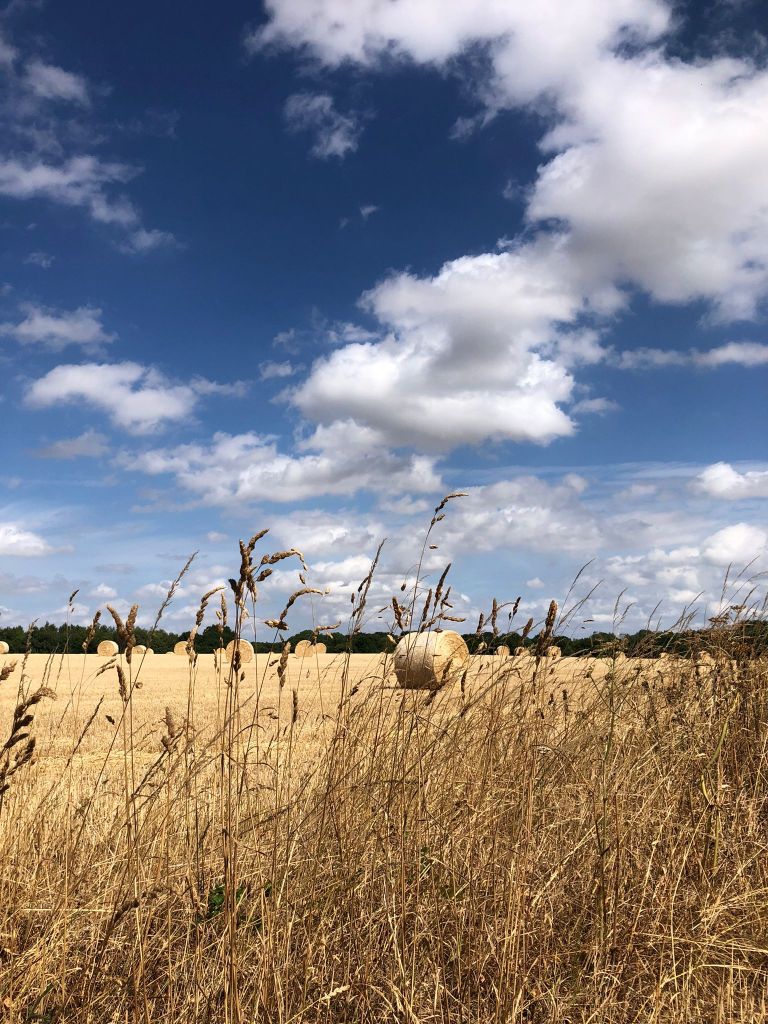
Photo: Julia Sheffield

[Mr G]

In praise of Angels

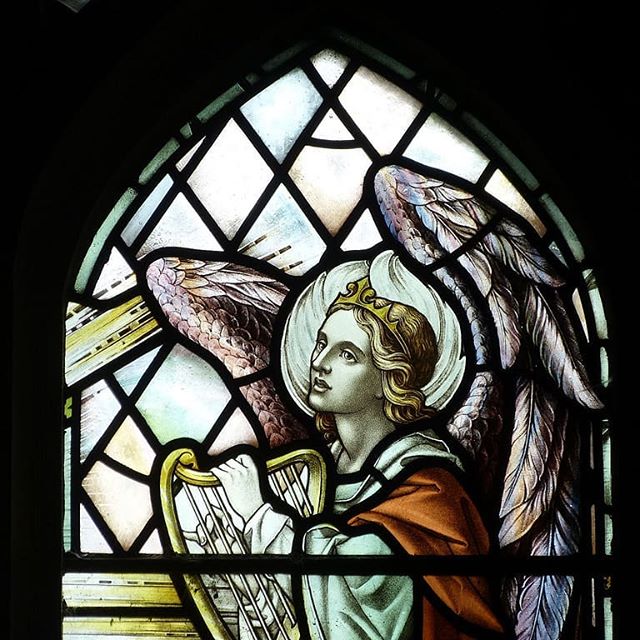
Photo detail of East Window,Parish Church of St. Eadmer, Admarsh-in-Bleasdale, Lancashire.
taken by Mr Robert Gardner, then Church warden.

In praise of Angels.

Edward King, the 19th century saintly bishop of Lincoln was described by Archbishop Cosmo Lang as the most saintly of men and the most human of saints.’  He was a man truly in touch with both God and with people.
As a bishop he continued to place great importance on visiting and one person he visited regularly was an old woman who lived in a woodland.
He also visited prisoners and he met one prisoner who told him that once he had followed the Bishop as he went to visit the old lady with the intention of robbing him. ‘But’ he said, ‘though you always went alone, on that day you had a companion with you, so I didn’t rob you.’
Bishop King shook his head. ‘I always went alone,’ he said and then he smiled. ‘Ah, that would be my guardian angel watching over me.’

We might say that is a fanciful notion because not every Christian believes in the existence of angels. (probably not a few non-Chistians either!)

Yet the Scriptures refer to angels a great deal and name four Archangels—Gabriel, Uriel, Raphael and, of course, Michael, who contended for God. In the Book of Revelation he waged war on God’s enemy, Satan and promised to guard and defend God’s creation from the wiles of the devil.
Each of these, and the others unnamed but present and active in the Bible are signs of God’s presence and activity in the World. In that sense they are God’s messengers, bringers of God’s word, God’s blessing, His healing and the carrier of our Souls back to God.

The word Angel comes from a Greek word meaning messenger and the angels do God’s bidding as his loving and loved servants, linking heaven to earth. Gabriel is, of course, the most famous messenger who came to Mary with God’s announcement that she would become Christ-bearer.

There is also a view that Angels carry back to God our prayers and so are always near to us especially during the Eucharist and other times of Worship,  when we pray, that we are linked with the whole company of heaven.“Therefore with angels and archangels and all the company of heaven, we proclaim your great and glorious name.  

If we don’t believe angels exist, I wonder what those who say the Creed at that point where we say that God is the maker of heaven and earth, of all that is, seen and unseen. This  reminds us that God creates far more than we can see on earth, and which we can see only with the eyes of faith. Like angels!

The angels are there, surrounding us, bringing God’s guidance and His interpretation.

But we can miss all that by our lack of attentiveness or our unbelief.
I think that it was  the Novelist, Patrick White, in his novel, Solid Mandela, who quoted some words by the French poet, Paul Éluard : There is another world, but it is in this one.
Sceptism and a narrowness of vision can prevented us seeing that other world which surrounds us but that doesn’t make angels less real.

At an important moment in my life, my friend & mentor, Patrick Kent, introduced me to a powerful poem that nourished and deepened my belief in angels was written by Francis Thompson, in his poem, In No Strange Land,  wrote:

O world invisible, we view thee,
O world intangible, we touch thee,
O world unknowable, we know thee,
Inapprehensible, we clutch thee!


Does the fish soar to find the ocean,
The eagle plunge to find the air–
That we ask of the stars in motion
If they have rumor of thee there?


Not where the wheeling systems darken,
And our benumbed conceiving soars!–
The drift of pinions, would we hearken,
Beats at our own clay-shuttered doors.


The angels keep their ancient places–
Turn but a stone and start a wing!
‘Tis ye, ’tis your estrangèd faces,
That miss the many-splendored thing.


But (when so sad thou canst not sadder)
Cry–and upon thy so sore loss
Shall shine the traffic of Jacob’s ladder
Pitched betwixt Heaven and Charing Cross.


Yea, in the night, my Soul, my daughter,
Cry–clinging to Heaven by the hems;
And lo, Christ walking on the water,
Not of Genesareth, but Thames!

Francis Thompson

The angels keep their ancient places;–
Turn but a stone and start a wing!
‘Tis ye, ’tis your estrangèd faces,
That miss the many-splendoured thing.

Personally, with Edward King, I am delighted to know the presence and care of the many-splendoured angels because I need all the help I can get!

Robes won by dying

Those of us who live in the Northern Hemisphere began the season of Autumn at the end of last week. The day is known as the Autumn ‘equinox’ or, more technically, the ‘astronomical equinox’

‘Equinox’ is  the day when daylight and darktime hours are equal. This happens twice a year in Spring and Autumn. The word ‘equinox’ comes from two Latin words, aequus which means, equal and nox which means night.

The initial effect is that we notice the nights are darker for longer and there is generally a drop in temperature. Nature begins to adjust accordingly. Many birds migrate whilst other birds arrive to over-winter. Many animals hibernate (just as, in this season and, in winter many of us would like to do so also!)
Biologically the pace of life slows. For some it isn’t a happy season but for others it has a magic of its own.

The countryside, forests, woods and parkland areas of towns are ablaze with colour as the leaves of the trees put on their autumn garb. They are stunning signs of summer’s end and the onset of winter as the trees  become skeletal. Not everyone enjoys this time of year. Those beautiful leaves, golden, red and bronze are fluttering to their death.

A poem, I was once given, expresses a poignancy about this process of autumnn and deepens the message.

‘When I am King
I’ll wear a robe of autumn gold
and deep blue sky
and tell my fierce red subjects ‘Hold
up your rich dying, do not die
For I’m your King.’
but they’ll reply
Such robes are only won by dying.

The poem was composed by a young man who was diagnosed with an illness for which there was no cure. It was a powerful comment on his own impending death, but not in any morbid or fatalistic way. It ends on a note of hope.
There is no way we can hold up the natural order of things as season moves into season. Nor can we hold up the process of our own dying which is as inevitable as that of the leaves falling from the trees.
But it is how we view, or bear,  this process of dying which matters.
As Christians, death should be viewed as a positive experience which ought not to frighten us.
Gilbert Shaw, an amazing guider of souls wrote:

God’s gift is death as well as birth:
No man can close the open door,
Through which the soul must pass from earth,
To meet unveiled the LOVE that waits.

The open door, through which we pass from death to life eternal where LOVE, who is God, awaits us, in Christ Jesus.
In His dying Jesus put on the robe of autumn gold that can only be won by dying. but in that dying he opened for us the way to a completeness of life that is far more glorious than we dare imagine. This is why we can face death hopefully. It is the door through which we must pass to God

At one level, the falling of the leaves is a sign of Nature’s essential renewal and there is never a complete dying. Even in Autumn, buds are forming on the tree which shed the old leaves so spectacularly.
New life is always near, which is why there is such a truth in  the poem by the young man facing his death. You cannot ‘hold up the dying’ .
The rich robes of our Lord are ready to clothe us in Resurrection light and life and love.
Autumn then, is a season of both the emptying of nature and the beginning of renewal and re-birth.

That is a truth for all who are prepared to allow God to draw our souls into the  arms of ‘the LOVE that always waits.

[Mr G]