Richard Ratcliffe with the image of his wife during his Hunger Strike of 21 days
The Bishop of Chelmsford, The Rt Revd Dr Guli Francis-Dehqani has written this prayer about the plight of Nazanin Zaghari-Ratcliffe and all being imprisoned unjustly in Iran.
It is timed to coincide with Nazanin’s husband Richard’s ending of his hunger strike outside the Foreign Office in the hope that the British Government might make a real effort to persuade the Iranian Government to free her.
Bishop Guli is an Iranian refugee who with her family had to flee from Iran at the time of the Iranian Revolution. At that time her brother was murdered. Her father was an Anglican Bishop in Iran at the time. This prayer comes, therefore, from her heart and she invites us all to pray it daily with her over the time ahead.
O God, the source of all that is good and holy, who through your Son calls the weary and heavy-laden to find comfort in your presence: look upon Nazanin, and all those who are imprisoned unjustly, with your gentle gaze; surround them and their loved ones with the assurance of your love; give them the gift of hope; and soften the hearts of the powerful, so that justice may roll down like waters and righteousness like an ever-flowing stream. In the name of Jesus Christ, the Prince of Peace. Amen.
Each Year we keep a time of special Remembrance for those who served and gave their life for their country in wars and conflicts.
This remembrance encompasses not only those who died in World War 1 and World War 2. Other wars and conflicts have claimed many more lives in Aden, Iraq, Afghanistan to name but a few. We also increasingly remember those civilians who have died fleeing from their homelands in the middle East countries such as Iran, Syria, Yemen, Lebanon and Africa. Places which today have left the rest of us with the care and safety of refugees. Every war has victims, many quite innocent like the Jewish people who suffered and died at the hands of the Nazis.
Throughout the United Kingdom and in our Commonwealth countries there is a solemn observance and a quiet thanksgiving for all who died and for those who were injured, many with life-changing injuries.
Names of the fallen are prayed in their local communities or on foreign fields away from home.
Today, as we might stand before War Graves in churchyards or in War Cemeteries, many names are just that. We know little about them. Of those who died in the First World War, the youngest graves are now 103 years old.
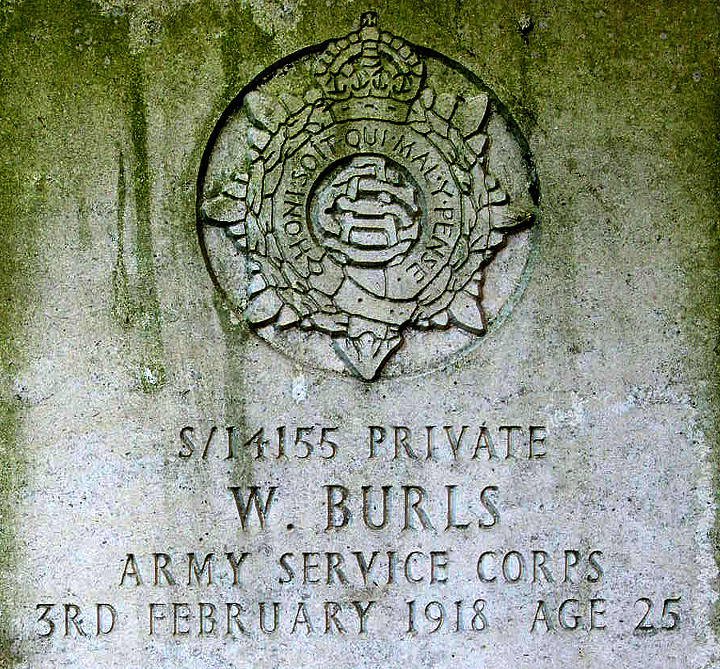
Often the Christian names are not recorded. So for them I have written this poem – inspired by the grave of Private Burls, buried in the churchyard at St. Mary-at-Latton.
A Military Man
You lie almost hidden one of Latton churchyard’s quiet secrets. You are a private, military man. One quarter of a century spans your life. We do not even know your name. The name which belongs to you alone. What did they call you Private W Burls, Died 3rd February 1918 ?
You almost escaped but your destiny was to die a military man. You have lain here for one hundred and three years and still we do not know your name, Private W Burls.
You gave your life, like so many, for the cause of peace , a peace in which you now lie. The peace of God. God knows your Name. It’s all that matters.
Rest in the Lord, Private W Burls. A military man.
Born in about 315, he was a native of Pannonia in Hungary and he began to follow the Christian faith at the age of 10. For 25 years or so he served in Roman army as his father had done before him. He was stationed in Milan and Germany. In Worms he struggled with the clash between his occupation as a soldier and his faith. He refused to fight and was imprisoned for a time. When the enemy surrendered he was released from the army.
It was around this time that probably the most famous story about him took place.
Riding into Amiens he came across a poor beggar who was almost naked, and he cut his soldier’s cloak in half in order to clothe the man. The following night he had a dream in which he saw Christ himself wrapped in half of a soldier’s cloak and saying, “Martin, a mere catechumen, covered me with his garment.”
After Baptism he spent time in Milan and then settled in Poitiers where he was influenced by St. Hilary. He then became a hermit for a time as he dedicated his life to God. He then set up a religious community in Legugé and from there moved to Tours.
He lived through a turbulent time for the Church as it overcame a number of heresies and wrestled with the most important struggle ever of the Christian Church – whether Jesus was both truly divine and truly human. It was a period when the Emperor Constantine declared Christianity to be the official Religion of the Empire. Various Councils of the Church followed and, in Martin’s lifetime that,at Nicea in 325 led to a Creed affirming our Lord’s divinity and humanity – true God and true Man. This was strengthened at the Council of Constantinople in 381AD. (The final Council on this subject was in 451AD at Chalcedon after Martin’s death)
His holiness became known and the Christians at Tours in France elected him to be their new bishop. When they went to find him he had fled into hiding because he did not believe he had the qualities and gifts to be their bishop. However, one might say that, his goose was cooked, when a gaggle of geese honked so loudly that they drew attention to his hiding place! Despite his own reservations. he became Bishop of Tours and served his Lord and the people with humility and devotion. He was especially concerned for the poor.
The Geese however were not forgotten and legends grew up about them.
Amongst several customs and practices which became associated with St. Martin’s Day the cooking and eating of a goose was, and, in many parts of Europe, still is, part of the celebration of a Saint who gave his name to a season – Martinmass. This was accompanied by Fairs, street celebrations with lighted lanterns, and the cooking of geese and sometimes ducks.Amongst several customs and practices which became associated with St. Martin’s Day the cooking and eating of a goose was, and, in many parts of Europe, still is, part of the celebration of a Saint who gave his name to a season – Martinmass. This was accompanied by Fairs, street celebrations with lighted lanterns, and the cooking of geese and sometimes ducks. It’s popularity as a season is also bound up with the final ending of the Harvest when animals were slaughtered and salted for the dark winter months ahead. In religious observance it was linked with Advent to signal a period of preparation for Christmas. So the festivities at St Martin’s tide were especially observed. A Martinmass Fair in Nottingham used to last for 8 days. It’s popularity as a season is also bound up with the final ending of the Harvest when animals were slaughtered and salted for the dark winter months ahead. In religious observance it was linked with Advent to signal a period of preparation for Christmas. So the festivities at St Martin’s tide were especially observed.
Today the feast in the UK is associated with Remembrance, being linked with the signing of the World War 1 Armistice on St Martin’s Day in 1918. It is therefore a more solemn day.
However, it is still kept in Hungary, Germany and Scandinavia, especially southern Sweden. In Britain there are a few Lantern Walks in Scotland and Wales.
Of course, there is always the Goose! There are many delicious recipes linked to this fest. In Germany, for example it is always served with braised red cabbage and bread or potato dumplings. St Martin is toasted with a glass of matured new wine which is known as ‘Martin’s glass’.
There is always plenty of Goose fat leftover for Christmas cooking.
Some may think that the poor Goose got its come uppance for revealing Martin’s hiding place but perhaps we should toast it too. After all, by honking away, it gave the church one of its most loving and holy bishops, whose heart for the poor may have made him a little surprised that his day is associated with rich food, One hopes that some portion of these meals might be given to the poor, or a monetary equivalent! Dare I even suggest that we might be kind to geese.
Photo by Piers Northam : Poppies at Newhall, Harlow.
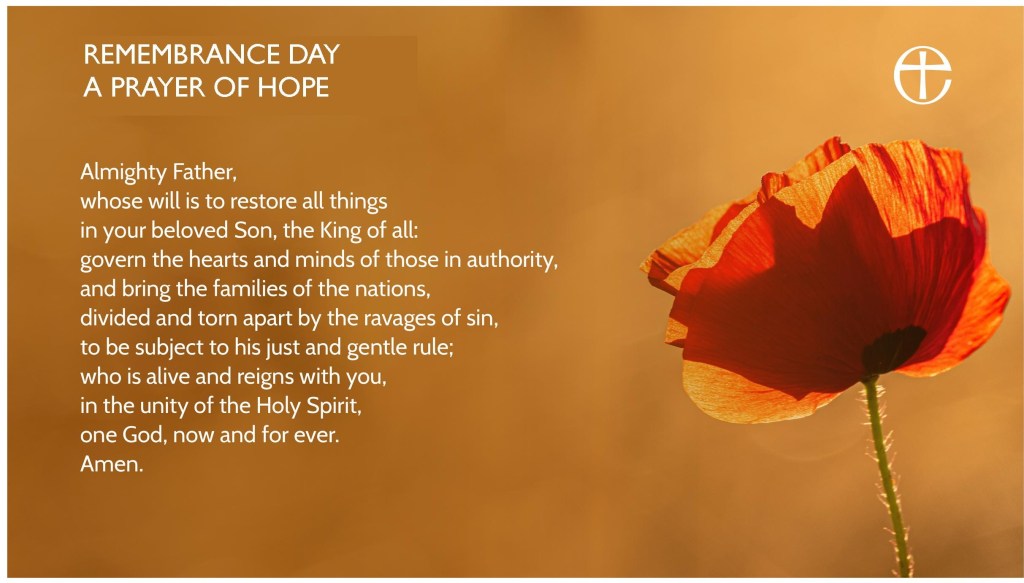
Today, Thursday November 11th is Remembrance Day. Further official commemorations will take place over the weekend. Here is a prayer from the Church of England expressing hope and trust in God.




 Mr G's Ponderings