Venerated by Angels

Durham Cathedral is one of my very special places for very personal reasons.
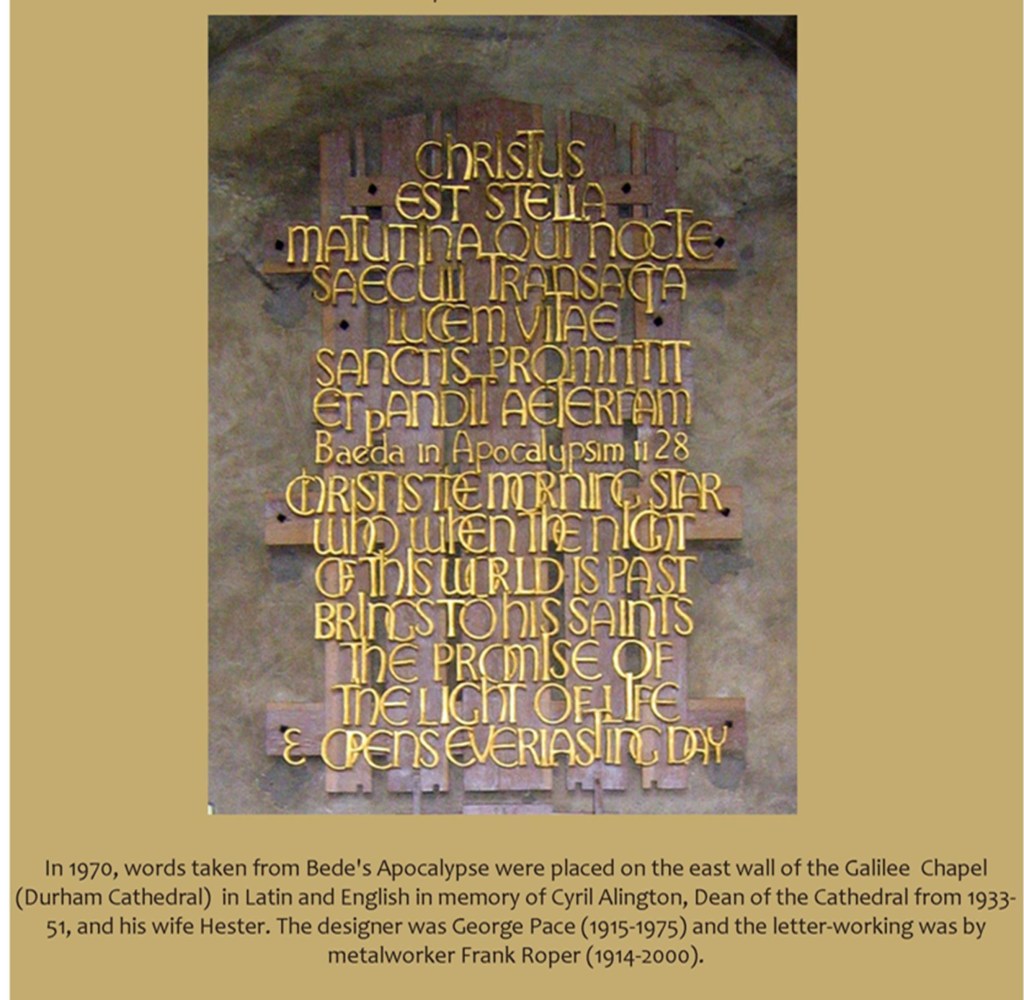
This great Northern building is especially precious to many because, without doubt, a visit can enfold you with a feeling that this is a very holy place. That may very well be because it houses the shrine of the great Northern Saint, Cuthbert and also the bones of another Northern Saint, the Venerable Bede.

Bede is most renowned for his Ecclesiastical History of the English People, a chronicle of our early history as a nation and as a church and for which he is rightly recognized as the ‘father of English History’

It is all the more remarkable because Bede never left the North East of England. When he was 7, in what is described as a free-will offering  to the church, his parents placed him in the care of the Anglo-Saxon monastery at Wearmouth near what is now Sunderland. This was in  about the year 680AD and a year later he moved to the new sister monastery at Jarrow where he stayed until his death. Here he learned and taught the scriptures and shared faith and prayer with others.

At the age of about fifty nine he said: “I have spent all my life in this monastery [of Jarrow], applying myself entirely to the study of the Scriptures; and amid the observance of the discipline of the Rule and the daily task of singing the Divine Office in the church, it has been my delight to learn or to teach or to write.”

Apart from the Ecclesiastical History, Bede also wrote the lives of various Northern Saints including Cuthbert but he was also a renowned Biblical Scholar. He wrote commentaries on many biblical books including the first Latin commentary on the Acts of the Apostles, which is still available today and which has a contemporary feel to it.

He led a quiet, devoted and happy life in which he simply obeyed God and followed what God asked of him. In that life he left a mighty legacy of learning but also the foundation of all our knowledge about the British lands, its people, its church and its faith. It was a life deeply rooted in prayer.

St.  Alcuin related that Bede used to say: “I well know that angels visit the congregations of brethren at the canonical hours. What if they should not find me there among my brethren? Will they not say, ‘Where is Bede? Why comes he not with his brethren to the prescribed hours?”

Hehas become known as Bede the Venerable  and there is a little story as to how he got this title. Late in life he is said to have become almost blind. One day some jesters came to him and said that there were some people in the church waiting to hear the word of God. In fact there was no-one there except the jesters. So, ever anxious for the salvation of others, the saint went to the church and preached, not knowing that it was empty. When he had ended his sermon, he prayed, and, instead of a human response, he received one from the angels: “Amen, very Venerable Bede”.

I do not know how much truth is in this story but it has a certain holy authenticity about it!

When Bede was dying he was working on a translation of the Gospel of John.
Bishop Joseph Barber of Durham in his famous Leaders of the Northern Church describes the scene:

A man past the middle of life lay on his deathbed, surrounded by his disciples. They were sorrowing, says a bystander who relates the incident, at the thought that they should see his face no more in this life. A youth was taking down some words from the master’s lips. ‘One chapter still remains,’ said the lad, ‘of the book which thou hast dictated; and yet it seems troublesome to thee to ask more of thee.’ ‘It is not troublesome,’ said the dying man, ‘get out thy pen and prepare, and write quickly.’ So the hours went on. At intervals he conversed with his scholars; then again he dictated. At length his amanuensis turned to him; ‘Beloved master, one sentence only remains to be written.’ ‘Good,’ he replied,’ write it.’ After a short pause the boy told him that it was written. ‘Good,’ said he, ‘it is finished; thou hast said truly.’ And in a few moments more he gave up his soul to God, with his last breath chanting the doxology, familiar to him, as to us.

Glory be to the Father and to the Son and to the Holy Ghost.

I like to think that his friends the angels awaited to take him into the joy of eternal life.

The prayer below says so much about him. It is based on one Bede wrote.

Lord God almighty,
open wide the door of my heart
and enlighten me with the grace of the Holy Spirit,
that I may seek what is pleasing to your will.
Guide my thoughts and my heart,
and lead my life in the way of your commandments,
that I may always seek to fulfil them,
and that I might be found worthy of  the eternal joys of the heavenly life;
through  Jesus Christ our Lord.
Amen.

[Mr. G]

And Sparks flew

SPARKS FLEW

We are each of us a different-sized ring,
slipped over the ring of the Spirit.
We can slide round it and, on occasion,
simultaneously touch any number of other rings.

On the first Pentecost many people
of different races and languages
touched one another in the Spirit
at this level of their being.

They understood one another;
they seemed one;

Spiritual sparks flew.

Bishop Richard Harris

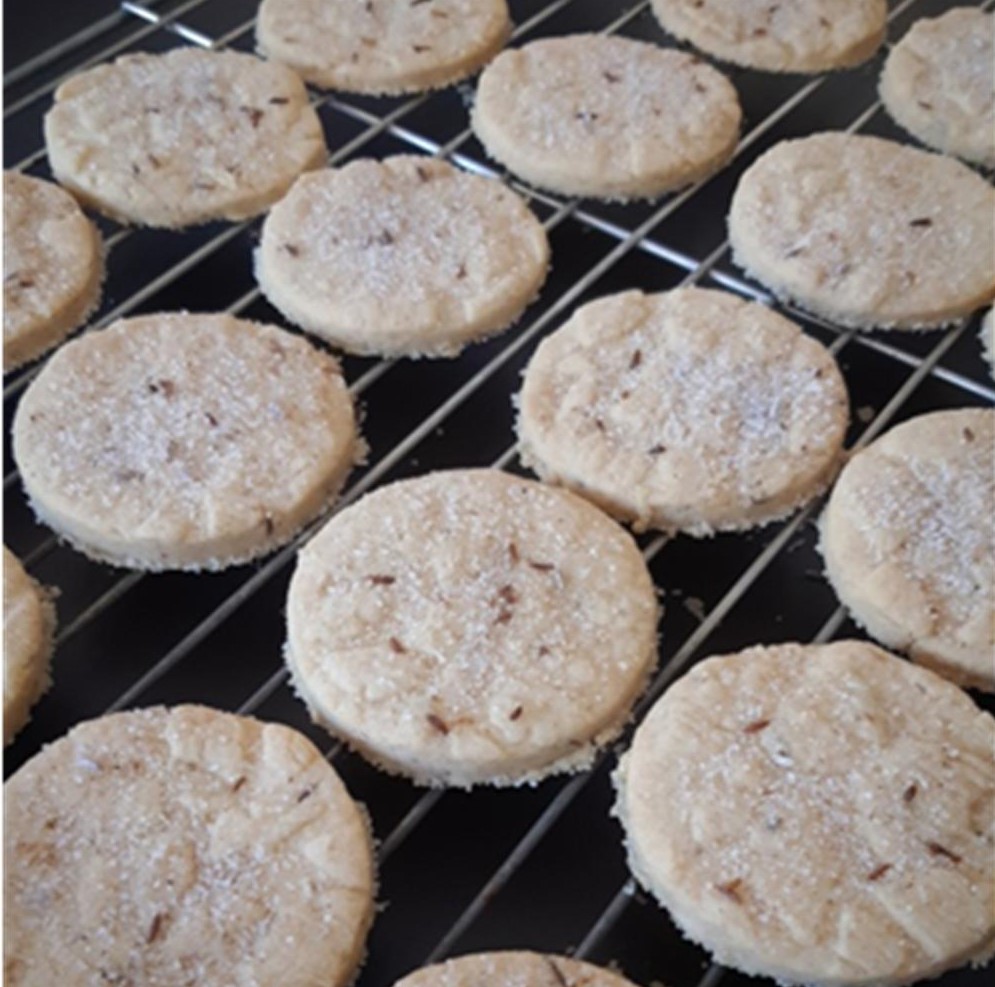
Pentecost Cakes

photograph | Piers Northam

Here’s some we made earlier!

Goosnargh Cakes – a Lancashire delicacy.

Originating from the Lancashire village of the same name, Goosnargh cakes are actually biscuits; a form of shortbread or ‘shortcake’ traditionally sold at Easter and Whitsun. Their characteristic flavour comes from caraway seeds, which were popular in the 16th and 17th centuries, and are also used in seed cake

Goosnargh ( pronounced something like GOOZ-ner) is a village just outside Preston, about 4 miles from the villages  where I ministered for ten years, in Whitechapel and Admarsh-in-Bleasdale.

The church at Bleasdale had a unique patronage – St. Eadmer who is not a saint known anywhere else. The folk there were more famous for Lancashire HotPot  than Goosnargh Cake!

The Goosnargh cake is no longer produced commercially but during my time of ministry in North Lancashire, the cakes were available to be bought at  the Goosnargh village post office at Easter and Pentecost. A ‘private’ supply was made for me by my ‘Aunty Mary’, who was a very dear friend who looked after me in Whitechapel. She had a ‘secret’ recipe which is proving to be elusive to find but will one day see the light of day again.

Whitechapel and the surrounding area were riddled with priests’ hiding places, mainly because in the time of the Jacobites the local priests were outlawed. They hid in secret places in farmhouses and other buildings. I have certainly been in a couple. The Roman Church was suppressed and worship forbidden. I think, however, that one of the farms in the area served as a church, as it has a rather large, church-shaped barn door.

My fanciful mind can easily turn a lightly whispered rumour into a plausible fact! I have this theory that the Goosnargh Cakes or Pentecost buns were part of a way to feed the priests and for hidden congregations to celebrate the great feast of Pentecost or Whitsunday. I cannot be proved absolutely wrong so I invite you to join me in marking this great feast day of the Christian year by partaking of some Goosnargh cakes.
Don’t worry if you think it’s too late to make them for this Pentecost.

Pentecost is kept traditionally  as an ‘Octave’ – Eight day feast,  so you have plenty of time to make some yourself. Good Luck! And don’t forget to share with those who would be perked up by your gift, and more especially, by you the giver. That would certainly have made my Aunty Mary glad.

Here’s a recipe..

It isn’t quite that of ‘Aunty Mary’ but we’ll be back next year, hopefully with the real thing. It’s not a bad substitute. Enjoy!

Goosnargh Cakes – makes 20

225g unsalted butter

125g caster sugar

350g plain flour

½ tsp ground coriander

1½ tsp caraway seeds

1. Preheat oven to 180C/350F/Gas 4. Grease two baking sheets.

2. Cream together butter and sugar until light and fluffy.

3. Sift flour over the creamed mix, add the coriander and caraway seeds, mix with wooden spoon until mixture resembles breadcrumbs.

4. Using your hands, work mixture together to form smooth paste. Take out of bowl and onto floured surface and knead gently so that dough is smooth and ready to roll out.

5. Roll out to about 1/4″ thickness, and using a circular cutter (mine was a 2″ one), cut out circular discs of dough.

6. Place the discs onto the baking sheets, and sprinkle with caster sugar.

7. Put the baking sheets into your fridge (having cleared all your chilled wine off one shelf to make room). Leave for 30 minutes/1 hour until well chilled.

8. Pop into oven and bake for 15-20 minutes – they should remain quite pale. Keep an eye on them as the minute you leave the room they overcook.

9. Remove from oven and sprinkle with more caster sugar. Leave to cool slightly, then transfer to a wire rack.


[Mr. G.]

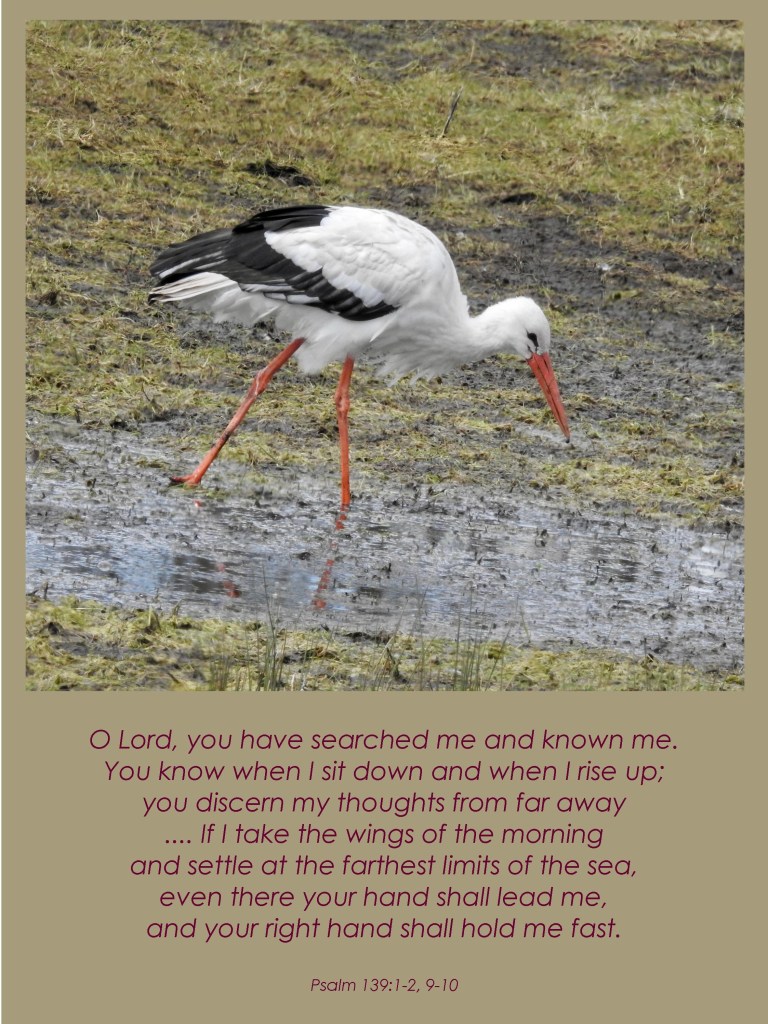
If I take the wings of the morning…

My friend Joyce has sent me another bird tweet with a quotation from one of my very favourite Psalms – Psalm 139, often known as ‘The Hound of Heaven’

Joyce writes this:

Dear Friends,
This White Stork was a surprise visitor on Hall Marsh scrape for just a very short while.
I suspect it’s satnav then re-calibrated and it flew back to mainland Europe.
Whatever the case, our Creator God watches over it and us, wherever we are.
With my love and prayers, God bless Joyce

Psalm 139 is one in which God’s care for us is celebrated but also which has an acknowledgement that there is no getting away from God who knows us through and through.
We can’t hide from Him, no matter where we try to go.
Why should we want to?

Well, we sometimes find it difficult to cope with someone who knows us, seemingly, better than we know ourselves. Sometimes God’s attention is unwanted.

In the film Amazing Grace (2006) about the great campaigner against Slavery William Wilberforce , there is a scene where Wilberforce (played by Ioan Gruffudd) leaves the house, his mind and heart in turmoil.
He knows what he is being called to do but it seems so difficult to do it. As he lay on the grass it begins to rain. His butler rushes to him with an umbrella and is perplexed at the state Wilberforce is in.
“Have you found God, sir?” he asks.
“Found God!!”, he replies. “No, He’s found me” and then he adds, “Do you know how inconvenient that can be!.

Well, yes. I think more than a few might agree with that!

Psalm 139 certainly played a big part in my own discovery of what God wanted from me.
But in that process He also showed me how dedicated and committed He is to me. To us.
He beckons us to Him because He so deeply loves us and that is just wonderful, as I’m sure the White Stork discovered.

We hope you do too.

[Joyce Smith & Mr G]