Very early in the morning, the myrrh-bearers ran with sorrow to thy tomb but the angel came to them and said: “The time of sorrow has come to an end! Do not weep but announce the resurrection to the apostles!“
At our church during Holy Week we have been using different symbols to help us concentrate our thoughts on each day’s theme. So, for example on Monday which was about the Anointing at Bethany, we all had a small envelope of spices which gave a fragrance to the Gospel reading and reflection.
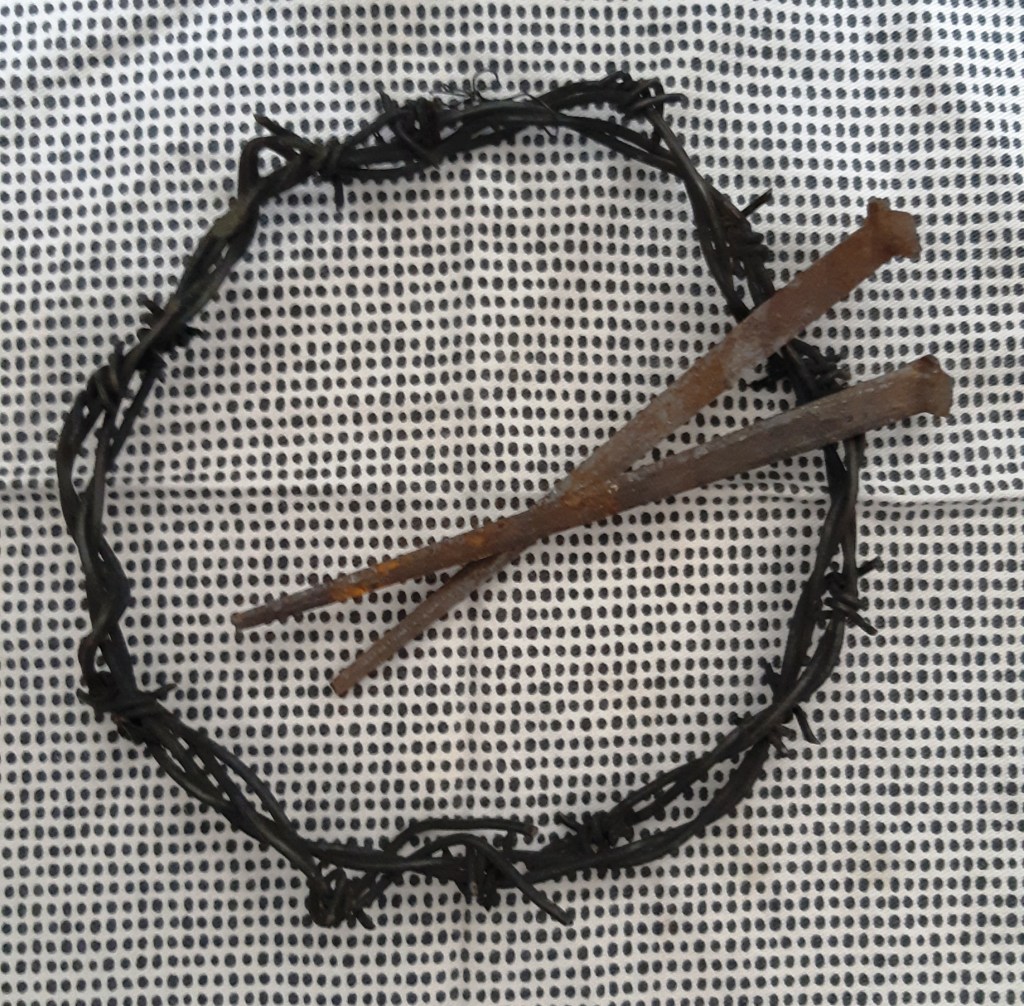
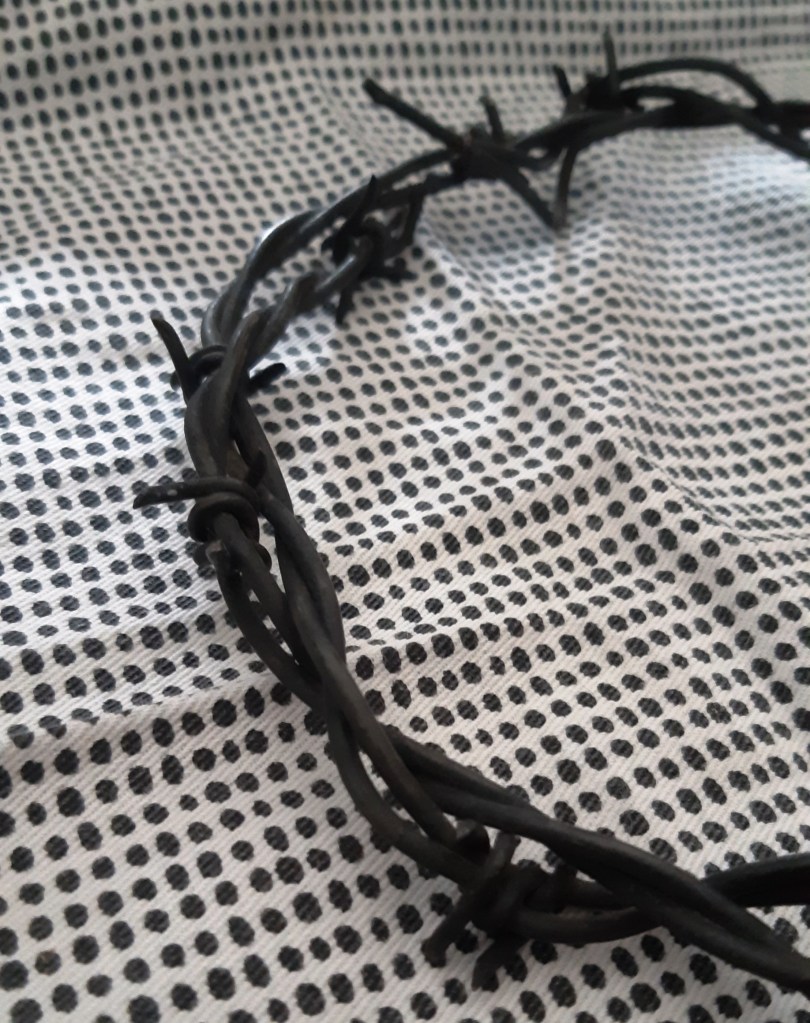
Today, Good Friday, we all held rusty nails but on my bookshelf I saw something that helped me to get more out of that symbol. It was a crown of thorns. What is really special about this Crown of Thorns is that it is made of barbed wire (see photo above) and it isn’t easy to handle.
What makes it truly special is that it was made for me by a fellow theological student in the 1970s at King’s College, London. The final year of our course was spent at St. Augustine’s College Canterbury. There I was part of a Christian yoga prayer group which met every morning, using a different Christian symbol each day as our focus.
Someone had produced a Crown of Thorns made out of twigs and I remember remarking that I’d love one for personal prayer. It was just a chance remark. After Easter when we returned, I was presented with a crown of thorns, made out of barbed wire. It was from my friend John Aves, a farmer’s son from Norfolk. He had made it himself.
I have used it often as a focus for prayer and meditation but it also took on a deep meaning when John, who became a faithful and loving parish priest, died suddenly at the age of 52. My last meeting with him was when I lived in Edinburgh. He had been studying part time for a higher degree and his tutor/supervisor was at Edinburgh University. If my memory serves me, my last letter from him was to tell me he had got his qualification. Then he had a sabbatical in the Holy Land and it was whilst staying in the Dheisheh refugee camp near Bethlehem, and just before he came home, that he died.
Though I hadn’t seen him very much at all since we left college, he left an indelible mark of friendship and love upon me and on so many of us who knew him in those days. I can still hear his beautifully infectious laugh and his sense of joy as well as his impish humour that would catch us out as he roped us into some plot to make life a bit lighter and a bit zany. That flowed out from a real faith and a joyful love of God. It came as no surprise to hear that he was a much loved priest in the parishes where he served. He was to my mind one of God’s holy and caring servants.
I am not alone in that view. His bishop, Graham James, wrote a Lent book in 2015 and it portrayed 40 companions who had a message to give for Lent. John was one of them.
Bishop Graham began what he said of John with these words: “John Aves was one of those priests whom bishops treasure,” explaining that John’s farming family background led him to value country ministry and that “his faith came alive in the context of an ordinary country parish. He never dismissed the value of tiny, elderly, rural congregations.” (for 17 years he was Rector of Attleborough and Besthorpe in South West Norfolk.) He also said that John was one of those priests who not only received ministry from his bishop but gave ministry to him.
Those who knew him in London and Canterbury know exactly what Bishop Graham means when he says he valued his “words of pastoral wisdom, gentle enquiries and occasional admonitions over a shared whisky” as the balm to his soul.
One of John’s legacies is an educational project which provides bursaries and other support for Palestinian refugees to study at Bethlehem University. The Project lives on through John’s wife and sons.
A simple crown of thorns made of barbed wire is for me an apt symbol to sum up John – he was truly a Good Friday person. He understood the theological truth that God so loved the world that he gave His only Son, so that everyone who believes in him may not perish but may have eternal life. (John 3:16), and he lived that truth and opened people up to it. He was a simple soul with a profound and deep understanding of Jesus and the love of God which saves the world.
John was a minister of that salvation and a proof that it is love poured out simply in His name to ordinary folk that changes everything. John certainly showed that to me. John’s crown of thorns will always be for me a symbol of what Jesus brings to all our lives and how he does it through lives like John’s.
This is his Passion. Darkness wraps around his very being, not a warming cloak but a shroud. Silence, punctured by friends snoring off the wellbeing of food, minds sloshed with wine. Alone with the shivers of the night, everything in him protests.
Sometimes, when we know our destiny, our minds close. Not this! No! Never! But our hearts are our undoing: our resolve begins; ends there.
So he battles with his need to say ‘Yes’, for himself, for others, for us. How else can the world know what it is to be loved?
Kneeling on the damp ground, tense, numb, scared, uncertain, he waits.
And the Father waits too as demons and angels whirl, stirring up the black air, a vortex of cosmic battle. Below them, sweat drops as blood.
And still the Father waits, listening expectantly, daring to hope…
God wrestling desperately with God with everything – just everything – at stake. This really is the Passion.
He sighs, deeply, calm descends.“Yes, let it be.” The Father wraps his love around him – and so too around us.
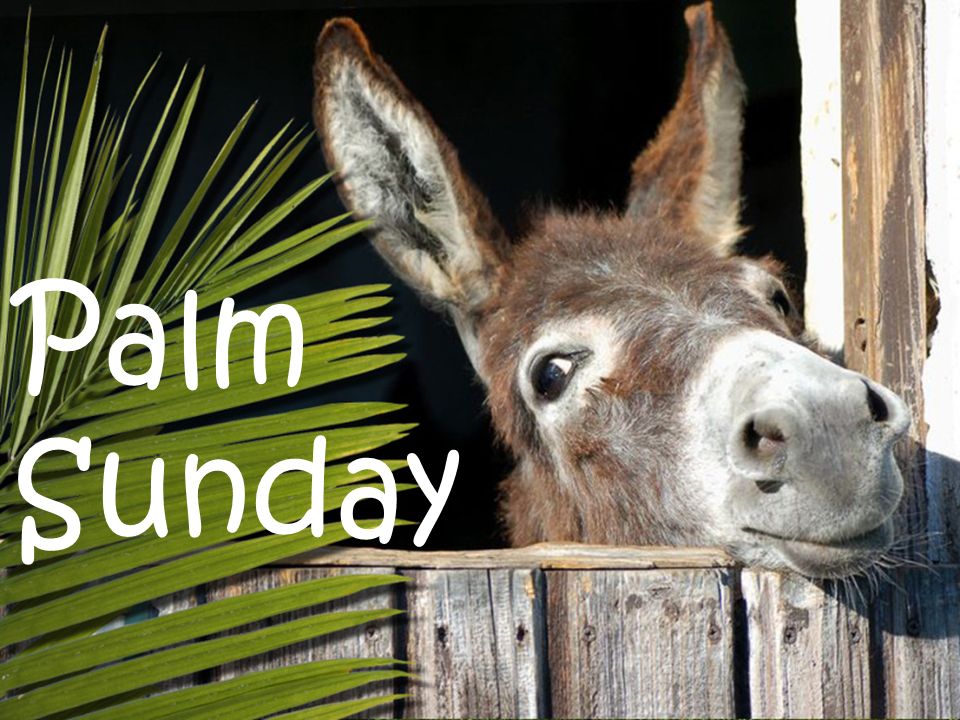
It promised to be a hot and sunny day as the early morning sunlight played on the little donkey’s face. Benji lazily opened first one eye and then the other, but although the sunshine was warm on his face, he shivered a little and huddled closer to his mother. It was, after all, only yesterday that he had seen the old donkey who lived along the road being cruelly beaten by his master. Benji’s mother gently nuzzled her son’s face and slowly licked one long ear followed by the other. Then, at the sound of their master’s voice, they trotted over to the edge of their field and had a long drink from the bucket of water he had brought for them, before turning to munch the hay which was piled up in the corner.
Even though their master was a kind man, Benji was still very frightened of the world outside his field and the scar on his mother’s back would always remind him of how cruel some people could be even to a donkey who had done nothing wrong. Sometimes, as Benji watched his mother carrying a person down the hill to the big city of Jerusalem, he could almost feel the pain of her scar and he longed to do something to help her. But the trouble was, whenever anybody asked for a ride on Benji, he was so frightened that he would begin to shake all over and no one wanted to ride him when he was like that. And so, in his short life, nobody had ever ridden on Benji’s back. But perhaps, just perhaps, today would be different……….
When Benji and his mother had finished eating, their master returned and, as he gently tickled their ears, he began to speak softly to them:
‘There will be lots of people going down to Jerusalem today to celebrate the Feast of the Passover’ he said ‘and I think that someone will need you to carry him today, Benji, so I’m going to get you both ready and I want you to stand quietly for me by the house.’
Then, using a long length of rope so that the donkeys could still graze from the grass, their master tied them to the trunk of a tree and they began to wait to see who might come by. They hadn’t been waiting long, however, when two men hurried towards the donkeys and, turning to their owner they said:
‘The Lord needs them’‘ That’s just fine’ said their master and as he untied Benji and his mother he whispered in their ears, ‘today will be your special day.’
The two men led the donkeys to the end of a dusty path and as they stood there, waiting, Benji turned his head and from where he was standing he could see right to the bottom of the big hill and all of the city of Jerusalem surrounded by big stone walls and lots of people, who looked as small as ants, hurrying around. Just then Benji’s gaze was arrested by a pile of rubbish outside the walls of the city and he began to tremble. He had often seen donkeys carrying rotting rubbish down to the tip and, sometimes, his mother told him, bad people were hung on crosses and killed there. At that thought, Benji shook even more, but just as he was beginning to feel so weak that he thought he would fall over, he felt a hand on his head and a gentle voice saying:
‘Not today, little donkey, not today; the rubbish tip’s not for today. Don’t be afraid little donkey, today I want you to carry me.’
Benji turned his head and found himself looking into the most understanding man’s face he had ever seen and suddenly his shaking stopped and he felt strangely calm. Yes, he would be able to carry this man because he knew he understood and he gently nuzzled Jesus’ hand. While his friends put their coats on Benji’s back, Jesus gently patted the scar on the older donkey’s back and this time she didn’t wince as she normally did, but she too, gently rubbed her head against him.
When they were ready, Jesus climbed on Benji’s back and began to ride down the hill towards Jerusalem. To his surprise, with this man on his back, Benji suddenly felt quite strong and sure of himself. Somehow, being with Jesus, had taken away his scary feelings and now he really did feel that he could carry him all the way to Jerusalem. And Benji’s mother was just a few paces behind trotting along quite contentedly. They hadn’t gone very far, however, when people started to come to the edge of the road and they began to cheer and wave palm branches as Jesus rode by on the little donkey. People even spread their cloaks and more palm branches on the ground so that Benji had a very soft road to walk on. People then began to shout:
‘Hosanna to the Son of David! Blessed is he who comes in the name of the Lord
Hosanna in the highest’
‘Yes, Jesus must be very special’ thought Benji, ‘ but I could have told all these people that from the moment he first spoke to me.’ And as he continued to trot down the road he, too, felt special and so happy.
But as we know, donkeys are very sensitive and after a little while, amidst all the cheering, Benji’s long ears began to pick up some whispers from people at the back of the crowd, people who said they didn’t like Jesus and even that they wanted to kill him. When he heard this, Benji began to shake again, but the man on his back gently patted him and said again; ‘Not today little donkey, not today.’ So, reassured once more, Benji trotted on right through a gate in the wall and into the city of Jerusalem, right up to the temple.
When they arrived there, Jesus jumped off Benji’s back, ‘ thank you, little donkey’ he said, ‘now you go back home with your mother and rest – well done little donkey, well done.’ Benji was so happy, he didn’t want to leave, but after rubbing Jesus’ arm with his muzzle one more, he turned and trotted back up the hill with his mother.
When he got home, he turned his head and looked at the city of Jerusalem once more and he wondered what Jesus was doing now. Then, as his gaze again took in the rubbish tip, a big tear rolled down his face and he heard that gentle voice saying ‘not today, not today, little donkey’ and he wondered what tomorrow might bring……
This story forms part of a series of reflections written by Joyce , ‘A Journey through Lent and Holy Week.’



 Mr G's Ponderings