The quotation from Pope John Paul II is from a sermon he preached to young people in Baltmore in 1995. It has a dual context.
First, it is a call to seek that kind of freedom which results not in self-centredness. Freedom is not about getting our own way regardless of others. This is enslavement and mainly to a ‘You’ which is a false self.
Real Freedom must be seen in context of the freedom of others. Eleanor Roosevelt, wife of President Roosevelt once said: “Freedom makes a huge requirement of every human being. With freedom comes responsibility. For the person who is unwilling to grow up, the person who does not want to carry his own weight, this is a frightening prospect.”
Pope John Paul’s words are actually those of Abraham Lincoln. Here’s an extract from his sermon:
“One hundred thirty years ago, President Abraham Lincoln asked whether a nation “conceived in liberty and dedicated to the proposition that all men are created equal” could “long endure.” President Lincoln’s question is no less a question for the present generation … Democracy cannot be sustained without a shared commitment to certain moral truths about the human person and human community. The basic question before a democratic society is: “how ought we to live together?
Surely it is important for America (and everywhere) that the moral truths which make freedom possible should be passed on to each new generation. Every generation … needs to know that freedom consists not in doing what we like, but in having the right to do what we ought.”
This shared freedom was spoken of upon by President Barak Obama who preached a eulogy in 2015 for Pastor, Reverend Clementa Pinckney, who with eight of his congregation was shot dead by a gunman in Charleston. In an anguished sermon he pleaded that, my liberty depends on you being free too. In order for that to happen, President Obama said that we need a different road from that of violence. We need the road of grace and that, he said, requires an open mind and, more importantly an open heart.
So the second context of the quotation of John Paul II requires of us a persuit of freedom which centres not on what we want to get from life but rather, what we can do with and for others.. Freedom requires of us a life dedicated to the service of others. This involves us in seeking grace, as President Obama recognized, but a grace which is Amazing. A grace that can only come from God.
This is centred on living a Freedom that can ony be found in the truth of the Gospel – a truth which Jesus says in John Chapter 8, will set us free. We are encouraged to live in this truth. As Pope John Paul said at the end of his sermon:
Always be guided by the truth – by the truth about God who created and redeemed us, and by the truth about the human person, made in the image and likeness of God and destined for a glorious fulfillment in the Kingdom to come
Josefina de Vasconcellos, they fled by night.detail Cartmel Priory. Photo: Mr G.
St. Joseph’s Day 2021
Josefina de Vasconcellos, the sculptor, was commissioned on a number of occasions to carve large statues of the Holy Family. What never fails to strike me is that always Joseph is central to the scene. He does not lurk in the background or act like some passive kind of bystander. Josefina shows him as a strong fatherly figure who is a protector of both Mary and Jesus. It is clear that Josefina had a soft spot for the shadowy figure from the Christmas story and was determined to give him the prominence he deserves. Perhaps it was because she was graced with the female form of his name.
One particular statue of the Holy Family, which I’ve featured on this blog before, is one that was graphically very different. It can be seen in Cartmel Priory in the Lake District. It is called They fled by night and it was inspired by the flight into Egypt taken by the Holy Family to escape the threat of King Herod.
It is a very powerfully real statue. Mary is shown to be exhausted with her head leaning backwards as she rests in Joseph’s arms. Joseph is holding her and looking down with loving compassion. Despite being exhausted himself he was concerned only about her. Meanwhile in the foreground of the composition, Jesus is leaping forward as he embraces the future.
What I like about Josefina’s portrayal of Joseph is that he is not the shadow figure that we find in the Gospel. Apart from Matthew’s ‘dream’ sequence when an angel tells Joseph it is God’s will to take Mary as his wife, and an incident when Jesus was 12, Joseph plays no further part in the Gospel story. There is a reference to him when Jesus is called the carpenter’s son but we are left wondering – what happened to Joseph?
We can invent our own story but I like to think that Joseph was content with his role in making the Incarnation possible. In a world like ours which celebrates status and fame it isn’t a bad thing to be background people. Those with a quiet but firm faith are the bedrock of the Church. They seek nothing more than to proclaim Jesus, not necessarily in words or spectacular deeds but with a fidelity towards Him which simply shouts faith in all they do and are. In Josefina’s statues Joseph comes across as a dependable, caring and protective parent. If I could choose a guardian angel, it would be like him.
It is good to think of him as the dependable one who may be in the background but whose care of Jesus and Mary is truly godly. Joseph, who can be relied upon and sought nothing for himself. Does that describe you?
Today, 17th March, is St. Patrick’s day, Patron Saint of Ireland.
Patrick’s first experience of Ireland didn’t begin very well. Raiders from Ireland kidnapped him from England and took him into slavery. We aren’t exactly sure from where. We do know, because he told us himself, that his grandfather (Potitus) was a priest and his father (Calpornius) a deacon. As this was before the two Missions from Iona and Canterbury they must have belonged to the Romano-British Church which had links with the Roman occupation. The Church of Ninian and of Kentigern (St Mungo) where established in the Dumfries and Glasgow areas with developments in Cumbria Ancient place names often leave clues and in Cumbria there is Mungrisedale (Mungo) and Patterdale (Patrick dale). There is a well at Glenridding (southern end of Ullswater) which, whilst Victorian, is called ‘St Patrick’s Well’ and is claimed to be on a site of an older well where Patrick was baptized. (along with a number of other sites stretching around the country!)
A true fact is one that Patrick supplied. When he was kidnapped he was 16. We know this from one of the two certain writings that he left us. In his Confession he says that he was about 16 years old. This would date the event about 406.
In the edition of the Confession published in 2011, a translation by Pádraig Mc Carthy, Patrick left us an indication of his spiritual nature and the humility with which he was to follow Jesus Christ. He said:
My Name is Patrick. I am a sinner, a simple country person and the least of all believers.
He spent 6 years as a slave before he managed to escape. By that time, his faith had grown stronger. He confessed to having gone away from God and did not keep his commandments. The Lord, however, “opened my awareness of my lack of faith. Even though it came about late, I recognized my failings. So I turned with all my heart to the Lord my God and he looked down on my lowliness.” Patrick went on to say that even before he fully knew the Lord, Christ “guarded me.” Even before he came to wisdom and “could distinguish between good and evil,” he knew the protection and consolation of that of a father caring for a son. These were important insight of Christ watching over him because it was something that would shape his life, mission and ministry.
Alongside this growing faith in Christ, Patrick felt a yearning and desire to open the Irish people to faith in the Good News of the Gospel. He became attentive to the voice of God speaking to his heart and so his vocation became stronger and stronger. When he escaped from Ireland he knew that one day he would be back.
He didn’t return home nor to England at all. He had a feeling that the British Church might not honour nor encourage his vocation. So, he spent many years in Europe and awaited God’s moment in preparing spiritually, theologically and personally. Some time in this period the Irish Church gained its independence from Britain and Patrick begged the Pope to send him as an Apostle to the Irish. He arrived about 432. He set up his base in Armagh and from there, the Good News was preached. A record in one of the Papal annals recorded, briefly but with approval, ‘Patrick flourished.’
But it was a ‘flourishing’ which needed all of Patrick’s strength, faith and determination. The pagan religion was not to be defeated easily and there are times when Patrick had confrontations, not least with the High King and his religious pagan leaders who saw the threat of Jesus Christ to their livelihood, power, influence and way of life. In the end Patrick and Christ prevailed.
Patrick’s faith was deep and prayerful. It was centred on the Holy Trinity and his relationship with God as Father, Son and Holy Spirit. This faith compelled him eagerly to share the Gospel and Salvation of Jesus with the people of Ireland. Everything was centred on God and He was certain of God’s protection and blessing.
Patrick expressed his Trust in God in what is known as a Lorica. A Lorica, or Breastplate prayer, is essentially a ‘protection prayer’ in which the petitioner invokes all the power of God as a safeguard against evil in its many forms.
As we have seen, Patrick knew his need of God and the prayer enshrines this and it therefore has an appeal for us today in our own particular need. We know it today as St. Patrick’s Breastplate often sung in churches on Trinity Sunday. Whilst there are many who say that it was written after Patrick’s time, there is little doubt that it enshrines Patrick’s theology and spiritually. It contains the essence of his belief and also his certainty of God’s love, protection and blessing of him and of his mission.
There are many versions of it but the one most used is that composed by Mrs Alexander in 1889 for St Patrick’s Day.
The beginning of the Hymn anchors Patrick’s belief in God in a powerful way.
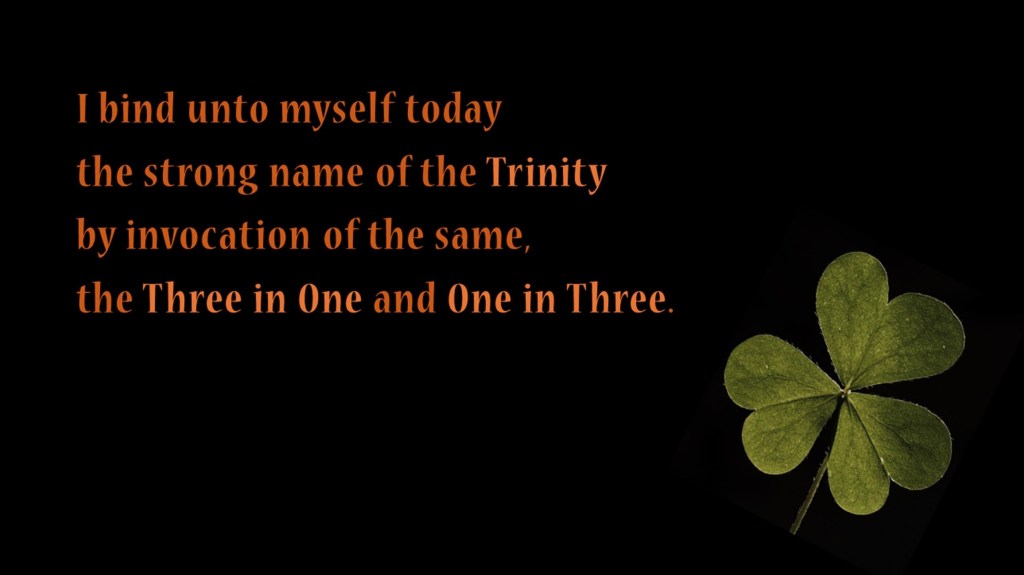
I bind unto myself today the strong name of the Trinity by invocation of the same, the Three in One and One in Three.
Our life is bound up with the Holy Trinity. We are enfolded by the Father, Son and Holy Spirit who protects and flows into our lives. This is union with God who holds, cherishes and nourishes us. We belong to God and God pledges his total presence and eternal life to us. It deserves praying over Part of the hymn becomes a Protection Prayer in its own right.
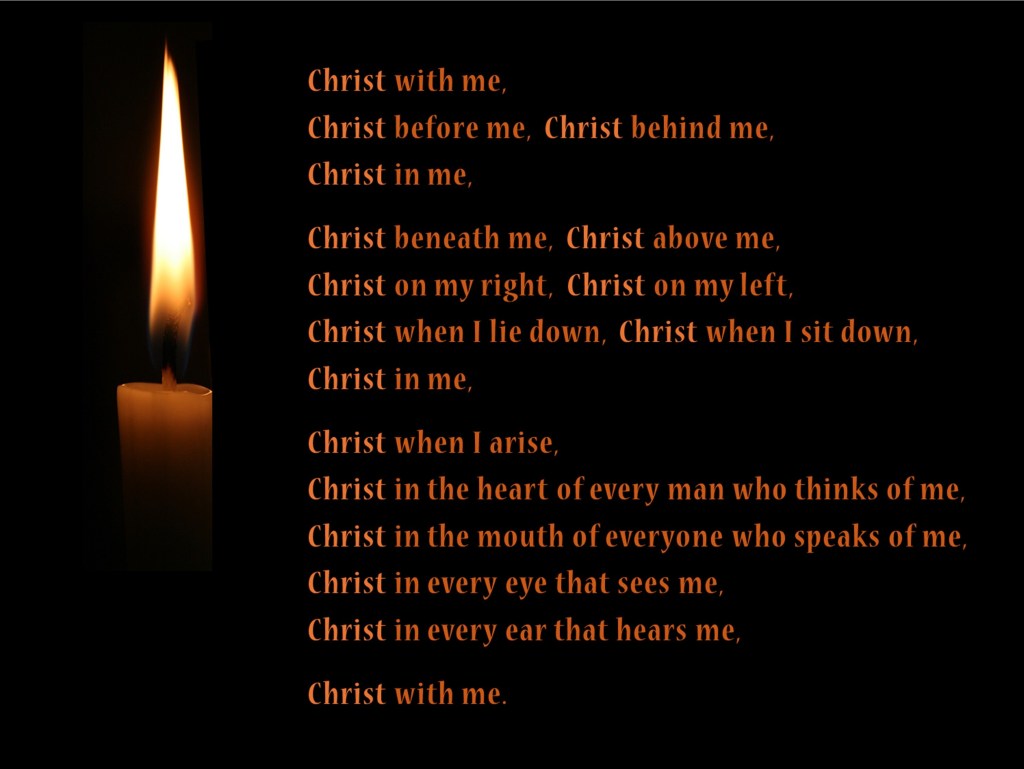
Christ be with me, Christ within me, Christ behind me, Christ before me, Christ beside me, Christ to win me, Christ to comfort and restore me. Christ beneath me, Christ above me, Christ in quiet, Christ in danger, Christ in hearts of all that love me, Christ in mouth of friend and stranger.
This is such an intimate and personal prayer. In Jesus each of us is surrounded, circled by his presence. This is sometimes known as a Caim Prayer, a circling with God’s love and protection. This is a favourite theme of Irish and Celtic spirituality. We call upon God and He circles with His protective love. He is with us every day of our lives and is our joy and our comfort. So we can say that Our God is with us and we are with Him.
There is also a version which ends like this: Christ in the heart of everyone who thinks of me, Christ in the mouth of everyone who speaks to me, Christ in every eye that sees me, Christ in every ear that hears me
This reminds us that when we are living close to Jesus Christ we live close to all others. Our being bound to Christ is inclusive and extensive. And if we live trustfully, faithfully, and open-heartedly then others will see us in Him and much more importantly see Him in us. That is what Christ achieved in Patrick’s life and ministry and mission.
ooooooooooooooooooooooooooooooooooo
The prayer, Christ with me (see above) has been set to music by Arvo Pärt. It is very beautiful and moving. The two versions I know are sung by Voces8 and The Sixteen.
A note in the Confessio invites people to copy and distribute the text but also to remember that it is still subject to copyright law and should not therefore be distributed or copied for monetary gain.
The words of the Hymn by Mrs Alexander, Patrick’s Breastplate, “I bind unto myself today” is in many regular hymnbooks or can be viewed on one of the hymnal sites on the web.
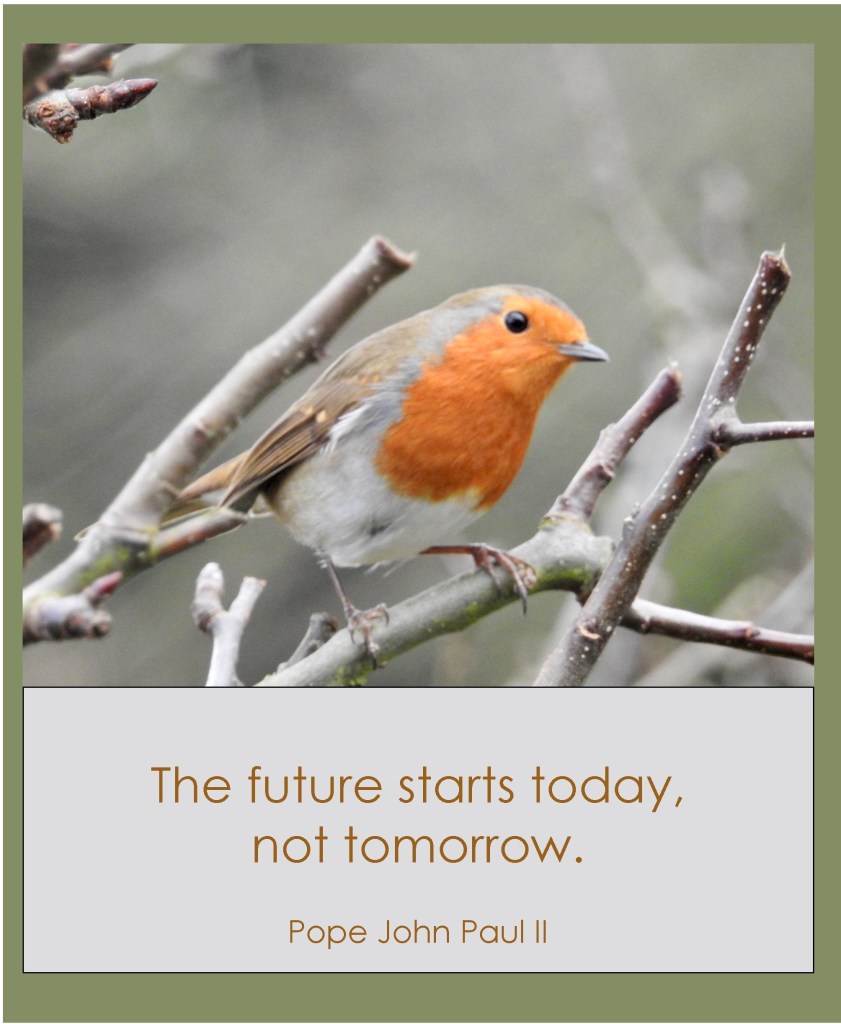
This little robin sees signs of new life in the buds on the tree and looks forward to renewed joy. You just have to wait and trust. The Future is here! Don’t keep running around and chasing what is already in front of you. You may well know this little ditty by Elizabeth Cheney
Said the robin to the sparrow, ‘I should really like to know, Why these anxious human beings Rush about and worry so.’ Said the sparrow to the robin, ‘Friend I think that it must be, That they have no Heavenly Father, Such as cares for you and me.
Of course the Sparrow is only half right. Our Heavenly Father certainly cares about the birds of the air but he does care for us too and he provides for all we need, even if that isn’t always quite what we want! Why not read and pray over Matthew 6:25-34 (NRSV or in your favourite version if you prefer
“Therefore I tell you, do not worry about your life, what you will eat or what you will drink, or about your body, what you will wear. Is not life more than food, and the body more than clothing? Look at the birds of the air; they neither sow nor reap nor gather into barns, and yet your heavenly Father feeds them. Are you not of more value than they? And can any of you by worrying add a single hour to your span of life? And why do you worry about clothing? Consider the lilies of the field, how they grow; they neither toil nor spin, yet I tell you, even Solomon in all his glory was not clothed like one of these. But if God so clothes the grass of the field, which is alive today and tomorrow is thrown into the oven, will he not much more clothe you—you of little faith? Therefore do not worry, saying, ‘What will we eat?’ or ‘What will we drink?’ or ‘What will we wear?’ For it is the Gentiles who strive for all these things; and indeed your heavenly Father knows that you need all these things. But strive first for the kingdom of God and his righteousness, and all these things will be given to you as well.“So do not worry about tomorrow, for tomorrow will bring worries of its own. Today’s trouble is enough for today.”
Spring officially begins on March 21st but Nature doesn’t always check the Calendar . Which is fine because the sooner Spring begins the better. We could wait a while longer but why don’t we take to heart what Pope John Paul II said in the picture quotation above. Let the Future begin today.
And don’t spoil it with anxiety and worry. There are two words which are underpinning this time in our lives and in our world. Kindness and Trust. Let God be kind to you and in return Trust Him. That’s what Jesus teaches. Do not worry.! Easy to say; harder to do I know. But The Robin has arrived and the other birds are singing. Those vulnerable creatures trust God and rejoice. Why can’t we?


 Mr G's Ponderings