A poem by Daryl Madden whose blog I follow. He is an active member of St Thomas a Becket Parish in Reston VA, USA and a minister at Holy Communion. His poetry on religious themes are regularly available on his blog—https://darylmadden.wordpress.com
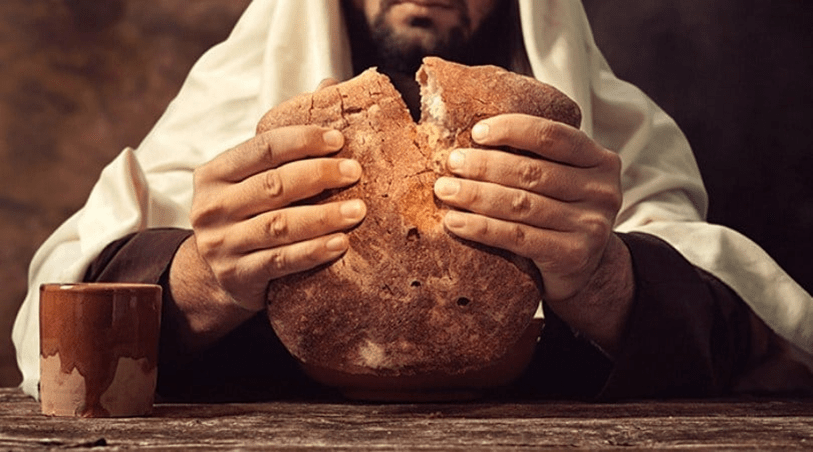
He took, blessed, and broke Then He gave the bread A miracle to all Five thousand souls were fed
And for His last supper Again, He took and blessed He broke and He gave His love to friends, professed
The chosen One was blessed On His cross was broken God incarnate, given He is the Word spoken
Walking to Emmaus With bread of which to share Took, blessed, broke and gave Our Lord to them appeared
And so, as His beloved Through Him, spiritually Chosen, blessed and broken And given, let us be
Based upon words by Henri Nouwen Reproduced with Daryl’s permission
Here is another Picture Reflection from my friend Joyce Smith.
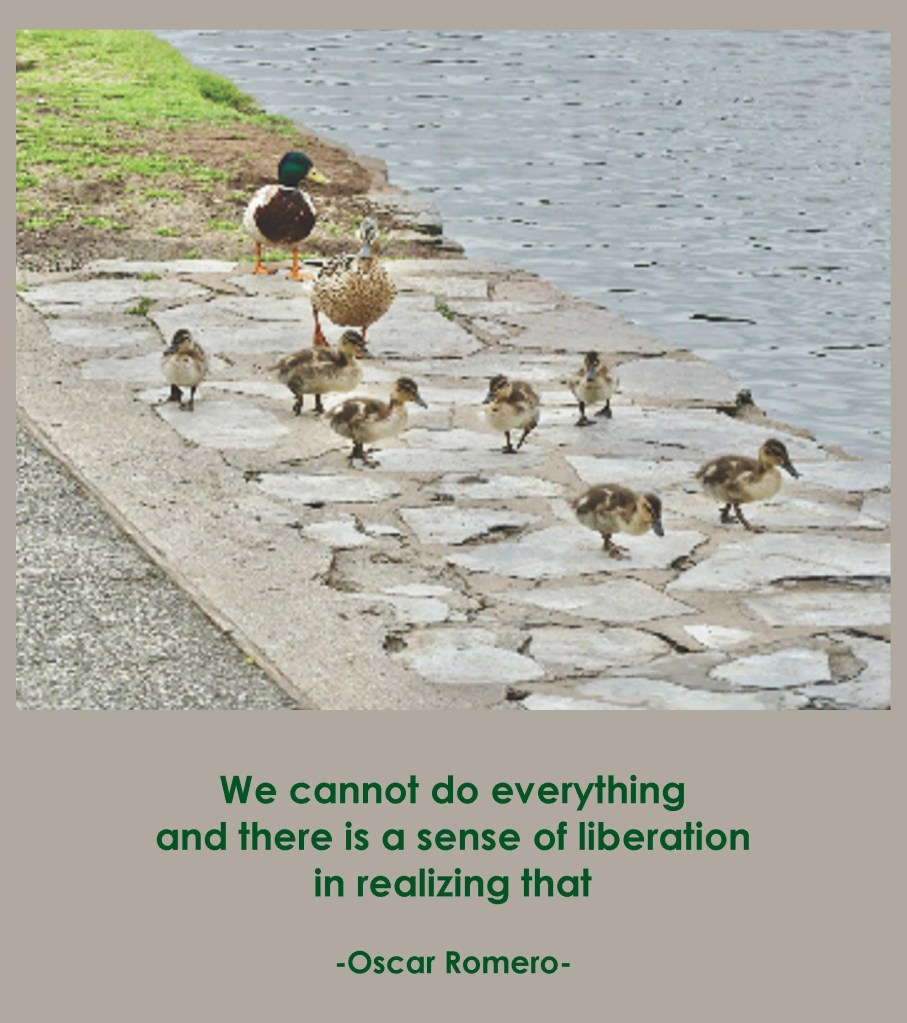
The ponder quotation is attributed to Oscar Romero, the saint and martyr who died for his faith in El Salvador on 24th March, 1980 It is a thought contained in a very special prayer. The next words of the prayer are:
This enables us to do something and to do it very well. It may be incomplete, but it is a beginning, a step along the way, an opportunity for the Lord’s grace to enter and do the rest.
The Prayer, A Future Not our own, is worth praying through slowly because it has much to say to our souls particularly in these days when we are perhaps impatient to get on with things and frustrated, perhaps even despondent and in despair with the Covid restrictions. May the prayer reflection have something meaningful for us.
Prayer…. A FUTURE NOT OUR OWN
It helps, now and then, to step back and take a long view.
The kingdom is not only beyond our efforts, it is even beyond our vision. We accomplish in our lifetimeonly a tiny fraction of the magnificent enterprise that is God’s work.
Nothing we do is complete, – which is another way of saying that the Kingdom always lies beyond us.
No statement says all that could be said. No prayer fully expresses our faith. No confession brings perfection. No pastoral visit brings wholeness. No programme accomplishes the Church’s mission. No set of goals and objectives includes everything.
That is what we are about. We plant a seed that will one day grow. We water seeds already planted, knowing that they hold future promise. We lay foundations that will need further development. We provide yeast that produces effects far beyond our capabilities.
We cannot do everything, and there is a sense of liberation in realising that. This enables us to do something, and to do it very well.
It may be incomplete, but it is a beginning, a step along the way, an opportunity for the Lord’s grace to enter and do the rest.
We may never see the end results, but that is the difference between the master builder and the worker. We are workers, not master builders, ministers, not messiahs.
We are prophets of a future not our own.
The prayer is known today as The Romero Prayer though, in truth, there is no evidence that he every prayed it! It was Cardinal Basil Hume who unwittingly first attributed it to St Oscar Romero. Delivering a paper at Westminster Cathedral on Catholic Education in 1997 he misattributed it. When the paper was subsequently published, the attribution remained and was taken up by CAFOD and Caritas Internationalis in Rome. From then it went round the Global church and in the process became known as The Romero Prayer. The prayer was actually composed by Bishop Ken Untener of Saginaw, who drafted it for a homily for the celebration of a departed priest. The homily was delivered by Cardinal John Deaden. It has become established as the Romero Prayer mainly because, though St Oscar may not have written or prayed it, it could easily have been. It has the essence of the Saint’s own teaching, theology and spirituality. It is no surprise therefore that it has been ‘owned’ by devotees of the Saint who find so much in his teaching and example to guide, form and enrich their own thinking and praying.
To pray this prayer and own it would go a long way to helping us to look at what it is happening to us and to our disfigured world, and placing everything and our future into God’s hands. Under God we are indeed prophets of a future not our own. We are prophets, heralds and signs of a new future which is God’s. In the many issues in which humanity has tried to rule and dictate how we treat the Planet, we are being called to work afresh with God to reclaim everything for a new vision of what it means to be stewards and cherishers of the amazing ‘gift of our stupendous earth.
Maybe this virus will come to be the turning point of a genuine global repentance as we return our planet back to God for His safekeeping.
‘Galanthus ‘S.Arnott‘ photographed by Gill Henwood
Candlemass Bell peals out, tender frame swinging in the winter wind, pure and poised with expectancy. Its message tolling across ice and snow. Another time is coming warmer, more hopeful.
Galanthus waves gracefully determined, scenting us with honey. Points us to a future we long to reach towards but dare not until Simeon’s flower captivates us and God, in the sounding peal of Nature, holds us in his arms and blesses us.
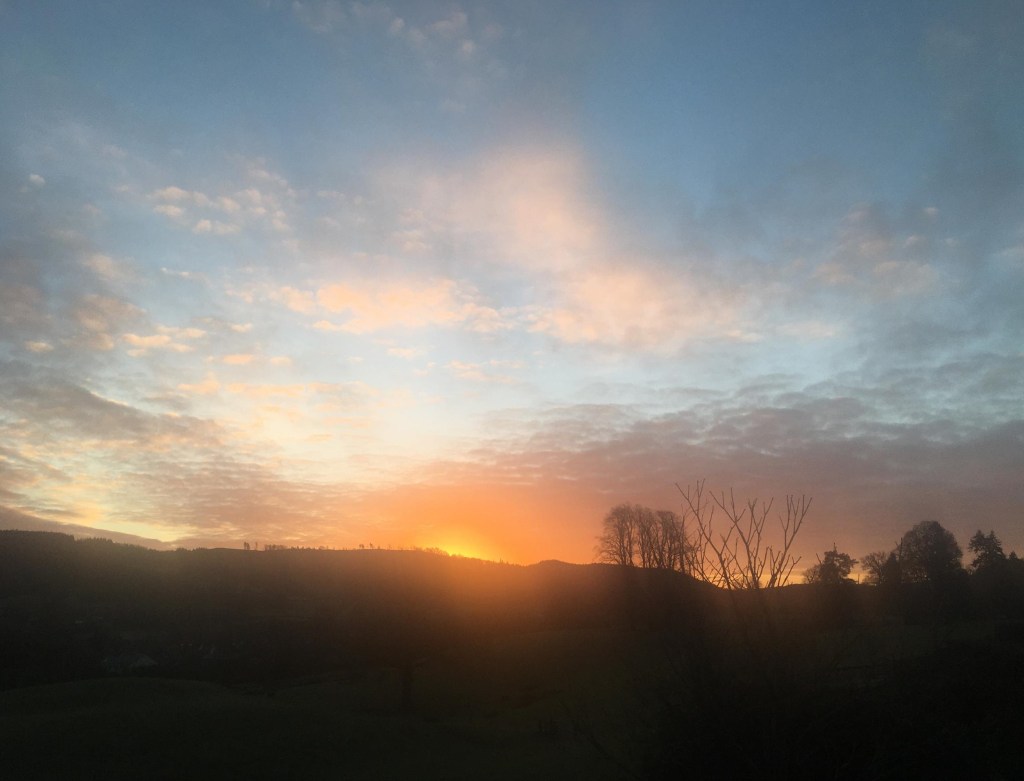
Sunrise on St Brigid’s Day, February 1st 2021. Photo taken in the Lake District by my friend Gill Henwood
One of the highlights of a visit I once made to Ireland was to arrive at Kildare which was made famous by St. Brigid (sometimes known as Brigit, or Bride). She is said to have been baptized by Patrick and with him is known as Patron Saint of Ireland. She founded a monastery there just after Patrick began to convert the Irish. Brigid’s monastery was a mixed house of women and men—something that was unknown outside Celtic lands. (They were more enlightened than most!)
Her feast day kept today, on February 1st, coincided with the pagan festival of Imbolc, the Celtic season that marked the coming of light after the dark days of winter. Once again, the Christian Church displayed ingenuity and common sense in replacing a pagan feast with a Christian one because Brigid’s day is quickly followed by Candlemass, the day when we celebrate Christ as the Light of the World—the light which overcomes darkness or to put it in the words of Simeon’s song the Nunc Dimittis: a light to lighten the Gentiles (non Jews).
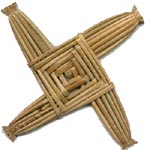
There is a further connection between Brigid and the feast of Candlemass. Just as we are pointed, by Simeon’s prophecy, towards the Cross of Christ, so too is the story of Brigid connected to a Cross. The story goes that on a visit to a sick friend who was close to death, Brigid reached down and picked up pieces of straw from the floor of the cottage. As she prayed for healing she wove the straw into a simple square-braided cross and hung it in the rafters over the bed. The friend began to get better and the Cross became a symbol of this healing. Today, it is known as St Brigid’s Cross.
Christianity is often a faith of paradoxes and none more so than the connection of birth with death. At Candlemass we complete our Christmas celebration of Christ the Light and then begin our journey towards Holy Week and Our Lord’s death on the Cross. Yet there is nothing strange in this. Christ’s victory over the human heart, and the darkness which so often besets our lives, begins in the Christmas event but needs Calvary to complete it. There Christ’s love shine from the Cross and in the light of that love we can claim our place in God’s heart.
Brigid’s cross, woven from simple straw became a sign of healing and of life. The straw of the Manger and the wood of the Cross, woven together, are symbols of our healing and salvation. A salvation that we Christians believe only Jesus Christ can offer.

 Mr G's Ponderings