Had we been able to sing carols this year, many of us would inevitably be singing ‘In the bleak midwinter’. It was written by the romantic poet Christina Rossetti who was sister of the artist Dante Gabriel Rossetti.
Its imagery, particularly the first verse, is borrowed from the signs of winter in the Northern Hemisphere. So the frosty winds moaning, begins to paint a picture of a winter which was harsh. The earth was hard as Iron and water was so frozen, it was like stone. Inevitably the ground was also white with snow. Snow had fallen, snow on snow…In the bleak midwinter long ago.
Rossetti, I suspect, drew her description of an earth sleeping in the depth of winter from her own experience of hard winters and dark nights which were part of her lot. In her early teens, her father had to give up his teaching post because of severe illness. He was plunged into depression. This was something which began to cloud her own life. When she was 14 she had a nervous breakdown and bouts of depression dogged her until she discovered the Anglo-Catholic expression of religion. So, In the bleak midwinter, may well have had an autobiographical foundation but also it reflects the kind of winters that were common in Britain and Northern Europe at the time.
Whilst Rossetti gave Christians of that period something to which they could relate, it was a far cry from the birth of the Christ-child in a Middle Eastern climate. But it celebrated a Christmas which was not unconnected with the turning of the earth away from darkness towards light and, as such, it captured the essential message, particularly promoted by St. John in his Gospel account that the birth of Jesus was the Light coming into the world and which the world could not overcome.(something we need to remember and hold on to right now!)
Christmas and the turning of the year back towards the sun are related. One is the physical movement of the earth towards the lighter nights and the movement towards Spring whilst the other expresses a spiritual turning towards the Light of God which Jesus came to bring. A light which includes renewed growth and hope. The world turns in a pivotal way towards the new birth of Spring and the Incarnation turns human destiny toward the new life which becomes our inhertance through the life, teaching, Passion and Resurrection of our Lord Jesus Christ.
In the birth of the Christ child, the tiny shoots of this new life, hope and love are expressed in the manger and in the Adoration of the Shepherds (not forgetting the animals!) In the world of nature, the buds are already forming on the trees and tiny shoots appear pushing up through the soil of the earth. All around us, if we but look, we see nature hard at work as new growth appears, though there are plenty of signs that the beauty of nature never really sleeps.
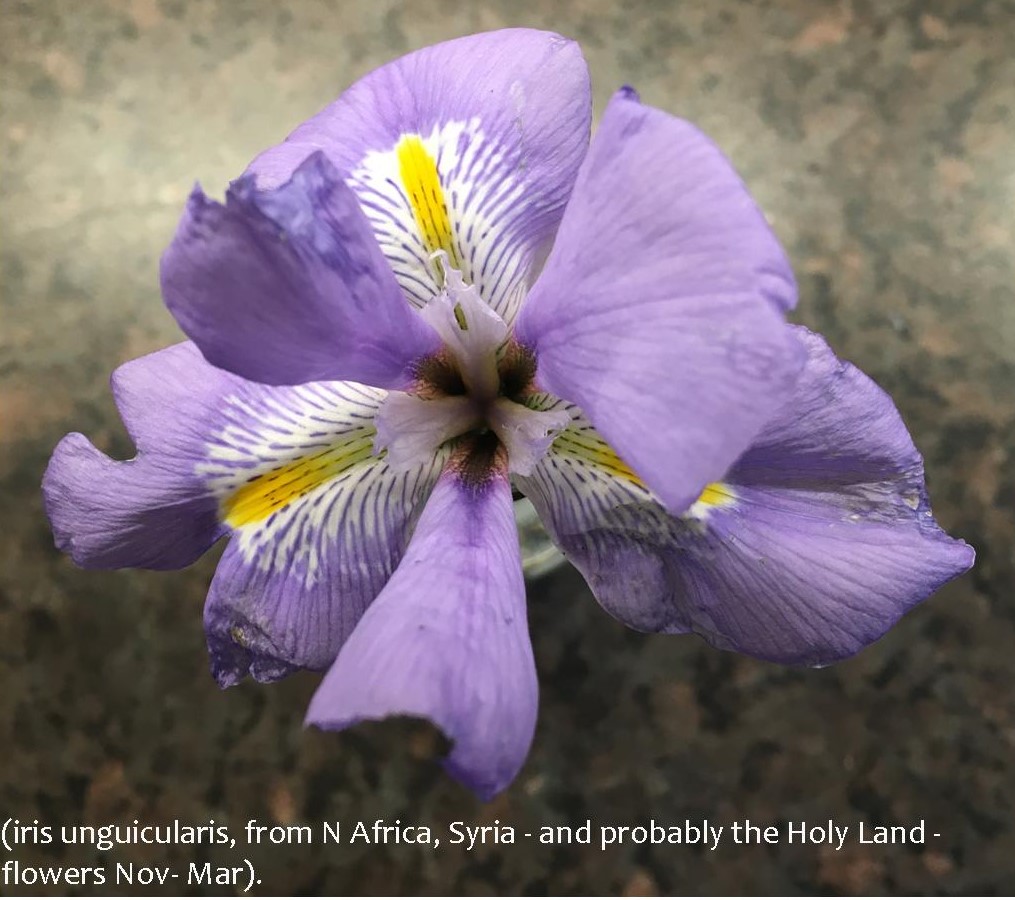
Which is why the photo I have chosen to head this piece is of an Iris unguicularis which originates in North Africa, Syria and possibly the Holy Land, not to mention Cumbria where this photo was taken by my dear friend Gill Henwood. She tells me that it flowers from November to March.
In the bleak midwinter may well be a sign of the phase of the earth near to Christmas but so is the Iris illustrated above. There will plenty of other flowers just around the corner , such as aconites and snowdrops, Hellebores and crocuses. Christmas follows soon after the shortest day and so becomes another sign that the world is turning in a new direction which brings renewed light, but this time in our hearts. Whatever darkness is dragging us down right now, we need to look up, look out and look around us.
The last line of Rossetti’s poem/hymn says that whilst we can’t give Jesus seemingly very much, we can give him our hearts. In the midst of the darkest time of our planet with Covid, Global warming, and destruction of nature, it may not seem very much but, in truth, it is enough. It is everything.
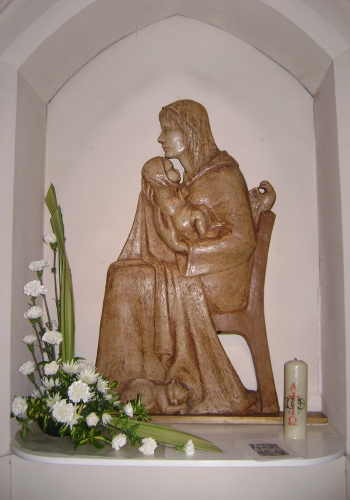
photo: Mary with Jesus, dove and cat! bas-relief statue by Josefina de Vasconcellos commissioned for the Lady Chapel of St. John the Baptist Parish Church, Epping
A sermon for the Fourth Sunday of Advent, preached by my friend, The Revd Beth Joss-Pothen in St. Mary-at-Latton, Harlow.
May God be in all our heads, in all our minds, in all our hearts, and in all our understanding. Amen
I’m going to start, much as we often start proceedings as a church, with a confession. I wrote a lot of notes for this sermon. Notes about hope, and resilience, about the bravery of Mary and the dawn of Christmas that we are just beginning to see peeping through the darkness and anticipation of Advent. I even had an admittedly tenuous Taylor Swift reference lined up and ready to go.
However, then 4pm yesterday rolled around. We were all introduced to the brave new world of Tier 4, scuppered Christmas plans, I suspect many tears and fresh, acute, crushing disappointment, at the end of a year that has dealt a so many people so many blows in such quick succession. Reminiscient of the first lockdown back in March, there is fear and uncertainty about what lies ahead of us, frustration, despair, worry and anger. It felt and still feels difficult to offer the hope of Advent, and of Christmas, into this. Optimism, hope, a light at the end of a tunnel have to be searched for that bit harder.
So here I am to offer you my own version of that search, that dig into ourselves we all must do sometimes to find the will to go on, and forage for the light with uncertain prospects. And who better to help us with that than Mary? She is arguably our resident expert in how to make the best of a new, terrifying, confusing situation. And she is not alone, everything about the Gospel story of the Annunciation has shared properties with the prophetic calls of the Old Testament. In this, Mary joins the illustrious company of Abraham, Moses, Isaiah, Jael, Miriam and others, being moved to say and do what the Lord commands. The words ‘The Lord is with you’ has echoes of these very same people, prophets and warriors and visionaries, being told to do various things, go and liberate, go and preach, go and strike through the head with a tent peg. Maybe not that last one!
And yet Mary’s call as described to us here is distinct. We hear how Gabriel offers no qualification for Mary’s favour, only that she has it, that it is of God. She already has everything that God requires, all that is needed is her acceptance, her choice, to become the God-bearer. We hear how Gabriel painstakingly lays out what her acceptance would mean for her people. We hear how, for all the shock and confusion, there is also gentleness and patience, as Mary is told of another, her cousin, who may be able to shed light into her situation and offer her love and solace in the magnitude of what has taken place.
And finally, we hear her yes. ‘Here I am, a servant of the Lord. Let it be with me according to your word.’ Her response rings with the response of Isaiah 6, of Moses at the Burning Bush, and yet it is different through its unconditionality. Her response is radical not just because she agrees, but because she agrees after hearing what will happen, rather than before. She hears Gabriel out, realises the task is vast, almost beyond comprehension and will cost her greatly, but accepts nonetheless. She does not object or change her mind, as Isaiah and Moses both did at various points, she continues, steadfast and dignified. Gabriel leaves, our reading ends. But for Mary, all at once, everything is different. The world is a changed place. In a very real sense, that moment marked the beginning of her own unique solitude. Forever afterwards, she bore a son only she and God would fully understand. Only she knew what it was to carry Him, nourish and love him.
I often wonder what she did in the liminal, fragile space immediately afterwards. Did she run outside? Feign going to the well so she could be alone with her thoughts? Did she long for a friend? Did she run to the Temple and pray? We will never know, we can only imagine, but the image remains. What do we do in the aftermath of such news? What did Mary do in what could only be considered her own personal Advent? One thing is for certain, life was never the same, and the biggest step had already been taken. In a very real sense, Mary’s yes was the ultimate experiment in not fully reading the terms and conditions, the biggest gamble in all of human history. A yes, offered with thought, but with no other foundation other than faith in God to see her through.
Perhaps we read this and think we could never do such a thing, that we aren’t brave enough, but I’ll warrant in some way we have all had those moments of pure courage, stalwarted by faith in God. Marriage and partnership or indeed leaving a marriage or partnership, becoming a parent or guardian, moving home or job. These are all gambles that we sometimes hold together and follow through on with little else other than our faith to anchor us. We cling on as best we can, and say to God in our own way; Here I am, let it be with me according to your word.’
Mary was no different. Much of Western art and indeed a lot of Western theology around Mary centres around her perfection, her purity, her unblemished-ness. She is rarefied, held aloft as an example of perfect womanhood, perfect motherhood. Some writers have even proclaimed that angels helped her with housework and chores, such was the level to which she was no longer preoccupied with the human things of life after birthing Christ! But I think this is erroneous. After all, just as those prophets and visionaries before her, Mary, remained an ordinary human woman, called to a life she didn’t fully understand, and like the rest of us, feeling our way through with faith. Only her son, Emmanuel, God with us, Jesus Christ, fully knew the depth of what it was to be both human and divine.
I started off today by saying that all my notes about hope and resilience and the dawn of Christmas felt harder to deliver than ever. And I promised to offer up the results of my own digging, my own confusion and searching. So here goes:
I have concluded that getting a blessing is not the same as getting a present. God’s favour doesn’t always feel good, and whilst following our callings in life will change our circumstances and who we are surrounded by, faith will not protect us altogether. For this, Mary is our example. Whilst her faith and her favour led her to bravery, and the world to salvation, I imagine she may not have felt all that blessed when Joseph planned to leave her, when she laboured on a stable floor, or when she watched Jesus die.
Our own struggles of hope and optimism does not mean that hope or optimism cease to exist. If anything, what Advent and Christmas ought to teach us is that God is constantly present. Remaking, renewing, rebirthing. What we celebrate every year is this reappearance into the world, and the reminder that no matter what, the dawn is coming. In many ways this whole year has felt like an Advent . We are waiting, in the wilderness, in the darkest part of the night. Anticipating a dawn that we are getting glimmers of but cannot yet see our way with. We know it’s there, but there is still a road to go, and it’s rocky and bleak. More and more is being asked of us emotionally, physically, at work or at home, and perhaps we are increasingly running on less and less. Where usually the harder days of life are buoyed and padded by moments of joy and connection, special occasions and days together, this year has meant a lot less is keeping us emotionally afloat. And the background to this toil are tales of unprecedented hardship, woe, and devastation.
And still into all this, our yesses to God, to renewal, to carrying on, to life itself, to the miracle of the incarnation must still resound. May it resound for all of us here today, with those we love and who we cannot be with, and especially today as we prepare to admit our own wonderful Cliff and Ruth to baptism. What joy and what happiness this is, that we are still permitted. What an admission of hope and life in Christ, foretold by John, brought to birth by Mary and baptised with water and the Spirit.
May you know the truth, that as Gregory of Nyssa wrote ‘ What was achieved in the body of Mary, will happen in the souls of all who receive the Word.’
Another picture reflection from my friend Joyce Smith
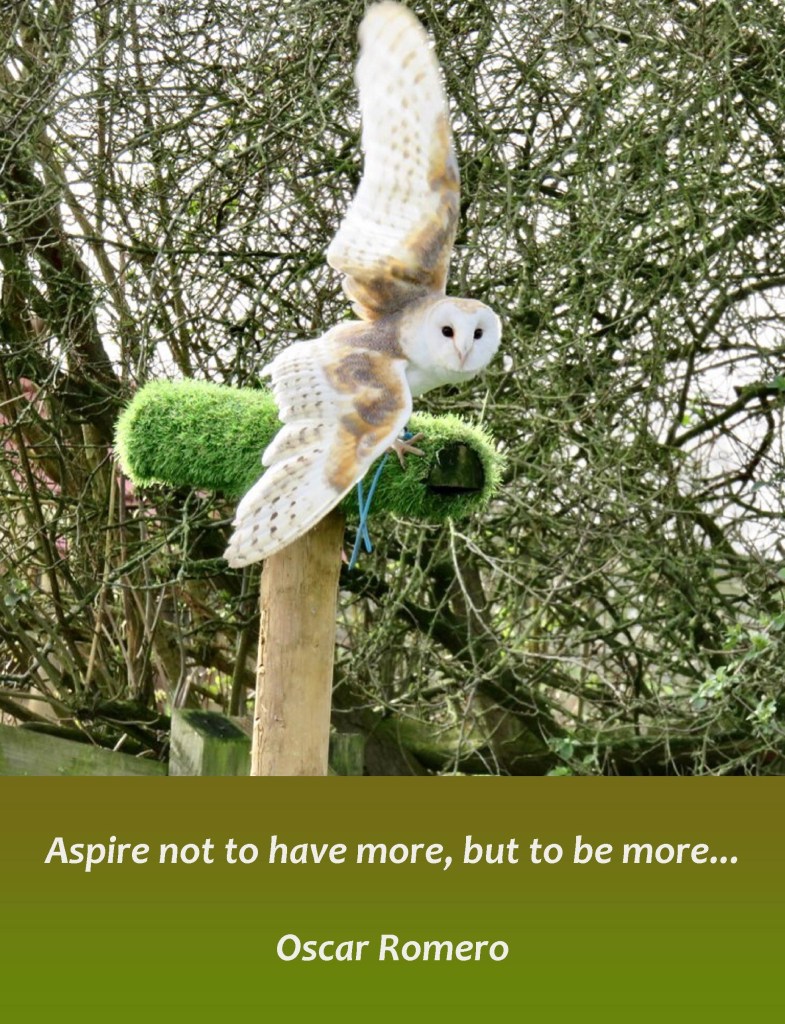
This quotation from Oscar Romero is one that is often quoted. In one sense it is about putting the needs of the poor and the oppressed before onself. In our tupsy-turvy world the love of possessions is often greater than responding to the needs of the people who have little. This is becoming more obvious as the Covid virus is affecting levels of society which have, hitherto, been fairly immune, maybe even cushioned, from reality. Less so now, though there is a strata of society who have been rarely affected by the vagaries of the economic and social situation. We had an example of that yesterday in a thoughtless and rather pompous utterance in Parliament by a Government minister, with much personal wealth, whose main job ought to be about serving the people – all, not just a select and privileged few.
Oscar Romero knew life to be at its harshest and also fought for those in material terms have very little. He cautioned against judging people on what they haven’t got in the way of possessions. We must affirm people not for what they lack in a material sense but rather for WHO they are. Being or becoming the person God means us to be is much more important than any thing else. Sister Edmee of the Sisters of the Love of God believed that it’s our prime vocation to enter into a unique and personal relationsip with God as, through grace He shapes us into becoming the person He longs us to be. Each of us is called into a unique relationship with God which allows Him to love us in a special way. It is a call heard and answered in prayer. Out of this is the love we pour into a fragmented and often despairing society, especially at present. Our true being is expressed primarily in serving God and so reaching out in love to others. Especially those who need our love the most – the lonely and afraid, the sick and the suffering, those who are having a rough time in so many different ways. We are called to be healers who in the power of Jesus’s name touch open wounds and pour in the balm of love.
Jonathan Sachs understood this more than most and not just because he represented a people who have suffered (and go on suffering) at the hands of others through prejudice, persecution and destruction. He understood the need to celebrate who we are and to reach out to others way above aquisitiveness.
In the end we will be judged by how much we have tried to love others, God, and yes, in the right way, ourselves, rather than how much we have in the bank or how much we have achieved in terms of personal success or what we have acquired. In his book, To heal a Fractured World, Jonathan Sachs speaks of the most difficult thing he had to do after becoming a rabbi – taking funerals. Being new, he had little knowledge of his people and he had to ask others about the deceased. Usually, he says, they would tell him about how so-and-so had been a loving husband or wife, a loving parent, a loyal friend. They would speak about the good they had done to others, often quietly, discreetly.When they were needed, they were there. They shouldered their responsibilities to the community. They gave to charitable causes and if they couldn’t give money, they gave time. Those most mourned and missed, he says, were not the most successful, rich or famous. They were people who enhanced the lives of others. They were the people who were loved. At no point did people speak in praise of people who had died, about what car they drove, what house they owned, the clothes they wore, the exotic holidays they took.
At the heart of all this, he says, is that “God created the world so that others could enjoy it. Goodness is not an attribute of the soul but a way of acting and creating: creating happiness for other people, mitigating their distress, removing even a fraction of the world’s pain. we worship God spiritually by helping his creation physically.
That was central to the praying, teaching and action of Oscar Romero and it breathes meaning into his belief that we should : Aspire not to have more, but to be more. Rather like the lovely owl who is ready for flight and freedom. Who soars above the world and celebrates sheer being and brings joy to all whose lives are lifted by the sight. Do we lift others by our actions, our love, and who we are?
Thank you Joyce for the lovely image to go with Oscar Romero’s vital words.
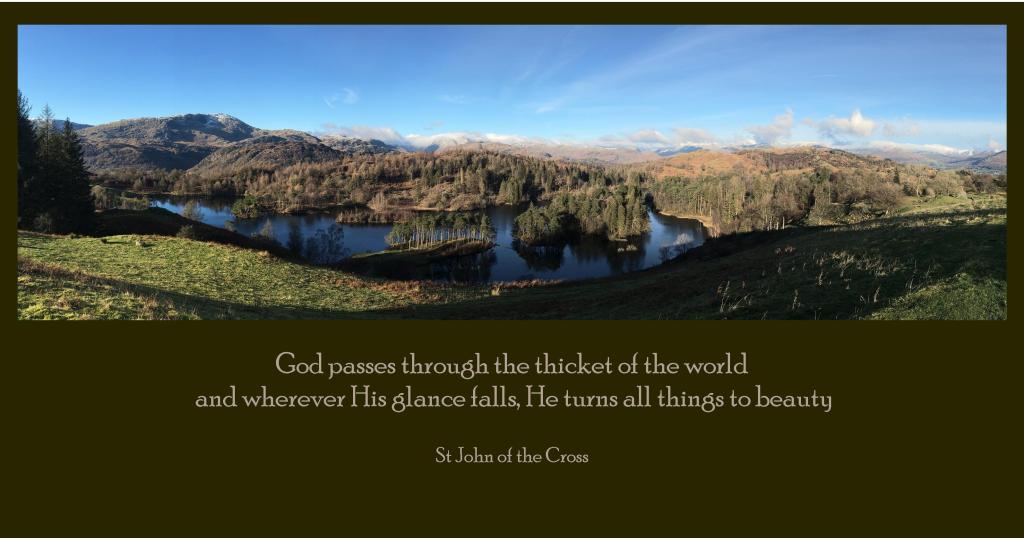
Photo of Tarn Hows and surrounding hills by Gill Henwood
Today, December 14th, is a special day. It’s the day the Church keeps the feast of St. John of the Cross.
Some years ago, towards the end of a visit to Spain, we arrived at Ubeda. It was a wet Sunday afternoon and the town was all but deserted. The one eating and drinking place was the only crowded place. I had gone there, however to see something very important.
We had started the Spanish journey by travelling from Madrid to Avila. There, my companion and I visited the shrine of St. Teresa of Avila. She has been a favourite saint of mine for a long time and I have tried to dig deep into her spirituality. There is something profoundly mystical about her and yet, also, an accessible ordinariness. Teresa tells it as it is! She also tells God what’s on her mind!
Her legacy, for which she was honoured as a Doctor (Teacher) of the Faith, is her teaching on prayer. Yet her writing, done usually on the hoof, had to be encouraged. She was busy at the time reforming the Carmelite order and founding new convents of what became known as the discalced (barefoot) order of the contemplative Carmelites. (when she wasn’t actually shouting at popes, nobles and, at times God!)
In all this activity she had a series of mentors, confessors and encouragers. The chief amonst these, and her very special friend was St John of the Cross. His friendship did so much to help her in guiding others and in leaving us the great spiritual treasure we still have today.
St. John of the Cross was, himself, a man of deep spirituality. His writings and, especially his spiritual poems, established him as a mystic who walked close to God and for whom God’s love was deeply personal. The power of God’s love to touch ALL hearts is expressed by John in something he truly believed. He said, Where there is no love put love in and you will find love. In people and in situations where love is lacking, put the love of God in and you will draw love out. John of the Cross saw this as one of the most important witnesses we can make for God.
Often misunderstood and persecuted, even imprisoned, he found strength from his deep relationship with God. He also found a spiritual home in Teresa’s discalced Carmelites which he joined.
Amongst his writings is ‘The Dark Night of the Soul’, ‘The Ascent of Mount Carmel’ and ‘Spiritual Canticle’. A good introduction to his life and spirituality is by E Allison Peers, available still from good bookshops.
Like Teresa he was made a Doctor of the Church.
That rainy afternoon in Ubeda, our knocking on the door of the museum/monastery was rewarded at precisely 4pm! (When siesta was over). We were led by a quiet but welcoming monk to the shrine of St. John of the Cross. A wonderfully profound moment at the end of our joureying in Spain. In my heart was the link between the beginning of that journey and its end, not least because these two saints, in so many ways, had hearts for God that beat as one. Teresa said of John: “I cannot be in the presence of John without being lifted up into the presence of God.” In each other, they found God’s friendship and company.
But let Teresa have the last word about him on this, his feast day. She said of him, ‘Though he is small in stature, he is Big in God’s eyes.’ What better thing could be said of anyone!
 Mr G's Ponderings