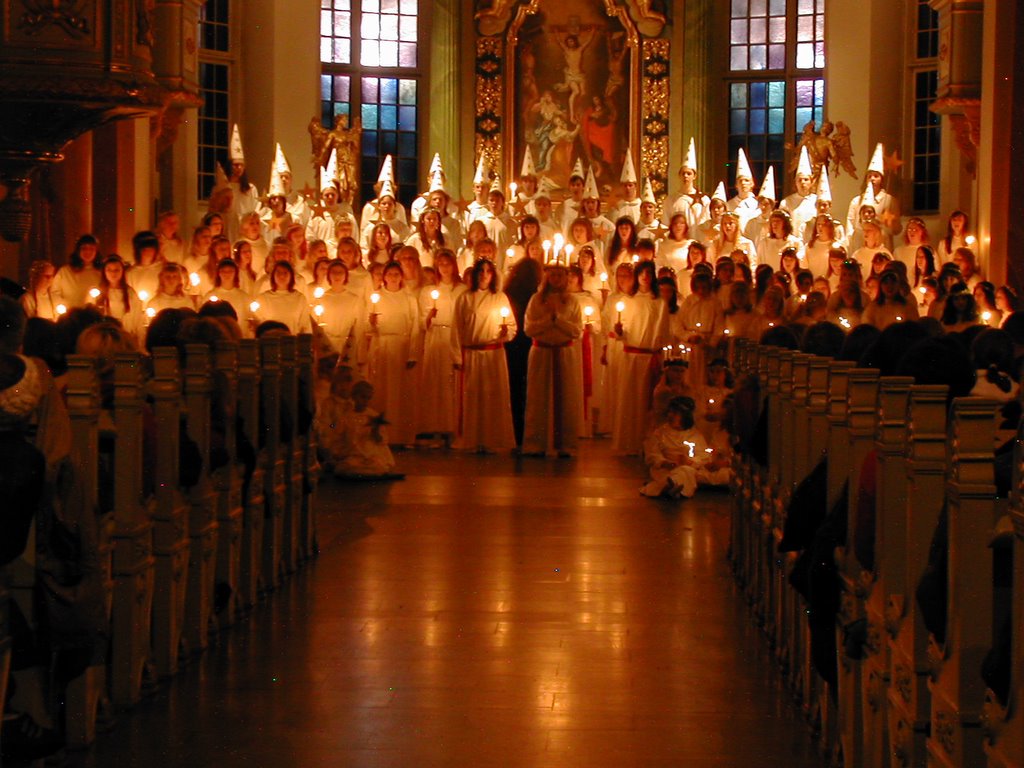
The Year’s Midnight

St Lucy’s day celebration in Sweden

December 13th is  the feast day of St. Lucy.
She was an early 4th century Christian who lived at Syracuse in Sicily at a time when the Roman Emperor wanted to restore the worship of pagan gods and, particularly, worship of himself as a god.
Lucy was supposedly a wealthy woman who, in a true following of the Gospel, decided to give away all her possessions and provide for the poor. Engaged to be married at the time; her betrothed took exception to this – no doubt having planned to marry her for her money – and so, in a fit of pique, he denounced her to the authorities. They are said to have tortured her and finally put her to death. As she died she predicted that soon persecutions such as hers would cease. Within a few years, when Constantine became Emperor he established Christianity as the only religion of the Roman Empire thus fulfilling her prophecy.

Lucy belongs, then, to that period of Christianity when martyrdom – dying rather than denouncing Christ – was not only common but also inspirational. Christians under suffering drew strength from the martyrs witness.
As with many early saints, her story became surrounded by legend as it was told throughout Christendom and her cult increased. Up until late medieval times her feast day was one that was well observed.

Whilst the martyrdom itself is the chief reason for remembering her there is another reason and it is contained in the meaning of her name – Lucy means ‘Pure Light’ – and in the position of her feast day in the Church’s Calendar. Until the secular calendar changed in the 18th century, St. Lucy’s day was the shortest day of the year – the day when the hours of daylight reached their lowest point.

The 17th century priest and poet, John Donne – who became Dean of St. Paul’s, wrote a poem  entitled “A nocturnall upon St.Lucie’s day, being the shortest day”  which began with the words:
‘Tis the yeares midnight’
which captures the sense that on St. Lucy’s day the world is at its lowest ebb. It was the time of the pagan midwinter solstice when Nature is at its deadest, which for us is marked by cold and cheerless weather, a longing to be warm indoors – our own version of hibernation, a looking forward to the light of spring. For our forebears it was a time of terror, confusion and darkness, of infertility, hunger and danger as the sun’s light all but disappears.
The Christian overlaying of this time of the year with the Festival of Christmas is no accident – the early fathers of the Church were determined not only to stamp out paganism by replacing it with new interpretation – they also recognised that midwinter was a time of gloom, despair and shadows. What better than to transform it with a festival of light and joy. So the observance of Christmas in late December seemed a natural development. St. Lucy’s day anticipates that and in Sweden and other Nordic countries it is a day of great celebration of Light.

St. Lucy’s day, falling in mid-Advent became a natural turning point as, in old calculation, we pass the shortest day and move slowly but certainly towards the re-birth that we know as Spring. From the day of her feast – though now from December 21st – the light returns; hope in new birth is gradually awakened and the year’s midnight turns towards a new dawn – the dawn of spring, still some time off but from that moment coming ever near. Here is promise and hope. It is perhaps harder for us in a world of artificial light to fully understand the relief of insecure primitive man as light returns.
Lucy, representing Light became the pivot on which the world turns.

The Christian interpretation is easy to see – as the anticipation of the Christmas festival begins to gather pace. St. Lucy’s day marks not only the restoration of the Sun’s light – it marks much more the movement towards the celebration which, in the words of St. John’s Gospel, is about God’s light coming into the world – the light which ‘shines in the darkness’  and which the darkness cannot overcome.
The physical ‘world’s midnight’ is reinterpreted as its ‘spiritual midnight’. The darkness and gloom of unbelief is pinpricked with a dawning light shining from the Incarnation of God’s Son who , in St. John’s words, is the ‘true light, which enlightens everyone.’ He was coming into the world.

The place of Light in the Christian tradition is always connected with Christ. We fill our churches with candlelight which, in former times, had a practical purpose, but as with most things Christian, is also resonant with a spiritual interpretation.
In many churches there is perpetually a light burning before the sacrament in the aumbry or tabernacle – a reminder of the light within contained in the Blessed Sacrament – a symbol itself of Christ’s perpetual presence amongst us.
How many, like me, have entered a church when it is dark and been drawn to that pinprick of light and have known that whatever life throws at us, there is always the light of Christ drawing us from gloom, darkness, life’s pain and confusion towards Him who is both Light and hope?
This is the essence of Christmas – a festival to banish the darkness of winter which for the world is symbolised by decorated trees, carols, songs and festive fare and much tumult but which has, at its heart, the silent pinprick of light puncturing the darkness and refusing to be overcome by it. What hope that contains!

So we move through Advent towards the certainty of that light and as we pass St. Lucy’s day we are reminded that whilst there is suffering in this life, not least throughout the pandemic which has marred 2020, – there is beyond it a real hope. This hope is to be found in the ‘meaning’ of Christmas which is a festival celebrated in darkness yet within that darkness is the faint glimmer of light which grows stronger as Christ leads us from Christmas to Resurrection.

How strong that glimmer becomes personally depends as much on us as on anything else. Christ has already lightened the yeare’s midnight. He has already come into the world. Whether he can penetrate through to our hearts depends on whether we are prepared to put our hopes and our trust in God so that in his Word to us at Christmas – which is Christ – we are drawn to celebrate his light – not as a cultural festival with all its trimmings  which will be muted this year anyway– but as a profound sign that God really is in the midst of our lives, shining with the radiance of a love so powerful that not even our own worst fears, forebodings or the dark things that happen to us can drown him out.

Lucy, St Lucia – pure light gives us the word lucid – to make clear. In the morass of this present time may the light of hope, of love, of God become clear to us personally and shine in all our hearts and through us, into a world deeply in darkness and in need of Light.

[Mr G]

The Rainbow Promise

A vibrant rainbow arcs across Norfolk Bay on the Tasman Peninsula, Tasmania, Australia.

An Advent reflection from my friend Joyce Smith.

God said, ‘This is the sign of the covenant that I make between me and you and every living creature that is with you ….  I have set my bow in the clouds, and it shall be a sign of the covenant between me and the earth. When I bring clouds over the earth and the bow is seen in the clouds, I will remember my covenant that is between me and you and every living creature of all flesh; and the waters shall never again become a flood to destroy all flesh.  (Genesis 9: 12-15)

As the last tears of rain fell to the waiting earth,
the sun emerged from behind the darkened cloud
and a rainbow arced across the sky.

A rainbow
bright with promise
fragile with love.

Each colour of the bow
formed through brokenness
each colour
shining with hope.

The red, energetic and passionate;
on the outside, yet enveloping the whole.

The orange, glowing and warm;
encouraging, yet challenging.

The yellow, bright and sharp;
fun-loving, yet self-giving.

The green, vibrant and fruitful;
dancing, yet nurturing.

The blue, clear and concise;
seeing, yet knowing.

The indigo, royal and strong;
commanding, yet feeling.

The violet, mysterious and delicate
on the inside, yet in touch with the edges.

Each colour, unique and special;
each formed from the one broken and true light.

Each colour, unable to exist without the others;
each a vital part of the bow.

Each a part of the promise;
each a part of the brokenness.

Lord, as you remember your promise to us,
help us to join together to be the colours of your rainbow;
and reflect your one true light.


Lo, He comes with clouds descending

photo | sky over Newhall, Piers Northam

My friend Diana reflects on one of her favourite Advent hymns.

‘Lo! He comes with clouds descending’ is not a typical Advent hymn: these tend to be reflective and in minor keys. This one is a jolly good sing, but also has some theology in it, like all good hymns do. Many years ago, under a previous vicar, we used to sing it every week in Advent so I suspect it was a favourite of his too! I don’t think we should sing it that often as its very familiarity can stop us hearing its message.

It was written by Charles Wesley, so we shouldn’t be surprised at the theology, and the tune, Helmsley, was written by Thomas Olivers, a Welsh preacher and hymn writer. As is often the case with Wesley’s hymns there were more than the usual four verses that we have in our hymn books; it is likely that he started with a text by John Cennick, which starts with ‘Lo, he cometh, countless trumpets’. Charles Wesley modified some of the verses and in the New English hymnal we have the most popular version. If you look on line you can find some variations but all of them start with the image of the triumphant Christ of Revelation returning to earth, a second coming that will be very different from the first as a baby in Bethlehem.

However this hymn does not shy away from the story of Holy Week – in contrast to the image of the Son of Man coming on clouds, in line one, we are told that he was ‘once for favoured sinners slain.’ But this entrance into the world sees Jesus accompanied by ‘thousand thousand saints attending’. ‘Alleluya!’ they sing, we sing, ‘God appears on earth to reign.’ Wesley points out that everyone will see Jesus this time, including those who played a part in his killing. Now, though, they will see the ‘true Messiah’ the one the Jews had been expecting for millennia, the true King of all creation in power. But, the third verse goes on, don’t forget what happened, those scars can still be seen to remind us of the great love that he showed us at Calvary.

The fourth verse is all about giving Jesus the praise that he deserves as God the Son. We acknowledge him sitting on the eternal throne and we ask him, we plead for him, to claim the Kingdom with all his power and glory so that God’s Kingdom is established on earth in all its fullness. ‘Come quickly, O come quickly! Allelyua! Come, Lord, come!’ Amen

Lo! he comes with clouds descending,
once for favoured sinners slain;
thousand thousand saints attending
swell the triumph of his train:
Alleluya!
God appears, on earth to reign.

Every eye shall now behold him
robed in dreadful majesty;
those who set at nought and sold him,
pierced and nailed him to the tree,
Deeply wailing
shall the true Messiah see.

Those dear tokens of his passion
Still his dazzling body bears,
Cause of endless exultation
To his ransomed worshippers:
With what rapture
Gaze we on those glorious scars!

Yea, amen! let all adore thee,
high on thine eternal throne;
Saviour, take the power and glory:
claim the kingdom for thine own:
O come quickly!
alleluya! come, Lord, come!

[Diana Lowry]

Where prayer is valid

Little Gidding Church | photo Mr G

Today the Church of England remembers Nicholas Ferrar.
He is forever connected with Little Gidding which is near Huntingdon. It here that he founded a community to live a life of prayer. This was in 1625. Their prayer was based on the Book of Common Prayer which was that of Edward VI (1559). The Community gathered in the Church at Little Gidding to say Morning and Evening Prayer together with reciting the Psalms. They also maintained a ceaseless intercession. They set up a school for local children, cared for the local sick and helped to relieve the destitute.
Nicholas was a deacon and the community was made up of his immediate family. The community was broken up by the Puritans after Nicholas’s death who feared that it was bent on re-introducing Romish practices into England. (Despite their prayer being based on the Church of England’s Prayer Book!) The Puritans demonstrated what alas is still prevalent today—that fear often leads people to act irrationally and often cruelly.

The memory of the Ferrars lived on and this had much to do with the consecration of the Church at Little Gidding by constant and faithful prayer. It has many visitors, apart from this summer, of course.
Its fame today also has much to do with the 20th Century poet, T.S.Eliot,  who wrote about Little Gidding in a poem of that name which was published in his Four Quartets. It was of Little Gidding that Eliot wrote:

“You are not here to verify, instruct yourself, or inform curiosity, Or carry report. You are here to kneel where prayer has been valid.”

That is certainly true of Little Gidding where the prayers of countless pilgrims have soaked into the very atmosphere of the place, and indeed formed that ‘atmosphere’. Well might we say with Jacob in Genesis 28:17, ‘How awesome is this place.; this is none other than the house of God. This is the gate of heaven.
This is a meeting place with the Holy Spirit.

For Eliot, prayer is ‘more than a form of words’ which are often inadequate. The Holy Spirit transforms our efforts, however halting, into a powerful utterance which turns buildings such as the church at Little Gidding into portals through which we seek and find a glimpse of heaven. In such places, not all by any means churches, we can sense that the divide between earth and heaven, between us and God, is tissue paper thin.These ‘thin’ places are where Heaven and earth seem to touch. The eternal breaks though. The extraordinariness of God meets with the ordinariness of our lives and reveals the glory within.
These become in some way ‘places of Resurrection’, and you may perhaps revisit some of the places which have become special meeting places with God in your own lives.
Just being able to visit them in your memories may be just as valid because Whilst it is possible, in the words of T S Eliot in Dry Salvages we can have the experience but miss the meaning, it is more likely that the sense of being in God’s presence never leaves us. We can visit the memory and call to mind what God has already shown us – his love. We re-member this as surely as we re-member Jesus in the Eucharist or in his drawing of us safely to heaven. A past experience becomes immediate again.

The search for one’s place of Resurrection is not necessarily a physical journey but it is always a spiritual one. All of us are on a pilgrimage, a journey to where we belong and that journey is towards God. In this journey, as a friend of mine once said, “we are to ask that ‘the journey be long, full of adventures, full of things to learn.’ The significance of the destination is that it gives a reason for the journey. Desire for the homeland, longing for God, quest of whatever Grail we seek” (Ronald Trounson)

One certainty is that on this journey, in those places where we meet him, God touches our hearts wth his love again and again and it is this that ultimately makes all our prayers valid.
Little Gidding and Nicholas Ferrar bear testimony to that.

Loving God, the Father of all,
whose servant Nicholas Ferrar
renounced ambition and wealth
to live in a household of faith and good work:
keep us in the right way of service to you
so that, feasting at the table in your household,
we may proclaim each day the coming of your kingdom;
through Jesus Christ your Son our Lord. Amen.

[GC]