Liturgy is praxis where Beth-el recurs. The ladder is always there, Emmanu-el. Angels are always around us, enfolding us, watching over God’s little ones.
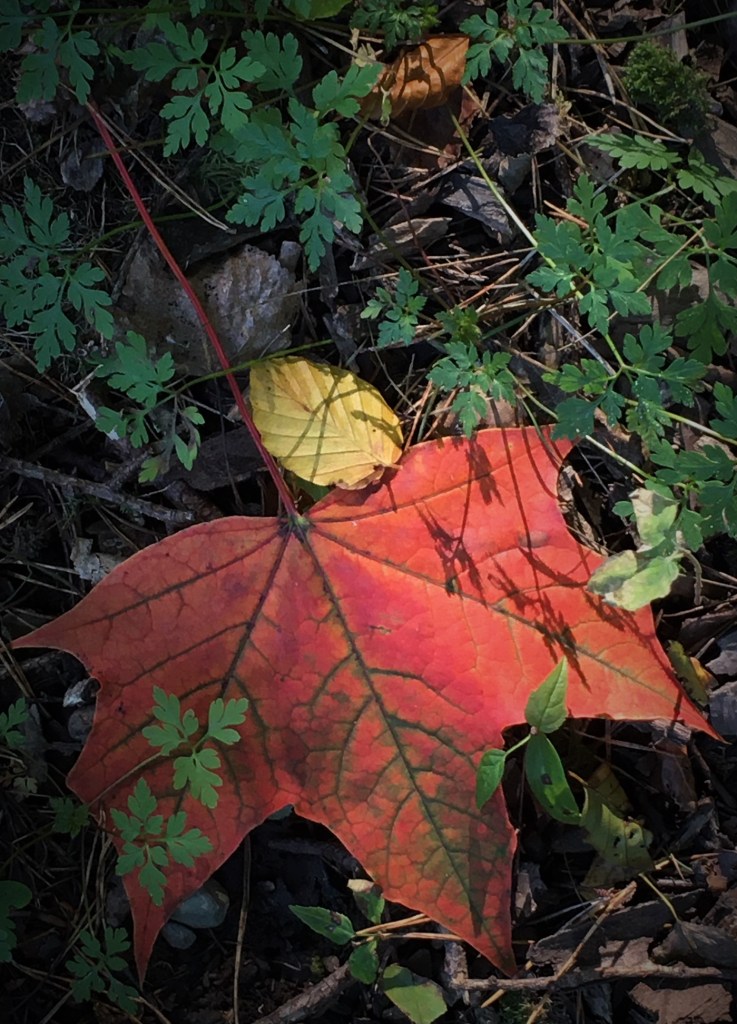
Today, the burnt red leaves fallen from the Norway maples sear the earth with their lifeblood, to nurture the future. ‘God’s grandeur’ always around our misted vision.
A reflection by The Revd Dr Gill Henwood, shared with the people of St. Michael’s Church, Hawkshead, Cumbria.
painting in Hawkshead Church of St Michael & All Angels | Paul Gregson reproduced by permission photo | Gill Henwood
Readings: Genesis 28.10-17, John 1.47-51
It’s an honour to share with you this morning as we celebrate Michaelmas, the Christian quarter day near the autumn equinox that marks the turning of the season towards winter – and towards the midwinter quarter day of Christmas. Quarter days are major transitions in the natural world: at Michaelmas the earth turns away from the sun, entering the darker half of the year. As our days shorten and nights begin to lengthen, darkness gradually takes over from the bright sunlight of midsummer. It’s a time of change, with chilly nights and cold rains, heavy dews, clouds down into our valleys and soon, the first frosts.
Michaelmas marks this transition from light to darkness in nature (of course, only in the northern hemisphere). And this year, 2020, we are entering another period of restrictions, to try to slow down the Covid19 pandemic. A transition from the summer’s easing of limits by being outside in the fresh air, to autumn’s more dangerous enclosure within homes and workplaces where the virus can thrive.
This year as we recall our church’s patronal festival, we may ask, who was St Michael and why were so many churches dedicated from the mediaeval era onwards to Michael and All Angels? Because it turns out that – in the Church of England – only St Mary, All Saints and St Peter are more popular patron saints than our own St Michael and All Angels.
The timing of Michaelmas, when sunlit summer gives way to darkening winter, speaks to us of times in our own lives when we face dark times. This year, the whole world is facing the threat of a global virus. We as a nation are trying to find ways to live protecting one another, recognising the vulnerability of many in our society. We as a parish community are trying to keep one another safe, to get through this crisis, to withstand the threats to health, livelihoods, education and even to lives.
Michaelmas recalls our longing, as people in crisis, for help. Our sense of powerlessness before a threat for which there is as yet no vaccine or cure. Our sense that once again, we are faced with the limitations of our humanity. We realise anew the real challenges: to the ingenuity of scientists and researchers, to the care of medical, nursing and caring professionals and family members, to people trying to work and live through this crisis.
When our church became a parish, our mediaeval forbears turned to Michael and All Angels as their patrons. Michael was associated with healing and later with protection. There are many stories and works of art picturing Michael as a victorious archangel in a soldier’s armour vanquishing the dangerous threat, symbolised as a serpent or dragon or demon. The iconography of Michael defeating evil may also underlie the later adoption of the Christian Roman soldier George as England’s patron saint, conquering a dragon that threatened peace and harmony.
The scriptures tell us of protecting angels of God. In the reading from Genesis, Jacob dreams of a ladder between earth and heaven with the angels of God ascending and descending on it. The angels connect earth with heaven, humankind with God, nature seen with nature sensed-as-beyond-us. Sometimes in our dreams, sometimes in our hopes and prayers, sometimes in our fleeting glimpses of God’s presence with us and among us. Jacob dreams of the great ladder with angels connecting heaven and earth, and hears God’s promise: ‘Know I am with you and will keep you wherever you go… for I will not leave you’. When he wakes, Jacob recognises that he has encountered God in his dream, formerly unrecognised when he lay down to sleep. He is afraid, overawed, by the presence of God with him. Jacob realises – Jacob knows in his own heart – that ‘This is none other than the house of God, and this is the gate of heaven.’
Wherever God comes to each one of us – whether in a dream or daydream, in our hopes or longings, on a fell top or in our garden, in the isolation of lockdown or the busyness of everyday – we may, like Jacob, recognise God is present with us. It may be in a very short conversation between someone we meet on a footpath, maybe in the kind word of a stranger or phone call of a friend. That moment of recognising God is present with us may be when the evening sun hits Latterbarrow and sets the autumn bracken on fire, or breaks through the clouds in a shaft of light or a rainbow. God is present with us every day, when we open our hearts to recognise that presence. It may be in the quiet of our church, open during the week for prayer, that we sense ‘this is none other than the house of God, and this is the gate of heaven’.
And it may be when a robin sings in our garden, or in Crag Wood, a cathedral of oak trees. This too may be the gate of heaven.
Jesus knew the presence of God with him, within him, as he was out and about in the natural world of fields and trees, as well as worshipping in the synagogue. In our gospel reading he recalls to his followers Jacob’s dream of the ladder, with angels of God ascending and descending, connecting heaven with earth. Jesus promises that one day they too will recognise God’s presence with them as Jacob did, through the ladder of the Son of Man.
Through Jesus, God’s promise to Jacob is renewed and made real for them – ‘Very truly, I tell you, you will see’ – you will know – we will know, as Jacob knew, that God is with us. We too can hear God’s promise throughout the ages to his people, ‘Know I am with you and will keep you wherever you go… for I will not leave you’.
We too can wake up, every day, every moment of our days, to pause and recognise that God is present with us. Jesus is God’s ladder uniting heaven with earth, reuniting divine with humanity, renewing creator with creation. We too can sense the angels of God protecting us, prompting us, surrounding us; pointing us to Jesus, the way, the truth and the life.
This Michaelmas, let us prepare for darkening days ahead by opening our hearts as Jacob did and as Jesus’ disciples did, to hear God’s voice speak within us and among us afresh. Let us open our hearts to receive God’s presence with us anew, to let God’s Holy Spirit come to us as the Comforter who assures us of God’s love given to us in Jesus. Let us open our hearts to be united in love with God in Christ through the Spirit, and so to be united with one another. May we know – that God is with us and will keep us wherever we go… for God will not leave us.
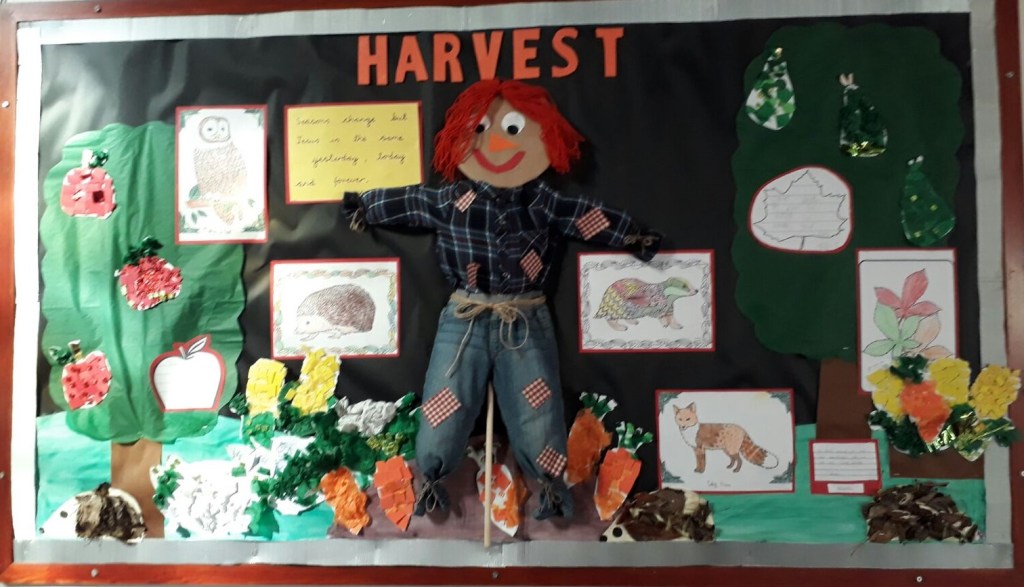
Harvest poster @ St. James, Whitechapel, Lancashire created by Helen Smith & Sunday School children
John, a Vicar in North Lancashire once told me that on Harvest Sunday he had blessed the Atlantic Ocean . As his parish was extremely land-locked I expressed some scepticism about this. “The trouble with you,” he told me, “is that your vision is too narrow!” He then explained that on Harvest Sunday morning he had held a service at a farm in the parish. During this service he had blessed the farm’s water-supply, a stream which ran into a small pool and then out again at the other end. This water then flowed down into a small river which eventually flowed into the mighty Ribble. This in turn flowed out into the Irish Sea and the Irish Sea was eventually joined to the Atlantic Ocean . So John, by a small stretch of imagination and a big vision had indeed blessed the Atlantic Ocean . I was both deeply impressed and very chastened!
John’s big vision was a reflection of God’s vision for Creation. Harvest Festival time is an opportunity to think about the Farming community and , despite the problems in Agriculture, to celebrate and give thanks for those who provide for our needs and share with God in the joys and fruits of creation.
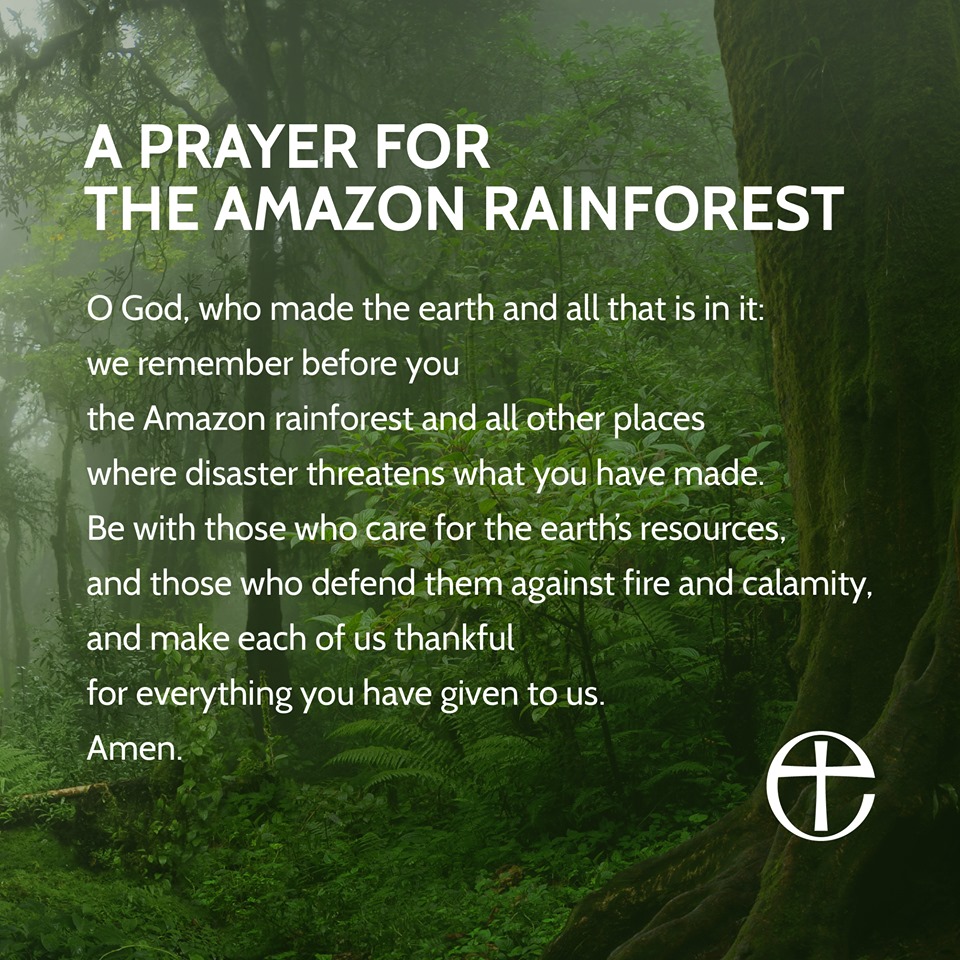
It is also essential to focus on those who have no harvest. This is a time of great uncertainty with all the effects of Coronavirus, not least the plight of the increasing numbers of those needing to use Foodbanks*. Then there is drought in various parts of the world, extreme heat causing wildfires in West Coast America, after devastating fires in Australia, the effects of war in the Middle East, the destruction of the rain forests, all of which are compounded by situations like the explosion in Beirut which destroyed homes and lives, and so much that mars creation. Add to that the possible problems for farmers and food producers and sellers who will be affected if we have a no-deal Brexit.
Whilst these are big issues affecting us as we try to harvest the resources of our planet with responsibility, we mustn’t lose sight of the bigger picture. In a world teeming with beauty there is a right moment to say Thank You to God for providing a world not only for our needs but also for our delight.
When, in 1843, the Revd R.S. Hawker introduced to his parish in Cornwall an Harvest Thanksgiving service, he simply wanted to give thanks to God and to the farming community. He did not guess then that by 1862 such a festival had become so widespread that the Church of England, encouraged by Queen Victoria, made it an official Thanksgiving. Others have joined the celebration.
Though that Cornish Vicar lived at a time of rapid and deeply unsettling change in Agriculture as people started to migrate to the new industrial centres seeking work in manufacturing industries, he still saw much to give thanks for. We can get bogged down in the negatives in a way which blots out the positive. There is a wideness of vision which can take in the difficulties and problems whilst pointing us beyond them.
In rural Lancashire during the time I was there, we had the beef and then the sheep crisis in the space of ten years. Both had a devastating effect on the lives of the farming community. We also lived in an official Area of Outstanding Natural Beauty. Both the problems and the joys existed side by side. With so much beauty around us the area attracted many visitors. Today many farmers still tend the land but also cater for those in search of the beautiful and the breathtaking. Those indeed who are able to drive or walk through the countryside in search of something we might call spiritual and what I would certainly recognize as God, are often refreshed in spirit. With the brushstrokes of His creativity God has painted on a wide and deep canvas. We should stand back from time to time and enjoy the view.
Harvest is certainly a time to pray for farmers and give thanks for their provision of food. It is also a time to do something practical about the needs of the world. It is, however, particularly, a time to thank God for all the providence and goodness towards us.
[GC]
Foodbanks* throughout the country are reliant on gifts from the public. Many are currently overstretched and would welcome donations of food . Why not find out where your nearest Foodbank is and phone them to ask what are their specific needs. Then think about how you might be able to help. This too is an expression of thanksgiving.

 Mr G's Ponderings