a photo reflection by my friend Joyce

a photo reflection by my friend Joyce
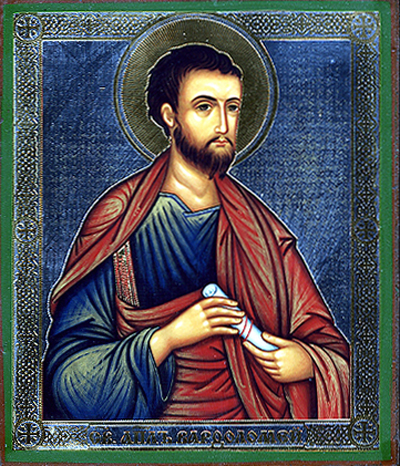
A bishop friend of mine once preached a sermon at a College where I was chaplain, about a rather obscure saint, St. Brassica. He told of many heroic and saintly deeds and we were enthralled. His tongue was, however, firmly in his cheek and we were not alerted to the fact that he may have been making it all up, even when he told us that she suffered martyrdom by being boiled in water and that the water turned green – though culinary experts will immediately recognise that ‘Brassica’ is just another name for the Cabbage family.
The saint we think of today, Bartholomew, could easily fall into the same category of ‘make-believe’ for, beyond being told his name as one of the 12 Apostles, Matthew, Mark and Luke give us no further information. John doesn’t even mention him at all. He can be found in the Acts of the Apostles, listed as one of the 12 Apostles. The compilers of today’s lectionary give us a piece of St. Luke’s Gospel which actually doesn’t mention him either.
All this leaves me in somewhat of a dilemma. To continue the culinary illustration, it is rather like trying to prepare a meal with only a pinch of salt as the ingredient.But a pinch of salt may be all we need to glean something from this Feast Day. The first grain of salt which provides a clue is his name.
In all probability, Bartholomew isn’t actually a first name at all. It was quite common in Judaism to identify a man by the name of his father – just as many of our own surnames identify us with people in the past, or with places and trades. Surnames which end in SON for example. In Judaism it was the prefix BAR which did this because bar means son of and it has been suggested that Bartholomew means Son of Tolmai or Talmai. This has led to some to quarry the Old Testament – often a favourite haunt for those looking for the obscure – and linking the name with that of Talmai who appears in the Second Book of Samuel as the King of Geshur and whose daughter became the mother of Absalom, the somewhat wayward son of King David. At this point, imagination runs riot because once you can make a link with King David you can get into all that royal lineage stuff which gets Matthew all excited at the beginning of his Gospel. The conclusion some have reached is that, amongst a group of followers which included humble fishermen and repentant tax gatherers there was one of Royal descent. If, as may be the case, Bartholomew is a surname it stands to reason that he must have had a first name and this brings us to our second grain of salt.
John’s Gospel makes no mention of Bartholomew but he does speak of Nathaniel and there are strong suggestions that the two are one person. Nathaniel, also known as the man without guile or lacking in deceit, was the young friend brought to Jesus by Philip. Initially he was somewhat cynical. Philip told him that they had found the one about whom Moses and the prophets had spoken. ‘Can anything good come from Nazareth’ he is reported as saying and Philip told him to ‘Come and see’. When he met Jesus he was surprised by the insight Jesus had into his character, based partly on the fact that our Lord had seen him standing under a fig tree – a favourite Jewish position for deep prayer. Just as today, actions show the depth of devotion and faith and so Jesus had drawn a conclusion about Nathaniel’s love for God.
That Nathaniel and Bartholomew may be one and the same person is further strengthened by the fact that in John’s Gospel it is Philip who brought Nathaniel to Jesus and in the other three Gospels, Bartholomew and Philip are joined together in the list of the names of the Apostles. The link is possible but not conclusive. Yet it is all we have.
The next grain of salt belongs to the realm of legend and the group of stories which grew up within the early church about the deeds of the Apostles but which never made it into the New Testament. This need not make them untrue because those who brought the books of the New Testament together had to make choices about what to include and what to leave out and many good sources of stories about the Apostles are to be found in the New Testament Apocrypha – the name given to the collection of early Church writings which were excluded. Amongst these is the Gospel of Bartholomew and the references made to him by Eusebius (who wrote a famous history of the early Church) and St. Jerome who translated the New Testament writings. Both mention that when missionaries arrived in India during the second century they found Christians already there who were using a version of St. Matthew’s Gospel in Hebrew which had been brought to them by Bartholomew.
A legend speaks of him as working alongside Philip in Phrygia which confirms their partnership of faith. Another legend tells of Bartholomew’s work in Armenia where he is said to have been martyred. It is from this source that we get a description of him as a man with black curly hair which was so long that it covered his ears, white skin, large eyes, straight nose, and a long and grizzled beard. He wore a white robe with a purple stripe and a white cloak which had four gems at the corners. It is said that he wore the same clothes for 26 years though they were as fresh as the day he put them on.
We are also told that he prayed a hundred times each day and a hundred times each night and that his voice was like a trumpet! Angels were said to have waited on him and he was proficient in all languages. He was always cheerful. It was not uncommon for the lives and characters of saints to be written up to make them larger than life and this has clearly happened here but we must remember that at a time when the church was suffering great persecution it was important to give the faithful inspiring stories of the saints to inspire and encourage them.
These grains of salt are almost all we have though there is one thing more and it is what makes this festival day so important and, in fact, which provides us with a truly spiritual meal to feast on. What matters, in the end, is not what we know about Saint Bartholomew but what he stood for – or rather, WHO he stood for. One of the most important marks of saintliness is that of taking to heart something our Lord speaks of in today’s Gospel – that those who are called to follow him must be prepared to serve him and must be servants, therefore of the Gospel. They mustn’t seek greatness for themselves.
Keeping the culinary theme going, Jesus speaks of waiting at table – and the dish the Apostles, and we ourselves, serve up is the dish of the Good News of Jesus Christ – which we are to present to the world for its feasting. In serving the Gospel it is not ourselves we promote.
The Church fails in its mission when it gets wrapped up in itself, its own concerns and in seeking to promote itself in the eyes of the world. Too often the Church is bothered about its image and about rather small-minded things. It neglects the Gospel in favour of its own opinion or, sometimes, prejudice. God is not served by disagreement, faction, bickering or self seeking. He is not proclaimed when we exclude from the God of Love and his Gospel those who do not share our views and those with whom he had a special relationship – often the ones we might shun. The Gospel is far bigger than anything we can say about it and Jesus is far greater than our ideas about him. We all have a great deal to learn about the Love of God and about how that love transforms lives.
So Bartholomew, about whom we know virtually nothing, and his ideas and theories about which we know absolutely nothing, is really quite a good model for us. What we need to know is that he proclaimed Christ, his suffering saving love and his deliverance to that joy of eternal life which begins not at death but now, when we serve him with cheerful, loving hearts.
I mentioned earlier the Gospel account which Bartholomew wrote and which is hidden in the midst of time. What has survived of it is some questions that he asked Jesus after the resurrection and at the end of the questioning he is said to have taken hold of our Lord’s hand and said these words:
Glory be to you, O Lord Jesus Christ,
Who gives unto all, the grace we have perceived. Alleluia!
Glory be to you, O Lord, the life of sinners.
Glory be to you, O Lord, death is put to shame.
Glory be to you, O Lord the treasure of righteousness.
For unto God do we sing.
Whether those words came directly from Bartholomew or not, we can be certain that his life as an Apostle was shaped by his intimate knowledge of the love of Jesus which caused his heart to sing of his Lord with joy and to proclaim Christ’s glory. That is what we need to know about him – and that is what we are called to imitate in our own lives.

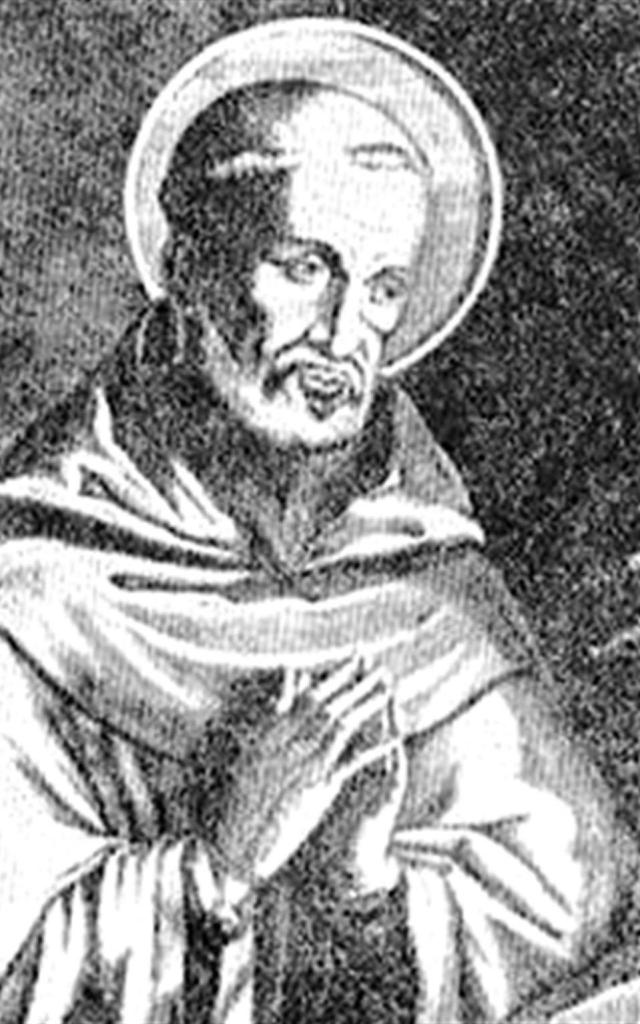
St Bernard of Clairvaux | feast day August 20th
Bernard was born in 1191 near Dijon in Burgundy. His family were wealthy and had great social standing. Bernard is said to have been a shy boy but he also became known as studious and meditative. With the advantages of his birth and upbringing it was expected that he would make a career with status and wealth as its motive but under the influence of his mother, who was granted visions about his future, he became attracted to a very different way of life. He became a monk and entered the Cistercian monastery at Cîteaux. Here he followed a life of simplicity, holiness and prayer which he combined with a deep ministry towards others.
As he became more drawn to the spirituality of the Cistercian Order, he felt called to spread the Cistercian influence and way to God and it is thought that he founded over 150 new monasteries all over Europe. He spread the vision of God’s love in Christ Jesus and became renowned as a preacher of God’s Word. Martin Luther was to say of him:
‘Bernard is superior to all the doctors in his sermons, even to Augustine himself, because he preaches Christ most excellently.’
His spiritual renewal of the church also spilled over into the world in general because he knew that the spiritual side of our lives involves us in being influential in the way society is shaped. The more involved Christians are in the world, including working for change and seeking to influence Governments to a greater integrity and honesty which leads to everyone working for the common good, the more our society becomes God-centred.
For All the Saints’ (prayers and readings for Saints’ Days published by the Anglican Church in Canada) puts it this way:
“He used his influence to renew in his own age the ageless thirst for that love which is above all other loves which God ‘has poured into our hearts through the Holy Spirit.
In his writings he expanded on his understanding of this love. In his Treatise On the Love of God, Bernard wrote:
“God deserves of us all our love which knows no bounds. This is the first thing to understand. The reason is because God was the first to love. God, who is so great, loves us so much; he loves us freely, poor pathetic worthless creatures though we be. This is which is why I insist that our love for God should know no bounds. And since love given to God is given to the One who is infinite and without boundary, what measure or boundary could we make anyway .…. the reason, then, for our loving God is God. He is the initiator of our love and its final goal.”
In order to help us to enjoy that, Bernard wrote a number of poems, some of which were translated from the Latin and set to music. Many of us will know St Bernard without realizing it. There is a strong belief (though not totally agreed) that the hymn O Sacred Head, sore wounded is by him and certainly, the hymn, Jesus the very thought of thee, (translated from the Latin by Edward Caswell ) is from a poem by St Bernard. It is sung to a number of tunes though the most usual is St Agnes by John Bacchus Dykes. Today we sing 4 or 5 verses but the original Latin poem “Jesu dulcis memoria” had 50 verses! Caswell selected verses 1-4 and verse 40. There is a beautiful rendition on YouTube sung by Brigham Young University and the Church of the Latter Day Saints. (dated 2013)
Jesus, the very thought of thee
with sweetness fills the breast;
but sweeter far thy face to see,
and in thy presence rest.
No voice can sing, no heart can frame,
nor can the memory find,
a sweeter sound than Jesus’ Name,
the Saviour of mankind.
O hope of every contrite heart,
O joy of all the meek,
to those who fall, how kind thou art:
how good to those who seek!
But what to those who find? Ah, this
nor tongue nor pen can show;
the love of Jesus, what it is,
none but who love him know.
Jesus, our only joy be thou,
as thou our prize wilt be;
in thee be all our glory now,
and through eternity.
Words
Bernard of Clairvaux
trans. Edward Caswall, 1849
Music
St. Agnes | Metzler’s Redhead | St. Botolph Bawley | Windsor (Rhythmic) | Dalehurst CM
Bernard of Clairvaux lived deeply within the love of God and his journey to heaven and the Lord he loved was on 20th August 1153.
Almighty and everlasting God,
You kindled the flame of your love
in the heart of your servant Bernard,
so that he became a shining light
in the midst of your Church.
Kindle in us such faith ,
that by deeds of love
we may show forth the light of Christ
and rouse this present age to desire your perfect beauty;
through Him who lives and reigns with You and the Holy Spirit,
one God, now and for ever.
Amen.
 Mr G's Ponderings