My friend, Canon Joyce Smith has been working on a project of photo meditations on the Psalms since lockdown began. It’s a project she has wanted to do for some time. This is one of her offerings.

My friend, Canon Joyce Smith has been working on a project of photo meditations on the Psalms since lockdown began. It’s a project she has wanted to do for some time. This is one of her offerings.
Years ago, when in my late teens, I was encouraged in my Christian faith by a handful of good and faithful Christians. They took an interest in me and patiently answered my questions about all manner of things to do with God, the Church and the Christian faith. One of them, whom I came to regard as my mentor, gave me a sepia card with a photograph on it. She had bought it in Paris in the mid-1930s. It was a picture of Rodin’s ‘Cathedral’. At the time I kept it in my bible and its meaning for me didn’t emerge until many years later.
‘Prayer is our Love Affair with God’
Mother Mary Clare SLG
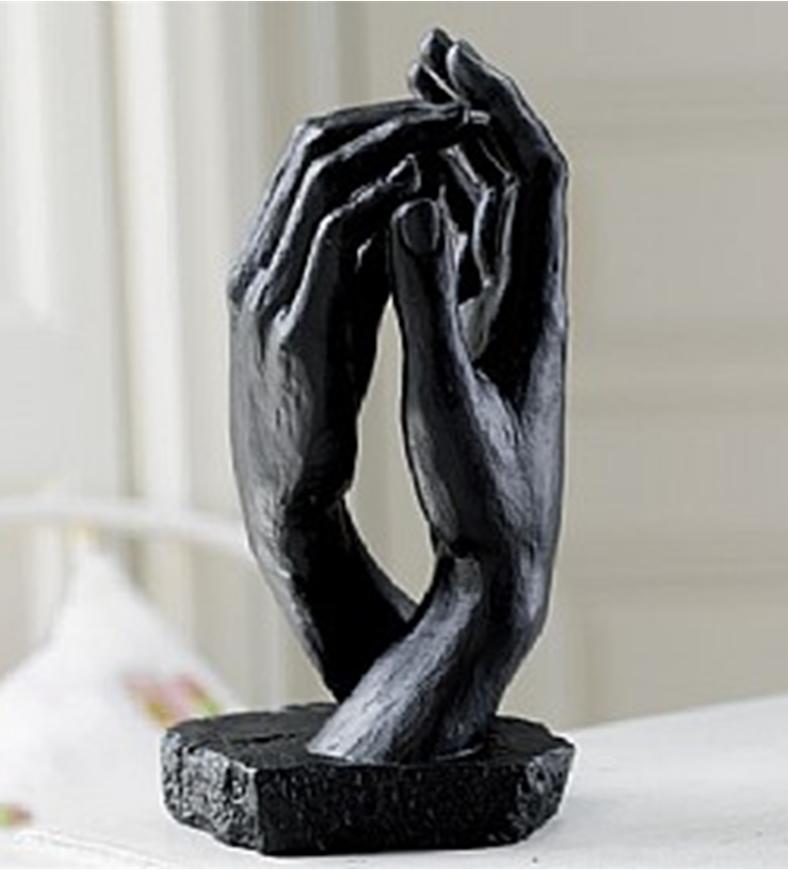
The Cathedral | Rodin
Sydney Evans, the former Dean of King’s College, London, preached a sermon in the parish where I served as a curate on the subject of ‘Hands’. He referred to the sculpture by Rodin and later on I was pointed towards another sermon, preached by Michael Stancliffe when he became Dean of Winchester. Again, it took Rodin’s Cathedral as its illustration.
When, later still, I made my first visit to Paris, I was taken to the top of the Montparnasse Tower from which it is possible to look down on the city. I searched hard and found what I was looking for. Before any visit to Notre Dame, The Louvre or the Eiffel Tower, there was something I had to see.
I made my way to the Rodin Museum and very soon I was standing in front of the exquisite statue of ‘The Cathedral’. I was amazed how tiny it was in comparison to many of Rodin’s other Sculptures. Rodin carved it in 1908, one of his later works.
It is of two hands emerging from the same base but it is unusual in that if you try to place your own hands as these are, you can’t do it – because both are right hands. The shape and poise of those hands form a kind of gothic arch and this gave Rodin the suggestion for its title. He had a passion for Gothic architecture and he combined this with his passion for modelling hands which, in his view were so expressive, capable of displaying so many human emotions.
In this work the sensuality which was such a feature of his life combined with the spiritual, avoiding that divorce that people often make, and the hands taper into a gesture of prayer.
What is important in looking at these hands is to see the gentleness and sensitivity in which they are reaching towards each other. They are not about to grip each other heartily. They are reaching towards each other but they don’t actually touch. The sculpture is held together by a connecting piece of stone but there is space between the fingers – the suggestion of almost meeting and the tantalizing thought that they might not. It is poised in that split second before connection is made and one could expect the fingers to gently intertwine. They are in the act of exploration. However, it is an exploration charged with vulnerability because they just might not connect. One or other might actually withdraw
Yet, overriding this is the much stronger image that the Cathedral presents of an exploration which is movement towards each other rather than away so I see in Rodin’s hands the hands of two lovers who are about to touch and caress. We catch them in that final moment of rather shy, exploration which will end in fingers intertwined – hands touching, holding.
It speaks to me of prayer.
Prayer in which both the one who prays and God are drawn in an act of love towards each other. E.M.Forster’s saying, ‘Only Connect’ is pertinent here. Prayer is when we connect with God and our hearts open in love to the one who always loves us. Only connect, in love.
According to a lovely nun I once knew, – the late Mother Mary Clare of The Sisters of the Love of God (SLG) – real prayer is like a love affair with God. In ‘Encountering the Depths’ she wrote this:
“Prayer is essentially […] a love affair with God, not schemes or techniques or ways of prayer, but the most direct, open approach of each one of us as a person to God our creator, redeemer and sanctifier. This is something beyond all methods and ideas. We are seeking God himself, not thoughts about him, nor about ourselves in relation to him. Prayer is an adventure at the end of which we stand face to face before the living God; not in a vague way in a place we call heaven, but in the here and now of our lives, by, with, and in Christ, as we are made part of his prayer and his offering to the Father through the power of the Holy Spirit.”
For me, this adventure of love is one of the powerful messages of Rodin’s, Cathedral. There is the suggestion of longing and loving which we need to constantly re-discover if our prayer is to remain fresh, real and a sign of the love by which we are held in God and through which we seek to become love.

photo | Lynn Hurry
The story of the Guru and the Cat.
A holy man or guru was devoted to prayer. However, when he knelt to worship each evening, the monastery cat would get in the way and distract him. So he ordered that the cat be tied up during evening worship.
After the guru died, the cat continued to be tied up during evening worship and when the cat died, another cat was bought so that it could be duly tied up during evening worship.
Much later, learned theological books were written by the guru’s disciples on the religious and liturgical significance of tying up a cat while worship is performed.
Adapted from Anthony de Mello, The Song of the Bird ,
(Image; Reprint edition, 1984) page 63.
Sometimes a simple and pragmatic action does not need to be justified by learned discussion.
It just is.
The testimony of Bishop Leonard Wilson

Leonard Wilson, who was born in Gateshead in County Durham, responded to the Call of God and was trained for the Anglican ministry at Wycliffe Hall in Oxford. On the eve of his ordination he is supposed to have prayed to God a prayer of (slightly conditional) commitment.
‘Lord, I will serve you anywhere – except the Equator, the North Pole and Birmingham!’
Whether true or not, part of his ministry was in Singapore, not far from the equator, and later he was ordained Bishop of Birmingham and is reported to have said, ‘as an old man of 70, I am waiting for my call to the Arctic!’ Whatever conditions he gave to the Almighty, he became, in fact a dedicated priest and ultimately bishop.
In 1941, during the Second World War, he was ordained Bishop of Singapore. Along with others he was arrested and interned in Changi gaol. In October 1943, the Japanese ‘Gestapo’ raided the prison and took 57 prisoners, including Leonard Wilson. He was accused of being a spy and endured days of torture. Bound to a table he was beaten with knotted ropes by relays of soldiers.
His daughter The Revd Canon Susan Cole-King, addressing the Lambeth Conference in 1998, spoke of this:
‘Often he had to be carried back to the crowded, dark and filthy cell, almost unconscious from his wounds. On one occasion, when seven men were taking it in turns to flog him, they asked him why he didn’t curse them. He told them it was because he was a follower of Jesus who taught us to love one another.
He asked himself then how he could possibly love these men with their hard, cruel faces, who were obviously enjoying the torture they were inflicting. As he prayed he had a picture of them as they might have been as little children, and it’s hard to hate little children.’
When asked by his torturers how he could still believe in God, he replied,
‘God does not save me by freeing me from pain or punishment. But he saves me by giving me the Spirit to bear it.’’
Part of that strengthening came to him, as he was being beaten. He called to mind the words of the hymn:
‘Look Father, look on his anointed face,
and only look on us as found in him.’
His daughter said: ‘In that moment he was given a vision of those men not as they were then, but as they were capable of becoming, transformed by the love of Christ. He said he saw them completely changed, their cruelty becoming kindness, their sadistic instincts changed to gentleness.’
Even in the face of his own suffering he ministered to his fellow prisoners and, in his biography, he spoke movingly of celebrating the Eucharist for his camp-mates. They had no consecrated bread so he used grains of rice and water instead of wine. He used a tin mug for chalice, on which he scratched a cross. Jesus did the rest. It was this that sustained Christian faith in the camp.
After the war he returned to Singapore as Bishop and had the great joy of confirming one of his torturers. This is how he described the moment:
‘One of these men who was allowed to march up from the prison to the cathedral, as a prisoner, to come for baptism, was one of those who had stood with a rope in his hand, threatening and sadistic. I have seldom seen so great a change in a man. He looked gentle and peaceful. His face was completely changed by the power of Christ.’
That change by Christ Jesus was a direct result of the testimony of Bishop Wilson – a living testimony preached not in words but through love.
The hymn that sustained Leonard Wilson:
And now, O Father, mindful of the love
that bought us, once for all, on Calvary’s tree,
and having with us him that pleads above,
we here present, we here spread forth to thee
that only offering perfect in thine eyes,
the one true, pure, immortal sacrifice.
Look, Father, look on his anointed face,
and only look on us as found in him;
look not on our misusings of thy grace,
our prayer so languid, and our faith so dim:
for lo, between our sins and their reward
we set the Passion of thy Son our Lord.
And then for those, our dearest and our best,
by this prevailing presence we appeal:
O fold them closer to thy mercy’s breast,
O do thine utmost for their souls’ true weal;
from tainting mischief keep them white and clear,
and crown thy gifts with strength to persevere.
And so we come: O draw us to thy feet,
most patient Saviour, who canst love us still;
and by this food, so aweful and so sweet,
deliver us from every touch of ill:
in thine own service make us glad and free,
and grant us never more to part with thee.
Words | William Bright
 Mr G's Ponderings