Ruthwell and the Cross of Christ.

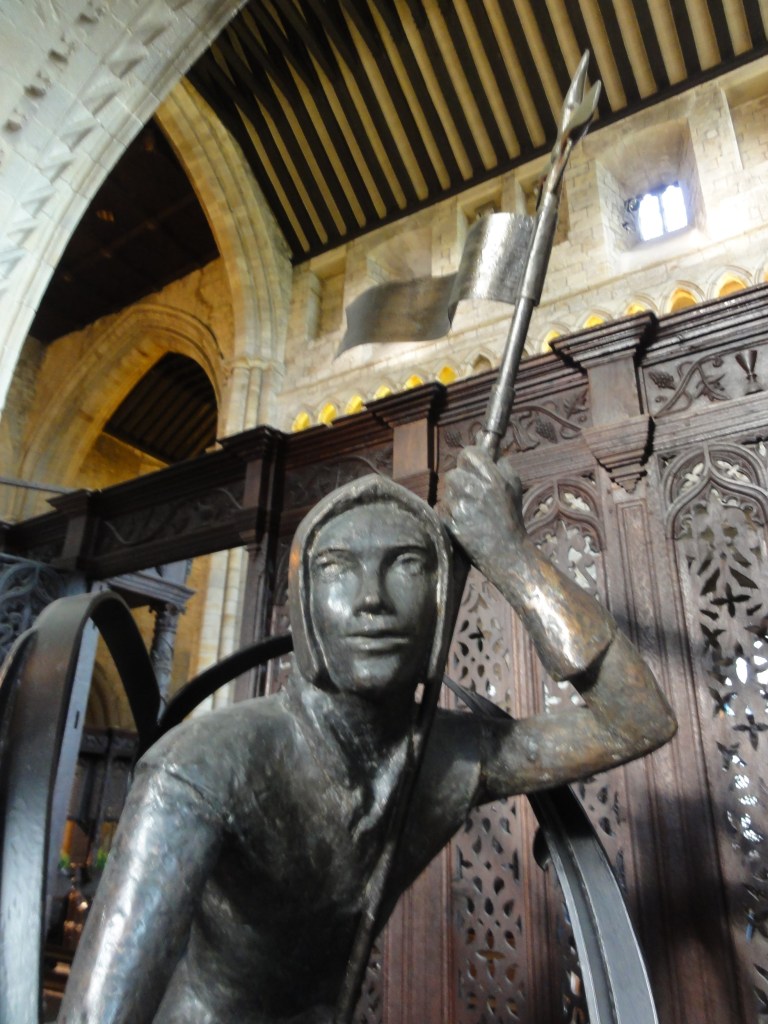
details from the Ruthwell Cross.

Near the shore of the Solway Firth, in Dumfriesshire lies the village of Ruthwell. It is famous for two things. The Trustees Savings Bank was first established here and there is a fascinating museum in the main village street.
If that serves mammon then God is also served in Ruthwell’s second and more important claim to fame.

On the edge of the village is the Parish Church with its neat and well-kept churchyard. Inside, it seems, at first, to be a simple and fairly ordinary Church of Scotland Church but it would not take you very long to notice that this is a church with a huge difference.
In an apsidal section there is a well (not a water one!) from which rises up an 18 foot Stone Cross, beautifully carved. It is breathtaking and it is also providential because it might never have been there at all.

The Ruthwell Cross, carved in the 8th century began life as a preaching cross – a common sight in Celtic and Anglo-Saxon times.
In the absence of Churches, missionary monks would build stone crosses on which were carved intricate scenes from the Bible as a kind of teaching aid – much as stained glass windows were to do in medieval churches. The monks would gather people around the cross and using the carved illustrations they would proclaim the Gospel. It was a kind of outdoor pulpit.

Many of these crosses survive – especially in Ireland, Wales, Scotland and Cornwall. These are hard evidence of the Celtic/Anglo Saxon Christian Mission in Northumbria, the Scottish Borders and elsewhere.

The Ruthwell Cross is Anglo-Saxon and was probably constructed as a preaching cross on the shore of the Solway Firth by Northumbrian monks from the double monastery of Jarrow and Monkwearmouth, who went to Dumfriesshire to assist King Necthan of the Picts in the re-Christianization of his territory.

The names associated with Ruthwell are the Venerable Bede himself (from whose Ecclesiastical History of the English Nation we learn so much about early Christianity in Britain ) and Ceolfrith, Abbot of Jarrow who is credited with Ruthwell’s construction.

Long after it was no longer needed as a Preaching Cross, it was removed to the  local Church  where it stood near the altar. In 1642, during the Scottish Reformation it was taken down, partially defaced and broken up. Part was used to repair the Church floor and the rest was buried in the churchyard.
In 1802 Henry Duncan, the then minister, dug up fragments of the Cross and then he set about finding as much of it as he could, carefully reconstructing it as a monument in the Churchyard.
In 1887 the Cross was moved back into the Church where it now stands, the damage having been repaired. It is now under the protection both of the Church of Scotland and the Historic Monuments Commission of Scotland.

Thus we have restored to us one of the finest examples of carved crosses there is to see anywhere in the world.
And it is truly magnificent. Many Visitors, myself included, are reduced to awe at its beauty.

It has much elaborate ornamentation and there are Gospel scenes and Old Testament scenes, common on many such crosses but it also has something else which makes this a very special cross indeed.
The Cross is also inscribed with Anglo-Saxon Runes – the Runic Alphabet of Germanic tribes which became the Anglo-Saxon tongue and which evolved into the English Language.
The Runes on the Ruthwell Cross are remarkable because, translated, they are part of a poem which is now known to be the earliest Christian poem in the English Language – and maybe the earliest Anglo-Saxon writing we possess.
The poem is known as the Dream of the Rood. (Rood  is the Anglo-Saxon word for Cross  and from it, of course, we get the Rood screen which in many churches is the chancel arch screen surmounted by a carved Crucifix.)

Michael Alexander *** in his work The Earliest English Poems  says it was the most famous poem of its day and we know of it particularly because it is carved on the Ruthwell Cross.
A more complete version is a 10th century  manuscript version in the style of early Gospel mss  found in the Italian library of Vercelli which has therefore given it the name it is now known by.

It is an intriguing poem in which the main narrative is provided by the Cross itself, of the Crucifixion of Jesus from its own experience. The Cross speaks of the Young Warrior (Jesus)dying for his people and is a wonderful example of Anglo-Saxon dream vision poetry.

It’s presence, in runic form, on the Ruthwell Cross, is a testimony that the Northumbrian Mission, converted people by proclaiming the faith of Christ Crucified, using illustrations carved on the Ruthwell Cross. People discovered just how much the Love of God for them was demonstrated in the proclamation of the Victory of God’s love in Jesus from the Cross.

A good reminder on the weekend which includes the celebration of Holy Cross Day. (September 14th)

[Mr G]
Holy Cross Day 2024

*** Earliest English Poems, Professor Michael Alexander

There are many translations of the poem, Dream of the Rood.
A Choice of Anglo-Saxon verse, edited by Richard Hamer, contains a translation I enjoy.
A good introduction to the poem is : The Dream of the Rood, edited by Michael Swanton.

Engraved

a poem by Piers Northam

Engraved

In the cradle of Your hand
there is safety,
intimacy,
trust…

And there I find my name:
“See, I have engraved you
  on the palms of my hands.”

There, my name is scored,
etched into Your flesh:
tattooed in love,
blood-red.

The pain of that etching
reveals the depth of that love.
The marks
indelible,
everlasting…


Piers Northam
6 September 2024
Deacons’ Retreat
in response to a ‘Word Friend’
– Isaiah 49:16
~ See, I have inscribed you on the palms of my hands.(NRSV)

Our Common Home

Hay bales in a Normandy field. Photo by Mr.G.

The time between September 1st and October 4th (The feast of St. Francis) is used by many Christians, other believers and organizations concerned about our Planet, as a time of meditation on Creation, our part in caring for it, and the dedication our lives anew to God who we celebrate as Creator and Sustainer of life

The photo of the Hay bales seems to express something of the beauty of the earth and gives me joy.  The bales were typical of the countryside of Normandy where I recently spent some time. Gathering in the hay and bind it in round bales was going on in many fields and farms. I was pleased to see that the bales were tied naturally and not, as is so often in England, bound in unsightly black plastic.

Rural Communities rarely have an easy time of it, so I am not moaning.   As well as farming and managing woodland, farmers often bear the brunt of the general failure to care for our planet. We dump on the rural communities a responsibility for caring about ecology and promoting climate change as well as nurturing the land to provide food and having consideration for their animals. Meanwhile, many enjoy the delights of the countryside, free of charge, even insisting that maintenance and trouble free access is our right and we expect the farming community to maintain it so that we might not feel responsible. A generalization, I know, but it contains truth.
Many of us know that blaming others for things that go wrong or which don’t achieve our aims is an excellent way of ducking out of our own responsibility! Yet we don’t fool anybody, not even ourself.

Equally importantly is our concern for those in our world who are without food or water. We have a duty of care for the people who live in poverty and destitution either through crop failure; the inhumanity of war; or in our own country where people are reliant on Food Banks or through meals provided for children who otherwise go hungry.

There are big issues around our stewardship of God’s creation and climate change but if we do just little and responsible things like random but heartfelt acts of kindness to others, especially the poor and needy, then the world becomes a better place.
I am constantly being drawn back to something Saint Ambrose said:
“It is not from your own possessions that you are bestowing alms on the poor, you are but restoring to them what is theirs by right. For what was given to everyone for the use of all, you have taken for your exclusive use. The earth belongs not to the rich, but to everyone. Thus, far from giving lavishly, you are but paying part of your debt.”

 Here is a prayer we might consider saying, though it is uncomfortable!

A Prayer based on Psalm 102:5 (offered as a resource from the Churches)

“Future generations will never forgive us if we miss the opportunity to protect our common home.
We have inherited a garden; we must not leave a desert for our children.”
Joint statement from Pope Francis, the Ecumenical Patriarch Bartholomew
and Archbishop Justin Welby of Canterbury.

[Mr G]

Special places, special people

Lindisfarne Castle. Photo by Mr G.

Special places, special people thoughts on St. Aidan’s Day. 31st August 2024
In many journeys of faith there are special places that have spoken to people vividly about God. The early Christians called these the ‘thin places’ where the membrane which separates our world from the world of heaven is so thin that it is easy for heaven’s spirit to burst through, catching us up in a breathtaking experience of God’s nearness.
For me one very special ‘thin’ place will always be the Holy Island of Lindisfarne, off the Northumbrian coast between Bamburgh and Berwick-upon-Tweed. It was to this island that St. Aidan came in 635AD.
He nearly didn’t come at all!
When King Oswald won back his Kingdom from the pagan king of Mercia, he immediately sent to Iona for a monk to teach his people Christianity. Oswald had spent many years in exile on Iona and there embraced the Christian faith. His desire was that his people would also find a love for Christ. The Abbot of Iona sent a monk who soon fell foul of the local people whom he branded as barbarians and un-teachable. Returning to Iona he told his brethren what he thought and a gentle monk admonished him. “I think, brother, that you gave them the meat of the gospel when what they needed first was milk.” Wise words but as so often happens, those who criticize (however gently) must be prepared to serve. Aidan was sent to Northumbria. There he set up his base in the place which, twice a day became an island—Lindisfarne. Here he built a monastery and founded a school in which he taught 12 boys amongst whom were the future St. Cedd, apostle to Essex and his brother, Chad, Apostle to Mercia.  They were part of a great mission which was to take the Christian Gospel throughout the North and the Midlands and to Essex.
Because, initially, Aidan couldn’t speak the language, King Oswald went with him on his missionary journeys to act as interpreter. One of the earliest examples of the co-operation between Church and State!

Lindisfarne remained a Christian centre until Viking raids led to the withdrawal of the monks. Today it is once again a centre both of pilgrimage and prayer. The local Church set up a Christian house for pilgrims known as Marygate House and it was here, in 1974 that I first came across Aidan and the spirit of the Celtic saints. I have returned many times since and more than once I have experienced the sense of God’s nearness and presence. It truly is a ‘thin’ place. Some, reading this will know exactly what I mean and will have their own ‘thin’ or special places (associated often with special holy Christians). They are places where faith comes alive in a unique and special way. Such experiences carry us through the more mundane parts of our Christian journey. What marks such places is that they are, in the words of the poet T.S.Eliot, places ‘where prayer has been valid’ – where prayer has consecrated them to God.
It strikes me that we should not have to travel far to find such places. There are lots and lots of special people whose prayer has made valid places where God can be found. Whilst people like St. Aidan seem to be extra-holy, he would probably argue that he did nothing that all Christians, all believers in God, can do—which is to allow God to love them until they are on fire with God’s love. That can be true for all of us and where it is, then we become the ‘thin’ place where others can find God.

[Mr G]
St Aidan window by Leonard Evetts, Lindisfarne Church.
photo by Mr. G.