Humility

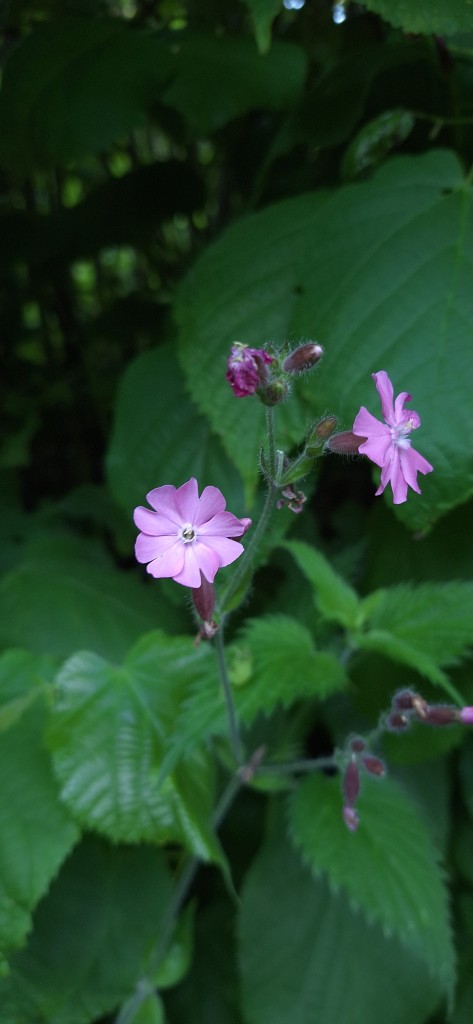
Little flower made by God. Photo Mr. G.

All those who exalt themselves will be humbled and those who humble themselves will be exalted  (Luke 14:11)

In his poem, East Coker (one of the 4 Quartets), T S Eliot said:
“The only wisdom we can hope to acquire is the wisdom of humility. Humility is endless.”

Earlier this week the current writer of the Church of England’s Daily Reflection, Chine McDonald, was reflecting on the passage from St Luke’s Gospel (14: 1-11). The section included a story Jesus told about guest at a dinner who grabbed the superior positions at the table. Jesus suggested that if more important people came, the host might have to  ask the others to take a lower seat. That would not only be embarrassing; it would be humbling.

Humility was the subject of Chine’s reflection and is at the heart of the story Jesus told. The passage ends with the quote above.
My further reflection brought to mind the quotation from Eliot’s poem.
It comes just after Eliot says, Quiet voiced elders have deceived us. Do not let me hear of the wisdom of old men but rather of their folly. The only wisdom we can acquire…is Humility.
Humility  and its practice as humbleness is often mistaken for the kind of grovelling we find in Uriah Heep in Charles Dickens’ novel, David Copperfield. In one episode, Heep was ringing his hands and wiping them on his handkerchief. It was a gesture of how he wished to present himself to David Copperfield as what he described as being “a very umble person” He went on to reiterate. “I am well aware that I am the umblest person going, said Uriah Heep, modestly; “let the other be where he may. My mother is likewise a very umble person. We live in an umble abode…

Taking pride in false lowliness is not what Jesus was speaking about.
Humility before God is not, as is so often presented, about feeling a complete lack of worth. It is not about making us feel bad about ourselves.  It’s actually the reverse. It’s about recognising that all the potential we have, all the gifts we can offer, all the love we can share, all the joy we can bring, all the things we can achieve – owe their origin to God. And we are called to use our lives and all God has given us, in His service.
Humility is about recognising and celebrating that.

Jesus was, however cautioning us against another false trait, opposite of the one taken by Uriah Heep, of thinking ourselves better than others. This leads to a view that some of us have rights and privileges over others. Our view of humanity then becomes warped. It leads, ultimately to nations trying to lord it over others. We do not have to look far to know what I mean but before we sweep our vision towards the Holy Land or Ukraine, let’s not forget to look nearer to home at the boat people, refugees, the poor and homeless.
Chine McDonald in her reflection widens the story Jesus told. She says, “Jesus words reflect the nature of the Kingdom of God. This is a place where the usual rules do not apply. What applies, she says, is humility because we are dealing with the upside-down nature of God’s Kingdom.

By contrast, she says, “We live in a world where we are asked to measure ourselves against others; where we pride ourselves in our achievements and what we have, whether that is family, a great job or great car – are what matters.” 

Jonathan Sacks, the late Chief Rabbi,in his book To Heal a Fractured World,  makes the point that no one ever speaks in praise of someone who died, about the car they drove, the house they owned, the clothes they wore, the exotic holidays they took. He says that  the things we spend most of our time pursuing turn out to be curiously irrelevant when it comes to seeing life as a whole.
After death, he says, “what was important was the kind of life people led; the qualities they showed; the good things they shared in; the responsibilities they took within community life; who they were as people.”

Chine McDonald places this in context by saying that the Kingdom of God is a place “where human wisdom is replaced by divine wisdom. It is a place in which the status quo cannot be assumed. It is a place of newness and wholeness, where we see things as they should be.”
The way to inhabit this Kingdom is to embrace the kind of humility which translates into seeking the well-being of others; of putting service of others before self; of behaving towards others with respect and love, no matter who they are or the circumstances of their life; of encouraging others and being generous towards them; and to be examples of hope and gentleness. Most of all, of course, it is about embracing the Will of God for us and for others.

[Mr G 14th June 2024]
A Message

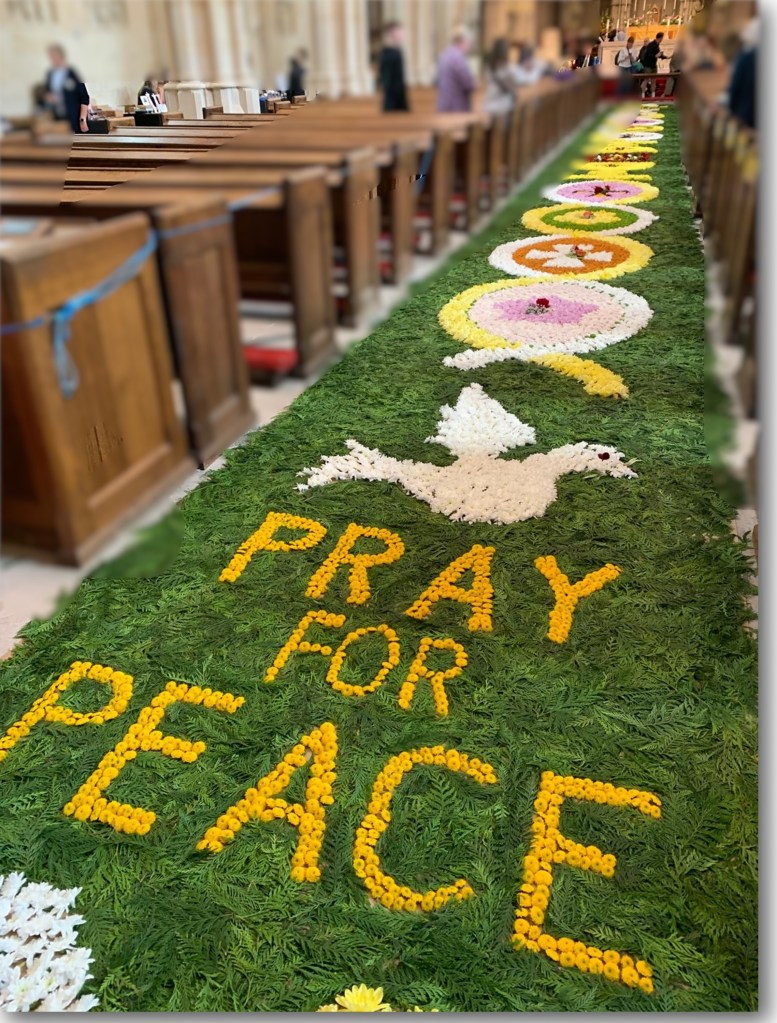
Photo of the Carpet of flowers, Arundel Cathedral
– sent to me by my friends, Emma & Nathan Pope

Carpet of Flowers – Every Corpus Christi, the Roman Catholic Cathedral at Arundel hold a Festival, the highlight of which is the world famous Carpet of Flowers.
It has been an annual event for 140 years. It began when the 15th Duke of Norfolk, Henry Fitzalan Howard. visited the village of Sutri just outside Rome. There he saw a carpet of flowers and this inspired him to introduce a similar festival in the church he had founded in Arundel – Our Lady and St Philip Neri. This was later to become the RC Cathedral.
Each year there is a focal message in flowers and greenery. This year, as you see, it is Pray for Peace.
Inspired by this, I wrote this little poem.

A Message from the Earth

You destroy the earth
with your lust for power, control;
the selfish bolstering of your ego.
Yet, you cry for peace.!

Your words and actions are empty.
So we must speak, for we are the world
which you tread on with your heavy boots
of rhetoric, falsehood, self-centredness
and greed.

Therefore,  we have chosen to send you a message
in flowers and branches,
in beauty and in love.
This is our voice to your heart,
the cry of the earth.
Become Peace!
Listen to us, please
and act.

[Mr G, 3rd June 2024]

Corpus Christi

Hay bales and harvest. Norfolk. Photo by my friend, Julia Sheffield

Evelyn Underhill

In the first five decades of the twentieth century, Evelyn Underhill was, perhaps, one of the most widely read writers on prayer and the spiritual life. The first woman ever invited to give a series of lectures in religion at Oxford, she was a fellow of Kings College, London, and in 1938 received an honorary Doctor of Divinity degree from Aberdeen University. But it was as a retreat director and spiritual guide that she became best known and loved. This is her poem about Corpus Christi, celebrated by many Christians today. It is a Day of Thanksgiving for the gift of Jesus in the Holy Eucharist.

Corpus Christi
by Evelyn Underhill

Come, dear Heart!
The fields are white to harvest: come and see
As in a glass the timeless mystery
Of love, whereby we feed
On God, our bread indeed.
Torn by the sickles, see him share the smart
Of travailing Creation: maimed, despised,
Yet by his lovers the more dearly prized
Because for us he lays his beauty down—
Last toll paid by Perfection for our loss!
Trace on these fields his everlasting Cross,
And o’er the stricken sheaves the Immortal Victim’s crown.

From far horizons came a Voice that said,
‘Lo! from the hand of Death take thou thy daily bread.’
Then I, awakening, saw
A splendour burning in the heart of things:
The flame of living love which lights the law
Of mystic death that works the mystic birth.
I knew the patient passion of the earth,
Maternal, everlasting, whence there springs
The Bread of Angels and the life of man.

Now in each blade
I, blind no longer, see
The glory of God’s growth: know it to be
An earnest of the Immemorial Plan.
Yea, I have understood
How all things are one great oblation made:
He on our altars, we on the world’s rood.
Even as this corn,
Earth-born,
We are snatched from the sod;
Reaped, ground to grist,
Crushed and tormented in the Mills of God,
And offered at Life’s hands, a living Eucharist.

Dance for Joy

Isis dancing with Old Father Thames. Leaded glass sculpture by Kay Gibbons.
This panel has been produced in a ‘kintsugi’ fashion, after the Japanese art of bonding broken ceramics with gold.

Beauty in fracture.. Broken beauty...

A Poem for Trinity Sunday, selected by Piers Northam. Written by the Persian poet , Hafiz. (1325-1390) and gently amended by Piers to refer to the Three persons of the Trinity.
The invitation to ‘dance’ is based on an early Church theology of ‘perichoresis’ – rotation or circular movement (hence dance) within the relationship of the Father, Son and Holy Spirit (The Holy Trinity of God). The early Greek Theologians of the Church, led by St. Gregory Nazianzus – one of the Cappadocian Fathers- helped Christians to discover the relationship of pure love between the Father, the Son(Jesus) and the Holy Spirit. This Love energizes all that God has created as it pours itself in the sheer joy of life. It becomes a dance which carries us into the fullness of the joy of God and therefore leads us to see that love and joy at the heart of our own life. So we are invited to the dance of life in which we are encompassed with the swirling love of God.

Created for Joy – Hafiz

I sometimes forget
that I was created for joy.

My mind is too busy,
my heart too heavy
for me to remember
that I have been called to dance
the sacred dance of life.

I was created to smile,
to love,
to be lifted up
and to lift others up.

O Sacred Three
disentangle my feet
from all that ensnares.
Free my soul
that we might dance
– and that our dancing
might be contagious.