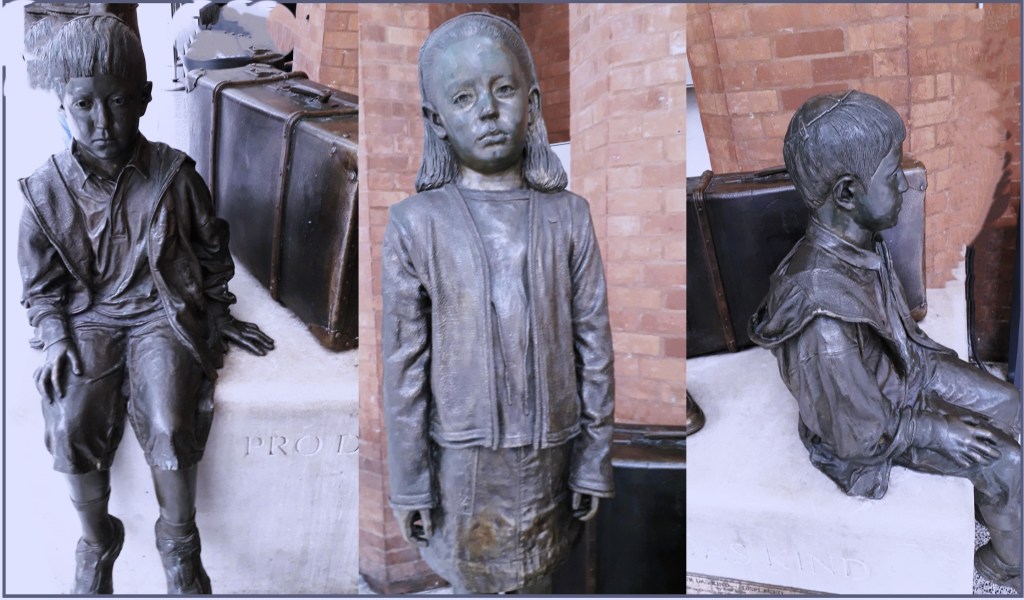
by Flor Kent. Another statue is on the upper level of the station. Photos taken & arranged by Mr G.
There has been quite a lot in the media this weekend about a new film which opened on New Year’s Day.
It’s called One Life and it’s a kind of biopic about Sir Nicholas Winton. I’m sure that many of you will know who he was (he died in 2015) and what made him so special.
The film tells the story of something that happened when, as a businessman, he visited Prague in December 1938. There he found families who had fled their homes, as it was becoming clear about the imminent danger to the Jews in Central Europe, posed by the Nazi Government in Germany.
Nicholas Winton, himself a Jew, decided to do something to help them. He determined to rescue as many Jews as possible and bring them safely to Britain. He was especially concerned about the children and together with others, both in what was then Czechoslovakia, and in Britain, he set up what was to be known as the Kinder transport.
He set about chartering special trains and returned to London to raise money and find host families who would accept the children. It was a race against time because, at any moment, the Nazis would close the border. In fact, right at the end of the evacuation, 251 children were trapped in Prague. The train they were on was in Prague Station when Germany declared war and closed the borders. By then, 669 children had been brought to safety but Nicholas never forgot the 251 who didn’t make it. Among those who did escape were the mother and uncle of a friend of mine, Dr Diana Lowry.
All those rescued were cared for by people whom Nicholas and those working with him, arranged. Most were given , security and love as Britain and her Allies took up the fight against Nazi-ism. Sadly, for many of the children rescued, it was a different story for their parents, many of whom were killed in the Concentration camps. Their story would not come to light until 1945 and for the children in Britain it would have been a most painful and sad time of loss.
Nicholas Winton never spoke of what he did, even to his wife, but she found documents on the Kindertransport by chance 50 years later in their attic. When his papers were discovered he received many honours but for a lot of the children, the story of the man behind their rescue was unknown. That changed when in 1988 he was the subject of the BBC Television programme, That’s Life. Unknown to Sir Nicholas, the BBC had invited some very special guests. At a point in the programme, Esther Rantzen, asked the audience, “Is there anyone in our audience tonight who owes their life to Nicholas Winton?” Most of the audience stood up. Visibly shocked, Nicholas met the children he had rescued, for the first time.
Their story has become his legacy, increasingly being carried by the children and grandchildren of those rescued.
Now it is being told in a biopic which will have a feelgood trait. It will be something that celebrates the goodness of a man who saw a need and did what he could. He was a kind, modest and humanitarian person and he would probably agree with a friend who said of him, “If there was something that needed doing and nobody was doing it, Nicholas would step in. That was the motto for his life.” The friend, was The Revd, John Fielsden, one of the children brought to safety.
Today, as we remember what one man and a few of his friends achieved, we might place it against what is happening in many parts of our world, not least the Ukraine and Gaza. There are so many similarities and it is easy to despair, give up and turn our back on those in genuine and deep need, including in our own countries.
But Nicholas Winton has a message for us if we but hear it.
My friend, Dr Diana Lowry, whose mother and uncle were brought to safety by Nicholas Winton, has reflected on this and on what it might mean for us today. This is what she says….
The Gospels are full of examples of Jesus helping others: healing, supporting and loving them into the Kingdom. He told us to love our neighbours as ourselves and Mr Winton followed this principle. He did not parade his altruism but settled down to the job in hand, concentrating his efforts on making a difference. Nicholas Winton’s small, but important, part saved others from the anti-Semitism of Nazi Germany.
Every day there are many selfless acts taking place: parents caring for their children, others caring for elderly parents, people looking out for their neighbours, wandering animals returned to their owners by a kind passer-by, youngsters helping with their disabled siblings and many more situations. It can be lonely and frustrating being in any one of these scenarios and sometimes doing the right thing can be difficult. You can feel that you are ploughing a lonely furrow. However if we listen to God and follow His guidance we are not alone. He knows about the needs of others and relies on us, His children, to help. Jesus did not promise it would always be easy following him but he did promise to be with us.
God can only work through us if we listen to Him. I don’t suppose the young Nicholas Winton thought much of the future beyond rescuing those children from Czechoslovakia but they knew he had saved their lives.
Who knows what we might achieve if we listen to God?

(Photo by Graeme Robertson/Getty Images)
Teach us, good Lord, to serve you as you deserve;
to give and not to count the cost;
to fight and not to heed the wounds;
to toil and not to seek for rest;
to labour and not to ask for any reward,
save that of knowing that we do your will.
Now and for ever.
Amen
(St Ignatius of Loyola)


 Mr G's Ponderings