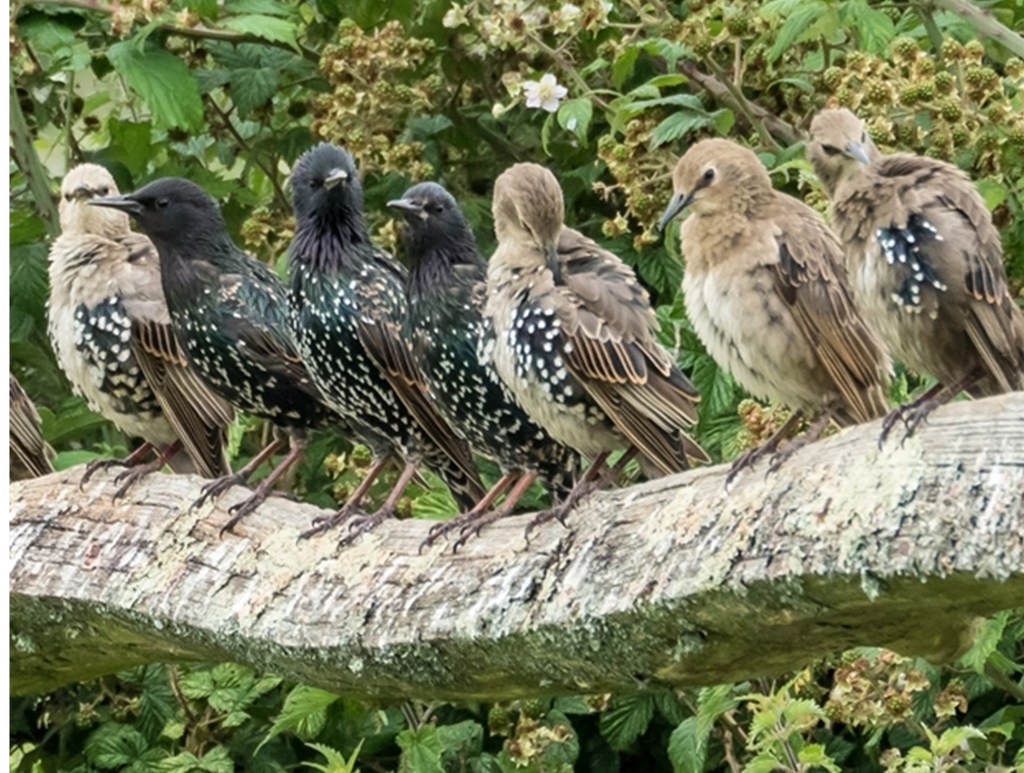
Starlings on Snettisham Beach, North Norfolk.copyright RSPB
Snettisham beach in North Norfolk, near Sandringham Royal Estate, is a good place to witness a phenomenon known as murmuration. Usually at sunset, large groups of Starlings occupy the sky alongside the Wash as they swoop and swirl in packs, ducking and diving as they twist and turn across the sky. They make beautiful shape-shifting formations which are spellbinding and fascinating to watch. It is sheer poetry in motion.
The word murmuration which describes this activity is derived from the noise the birds make by the flapping of wings of so many birds in flight.This tends to happen during the Autumn and Winter months, often from October to March, though sometimes earlier. It tends to peak in December to January when native birds are joined by more birds from all over Europe
At sunset, large groups of starlings take to the sky, swooping and swirling into spheres, planes and waves. The phenomenon is called a murmuration, and it’s named after the noise that is made by the many flapping wings of a group of starlings in flight. Being together offers safety in numbers – predators such as peregrine falcons find it hard to target one bird in the middle of a hypnotizing flock of thousands. They also gather to keep warm at night and to exchange information, such as good feeding areas.
Here’s a poem inspired by wading birds at Snettisham, a reminder of Murmuration of Starlings, by my friend Piers Northam
Myriad waders ribbon the foreshore, crisply backlit as they needle the sands.
Kettled by tidewater, they lift and resettle until, rising together, they skein like wind-rippled silk; billowing into clouded bee-swarm; funnelling and shoaling as they scud across the skies.
Autumn is the season for spiders both inside the house and also in the countryside and garden.
Not everyone is a fan of spiders and there are many species, from tiny mites to large, slightly threatening ones. Only a very few tend to bite human beings. According to the Natural History Museum, only about 12 species have been recorded as inflicting a bite on humans and of those only three have left an unpleasant or painful sensation. As there are over 650 types of spider the risks are minimal. Mind, if you insist on picking them up they will defend themselves!
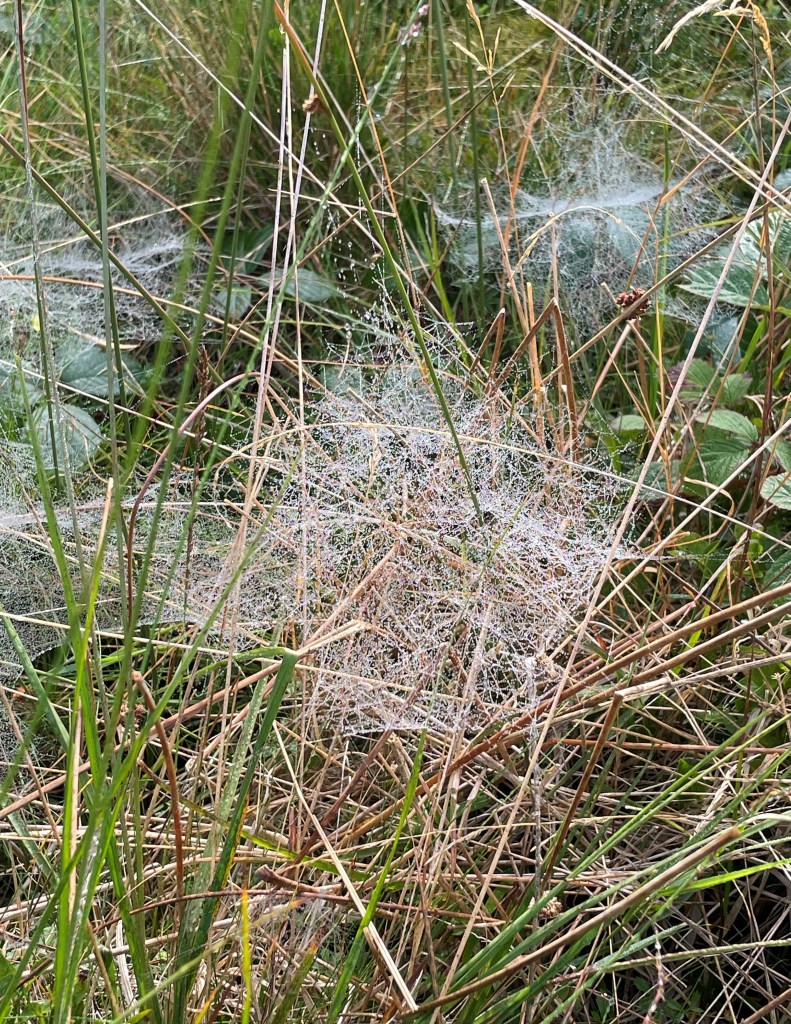
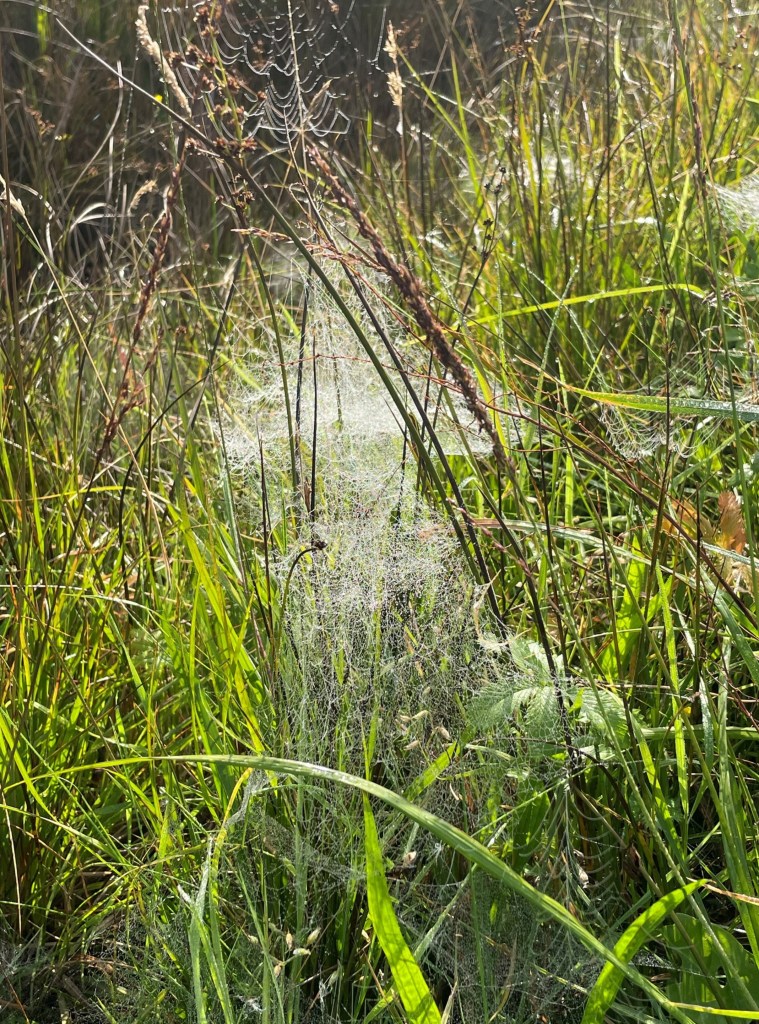
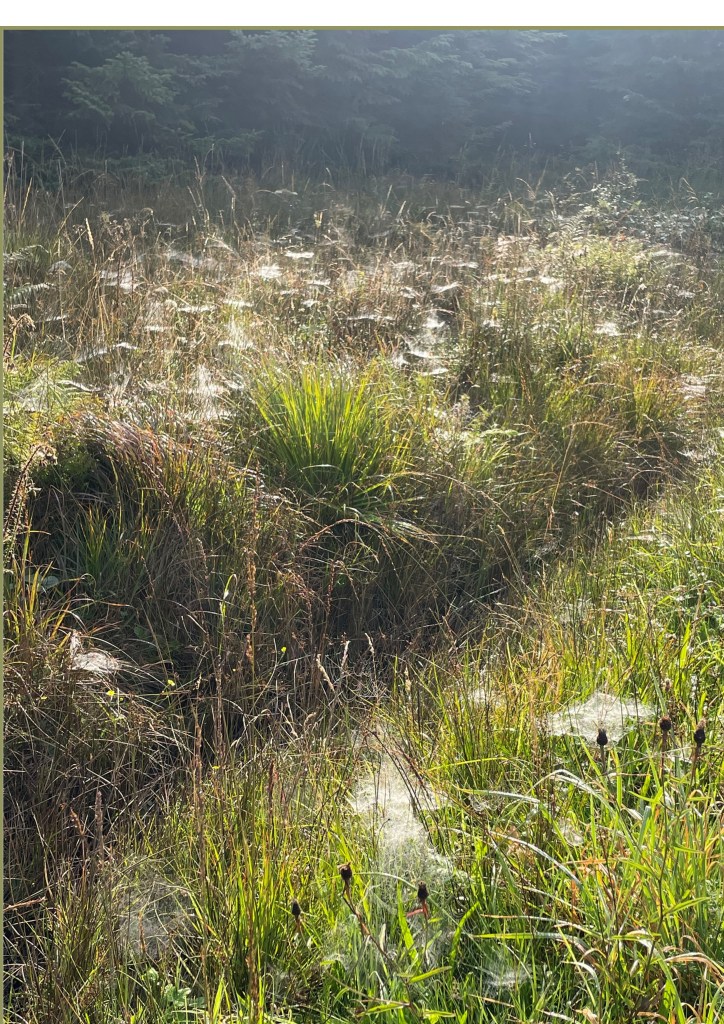
The evidence of spiders in our gardens and in the fields can be found on a low misty morning when the ground is strewn with gossamer webs, highlighted by frost. These can be found often in their hundreds. This is the work of one species particularly – the Common sheetweb spider or to give its posh name, Linyphia triangularis. It’s a very common species and its presence easily seen – the name sheetweb – may provide a clue!
This Sunday, many in the UK will be keeping Animal Welfare Sunday. Perhaps we could spare a thought and a prayer for these tiny creatures of God’s creation, often overlooked or avoided. I suspect that he had a lot of fun making them!
My friend, Gill Henwood, has captured this in photos she has taken in the Lake District, so here’s a couple.
Spider Trail. photo by Gill HenwoodGrizedale, webs in the forest.
Mother providing. An Icon of God’s provision. Photo by Henk Vandorp
A Harvest Thought.
In his book, Letters from the Desert, The Little Brother of Jesus, Carlo Carretto tells of a journey in the Sahara that he made soon after becoming a monk. He arrived at a place just as the sun was setting and the temperature plummeted. It is a fact that the Sahara is known as a ‘cold country where it is very hot in the sun’. Because of this he carried two blankets. In a village he noticed an old man shivering with cold. Carlo thought that he should give the old man one of his blankets but he thought of the night ahead and the cold that was descending. He knew that he really ought to have given the old man a blanket but when he drove off in his jeep the blankets were still with him. Eventually he made camp under a great rock that would give him shelter from the wind. He wrapped himself in both his blankets and eventually he fell asleep. And he had a dream. He dreamed that he was lying under the very rock he had camped under. In the dream the rock moved and a great boulder fell on top of him. It did not kill him but he was no longer able to move his body. He opened his eyes and saw the old man shivering before him. Now, he didn’t hesitate, The blanket was no longer any use to him so he tried to stretch out his hand to offer the blanket but the stone made even the smallest movement impossible. The blanket mocked him and reminded him of his lack of charity. He wondered how long he might have to remain under the rock and God then spoke to his heart:Until you are capable of an act of perfect love.
In an inverted sort of way this story is about God’s Providence. God provided warmth and protection for the shivering old man but it was denied him by the selfishness of Carlo Carretto. It isn’t that God hasn’t provided for the needs of the world – the planet teems with everything we need to sustain life and he expects us to share its goodness equally with all. It’s just that some have more and want even more and so deny Providence to those in need.
In Judaism an essential part of the Covenant was to provide for the poor through the principle of Justice-as-Charity. Prayer to God must be accompanied by how we act responsibly in the world. Creation is the gift we must ensure is enjoyed by all for, as Jonathan Sacks, the late Chief Rabbi, put it in his book To Heal a Fractured World:
God created the world so that others could enjoy it. Goodness is not an attribute of the soul but a way of acting and creating: creating happiness for other people, mitigating their distress, removing even a fraction of the world’s pain. we worship God spiritually by helping his creation physically.
St Ambrose takes this a little further when he says When you give to the poor it is not from your own wealth; it is a fragment of their property you are returning to them, for it is common property given for all to use that you are keeping for yourself.
An essential part of God’s Providence is ourselves. He has provided us with the ability to help each other. In a Christian society, as in the Jewish one of our Lord’s time, it is the mutual care we have of each other which makes a real difference to people’s lives. That needs to include those of all faiths if it is to have a Universal application.
Jonathan Sacks says that charity to others isa form of prayer – a preliminary to prayer. It is only when we act with justice and compassion, when we recognize his (God’s) image in other people and hear the silent cry of those in need that we shall really understand that we are part of God’s Providence – and for that be truly thankful.
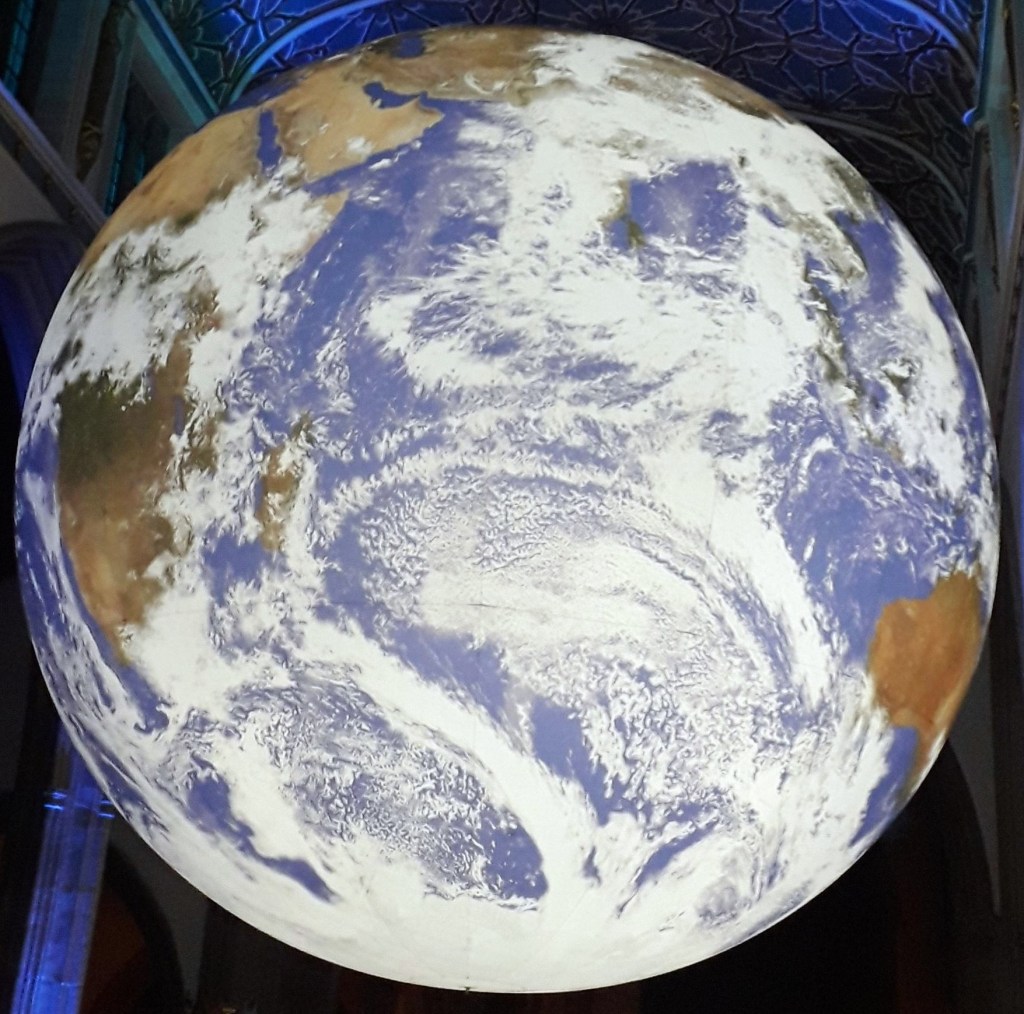
Photo by Mr G of the Gaia Globe exhibited at Chelmsford Cathedral.
AUTUMN EQUINOX
Today, September 23rd, is the Autumn Equinox in the Norther Hemisphere. It’s the Spring Equinox in the Southern Hemisphere
According to my sources, mainly the British Met. Office, the Equinox defines the transition between the seasons of the astronomical calendar. It is a key part of the earth’s orbit around the Sun. There are two each year – Autumn and Spring.
It occurs when the Sun crosses the path of the equator and is poised exactly between the Northern and Southern Hemispheres. During equinox, day and night are about the same length (12 hours each). The word Equinox means this. It is made up of two Latin words – ‘Equi’ meaning equal and ‘nox’ meaning night. From today, in the Northern Hemisphere the darkness of night becomes longer as winter approaches.
This balance and interaction of darkness and light affects our daily life but it also affects our spiritual and physical life. Physically many animals slow down or hibernate. Our daily life is affected by darkness. Nature goes into sleep mode. Shortly the trees will drop their leaves and the buds of next year’s foliage and plants will be dormant. Physically we may become more lethargic and as the weather becomes colder, staying indoors is more welcome. Though we follow our daily life, our bodies would love to hibernate. That is a generalization, but spiritually we become more aware of nature, of the creative change of the world around us. At the beginning of this cycle, we often celebrate Harvest and we give thanks for God’s goodness towards us in the provision of food. For our ancestors the curing and storing of food was vital to carry them through the harsh winter months. This thought can remind us of those without food and who are coping with disaster in places such as Morocco coping with its earthquake; Libya with the floods; Ukraine with the evil of the Russian invasion. These are but three of the needs we need to pray about and act upon. In the United Kingdom, poverty, financial hardship, and the need for Food Banks, remind us of our duty to those in need. We should add to that the plight of the world’s nomads, forced to flee their countries because of violence, imprisonment and the inhumanity meted out to them on a vast scale. It is at a time of Equinox that we are invited to pray and act for a better world. A world where all are equal and a remembrance that every one of us owes our existence to our Planet Earth, which sustains us, and to our Creator God. All has been planned to be held in a creative tension which ultimately is not about who gains what territory and power, but to a finely balanced Universe over which we have no control or power; except, of course, the power of destruction in which we are all engaged at present. We do and should have gratitude as the world turns and our life is altered for a time and a season. Thankfulness should be at the heart of everything we are and do. A thankfulness which must embrace everyone who are tenants of the earth.
EQUINOX
Sun poised over equator heralds the day of equal light; equal darkness.
Earth catches her breath in a moment of cosmic stillness, bringing to mind the delicate balance of solar existence, of which we are but a small part.
Seasons turn in an astronomical process in which our human participation is not required. We are the result of a divine plan, of an eternal equality over which we have no control. This global moment is our reminder that in our vast, unfathomable universe we are of little significance.
Yet, in the heart of our Creator God, we are loved and held because of another Equinox, not on the equator but on Calvary, where darkness became light and a new direction was shown to the world. It is called Love. Together, with all on earth we are invited to embrace it.


 Mr G's Ponderings