The wind is wine to those who walk on bright December days the heath; Above, the cold, capacious sky, the rimy grass beneath.
With each a merry heart the guide, The sun for compass: they who know the wanton ways and whims of earth, and laugh to find them so.
No English hills, in English lanes, A man may walk with ease and find at every turn the mode and mark of earth’s best humankind:
May rest in quiet inns at night, in sleep enfolding bone and brain, and with the dawn may rise and take the long, free roads again.
(Sir William Addison)
This poem comes from a small collection, ‘Winter Forest’ by Sir William Addison. The poems are inspired by Sir William’s long association with Epping Forest where he was one of the four Verderers.The verderers of Epping Forest have represented the views of everyday people for over 800 years acting as a key go-between with the City of London.
Sir William was born in the Ribble Valley in Lancashire and he was educated at Clitheroe Royal Grammar School. His family had connections in the past in Grasmere and Bowness.
When he married Phoebe Dean in 1929, the couple moved south and eventually lived in Buckhurst Hill on the edge of Epping Forest, Essex.He bought a bookshop in the neighbouring town ofLoughton, and began his lifelong association with Epping Forest which included a love of the history of the area. The result was a number of books on the Forest area and Essex, Suffolk and of people like Dick Turpin, highwayman of the Forest. He worshipped at the Parish Church in Epping.
The collection of poems Winter Forest was edited by Richard Morris, Verderer of Epping Forest and published by the Corporation of London in 2002, by kind permission of legatees of Sir William’s estate, including the incumbent of St. John’s church in Epping. My personal involvement in this small way has led me to make the poems in this collection more widely known. Walking in December seems a good place to start. I am grateful that I am able to illustrate this with a ‘December’ photograph by my friend Gill Henwood, and appropriately the scene is from Cumbria, where Sir William’s family had their roots.
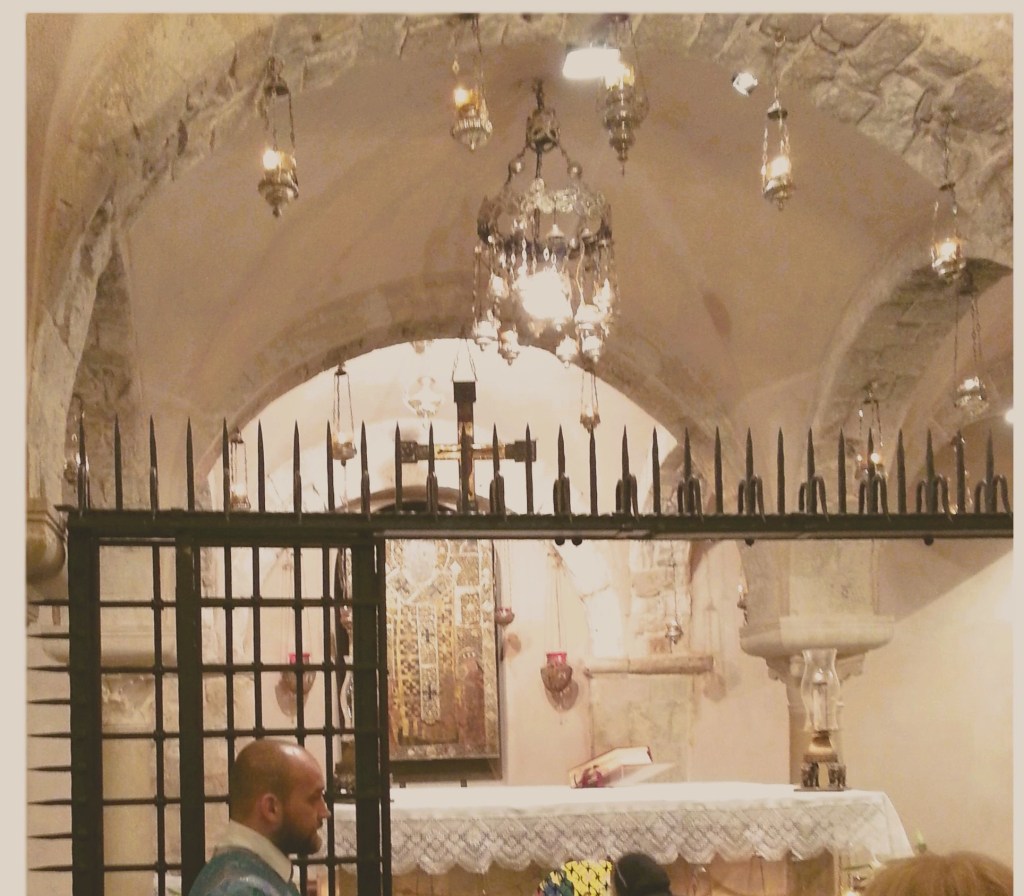
Shrine of St Nicholas, Bari, Puglia. photo by Mr G.
St Nicholas, kind, holy man, Feast day 6th December
Nicholas was a fourth-century bishop of Myra, a town in what is now southwestern Turkey, and we remember him because of the stories which have given him “a perpetual name for deeds of kindness on land and sea.” People of the Church held him in high honour from a very early date and many stories came to be told about him. The most famous of these tells of his merciful generosity.
Once there were three sisters whose parents were so poor that they thought of selling them. Bishop Nicholas heard of the sisters’ plight and tossed three bags of gold onto their doorstep — thus providing them with dowries for marriage and saving them from a life of prostitution. Another version of this story is that one day Nicholas heard about a rich man in Myra who lost all his money when his business failed. The man had three lovely daughters, all wishing to get married, but he had no money for their marriage. Besides, who would marry them since their father was such a failure? With nothing to eat, the man in desperation decided to sell one of his daughters into slavery. At least then the rest of them might survive. Before the first daughter was to be sold, Nicholas, with a small bag of gold in his hand, softly approached their house, and, tossing the gold through an open window, quickly vanished into the darkness. The next morning, the father found a bag of gold lying on the floor next to his bed. He had no idea where it came from. The poor man fell to his knees and great tears came to his eyes. He thanked God for this beautiful gift. His spirits rose higher than they had been for a long time because someone had been so unexpectedly good to him. He arranged for his first daughter’s wedding and there was enough money left for the rest of them to live for almost a year. He often wondered who gave him the gold. By the end of the year, the money had run out and the father, again desperate and seeing no other way open, decided his second daughter must be sold. But Nicholas, hearing about it, came by night to their window and tossed in another bag of gold as before. The next morning the father rejoiced, and, thanking God, begged His pardon for losing hope. Each night afterwards the father watched by the window. As the year passed their money ran out again. In the dead of one night he heard quiet steps approaching his house and suddenly a bag of gold fell onto the floor. The father quickly ran out to catch the one who threw it there. He caught up with Nicholas and recognized him, for the young man came from a well-known family in the city. “Why did you give us the gold?” the father asked. “Because you needed it,” Nicholas answered. “But why didn’t you let us know who you were?” the man asked again. “Because it’s good to give and have only God know about it.” Whichever story true, the good and kind deed became the reason why Nicholas is considered the special protector of children. In memory of his deed of mercy to the three sisters, the Dutch developed the custom of giving gifts to children on his feast-day, 6th December but there are so many similarities with the secular legend of Santa Claus, Nicholas became associated with Christmas. In Holland, where he is patron saint his day remains a festive one.
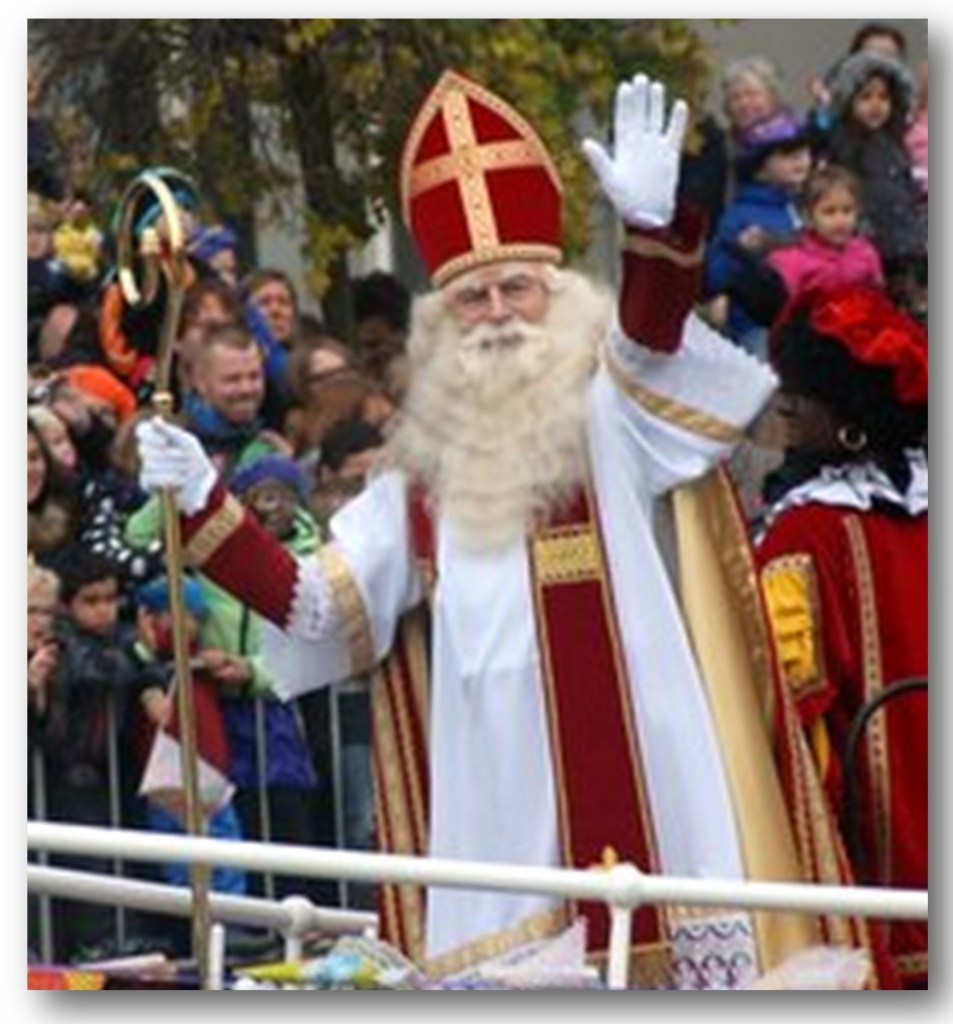
Sinterklaas often arrives in Amsterdam by canal boat when he is greeted by the children (and many adults too!). One of the customs associated with this day is the giving of chocolate letters. They are offered in every letter of the alphabet, in milk, dark and white chocolate. People are given letters in the alphabetical letter of their own name.
Another story tells how a company of seafarers were caught in a storm off the coast of Asia Minor. The waves were swamping their ship, and the mariners were nearly at their wits’ end when they remembered what they had heard about the bishop of Myra. Though he was still alive, the sailors cried out his name and implored his help. The legend says that Nicholas himself suddenly appeared in the rigging of their ship and calmed the storm, so that the ship and all who were in it came safely to port. Nicholas is considered the patron saint of many other groups besides children and sailors. The common thread in all these claims on his heavenly protection is his legendary kindness to those in need — and his special care of those who follow his storied example by aiding the desperate, the needy, and the sick.
At first, the body of Nicholas was buried in Myra where he was bishop, but, in the 10th century, during a time of upheaval, sailors from Bari in Puglia, Southern Italy, removed his body and he is now buried in the Church of St. Nicholas, Bari. Many pilgrims visit his tomb in the Crypt which, unusually in a Roman Catholic Church, is tended by Easter Orthodox monks.
It is in the Netherlands, however, where he is much celebrated and it is a special day for the Dutch people.
O Lord our God, grant us so to cherish the example of your servant Nicholas, that our offering may have justice as its consort and mercy as its sovereign. We ask this in the Name of Jesus Christ the Lord.
[Mr G]
(some information is from ‘For all the Saints’ the Episcopal Church of Canada. The second story of the gold given for the freedom of the three girls is adapted from Father Victor Hoagland, CP)
Let it Glow! Enjoy an unmissable after-dark spectacle of lights at RHS Gardens this festive season
Winter needn’t be doom and gloom. The snow can be a hazard for travellers and people living alone or in isolated places but it also brings its own beauty and even quietness. The Royal Horticultural Society at its 5 Gardens, Wisley, Harlow Carr, Hyde Hall, Bridgewater, Rosemoor are brightening the winter evenings with ‘Glow’ Festivals. Light displays around the gardens and illuminations on and in trees bring a magical beauty. A reminder that light arrangements penetrate the winter cold and gloom. In frosty (even snowy!) weather the combination with coloured lights is, for many of us, a cheerfulness which delights. (Sorry if you don’t agree!!)
The photo above was taken by my friend Gill Henwood at a visit to the Glow Festival at Harlow Carr Garden, near Harrogate, Yorkshire. There are variable dates at the Gardens, some not ending until 30th December. If you live nearby any of the gardens, look up the Royal Horticultural Society website for further details.
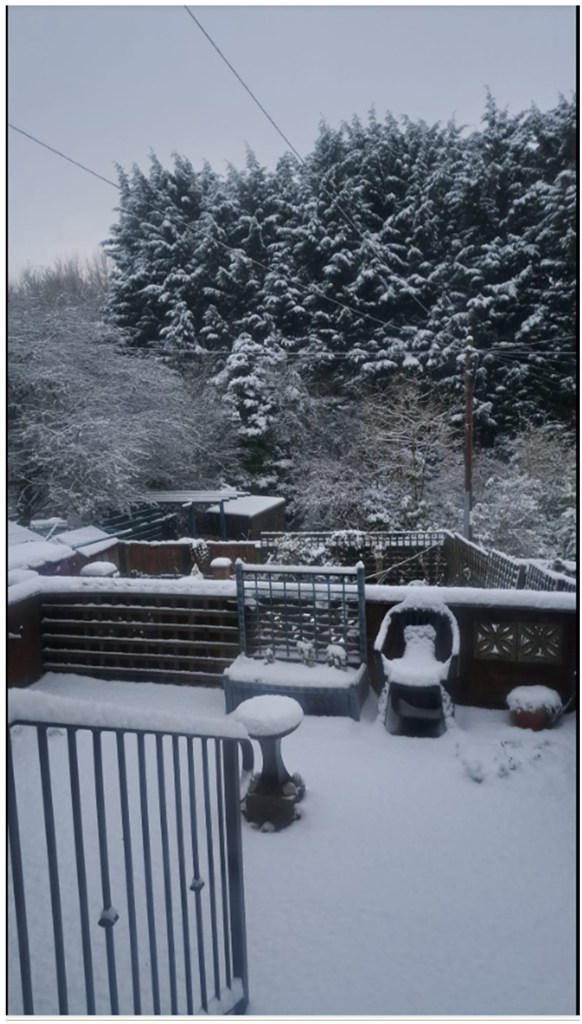
Meanwhile, my friend Heather Upfield has sent me a photo, from the West Coast of Scotland, of her garden and trees beyond, clothed in snow and breathing tranquility. So peaceful!
Both photos are aspects of Advent. The expectation of Light from God coming into the world, and the quietness and gentleness with which, in the birth of Jesus, He does it.
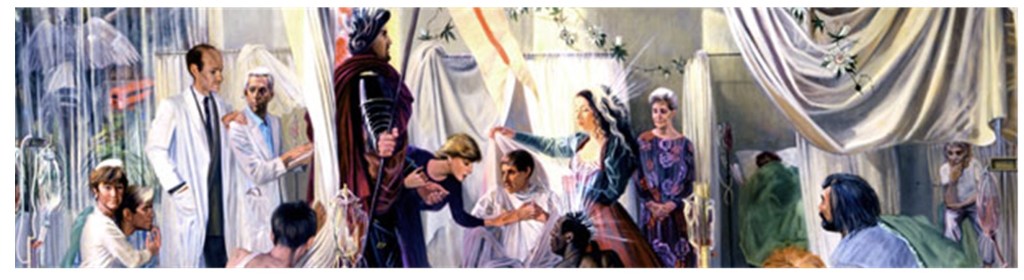
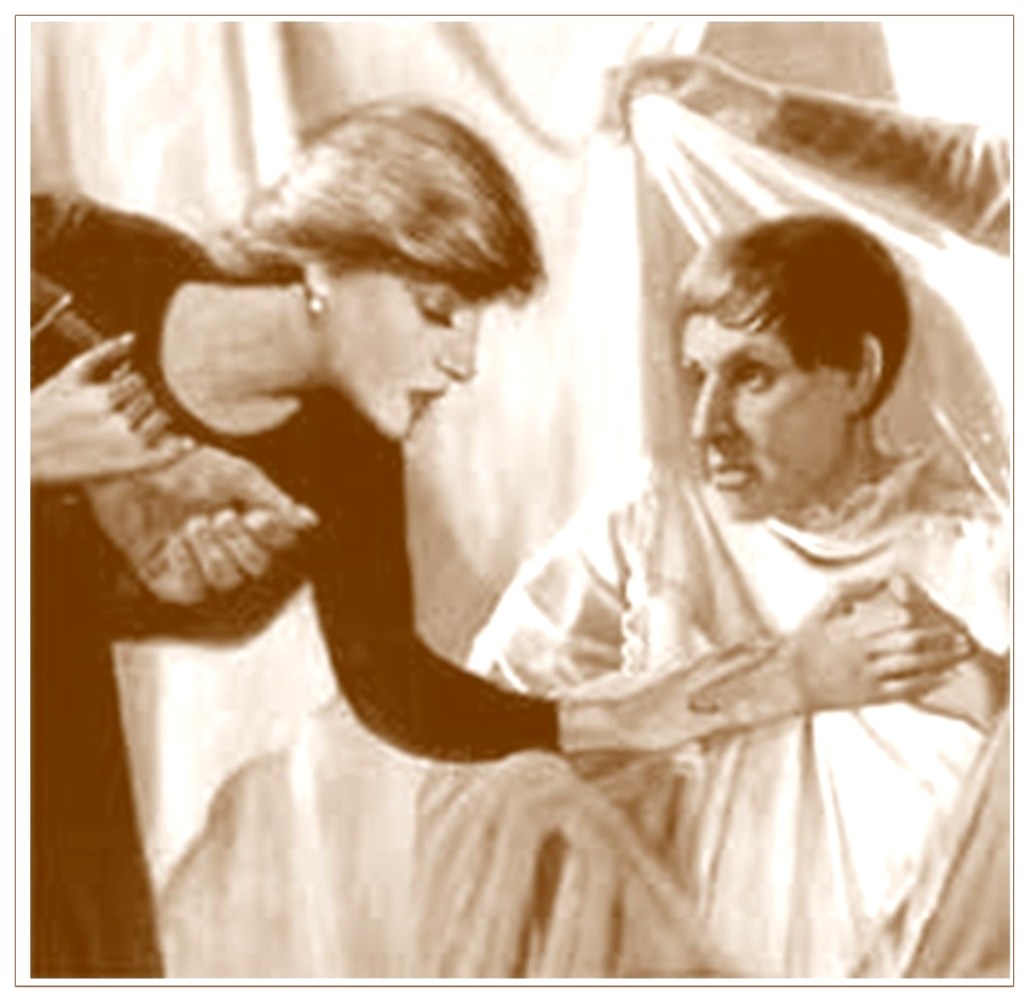
Votive Offering by Andre Durand, painted for CRUSAID AIDS Charity 1987 – detail
Votive Offering Thoughts on World AIDS Day. December 1st, 2023
When Sunnye Sherman, a 35 year old legal secretary in America, was dying of AIDS she was visited by Canadian artist, Andre Durand. He was deeply moved and vowed to dedicate a painting as an offering, a prayer for salvation from the disease. Therefore, he called the painting, Votive Offering which by tradition is an intercession or petition which asks a special favour from God. In particular it invokes God’s goodness to heal.
It was a very special painting – not only because it was an enormous canvas full of symbolism, but also because at the centre of it is Sunnye herself and she is being touched by Princess Diana. Votive Offering was an ex voto painting inspired by Sunnye and dedicated to her memory. It also commemorates the visit of Her Royal Highness The Princess of Wales to the Broderip Ward of the Middlesex Hospital on 9 April 1987. Of the fifteen life-size figures in the composition, ten, including Princess Diana are portraits of people involved in the battle against AIDS. Votive Offering depicts Sunny being ‘touched’ by Her Royal Highness invoking the tradition of the healing touch of royalty. Votive Offering was formerly unveiled and blessed by the Very Revd. Alan Webster, Dean of St. Paul’s Cathedral on All Saints Day, 1 November 1987 at St. James’s, Piccadilly. Recalling an ancient tradition, it then made a pilgrimage of great churches and cathedrals of Britian including St. Martin-in-the-Fields, St. John’s Church, Hyde Park, Peterborough Cathedral, Wells Cathedral, and Liverpool’s Roman Catholic Cathedral. The pilgrimage ended at St. Mary’s Episcopal Cathedral, Edinburgh in September 1988. During the pilgrimage many extra visitors went to the cathedrals to see Votive Offering and gave donations, flowers and said prayers. Parties of school children were taken to see the painting by teachers who realized the educational power of Votive Offering. I experienced it personally St Mary’s Scottish Episcopal Cathedral. During the Edinburgh Festival special services were held, including an All Night Prayer Vigil using the painting as the focus for prayers for healing in a city were AIDS was devastating so many lives, including young mothers and babies through drug-related causes as well as gay people.
Andre used artistic licence because Diana never met Sunnye but it was known that the Princess had a special concern for those dying of AIDS. She was a great supporter of the AIDS Charity CRUSAID and she regularly visited AIDS victims in London hospitals. By introducing the Princess of Wales into his painting, Durand was also keying into a tradition which is known as the ‘Royal Touch of Kings’. In earlier times in Europe, on special holy days, the Monarch would hold a special service during which those in need of healing would come to be touched by the King and prayed over, usually with the words: ‘The King touches you, God heals you.’ In England, the saintly Edward the Confessor, known today for his building of Westminster Abbey, exercised this ministry of touch, as did Charles II who, during his reign is said to have touched over 90,000 people in this way. Henry VIII, Queen Elizabeth the First, James and Queen Anne were known to have touched with prayer their subjects and an early edition of the Book of Common Prayer in 1549 included a special service to accompany the action with the Scriptural invocation: “He lay his hands upon them and healed them.’
One of the effects of exhibiting the painting in churches is that the Church felt strengthened in its ministry towards a section of society for whom there was, in the late 1980’s,fear, mistrust and moral judgement but it had a wider implication. It was a call to acknowledge that within the Christian tradition there was a Gospel imperative to a ministry of healing which, at its heart, offers the love and compassion of Christ to all. It was a challenge to proclaim the Kingdom of God’s love – a love which is not exclusive, reserved for an elect of those who believe they are specially chosen but which is open to all who turn towards Christ and out of their need cry out to him to touch their lives with his healing. This challenge has been at the heart of the Church’s response to the needs of a broken and vulnerable society. It has inspired Christians to respond in many different ways and, as it were, to make of their lives a Votive Offering – a vow to serve their fellow humans as an act of self-offering in the name of Christ. These are people who really do make a difference to society – who really do meet the brokenness of others and identify with it. What was powerful about the painting Votive Offering is that the artist brought the carer and the cared for into direct contact with each other. The Royal Touch of Kings demanded contact between the Sovereign and the one who came for healing. For Christians, the Gospel demands the same. Jesus does not act remotely. One of the consequences of Incarnation of Jesus is that God doesn’t stand on the sidelines of the world and direct its destiny from afar. He is involved. He touches and identifies with those who need him. That is one of the most important messages of the Cross and of Jesus’ suffering. Through his self-offering, God becomes accessible to us. This is a dynamic encounter with one who knows where we are coming from. Here is the context for all Christian healing and it is what makes it distinctive.
We are not agents of some divine social agency put on earth to do good to others. We don’t dispense healing like some spiritual ambulance driver wandering round the world looking for the wounded – we share healing which we have experienced within ourselves. What we offer to others stems from that. If we tryto divorce our own experience of the healing love of God from what we offer to others then we shall be false and our falseness will be recognised and rejected by those who need us to be true. Sometimes that experience is caught up in struggle. Being a Christian is not always about having answers to every problem and a glib, watertight faith can be quite unhelpful to others. When, for example we are faced with bereavement or pain or incurable disease we are often at a loss for words and platitudes will not do. When the Jew, Elie Weisel wrote a book, Night, about his experiences in a Nazi concentration camp, he took the manuscript to the French writer, Francois Mauriac. He confessed to him that he felt abandoned by God. Mauriac, who believed that God is love, pondered how he might answer the young Jew. His instinct was to speak of that other Israeli, his brother, whose Cross had conquered the world. In the end he could not speak at all. He could only embrace him, weeping. Yet it was, in that moment, the answer. Mauriac recognized that words were inadequate. He turned instead to touch and in that touch he was, in some way, Christ.
When I read what Mauriac wrote I felt that he had done something far more important than offer a theological justification for what Weisel was going through. He had done what Andre Durand tried to convey in his painting of Sunnye Sherman – he had brought to that young man the Divine touch of the King of Kings and whatever came of it, it was pure prayer. What Jesus asks of us is simply to be there and to let him reach out through our inadequacy, uncertainty, perplexity. A touch, a quiet prayer, a hug, the laying on of hands, anointing with oil, the lighting of a votive candle are all actions which bring Christ rushing to be a strength in our brokenness. For me this is, like Mauriac’s action, something to do with prayer. It isn’t magic. It’s about placing ourselves into the arms of God. That is not always an easy thing for those who are suffering. I am writing this just after I received news about a poorly baby, I and friends have been praying for. Sadly, after a very difficult operation, she has died. I don’t think that her parents will feel like placing themselves into the arms of God. So some of us need to become the arms of love around them. I take both comfort and instruction in words by Mother Mary Clare of the Sisters of the Love of God,( now with God in heaven). She spoke of the importance of Christians standing and praying “at that point of intersection where the love of God and the tensions and sufferings we inflict on each other meet and are held to the healing power of God.”
When others are in desperation and broken apart, being a channel to hold their pain up to God’s healing love is not a last resort – rather, it is about the most positive thing we can do. Out of this will flow love, compassion and hope; all of which is used by God as our votive offering, a candle-light of love which embraces them and weeps with them but also holds them.