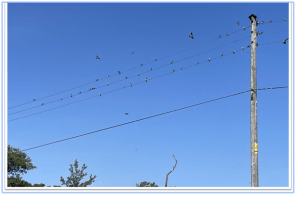
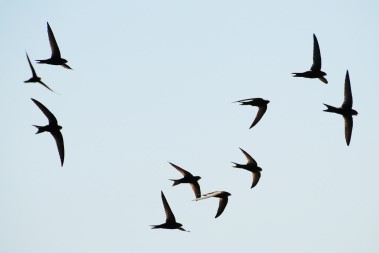
This is a photo taken by my friend, Gill Henwood, of swallows preparing to leave us for different climes. It is a sure sign that the Season are changing and that Autumn will soon be here. (Though the heatwave in Britain at the moment suggests that there may be a short delay!)
Today I received a letter from another Lakeland friend, Lesley, and she too makes reference to the Swallows. This is what she said:
I have been watching the swallows gathering on the wires that weave this way across gardens and fields. It is interesting to watch the birds jostle to claim and make space on the wires for themselves, some more forcefully than others.
They look so vulnerable. It is hard to imagine the long journey they are preparing to make back to their winter quarters. Soon they’’ll go, flying through difficulties but obviously with an inner certainty about it all. They are held through and beyond the struggles in God’s fantastic plan of Creation.
Even the sparrow find a home and the swallow a nest for herself, where she may lay her young, at your altars, O Lord of hosts, My King and My God. Happy are those who live in your house, ever singing your praise.
[}Psalm 84 v 3-4[]
Lord, your psalmist sings of the birds, the sparrows and the swallows finding a home and a nest in your presence where you take care of them with tremendous love. They fly now to winter pastures but they trust you on that long journey and they know confidently that you are near them and enfold them in your love.
May we be filled with that same confidence, trust and faith wherever our lives journeys take us. May wefind our home in you, May our song of praise, like the bird song, sound out in joy and thanksgiving.
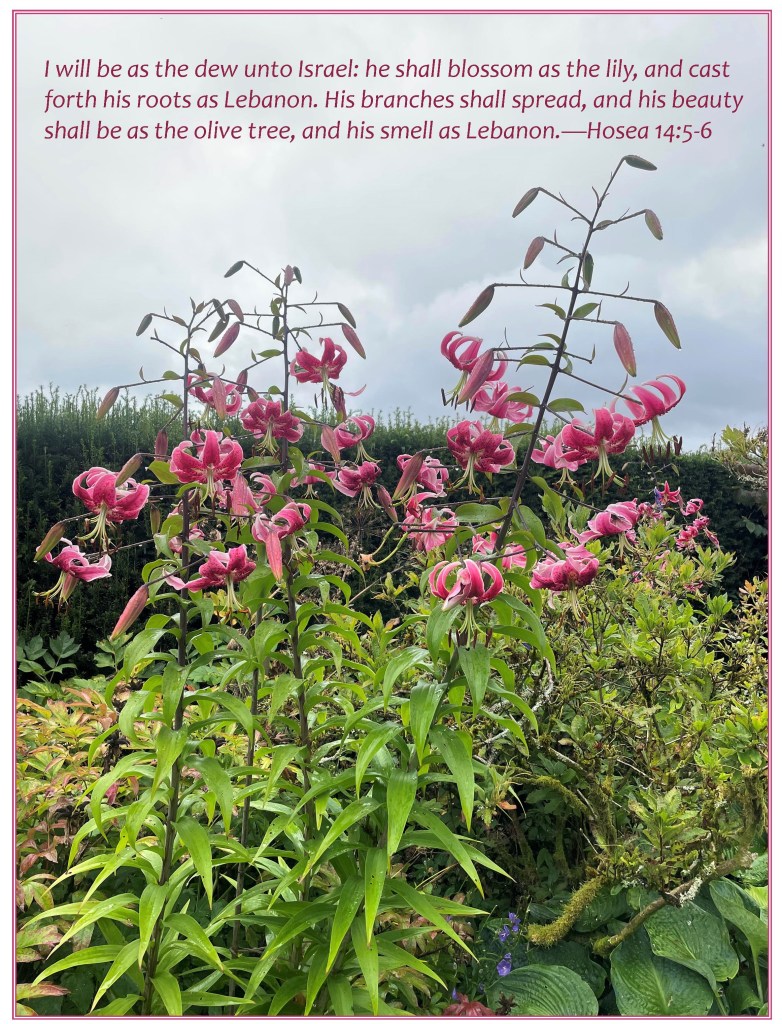
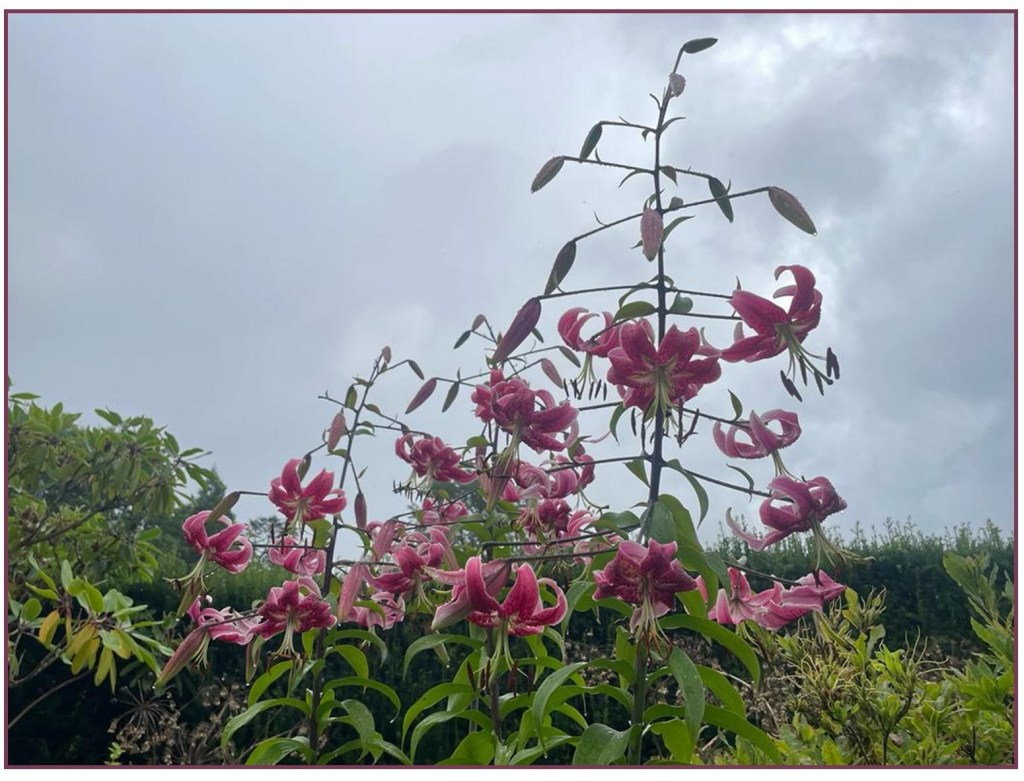
My friend, Gill Henwood, has sent me photos of a striking lily, growing in her Lakeland garden. It is known as the Black Lily, though it is generally deep pink/ purple outlined in white – with a green star in the centre which is scented. It was bred originally about 50 years ago by a plantsman called Leslie Woodriff. It’s pedigree is Lilium speciosum rubrum and Lilium Henryi. It can reach quite a height in mid to late August.
Like all flowers it has a meaning beyond itself. Lily flowers are regarded as symbols of purity linked with clarity of thought and sincerity of intention. In vocational terms it can be a symbol of dedication to a spiritual practice or calling. The lily has a long association with the Blessed Virgin Mary whose calling to become the Christ-bearer and instrument of the Incarnation is at the heart of every call to serve God.
Probably because the Lily is associated with devotion and fidelity, it is a flower often chosen by those celebrating their 30th Wedding Anniversary It is also referenced in the Jewish faith on the day when thanksgiving is made for the falling of dew. The quotation from Hosea (above) is part of the ritual for that day.
For Christians the primary symbolic understanding of the Lily is connected with the understanding of the death and resurrection of Jesus.For many people, Lilies are associated with funerals and bereavement but this link with death is rooted in the belief in the transformation and transcendence of death and the darkness of the world by the triumph of love by Jesus on the Cross. Add to that the symbol of the lily as a sign of re-birth and it is hardly surprising that the dominant flower associated with Easter is the White Lily whose opening represents the revelation of God’s love for us which is at the heart of Easter. It is new growth, new hope and new beginnings all rolled into one.
The Lily in its various forms, shades and colours is a symbol of joy and beauty bringing a special fragrance into our world, whenever and wherever it flowers.
One final thing – sometimes we can overdo our quest for perfection in our lives and in the things we do. So there is a saying ~ don’t gild the Lily ~ Only God is perfect. Even the gorgeous Lily has its imperfections. So do we but to God it doesn’t matter at all. God loves us come what may and it is love which gilds us so that we shine brightly in God’s eyes.
My friend, Gill Henwood, has sent me a poem she has written about House Martin’s. I want to share it with you.
The house martin is a small bird with glossy blue-black upper parts and pure white under parts. It has a distinctive white rump with a forked tail and, on close inspection, white feathers covering its legs and toes. It spends much of its time on the wing collecting insect prey. The bird’s mud nest is usually sited below the eaves of buildings. They are summer migrants and spend their winters in Africa. Although still numerous and widespread, recent moderate declines earn them a place on the Red List.
To find out more go to the website of the RSPB (Royal Society for the Protection of Birds) and the website of : House Martin Conservation UK & Ireland.
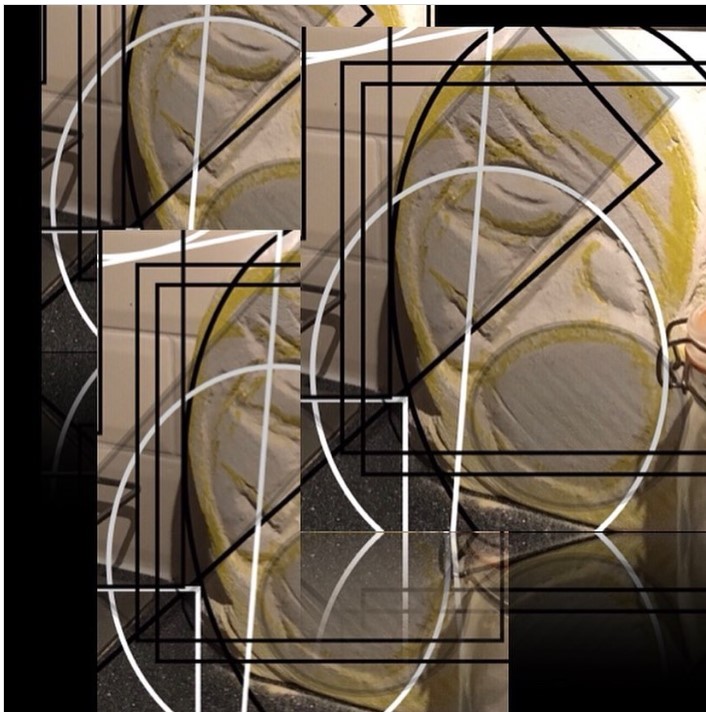
Mary emerging, a work in progress, a sculpture by Kay Gibbons and photographed by her. For reflection see the end of the piece below.
Today, August 15th, many Christians celebrate the Blessed Virgin Mary.
There are many interpretations of this festival and much that has been added to the simple picture given of her in the Bible. Theologically it can be argued that Mary is Primus Inter Pares – first amongEquals amongst Christians. She is, of course, also Theotokos – God-bearer. This is what makes her so special a human being.
English Christianity has always had a special relationship with Mary, partly because of the Glastonbury legend that she came to England after the Resurrection and partly because a biblically-based Christianity cannot ignore her. There are more English churches dedicated to St. Mary than any other saint and even those not dedicated to her usually have a ‘Lady Chapel’ which takes its name from her.
The Mary of the Gospel has much to teach Christians about what it actually means to be a Christian. Take the Annunciation for example (Luke 2:26-38). We see her singled out by God for a very special purpose—the human instrument in God’s plan for the world’s salvation. A young maiden whose faith is deeply rooted in the Jewish tradition is confronted by an angel. His announcement didn’t initially thrill her and she tried to wriggle out of God’s plan with objections and a sense of being unworthy. However, God’s assurances were enough for her to accept her role with humility and obedience. Mary’s ‘Yes’ to God was hard won but total when it came. Her instinctive reaction was to turn things away from herself and when she visited her cousin Elizabeth she was greeted as a woman blessed among women. Mary immediately says the hymn of praise to God which we know as the Magnificat. All her thoughts are rooted in God and from the moment of the Incarnation through to the Crucifixion her concern is for the child she bore at God’s bidding. The best statues of her show her looking at the child in her arms pointing us to Jesus himself. This was her purpose.
Her humility, obedience, praise of God, love and dogged determination to see things through -The Crucifixion where she stood at the Cross when others fled- are all things that should mark out the Christian life. The Orthodox Church calls her ‘Theotokos’ – God-bearer. That is the role of every Christian—to bear Christ to the world. We can learn much from this gentle but at times fiesty, Lady who was truly ‘full of grace’ – praying that we might be too.
The art which heads this article is by my artist friend, Kay Gibbons. It is a work of stone. She was working the stone in garden but was making too much noise and dust. When she told me that she was covered in honey coloured stone dust I suggested that she might stand nicely on the 4th Plinth in Trafalgar Square, London! Pocketing that irreverent thought, we talked of the effect of bringing the sculpture into the kitchen. It has changed the perception. As Kay said, our perceptions are constantly changing. Here amongst the kitchen utensils this was true. Mary was, in effect, being rescued from being a figure out of reach (On a pedestal, as it were), into someone who was accessible. That accessibility brings us nearer to the heart of Jesus. It was St Teresa of Avila who coined the phrase, “God walks among the Pots & Pans.” So Mary emerges in our picture from kitchen artefacts. The white and black lines are traced outlines of chopping and draining boards, pan stands; Kilner jar, even tea bags. Mary is placed among ordinary things. This is not to downgrade her but rather the opposite. She is consecrating with God’s grace the ordinary to make them extraordinary, just as the simple maiden in Nazareth became herself extraordinary through God’s grace to make her mother of Jesus, Mother of God.
Kitchens are holy places where food is cooked and dishes are made clean. They are also often places where people gather at parties and converse. They have a community role. In Kay’s picture we see something of this and maybe your reflection will find much more. There is never one way of regarding and contemplating God, Jesus, Mary or the Saints. Or, for that matter, the ordinary, extraordinary people we meet in prayer and in our lives. In all, and in different ways, we experience the Grace of God at work
Hail Mary, Full of Grace, Blessed are you among women, Blessed are you among Christians, Blessed is the fruit of your womb, Jesus.