Fleeing by night

They fled by night. Sculpture by Josefina de Vasconcellous, Carmel Priory, Lake District. Photo by Mr. G

Yesterday I shared worship with the folk at St Mary, Little Hallingbury, on the edge of Hatfield Forest.There I met three newcomers in the congregation. They are young men who are refugees from Iran.
They are Christian converts and hope to be baptized in the New Year.

Yesterday’s Gospel was the Annunciation to Joseph.
It is that part of St Matthew which comes after the genealogy – that strange but amazing introduction to Matthew’s version of the Gospel, which takes us through the family tree of God’s people, stretching back to Abraham, the Father of the Nations. Abraham, links the three religions of Judaism, Christianity and Islam. He also provides a link to King David and then to Joseph.

Joseph is vital to God’s plan for the salvation of the world and so it was important that his doubts about marrying Mary, who was by then with child, were addressed.
Matthew therefore reported on the visit by an Angel, probably Gabriel. (Matthew 1: 18 – 25)

The significance of Joseph and his link with the three Iranian men I met yesterday, comes a little later in the Christmas narrative.

After the birth of Jesus we are presented with the suffering of the Holy Innocents and the death edict  pronounced by King Herod the puppet king, collaborator to the Roman Occupiers. In Matthew Chapter 2 we are told of the visit of the Magi, the Wise men. Searching, they said for the one who had been born ‘king of  the Jews’ they met Herod who fearfully jealous ordered the death of all children under the age of 2.

Once again, an angel came to Joseph and this led to him taking an action which places him central to Jesus’s story. Often destined to be regarded as the ‘man in the background’, Joseph had a vital part to play in the mission of God to bring salvation to the world. He was there to protect, overshadow and care for God’s Holy Jesus.

He was to take him with Mary to safety in Egypt.

One of my favourite artists is Josefina de Vasconcellos, who was a sculptor.  Her Christian name is the feminine form of Joseph.
She carved a number of Crib seasons in which Joseph is enfolding Mary and the babe, in a posture of loving protection.
But there is another of her statues that speaks to me of the depth of Joseph’s care. It is called, They fled by night, and you can see it in Cartmel Priory in the Lake District. It is of the flight by the Holy Family into Egypt

In Josephina’s sculpture, The Holy Family are in mid-journey and it is night. Mary is exhausted and lies back drained of all energy. Joseph supports her, cradling her in his arms. He is protecting her with love and care. Meanwhile, the child is spread over her legs, his face forward, full of energy which comes from the security of being in the care of loving parents. He seems eager to go on and embrace his future and all that it will bring.

But for a moment, poised in space and time, Joseph holds his beloved ones in rest and care as he takes them away from danger and ministers to their needs.

As I think about this sculpture and the Gospel it portrays I think particularly of one startling truth which has a deeply contemporary meaning.The moment that Josefina captures in They fled by night’  is of Jesus as a ‘Refugee’. He is fleeing the danger and the tyranny being wrought in his homeland. It is the first time that Jesus was cast in the role of an outcast. Of all the people of history and in our modern times, he knew totally what it meant to be travelling away from danger, homeless and with no certainty of what life had in store for him at that moment.


For Josefina, her statue was more than capturing a moment of Gospel story. It was of seeing that as representing the plight of all refugees.
Yesterday we considered what that meant in a week where yet more of God’s children drowned in the English Channel being duped by traffickers who promised them safety.  Just a few minutes ago it was ruled by Judges that His Majesty’s Government can ship unwanted refugees to Rwanda passing the ‘problem’ to others.

This context, part of a huge migration of people across the earth, brings home to us a truth that millions are living in uncertainty, fear and despair.
For every one of them and for those of us responsible for their care, we need to hold on to this truth –  Jesus was a Refugee.!

That raises a huge question. As I talked with the three men from Iran yesterday, who were being watched over and loved by local Christians, what is my responsibility and yours. Joseph willingly accepted his. If we don’t do the same then what are we saying to God? What are we saying about God.

Because rejecting refugees means we are in danger of turning our backs on one who in Josefina’s Sculptured words, fled by night.

[Mr G]

Prayer for Migrants, Refugees and Asylum Seekers

God, no one is stranger to you,
and no one is ever far from your loving care.
In your kindness watch over migrants, refugees and asylum seekers,
those separated from their loved ones, those who are lost,
and those who have been exiled from their homes by violence and war.
Bring them safely to the place where they long to be,
and help us always  to show your kindness to strangers and those in need.
We ask this through Christ our Lord, who was also a refugee and migrant
and who travelled to another land searching for a home and safety.

Amen.

Seven little ‘O’s

In just over two weeks time we will join the rest of the United Kingdom and possibly some other neighbourhood nations in preparing to celebrate New Year.

As the moment approaches there will be, in some places a Count-Down’. Seven…Six…Five…Four…Three…Two…One… and then a brief second before everyone erupts with excitement; joy; and doubtless, as in most years, hope.

Perhaps this coming year, more than any other in recent memory, Hope will be a stronger desire than at any other time. Maybe some will be thinking that 2023 can’t be worse than this year!  That probably needs a lot more hope than we might feel!

The Church has its own version of a Countdown.  During the week leading up to Christmas, from December 17th there is an ancient custom of reciting what are known as the Advent Antiphons. They have been known since the 8th century.

They mark the final week of the Advent Season and each begins with O (a note of praise).There are  7 of them:

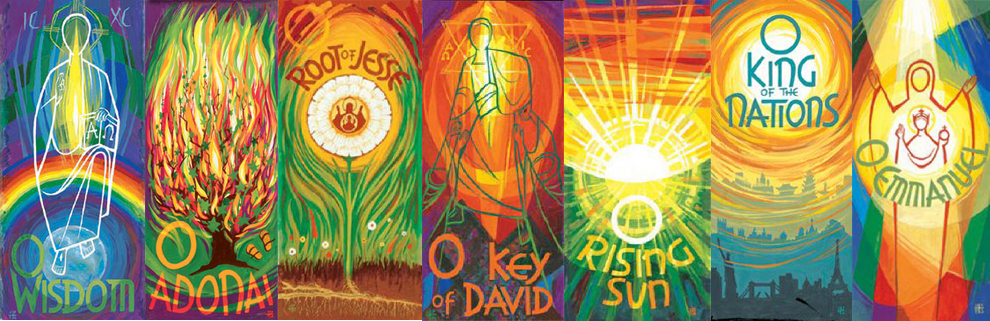
Wisdom (O Sapientia); Ruler of the House of Israel (O Adonai); Root of Jesse (O Radix Jesse) – referring to our Lord as being of the House of King David and therefore the rightful ruler of God’s people; Key of David (O Clavis David); Rising Dawn (O Oriens) reminding us that the birth of Jesus is the dawn of the new age of the New Testament; King of the Nations (O Rex), foretelling that Jesus is for all people, not just Jews; O Emmanuel—God with us, reminding us that Jesus was born as one of us to save us from within our humanity.

I understand that in Latin the initial letters form an acrostic which when read backwards means Tomorrow I will come.  This captures the mood of expectation which is rightly part of the Advent watch of Christians as we move towards the great celebration of Christmas.

They have their origin in Old Testament Scripture, particularly, from the Prophet Isaiah. They are scriptural sentences which top and tail the reciting of a canticle at Evening prayer, which we know of as The Magnificat the song sung by the Blessed Virgin Mary during her visit to her Cousin Elizabeth – as they share the joyful if rather stupendous news that they are both pregnant with rather unexpected babies – Elizabeth with John the Baptist and  Mary, of course, with Jesus.

Today, they are mostly sung at Evensong in these last days of Advent  but they can also be a springboard for personal prayer as we move towards the renewed celebration of the Christ-child.

The ‘O Antiphons’ are little aids to our thinking and praying during Advent.  It is so easy to lose the power of this season to prepare us for the Christ-Child at Christmas that we need all the help we can get!  As the Festive time approaches we shall become more and more embroiled in all the other preparations.  The Antiphons can help to keep us focussed on what is really important in this pre-Christmas season—which is to prepare us spiritually for Christ to be re-born again in our hearts and lives. 

Here is a version of the prayers.

December 17 “O Sapientia…”
O Wisdom, who came from the mouth of the Most High, reaching from end to end and ordering all things mightily and sweetly: come, and teach us the way of prudence. Amen.

December 18 “O Adonai…”
O Lord and ruler of the House of Israel, who appeared to Moses in the flame of the burning bush and gave him the law on Sinai: come, and redeem us with outstretched arms. Amen.

December 19 “O Radix Jesse…”
O Root of Jesse, that stands for an ensign of the people, before whom the kings keep silence and unto whom the Gentiles shall make supplication: come, to deliver us, and tarry not. Amen.

December 20 “O Clavis David…”
O Key of David  and Sceptre of the House of Israel, who opens and no man shuts, who shuts and no man opens: come, and bring forth the captive from his prison, he who sits in darkness and in the shadow of death. Amen.

December 21 “O Oriens…”
O Morning Star, brightness of light eternal, and Sun of Justice: come and enlighten those who sit in darkness and in the shadow of death. Amen.

December 22“O Rex…”
O King of the Nations,  and their desired One, the Cornerstone that makes both one: come, and deliver man, whom you formed out of the dust of the earth. Amen.

December 23 “O Emmanuel…”
O Emmanuel, God with us, Our King and Lawgiver, the expected of the nations and their Saviour: come to save us, O Lord our God. Amen.

Why not pray each one slowly during this time before Christmas?  It will take very little time but it will root you into the meaning of this special time before Christmas as you await the joy of the Christ-child.

Another way of meditating on the Advent Antiphons is in the singing of the Hymn, O come, O come, Emmanuel.  Each of the 7 verses takes one of the antiphons as its theme.

But the hymn begins and ends with the most important antiphon – O Emmanuel, God with us.

O come, O come, Emmanuel,
and ransom captive Israel
that mourns in lonely exile here
until the Son of God appear.
  Rejoice! Rejoice! Emmanuel
  shall come to you, O Israel.

O come, O Wisdom from on high,
who ordered all things mightily;
to us the path of knowledge show
and teach us in its ways to go.
  Rejoice! Rejoice! …

O come, O come, great Lord of might,
who to your tribes on Sinai’s height
in ancient times did give the law
in cloud and majesty and awe.  Rejoice! Rejoice! …

O come, O Branch of Jesse’s stem,
unto your own and rescue them!
From depths of hell your people save,
and give them victory o’er the grave.  Rejoice! Rejoice! …

O come, O Key of David, come
and open wide our heavenly home.
Make safe for us the heavenward road
and bar the way to death’s abode.
  Rejoice! Rejoice! …

O come, O Bright and Morning Star,
and bring us comfort from afar!
Dispel the shadows of the night
and turn our darkness into light.
  Rejoice! Rejoice! …

O come, O King of nations, bind
in one the hearts of all mankind.
Bid all our sad divisions cease
and be yourself our King of Peace.
  Rejoice! Rejoice! …

O come, O come, Emmanuel,
and ransom captive Israel
that mourns in lonely exile here
until the Son of God appear.
  Rejoice! Rejoice! …

(This translation is by John Mason Neale)

(image from Parish of St Ann, Bethany Beach, DE)

[Mr G]

All is beauty

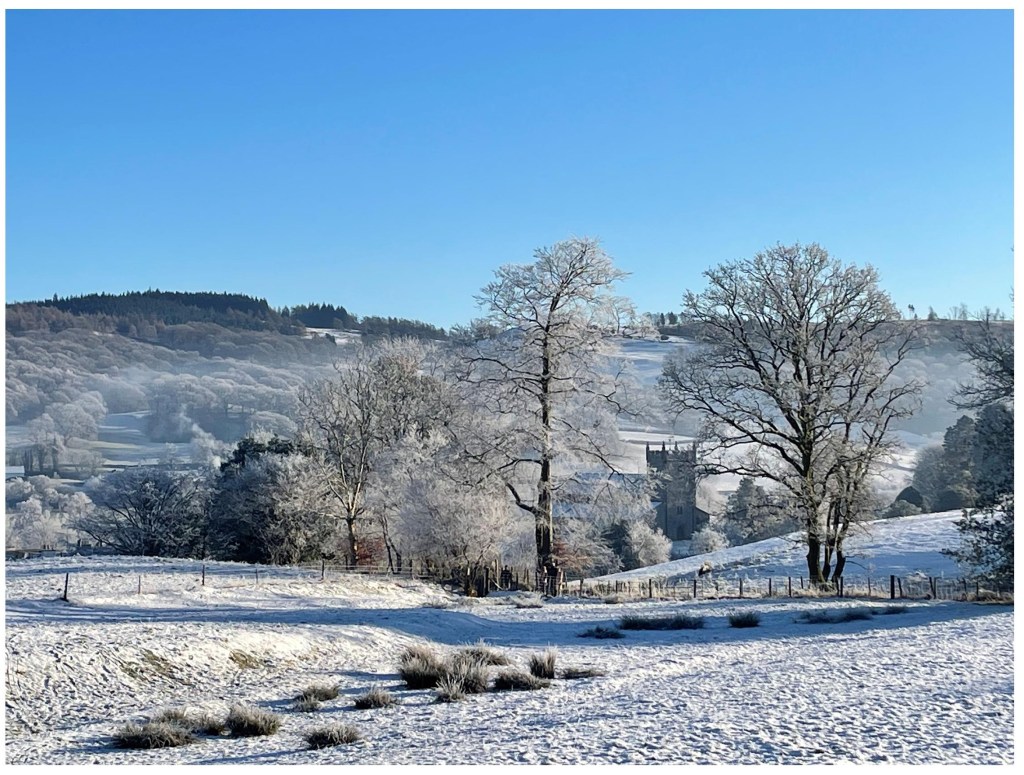
The photograph of Hawkshead is by my friend, Gill Henwood.
The quotation is by St John of the Cross whose feast day is December 14th.

John of the Cross was regarded as one of the greatest Spanish mystics of the sixteenth century.
His writings still nourish modern Christians in their hunger for a true experience in the spiritual life.
He was born in 1542 and became a Carmelite friar at the age of twenty-one. Four years later he met Teresa of Avila in one of those God-moment meetings were two souls are fused together by the love of God, for the greater good of Christianity.
Teresa was occupied in reforming the Carmelite Order, instilling renewed vision and discipline and founding many new Convents of Prayer throughout Spain. John of the Cross joined her in this work. He served as a spiritual guide to the nuns and to Teresa herself. He was one who encouraged her to write her teaching on Prayer. His prominence in the reform movement made him a target for those who preferred the more comfortable old ways and twice he was abducted and imprisoned. After Teresa died, he was again targeted, this time by his own superiors in the Reformed Carmelites. Their harshness contributed to his death in 1591.
Nothing, however, took him away from his love of God and he gladly accepted the hardships because he saw them as sharing in the sufferings of Jesus on the Cross. Hence his name.

Like Teresa, he experienced the presence of Christ in “intellectual visions.” His reflection upon these experiences issued, first of all, in poetry of extraordinary power and beauty. At the urging of his disciples, he selected a number of his poems and produced prose commentaries on them, which have become classics of mystical theology. This includes one of his most famous writings on The Dark Night of the Soul.

John united the vocation of a theologian with the experience of a mystic, and his writings are the good example of theology as the fruit of prayer.

The most lovely thing that was ever said about him was by St Teresa.  “I cannot be in the presence of John without being lifted up into the presence of God.”

John said, himself, about God:

How gently and lovingly
You wake in my heart,
where in secret You dwell alone;
and in your sweet breathing,
filled with good and glory
how tenderly You dwell in my heart
with love
.

from, The Living Flame of Love by St. John of the Cross

and here is something for us to ponder over and pray about, applying it to ourself.

God is more pleased by one work, however small, done secretly, without desire that it be known,
than a thousand done with the desire that people know of them.
Those who work for God with purest love not only care nothing about whether others see their works,
but do not even seek that God himself know of them.
Such persons would not cease to render God the same services, with the same joy and purity of love,
even if God were never to know of these.”

― John of the Cross, The Collected Works of Saint John of the Cross

[Mr G]

Winterscape : The hidden tree

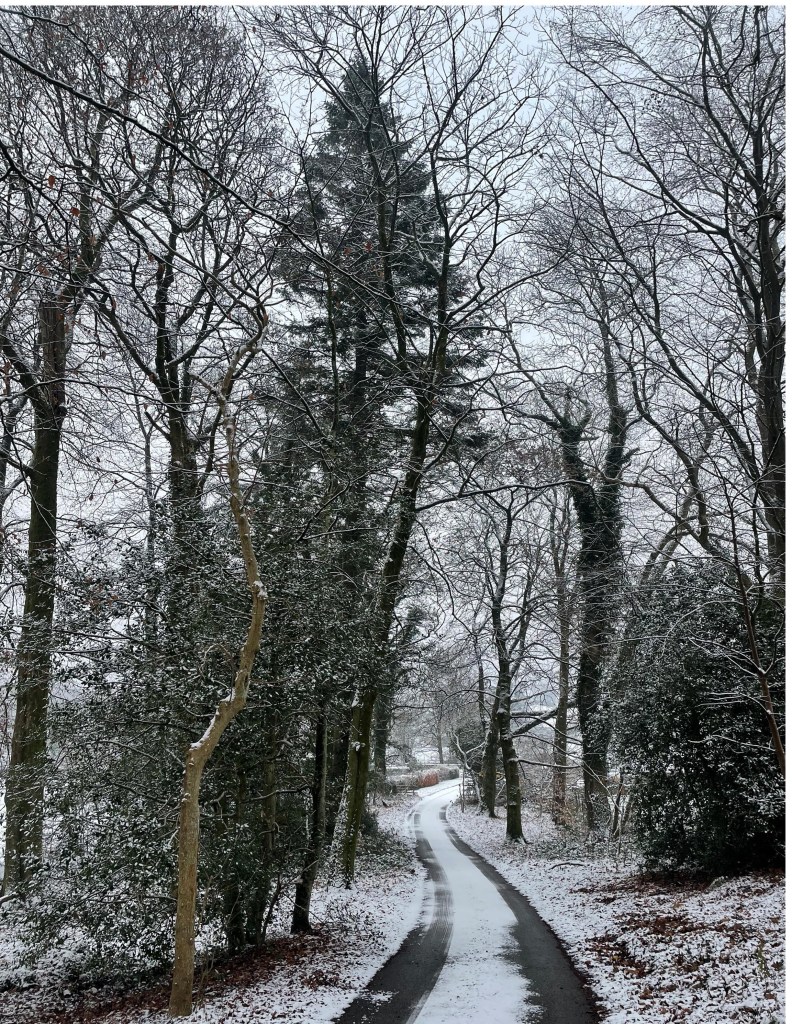
photo: Gill Henwood

Gill has been reflecting on her photo and what it has revealed about the Conifer/Christmas tree in background.

Revelation of the tree

The ‘Christmas tree’ (see above) has been hidden within the linear wood along the lane for a century or so, quietly growing upwards. Surrounded by vigorous sycamore, oak, beech and lower wych elm, the Christmas tree has gradually, slowly, reached maturity high in the canopy. 

Unnoticed by those who walk below while the deciduous trees are in full leaf, for they spread their branches and budding twig tips to catch the sun in every space, the Christmas tree has pierced through to the light, with a trunk straight and strong.

Throughout the decades, lower branches have been left behind – only the top half of the tree has needles now, the ridged bark of the trunk is bare. We have walked past, day by day, or driven up the lane, rushing past. Only now can we stop, look up and realise how our tall our Christmas conifer towers above us. Hiding in plain sight, revealed through the winter beauty of the  bare skeletal trees.

We can’t reach up into our Christmas tree to decorate it with baubles and candles. No ladder or steps can scale her height. S/he stands proudly wild, independent of human intervention, glorying in natural majesty. But the frost crystals settle on her needles, and the snow dresses her branches. The little birds flit in her shelter, glimpses of red breast or blue head, flash of white wing bar or red crest – these are our tree’s lively colours, as the flocks flutter up from foraging in the fallen leaf litter below.

S/he may have cones that will catch the snow too. They are secret, only for the seed hunters to find. And if the sun shines while s/he’s decked with crystals, s/he’ll sparkle in refracted rainbow colours.

Our Christmas tree is decorated from above, through frost, snow, light, birds and the many creatures living and moving through her shelter. God’s joyous blessings, given in creation of our natural world – a world we rush through and pass by, often failing to notice until we stop, and let ourselves look up.

This Advent, may each one of us find the gift of stopping somewhere, and receive God’s blessings as our Christmas tree receives – quietly, often hidden, but courageously growing towards the light. Light of the World, revealed in the mystery of Christmas… And as I reflect, the barn owls next door are screeching as they set off in the starlit dusk to hunt through the trees down the lane. Sometimes they perch in the trees, spying movement, watching. They are rarely seen, just a white shadow when flying, but their song – a screech – tells us they’re in the trees every evening. Perhaps one of them will perch in the Christmas tree tonight, waiting for the moon to rise in the clear, freezing sky

[Gill Henwood]