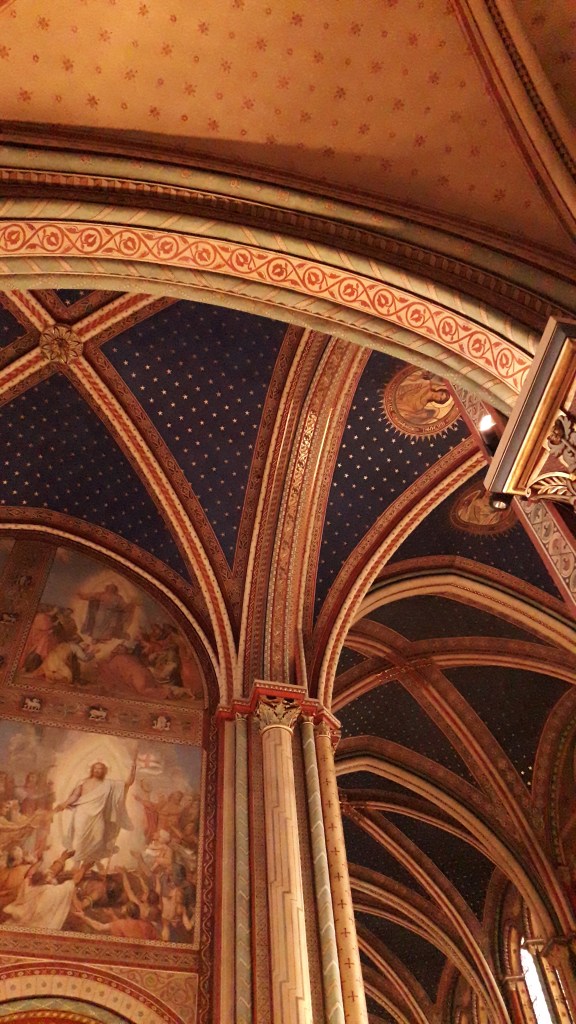
Photo: detail of ceiling at the church of St Germain des Prés, Paris. [Mr G]
One of my pastimes is to be a ‘groupie’ with a local choir which includes friends. Last weekend we went to Paris where they presented two concerts and a musical involvement in the Saturday Mass at St Sulpice. It is currently acting as the Cathedral whilst Notre Dame is being restored. At the first concert, in the church of St Germain des Prés, some of the sopranos noticed a spider hovering over the choir as they sang. It had travelled quite a distance from the ceiling but by the end of the concert, it had disappeared. So I wrote this poem….
A Spider goes to a Concert.
Down came the Spider Abseiling intrepidly, hanging by its own thread, precariously, from the church roof. It stops. Hovering over music ascending from collective voices. Sounds made by practiced singers. “Look, a Spider”, a soprano points out between pieces. but the Concert builds to its final crescendo. No time to spend on Spiders. As the music fades, the concert ends and the Spider is gone.
Not a Spider at all, but an Angel, taking up the music to heaven, for God to enjoy!
[Mr. G.]
Inspired by a spider who came to a concert by The Felicitas Choir at the church of St Germain des prés Paris. 27th Oct 2022)
All Hallows’ Eve – a time to Sparkle with light and love.
‘The Feast of All Pumpkins’ was one of the slightly irreverent names give by some to Harvest Festival. Judging from the decorations which fill our shops, pubs and many homes, it is presumably a description that we could apply also to Halloween. Once again this is a day which has been hijacked by commercial interest and turned into something that was never intended. ‘Trick or Treat’ could be seen as a bit of harmless fun – taking over from Guy Fawkes night. After all what does the tradition of lighting a fire and setting off fireworks on November 5th mean to most people today? – outside England, very little. The idea of blowing up Parliament would never occur to us today. Of course not!
The problem is that Halloween has long been associated with the occult, black magic and the darker side of life. A concentration on mock horror can quickly turn into real horror. A concentration on the dark side of life can have a negative effect on life. We are living through some very dark times on our world at present. Ukraine, the energy and cost of living crisis, economic uncertainty throughout the world, drought and famine and the way we are treating refugees, and the poor are all part of a darkness in humanity which creates a negativity that becomes the devil’s playground.
Try reading C S Lewis’s Screwtape Letters if you don’t get what I’m trying to say
However, like all negatives there is an opposite positive and it lies in the name of Halloween itself. ‘Halloween’ means The Eve of All Hallows. The word ‘Hallow’ means ‘Holy’ as in the traditional Lord’s Prayer – ’Hallowed be thy name.’ Halloween is the evening of the Feast Day of the Holy Ones of God – which is another way of describing the Saints.
All Saints’ Day is the glorious feast when we remember the Holy people who have perfumed the world with the fragrance of their holy lives and deep devotion to Christ. So Halloween is a time of preparing for All Saints Day. This is not best done by thinking about ghosts, vampires and witches.
It is best done by quietly reflecting on those people whose faith has influenced our lives and who have shown something of the saintly qualities we are seek to imitate in our own lives. Few of us has grown in faith without the help of good and holy Christians. People who have encouraged us, taught and shown us something about God’s love, and reflected Christ-like love in their own lives. These are the people we should be thinking about at All Hallows and All Saints. Some are now with God and others are still here, quietly showing us what God means to them. We honour them but more than that, we honour Christ whom they show us.
A better use of Halloween is to praise God for such ‘saints’ and to pray that the holiness they show us might become a quality in our own lives.
Praise God, from whom all blessings flow; Praise Him, all creatures here below; Praise Him above, ye heav’nly host; Praise Father, Son, and Holy Ghost. Amen.
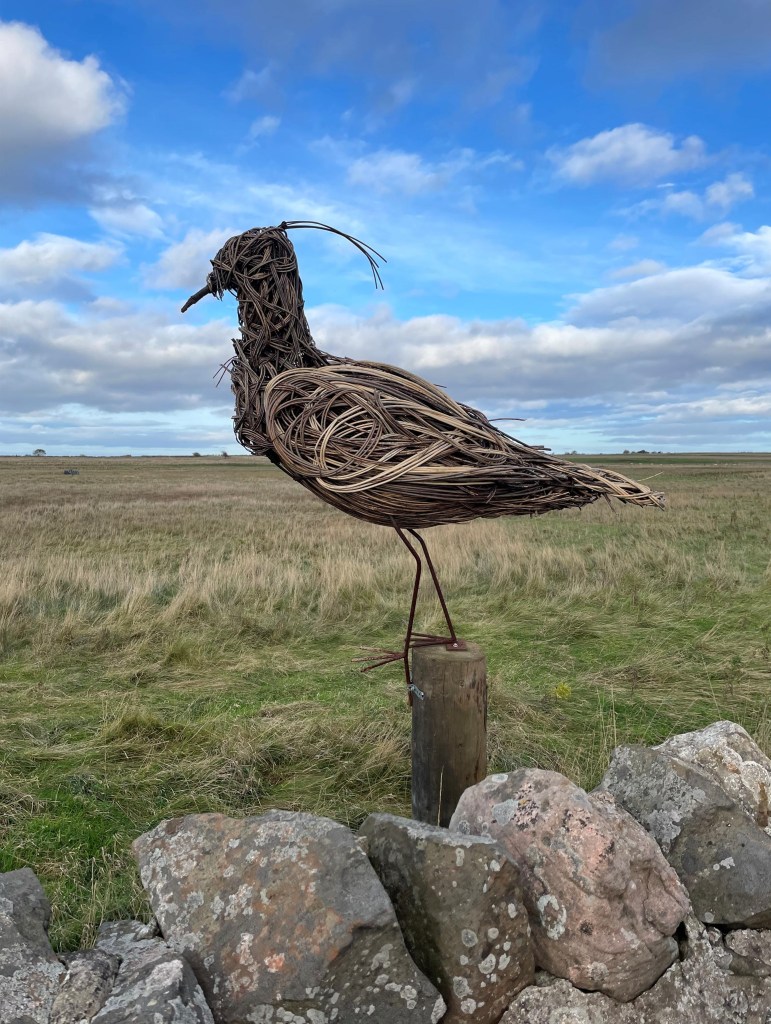
My friend Gill has just sent me this photo of an amazing willow sculpture on the Holy Island of Lindisfarne. It’s too splendid not to share! Especially as Gill has sent an accompanying reflection:
Holy Island weather cleared by late morning to a beautiful autumn afternoon. From the Heugh and the castle, the lighthouses on the Farne Islands were clearly visible and Bamburgh Castle towered over the sea.
The willow woven lapwing surveys the wildlife lough near the viewing centre. Calling birds were all around: overhead hanging on the breeze, feeding in the soft ground and shores, flocking together by the trees. Seals bobbed up in the channel below the Heugh as the tide swept in, marooning island dwellers and visitors for the day (unless they had a boat, or could fly!) Bladder wrack floated as the sea lifted its prostrate carpet from the wave cut platforms of rock, the lush seaweed dancing in the swirling currents with airy buoyancy – alive with joy.
In the church, the (renovated) hewn monks still carry St Cuthbert in his coffin, seeking safety and sanctuary, journey’s hasty start fleeing Holy Island, wandering to his final resting place in lofty Durham. “Who are they?’ My five year old grandson asked, astonished as he looked up by their life-sized embodied presence. Now at the back of the church, as if to process out of the south door.
The story of Cuthbert lives on, of Aidan before him and Oswald too. Of the Lindisfarne Gospels written in the scriptorium somewhere here, back in the north this autumn to visit again. It is also our story, as we too seek sanctuary from the dark troubles of our fragile world.
May the lapwing who migrated speak to us of the turning of times, tides and the seasons on Holy Island, a place of fragile peace and sanctuary. May s/he speak to us of the need to fly, to flee, when adversity comes. May s/he reassure us that, in God’s loving economy, there are places of safety when we seek together – even when that resting place is our ‘place of resurrection’, our own graves.
Gill Henwood
Note:
The Lapwing was part of a Nature Trail created by Anna and volunteers under the guidance of Lindisfarne National Nature Reserve.
The Lapwing, also known as the peewit in imitation of its display calls, its proper name describes its wavering flight. Its black and white appearance and round-winged shape in flight make it distinctive, even without its splendid crest. This familiar farmland bird has suffered significant declines recently and is now a Red List species.
The Heugh (pronounced Hee-uff) is an elevated rocky ridgeoverlooking the village and providing some protection from the wild weather which assails the island village. It was here that St. Aidan set up his monastery in the 7th Century when Lindisfarne became the cradle of Christianity for a vast area of England and Southern Scotland.
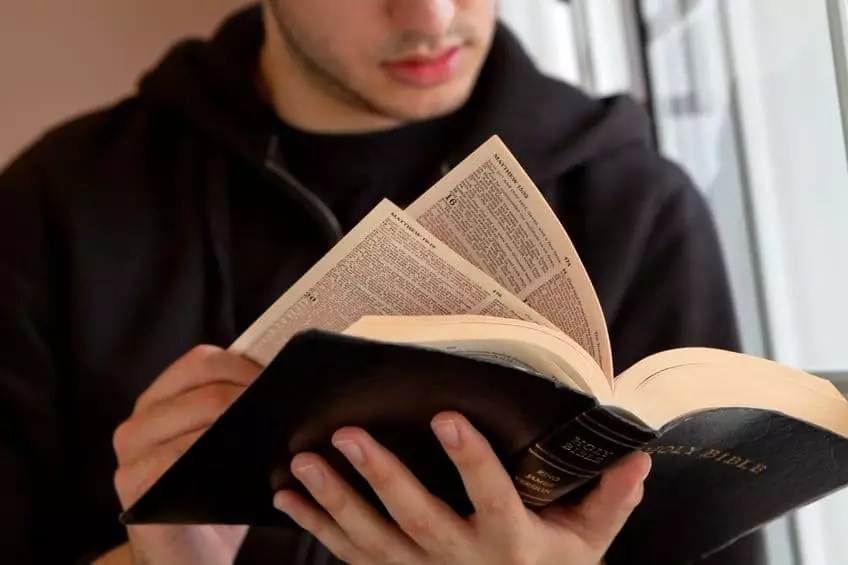
When I was at Junior School I remember John Garnett telling our teacher that he had just completed a reading of the entire Bible. He was quite smug about it and I suppose for an eleven year old boy it was quite an achievement. Not to be outdone, I decided that I also would read the Bible from cover to cover. I set off eagerly through the pages of Genesis and Exodus and all went well until I got to Leviticus when, sadly, I abandoned the project. Trying to read the Bible from cover to cover as a way of beating John Garnett rather missed the point of why we read the Bible. I know that now!
When we read the Bible and especially when we pray its pages we enter into a loving relationship with God. As Christians, we are part God’s story and it remains a continuous story of God’s Love Affair with His people – with us! We don’t read the Bible in order to chuck quotes at others, still less to prove some argument or opinion we hold – though sadly the Bible has been used and continues to be used by people in just such a way.
The Orthodox spiritual leader, Kallistos Ware, wrote that: The real purpose of Bible Study is to feed our love for Christ, to kindle our hearts into prayer and to provide us with guidance for our personal life. The study of words should give place to an immediate dialogue with the living Word himself – with God, with Jesus Christ.
To be reminded that the sacred words of the Bible lead us into an encounter with Christ is very important. We are in relationship with a Living God, and not just a book. An Orthodox Saint, St Tikhon, said that Whenever you read the Gospel, Christ himself is speaking to you. And while you read, you are praying and talking to him. This conversation must never be rushed.
A friend of mine once said that we should read the Bible in digestible bits rather than indigestible chunks! Modern translations of the Bible helpfully divide the text up into sections rather than chapters and one section at a time can be enough to feed our praying..
Today, we keep Bible Sunday and it is a reminder of how very important the Word of God revealed in Scripture is for our life of faith. How can we tell God’s story and be part of that story if we neglect the Bible? I love this quotation from Richard Carter, Associate Vicar for Mission at St. Martins-in-the-Fields, London. I offer it as a little Ponder Point.
“Sometimes, you just have to read the Bible with your heart. It’s not a theory, it’s not an argument, it’s not a weapon, it’s not words. It’s the Word made flesh. It’s God’s love deeper and wider and more expansive than your dreams.”


 Mr G's Ponderings