Incarnation, a collage by sisters of the Community of St Mary the Virgin, Wantage. Photo: Piers Northam.
Love came down at Christmas, Love all lovely, Love Divine, Love was born at Christmas, Star and Angels gave the sign. Worship we the Godhead, Love Incarnate, Love Divine, Worship we our Jesus, But wherewith for sacred sign? Love shall be our token, Love be yours and love be mine, Love to God and all on earth, Love for plea and gift and sign.
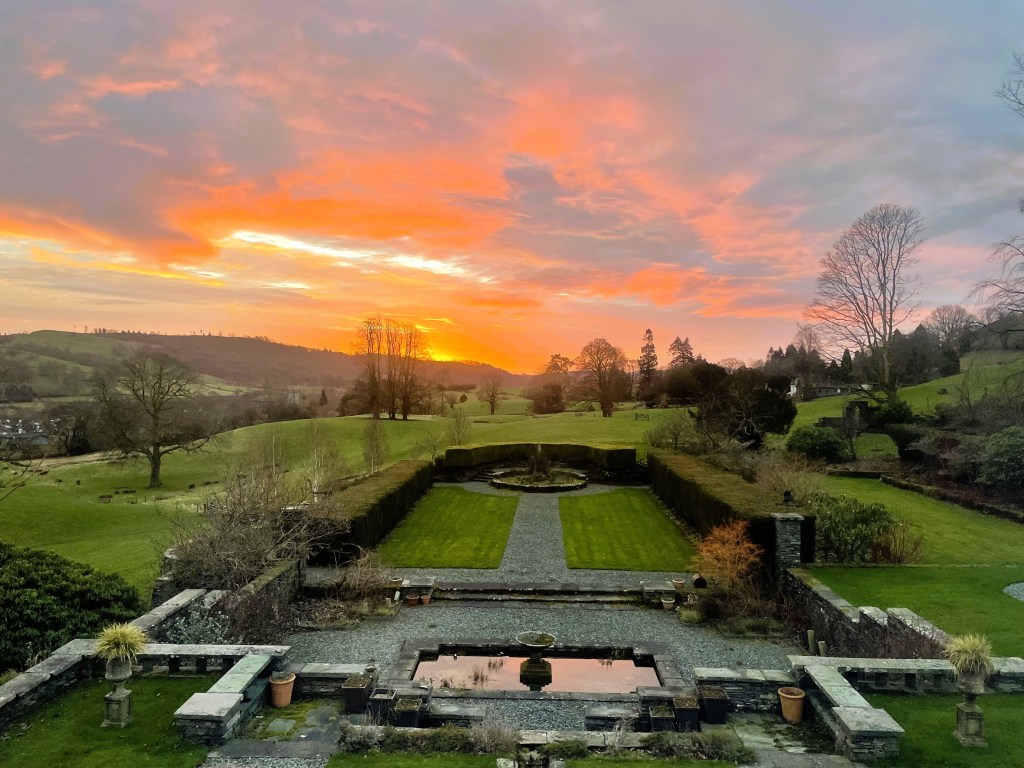
Lambs discovering the joy of sunbathing! Photo from the Lake District from my friend Gill Henwood
The Church of England commemorates Christina Rossetti today. She is known particularly as a poet and probably more popularly as the author of the Christmas carol, In the bleak Mid-winter. Tunes by Gustav Holst and Harold Darke have helped to build its reputation. No Christmas carol service would be complete without it though it has a somewhat fanciful beginning. In the bleak-midwinter, frosty winds made moan, earth was hard as iron, water like a stone and then follows a reference to snow falling on snow. That doesn’t quite fit in with the birth of Jesus at Bethlehem in the warmer climes of the Middle East but the carol was written for people who live in the Northern Hemisphere. In these parts the idea of a cold winter is not difficult to imagine though the hope for snow may remain just that! The carol raises other questions but it is probably the final verse which has the greatest appeal, for both children and adults.
What can I give Him, Poor as I am? — If I were a Shepherd I would bring a lamb; If I were a Wise Man I would do my part, — Yet what I can I give Him, — Give my heart.
The idea of giving oneself to God at Christmas, who gave Himself to us in the Incarnation, is, after all, a response to an amazing action of God to bring salvation to His world. Christina recognizes this action of God as an act of pure Love. In another Christmas Carol, Love came down at Christmas, she ponders on this theme of Love in a deeper, spiritual way.
Love came down at Christmas, Love all lovely, love divine; Love was born at Christmas, Star and angels gave the sign.
Worship we the Godhead, Love incarnate, love divine; Worship we our Jesus: But wherewith for sacred sign?
Love shall be our token, Love shall be yours and love be mine, Love to God and to all men, Love for plea and gift and sign.
It is not as well-known as In the bleak midwinter, though the poem was set as the text for the BBC Radio 3 Carol Competition in 2022 and so got a lot of air time on the Radio. The winning tune was, to my mind, both memorable and beautiful. I think Christina, with a life steeped in a loving experience of God expressed in poetry, might have approved.
She was born in 1830 and died at the age of 64. Her brother was the Pre-Raphaelite painter, Dante Gabriel Rosetti and she became steeped in the theological movement which was associated with this – the Anglo-Catholic expression of worship and prayer. This had led her on a journey from Evangelicalism. Her elder sister took this a bit further by becoming an Anglican nun! Many of her poems were mainly religious though some were born out of sadness of love that was never quite fulfilled in human terms. She did, however, compose poems for children, including a very popular one, Goblin Market, about two sisters who were tempted by forbidden fruit sold by Goblin merchants and what follows as a result! Christina denied this was a poem for children and, indeed, many modern commentators point out adult themes to which it alludes. She did, however, write genuine poems for children. She also wrote a book, Called to be Saints, which she subtitled ‘the Minor Festivals Devotionally Studied, which explored those saints in the Anglican calendar which were overlooked at the time. She provided a devotional reflection on each one in a poetic way which reflected the depth of her faith.
Today she has her own place in the Anglican Calendar and a greater recognition of someone who in her lifetime dealt with unrequited love and quite debilitating illness and yet with faith. She gave us poetic reflections for our own life’s journey which also reflect a love of God that produced a rich harvest.
Some of her poetry celebrated the world around her and the photo by Gill Henwood of lambs taking their ease in the Lake District, which heads this article, drew me to a verse in one of Christina’s poems, The Milking Maid …
The year stood at its equinox, And bluff the North was blowing. A bleat of lambs came from the flocks, Green hardy things were growing. I met a maid with shining locks, Where milky kine were lowing.
[MrG 27th April 2024]
Good Lord, I ask much of Thee, But most I ask to love Thee; Kind Lord, be mindful of me, Love me, and make me love Thee.
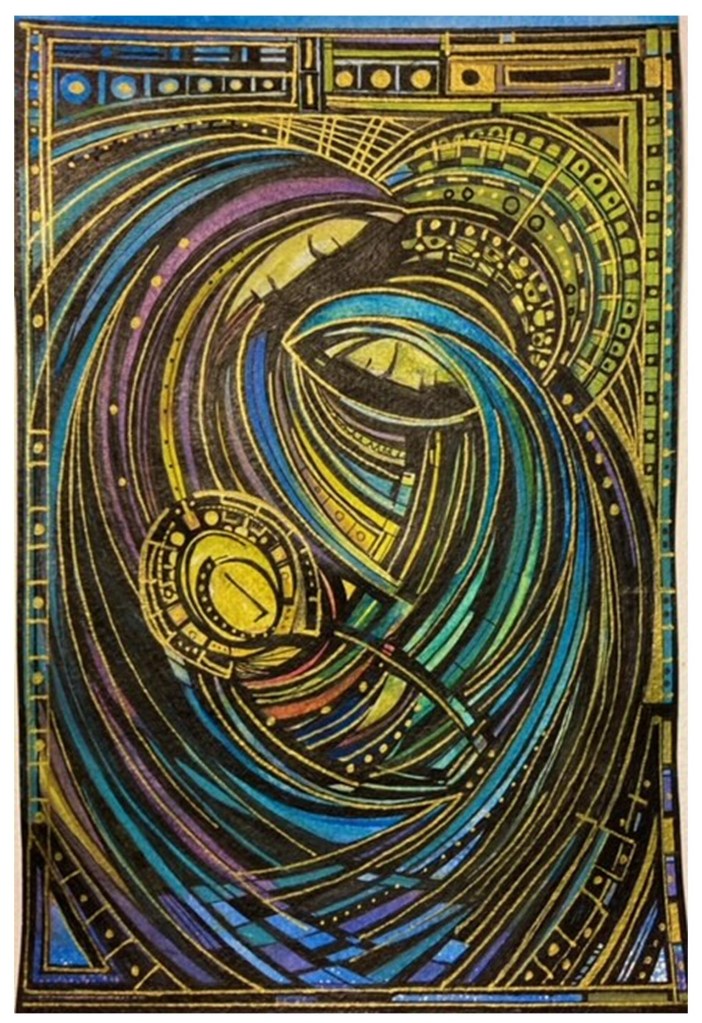
Christmas greetings through the usual card sent by post has been disrupted this year because of the industrial dispute between the Royal Mail managers and their hard-working and mostly dedicated staff, so most of my greetings have been sent by email. I wanted, therefore, to have a special design.
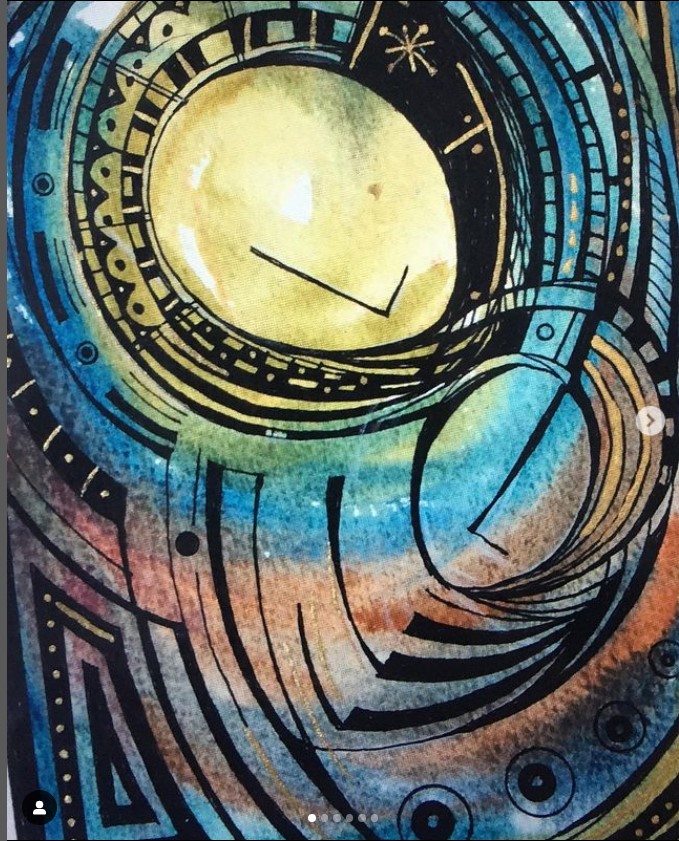
Who better to approach than my dear friend Kay Gibbons? She and I have known each other for a long time but more recently, over the past year or so, I have come to know her art too. She is described as a multidisciplinary artist and she works in a variety of media. These include glass, paint and stone. She lives near Oxford and has taken part in Oxfordshire Art Weeks.Next year she will be mounting an exhibition in the Oxford area, Her designs are amazing and she uses bright colours, swirling conceptions, geometric presentation, and a sense of movement which delight and inspire the senses. For me, just pausing to ponder her work gives sheer joy and uplifts me. I can’t fully put my finger on it but it is expressive visual poetry. She uses colour and shape to open a window to the numinous. You can judge for yourself by looking her up on Instagram.
Above is the commissioned ‘Nativity’ that I asked her to design for me. I would like to offer it to the followers of Mr G’s Ponderings as a greeting to you all in this Christian Festive Season when we give thanks in a special way for the birth of the Christ-Child. I would like to take this opportunity to thank all of you who look at my blog and take the time to reflect on what we post. I am very encouraged and grateful.
Not all of you are Christians but every faith has an experience of light triumphing over darkness; of goodness overcoming evil and of hope overlaying despair. Every faith speaks to individual hearts as well as to faith communities. There is the aspect of personal belief leading to how we are to live our life under God.
In our present human darkness and struggle which stretches from Ukraine to Iran; Afghanistan to Syria and as we struggle with the global migration of refugees; the consequences of natural disaster, poverty and hunger, and the lasting effects of Covid, we can, and many do, feel overwhelmed. For some, faced with all this, there is a test of faith, for others a quiet desperation. This year’s midwinter festival comes at one of our planet’s weakest moments. We are fragile, vulnerable and afraid. So Jesus, coming into our world as a vulnerable babe in very unpromising circumstances can be, for us, a reminder that God has us held in the palm of his loving hand. He knows our fears and our needs. The Incarnation of Jesus is about Loving us from within. Love comes to seek us out and it is the God who is pure Love who will lead us through.
None of us know, at this moment, what 2023 holds for us. However, working together across all sorts of divisions, boundaries and misunderstandings, we can make a huge difference to our future direction and security – and that of the earth itself. We have a stewardship of our planet and therefore a duty to all of Creation to do t
In the face of just 10 or so despots who think they have some right to impose their will over the billions of others, we need to return the earth and the care of all to God. The best way we can do that is through sharing God’s love for us with all inhabitants of the earth from human beings to blades of grass.
In whatever form you see God’s light, the birth of Jesus is, for Christians, the incarnation of that light and that love. Love flourishing in all hearts is my Greeting to you this Christmas.
Words of a poem by Christina Rossetti Love came down at Christmas.(slightly adapted)
Love came down at Christmas, Love all lovely, Love Divine, Love was born at Christmas, Star and Angels gave the sign.
Worship we the Godhead, Love Incarnate, Love Divine, Worship we our Jesus, But wherewith for sacred sign?
Love shall be our token, Love be yours and love be mine, Love to God and all creation, Love for plea and gift and sign.



 Mr G's Ponderings