Tag: Evelyn Underhill

Prayer filled teacher.

Evelyn Underhill, an image from Pleshey Retreat House.

Evelyn Underhill – remembered in the prayer of the Church of England, today, 15th June.

In the first five decades of the twentieth century, Evelyn Underhill was, perhaps, one of the most widely read writers on prayer and the spiritual life. The first woman ever invited to give a series of lectures in religion at Oxford, she was a fellow of Kings College, London, and in 1938 received an honorary Doctor of Divinity degree from Aberdeen University. She wrote two of the most definitive books on Worship and on Mysticism which are still classics today. She was influenced in her writing by her spiritual friend and mentor, Baron Friedrich Von Hugel.

It was, however,  as a retreat director and spiritual guide that she became best known and loved.

 Evelyn made her first retreat at Pleshey Retreat House in the Diocese of Chelmsford. This was during Ascensiontide in 1921. She led her first retreat at Pleshey during Lent in 1924. The invitation for her to so came from the then Warden, Lucy Menzies, a personal friend. For the next decade or so she was, arguably, the most distinguished Retreat Conductor of that time. She loved the Retreat House at Pleshey which, she wrote after her first retreat here, ‘seems soaked in love and prayer,’ and many of her retreats each year were conducted here.

A prolific writer, many first editions of Evelyn’s work can be viewed at Pleshey, and today there is a great resurgence of interest in her work and teaching on spirituality. Evelyn may take credit for establishing the place of retreats in the spirituality of the Anglican church in this country, and still today, many people come to the tiny Essex village from all over the world to see the place she loved, breathe the prayer-filled air she breathed, and, perhaps, sense her presence still in the great communion of saints which is so important to our past and our future.

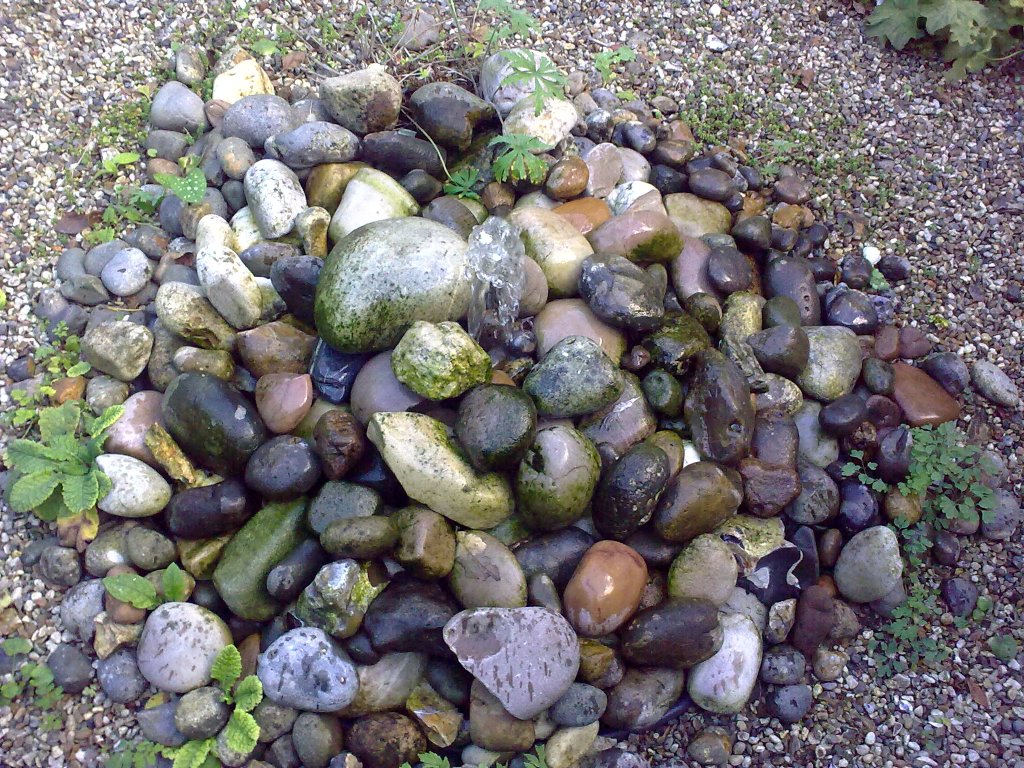
Water bubbling up in Pleshey garden behind the Chapel.
Photo: Mr G

Growing in Prayer

{There is much information about Evelyn Underhill on the Web. Try the Pleshey Retreat House Website.
The website of the Evelyn Association has a wealth of information.
}

Corpus Christi

Hay bales and harvest. Norfolk. Photo by my friend, Julia Sheffield

Evelyn Underhill

In the first five decades of the twentieth century, Evelyn Underhill was, perhaps, one of the most widely read writers on prayer and the spiritual life. The first woman ever invited to give a series of lectures in religion at Oxford, she was a fellow of Kings College, London, and in 1938 received an honorary Doctor of Divinity degree from Aberdeen University. But it was as a retreat director and spiritual guide that she became best known and loved. This is her poem about Corpus Christi, celebrated by many Christians today. It is a Day of Thanksgiving for the gift of Jesus in the Holy Eucharist.

Corpus Christi
by Evelyn Underhill

Come, dear Heart!
The fields are white to harvest: come and see
As in a glass the timeless mystery
Of love, whereby we feed
On God, our bread indeed.
Torn by the sickles, see him share the smart
Of travailing Creation: maimed, despised,
Yet by his lovers the more dearly prized
Because for us he lays his beauty down—
Last toll paid by Perfection for our loss!
Trace on these fields his everlasting Cross,
And o’er the stricken sheaves the Immortal Victim’s crown.

From far horizons came a Voice that said,
‘Lo! from the hand of Death take thou thy daily bread.’
Then I, awakening, saw
A splendour burning in the heart of things:
The flame of living love which lights the law
Of mystic death that works the mystic birth.
I knew the patient passion of the earth,
Maternal, everlasting, whence there springs
The Bread of Angels and the life of man.

Now in each blade
I, blind no longer, see
The glory of God’s growth: know it to be
An earnest of the Immemorial Plan.
Yea, I have understood
How all things are one great oblation made:
He on our altars, we on the world’s rood.
Even as this corn,
Earth-born,
We are snatched from the sod;
Reaped, ground to grist,
Crushed and tormented in the Mills of God,
And offered at Life’s hands, a living Eucharist.

Camino Communion

This poem, by my friend Piers Northam, takes its inspiration from a Pilgrimage to the Shrine of St James in Santiago de Compostela. The poem is written at the beginning of the Anglican Lambeth Conference. The Conference gathers Bishops and others from member churches of the Anglican Communion. It is a diverse group with differing opinions on many issues. It can be viewed as a ‘scattered family’ which gets together to celebrate a fellowship which is best described as Koinonia – a fellowship with each other brought together by the Holy Spirit and held by that same Spirit in a Communion with each other.

Sometimes, because of its diversity, there is disagreement and some heart-searching as a compromise is sought. Sometimes because of our separate cultures, it isn’t always possible to agree, at least not at present. The member churches seek to listen and keep talking and praying together under God’s guidance until a new understanding is reached.

Another way of seeing things is as a Pilgrimage to God’s Kingdom which we approach from differing directions – as with the Camino where pilgrims walk from many different places. Conversations, prayers and walking together produces many experiences as we share in the common adventure. Finally each of these ‘ways’ converge. The Camino symbol, tracing the cockle shell (emblem of St. James the fisherman) shows us the paths converging to the same point.

Piers reflects on this as he thinks of what is the nature of the Anglican Communion. There are parallels to be discovered between the Camino and the Anglican Communion. Might it, therefore, be possible to see a positive way forward, not just for Anglicans, but also for Christians of all denominations. Could we be even more brave and see some way forward for inter-faith friendship.

The Anglican mystic and teacher of prayer, Evelyn Underhill, had a belief that our differing views and beliefs are as Chapels in the Cathedral of the Holy Spirit. It is both a lovely and dynamic thought !