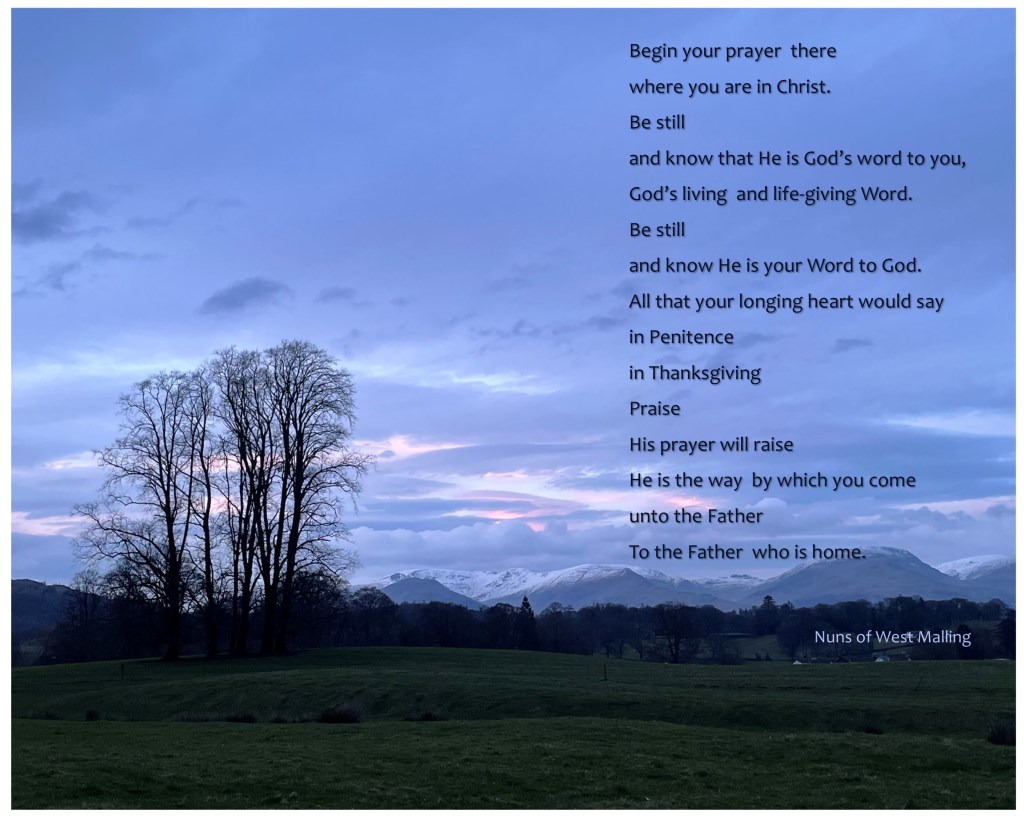
Tarn Hows photographed at the eve of Candlemass/Imbolc by Gill Henwood.
The photo speaks its own message. Very still, chilly breeze, birds singing for Imbolc/Candlemas ….But fallen giant conifer trees from the storms are on slopes exposed and waterlogged ground. After the storms, the birds sing of hope, for Spring, new life, another season to grow. Bittersweet calm, but the low sun rising is warming the cold wet land and her creatures. [Gill]
February tiptoes across a winter landscape, luring us away, from cold depression of dark, dank January.
Weak, shy strengthening Sun, practices dazzling us with brightness; whispering promises of hope about Spring beyond.
Ah! What trembling beauty lays a carpet of expectant joy!
Tarn How Gate, Lake District. Photo by Gill Henwood
The words below are often recited at New Year’s time. They are a poem by Minnie Louise Haskins which she crafted in 1908. She had studied at the London School of Economics where she also later taught. The poem first appeared in a collection published under the title, The Desert. It became particularly well known in 1939 when, in his Christmas Broadcast, King George VI quoted it. It words were particularly apt for a nation facing the darkness and uncertainty of War and in these dark days it remains powerful. It is suggested that Princess Elizabeth brought it to the attention of her father and later, it became a special favourite of Queen Elizabeth the Queen Mother who found comfort from it throughout her life. The poem appears on a plaque in the Royal Chapel at Windsor.
Gill Henwood has drawn the poem to my attention and has supplied a rather lovely photo of Gate to Tarn Hows from the woods above Coniston. Looking towards Fairfield Horseshoe on the Helvellyn range. English Lakes UNESCO World Heritage Site (The Lake District).
THE GATE OF THE YEAR
‘God Knows’
And I said to the man who stood at the gate of the year: “Give me a light that I may tread safely into the unknown”. And he replied: “Go out into the darkness and put your hand into the Hand of God. That shall be to you better than light and safer than a known way”. So I went forth, and finding the Hand of God, trod gladly into the night. And He led me towards the hills and the breaking of day in the lone East.
So heart be still What need our little life Our human life to know, If God hath comprehension? In all the dizzy strife Of things both high and low, God hideth His intention.
God knows. His will Is best. The stretch of years Which wind ahead, so dim To our imperfect vision, Are clear to God. Our fears Are premature; In Him, All time hath full provision.
Then rest: until God moves to lift the veil From our impatient eyes, When, as the sweeter features Of Life’s stern face we hail, Fair beyond all surmise God’s thought around His creatures Our mind shall fill.
[Minnie Louise Haskins]
Gate to Tarn Hows from the woods above Coniston. Looking towards Fairfield Horseshoe on the Helvellyn range. English Lakes UNESCO World Heritage Site (The Lake District).
The last Sunset of 2023, photographed over Tarn Hows in the English Lake District. It was photographed by my friend Gill Henwood who was inspired to reflect on the moving from the old year to the New….
Over Tarn Hows, the foreground devastated by storms Arwen and this winter, being cleared from huge fallen trees. Yet calm on the ruffled tarn surface and the wind is still. A rainbow caught the low cloud behind me as the sun kissed the top of the standing larches, turning them golden.
The old year is ending, nature battered and bruised, but clearing brings light into the forest floor for saplings, berries, mosses, new life.
The birds are beginning to sing that spring is on her way. There are storms ahead in 2024, but the turning of midwinter to the new year has happened from the dawn of time…
There is a power stronger than all our fears, bringing hope into our apprehension and potential for healing to those who are suffering. God’s creating Spirit, stirs anew, while still the Magi are following the bright Christmas star….
The wind is wine to those who walk on bright December days the heath; Above, the cold, capacious sky, the rimy grass beneath.
With each a merry heart the guide, The sun for compass: they who know the wanton ways and whims of earth, and laugh to find them so.
No English hills, in English lanes, A man may walk with ease and find at every turn the mode and mark of earth’s best humankind:
May rest in quiet inns at night, in sleep enfolding bone and brain, and with the dawn may rise and take the long, free roads again.
(Sir William Addison)
This poem comes from a small collection, ‘Winter Forest’ by Sir William Addison. The poems are inspired by Sir William’s long association with Epping Forest where he was one of the four Verderers.The verderers of Epping Forest have represented the views of everyday people for over 800 years acting as a key go-between with the City of London.
Sir William was born in the Ribble Valley in Lancashire and he was educated at Clitheroe Royal Grammar School. His family had connections in the past in Grasmere and Bowness.
When he married Phoebe Dean in 1929, the couple moved south and eventually lived in Buckhurst Hill on the edge of Epping Forest, Essex.He bought a bookshop in the neighbouring town ofLoughton, and began his lifelong association with Epping Forest which included a love of the history of the area. The result was a number of books on the Forest area and Essex, Suffolk and of people like Dick Turpin, highwayman of the Forest. He worshipped at the Parish Church in Epping.
The collection of poems Winter Forest was edited by Richard Morris, Verderer of Epping Forest and published by the Corporation of London in 2002, by kind permission of legatees of Sir William’s estate, including the incumbent of St. John’s church in Epping. My personal involvement in this small way has led me to make the poems in this collection more widely known. Walking in December seems a good place to start. I am grateful that I am able to illustrate this with a ‘December’ photograph by my friend Gill Henwood, and appropriately the scene is from Cumbria, where Sir William’s family had their roots.