Tag: Helen Smith

Waymarks of Faith

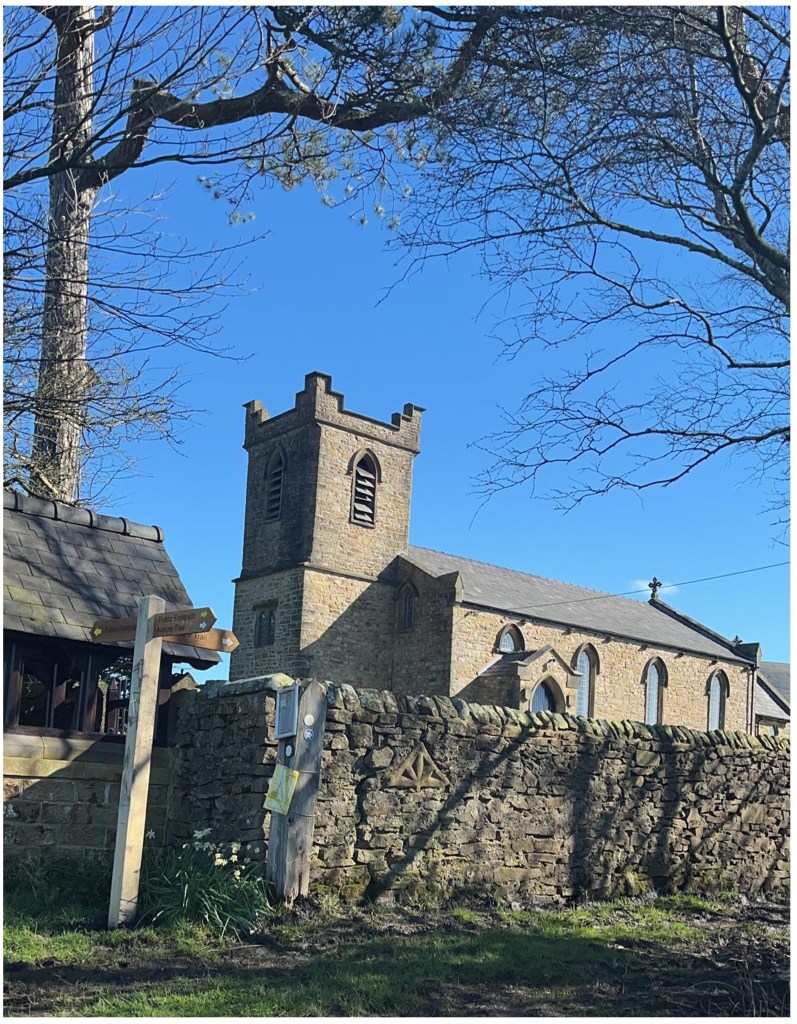
St Eadmer, Admarsh-in-Bleasdale. Photo: Helen Smith

This delightful church at Bleasdale (or to be correct, Admarsh-in-Bleasdale) is overlooked by Parlick and Fairsnape Fells in North Lancashire. Both are in the Bowland Area of Natural Beauty. The Church has a unique dedication – that of St Eadmer.

It has baffled many as to who he was and for a long time it was thought that he was the secretary to St. Anselm of Canterbury.( An Eadmer wrote Anselm’s biography.)
Investigations proved inconclusive until another Eadmer was discovered.
When the Body of St. Cuthbert was carried by the monks of Lindisfarne to safety from the Vikings, the journey was long and arduous. Indeed, with rests it took a very long time. It involved a stay in Chester-le-Street and a journey over the Cleveland Hills now known as the Lyke Wake Walk or Coffin Walk.

The final part of the journey is to be found in a ‘History of the Church in Durham’ by a medieval monk, Symeon.
He describes the arrival of the shrine at a place on the east side of what is now the city of Durham. The vehicle on which it rested could not be moved and the bishop directed his monks “that they should solicit an explanation of this sign from heaven by a fast of three days, which should be spent in watching and prayer, in order that they might discover where they should take their abode along with the holy body of the father”. This was done and Simeon goes on to relate that “a revelation was made to a certain religious person named Eadmer, to the purport that they were required to remove the body to Durham and prepare a suitable resting place for it”.
This was done and as a result, ultimately, one of the greatest Norman Cathedrals in the world was built.

What all this has to do with the Church in Bleasdale is sheer conjecture. It may well be bound up with the fortunes of a local family, the Parkinson’s, who came to live at Fairsnape Fell and who were Christian folk. The Chapel at Admarsh fell into decay and it was rescued and restored by the Parkinson family. It was my conjecture that linked Bleasdale with Northumbria and Durham.
The Fairsnape Parkinsons claimed descent from the Featherstonehaughs of Featherstone Castle in Northumberland then in the diocese of Durham. When they were looking for a dedication for their renewed church, it is reasonable to suggest that they looked to their Mother Church of Durham which was the last resting place of the remains of St. Cuthbert of Lindisfarne.
Possibly the Parkinson family felt that they shared the vision of Eadmer to build a church albeit a small and modest one.

Like so much of our history as a nation, facts are often shrouded in the mists of time and our stories are a mixture of truths, myths, poetic license and reasonable conjecture after sifting and weighing up the evidence.
What we do know is that in this beautiful corner of Lancashire, there has stood a church which has been cared for and used for a long time and has fed people with the nourishment of the Gospel.
An agricultural community works what is often a harsh land and with a changing lifestyle. Farming is not what it was nor is church life. The local Church of England School which provided an amazing education to children from the area sadly closed its doors in 2019. The village hall, however, still caters for a quaint but satisfying social life. Lancashire Hot Pot Suppers were, in my 10 years ministering there, a treat beyond measure and where else could you end each evening’s entertainment with a rousing rendition of the National Anthem, played lustily on the hall piano!

Worship still takes place in the serene church and placing oneself in God’s hands means lives continue to be consecrated.
This morning, my friend Helen send me the photo along with others of the fells. It opened up memories but also I was reading about the state of the Church of England as recorded in The Guardian  newspaper. It’s radicalism often tries to engage its readers with negativity about Christianity, when it isn’t busy with its other preoccupation, that of undermining the Monarchy!
This isn’t an easy time to keep churches going in small, rural places and logic might well suggest that we should close more of them down and reorganise ourselves into bigger and more manageable units. A large local Scout camp often uses St Eadmer’s as a shelter when their night hikes are interrupted by rain. Where would they go?

For the faithful Christians who find faith and God’s love in their little church, this is more than an act of survival. It is an act of belief and a witness in a God who converted a world with a motley crew and goes on doing so still.
Each of our churches are ‘waymarks’ – cairns- on our way to heaven.
We lose those pointers and the sharing of discipleship at our peril.
We may say that we have to be realistic but thankfully, the Parkinson family of Bleasdale and other places like them,  including, and especially, today, didn’t understand a realism which was fatalistic and devoid of hope and determination to claim divine footsteps to heaven. Cairns are built when wayfarers add a stone or a pebble. The Way to Heaven needs not so much stones as visionary people.

Father, as you gave Eadmer the vision to build a church to your glory:
and kindled that vision anew in the hearts of those
who built the Church in this land,
so guide all who meet you in our places of worship,  
to go on building your Church in the hearts and lives
which are wholly dedicated to you. Amen

[Thank you to Helen Smith for sending me the photographs
and thus reminding me of the importance of the waymarks of faith in our journey of life]
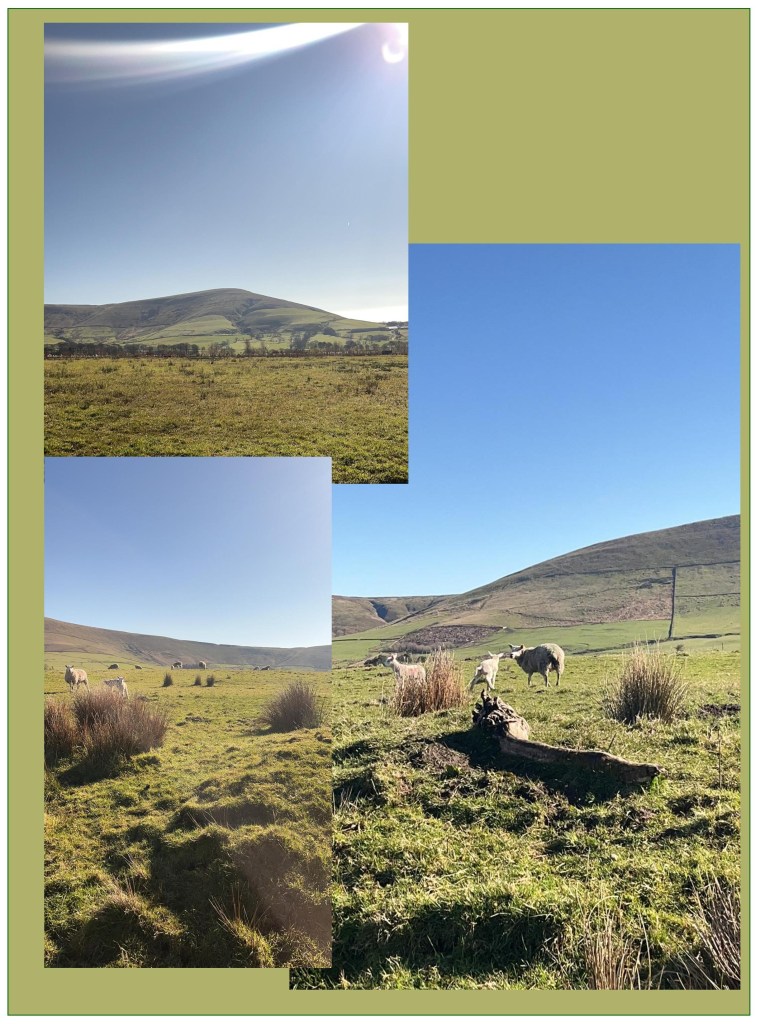
Parlick & Fairsnape Fells – photos by Helen Smith

About Angels

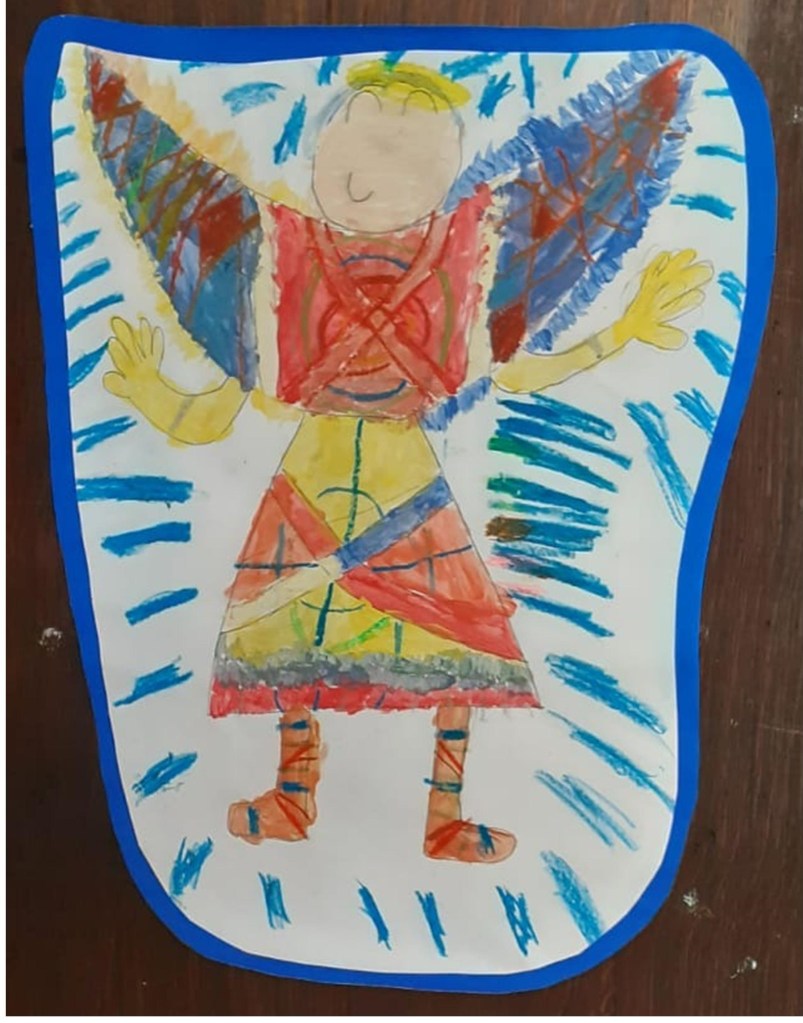
This photo by my friend Helen Smith is of the centrepiece for a Festival of Angels at St. Michael’s Church, Grimsargh, on the outskirts of Preston. The Angel, which appeared throughout the Church, was designed by the Art Teacher at Grimsargh School, and made by the children.

A thing or two about Angels

Many years ago, I was told a story about the saintly Bishop King of Lincoln. He never forgot that Ordination laid upon him the ministry of pastoral care. Though, as a bishop he led a busy life, he would love to visit people. One such person, whom he visited every week was an old lady who lived in a remote part of a wood. He also visited prisoners in the local gaol and one day, he was talking to one of them who confessed that he once lay in wait in the woodland with the intention of robbing the bishop. “You normally travelled alone” said the man, “but on this occasion you had someone with you.” The bishop was perplexed for he had always gone alone but then he beamed, “Ah! that would be my guardian angel.”

And he meant it!

The role of angels as ‘guardians’ of human beings is rooted in Scripture. In Matthew 18: 10 Jesus speaks of the angels watching over God’s ‘little ones’. In Psalm 91 we are told “He will give his angels charge of you to guard you in all your ways.” and in the beautiful service of Compline (the late night prayer service of the Church) is the invocation:

The angels of God guard us through the night, and quieten the powers of darkness.’

The role of angels taking care of us may seem fanciful to many  but I point sceptics to that moment when Jesus had been tempted by the devil. After a gruelling forty day fast, our Lord was weakened and it took all his strength to resist the devil. When the devil left him, St. Matthew tells us: suddenly angels came and waited on him. They were there all along!

Why that doesn’t surprise me is that I have experienced the ministry of angels often in my life.  For example, over the past two or so years I have spent a lot of time in hospital. On one occasion I was feeling scared and apprehensive about some treatment I was about to have. I was in a room on my own and as I tried to pray, I sensed an overwhelming presence of someone else there with me in a corner of the room. I just knew that an angelic presence was quietly but most definitely watching over me. This was not a product of my imagination. It made all the difference to how I was and how I faced things. I was not alone but more importantly, the angel’s  message was that I was being held and loved.

There is a sense that we never really walk alone in this world. God is always watching over us. Sometimes, when we are up against it and we feel that we really cannot carry on much longer, something happens that lifts the burden a little. There is a light at the end of the tunnel. There is  respite from the storm that rages around and within us. We are not on our own any more.

I know people love that  story about ‘Footprints’ in the sand where the two sets of prints become one and when the man meets Jesus he castigates him for leaving him. Jesus replies that he never left him. The single prints were when Jesus was carrying him.

We don’t always appreciate how much God ministers to us and we are prone to believe he is absent during some particularly difficult period of our life. I dare say Jesus felt that  sometimes —as we know from his cry on the Cross—my God, why have you forsaken me!  But Jesus knew the truth. The humanity of Jesus cried out but the divine heart knew that His Father was always near him.   I know that God never really abandons me though I am often conscious that I have often abandoned him!

So why do I need a Guardian Angel? I suppose the easy answer might be that I find it a comfort. The real answer is because God chooses this as a way to care for me (and you) and that’s what the Bible tells me.

I just know its true –  and my guardian angel agrees with me!

[Mr. G]

If you want to know what a Guardian Angel might look like, one of the children at Grimsargh School has helpfully provided you with a clue. (Photo by Helen )

Psalm 103: 21-22

The Lord has established his throne in the heavens,
   and his kingdom rules over all.
Bless the Lord, O you his angels,
   you mighty ones who do his bidding,
   obedient to his spoken word.
Bless the Lord, all his hosts,
   his ministers that do his will.
Bless the Lord, all his works,
   in all places of his dominion.
Bless the Lord, O my soul.

Version is that of the NRSV

New Revised Standard Version Bible: Anglicized Edition, copyright © 1989, 1995 National Council of the Churches of Christ in the United States of America. Used by permission. All rights reserved worldwide. http://nrsvbibles.org

We will remember them!

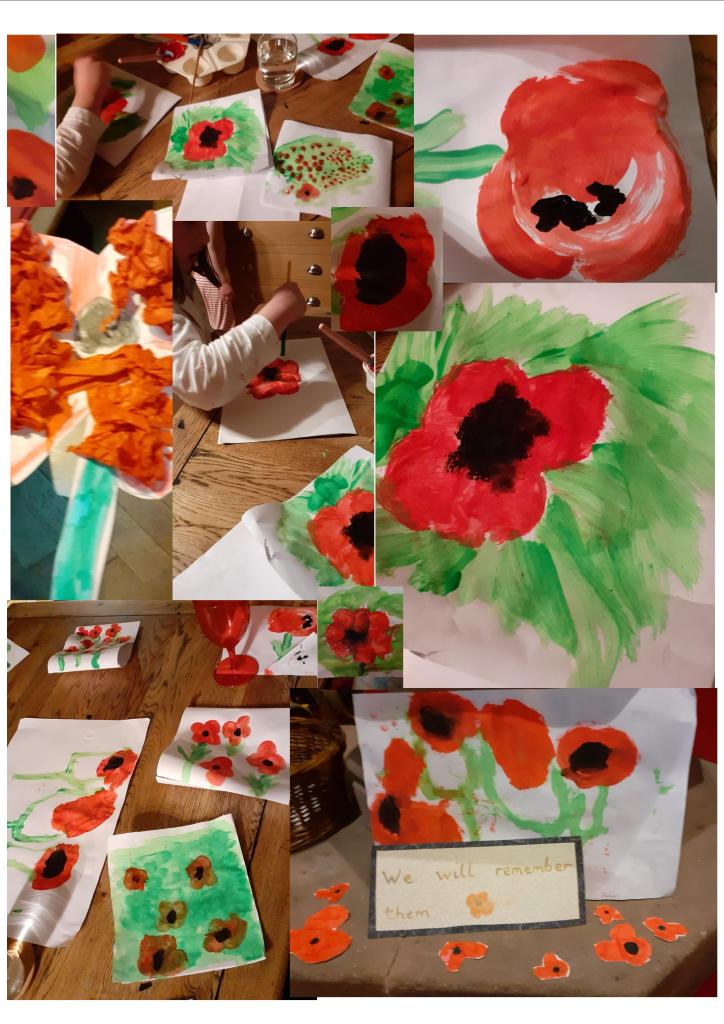
A collage of some of the Poppy paintings

The beautiful village of Whitechapel near Garstang, in the Bowland Area of Outstanding Natural Beauty, has recently been the home of a special Poppy Factory. In this strange time of muted celebration of Remembrance, a group of children have been extremely busy creating poppies to decorate the church.

My friend Helen is one of the leaders and her own children aged 8 and 4 have kept Helen on her toes with their creative skills, They have been joined by other children of Messy Church at St. James’, where I had the privilege of being Vicar some years ago.

Helen sent copies of the Poppy paintings to The Royal British Legion and received an immediate response:
“Thank you, on behalf of the Royal British Legion for your support. We appreciate it.I would also like to pass a message on to your children. What wonderful drawings! So talented! I will make sure that the staff see these so that a smile can be brought to them as it did for me. Stay safe.”

The children not only loved making the poppy paintings but they also learned more about Remembrance Day. Helen was able to share with her children stories about their great-great grandfather who was a soldier in the First World War . Being a Lancastrian of farming stock he looked after some of the horses. The children were fascinated to hear about how his horses pulled cannons into battle.

These remembrance stories, handed on from generation to generation help us to engage continually with Remembrance as a witness not only to the overcoming of violence and conflict but also as a celebration of the human spirit which strives for the victory of love and goodness over darkness and evil.

This is a continuous struggle made all the more poignant in this time of Covid.

St. James Parish Church, Whitechapel