Tag: Icon

A Life written by God

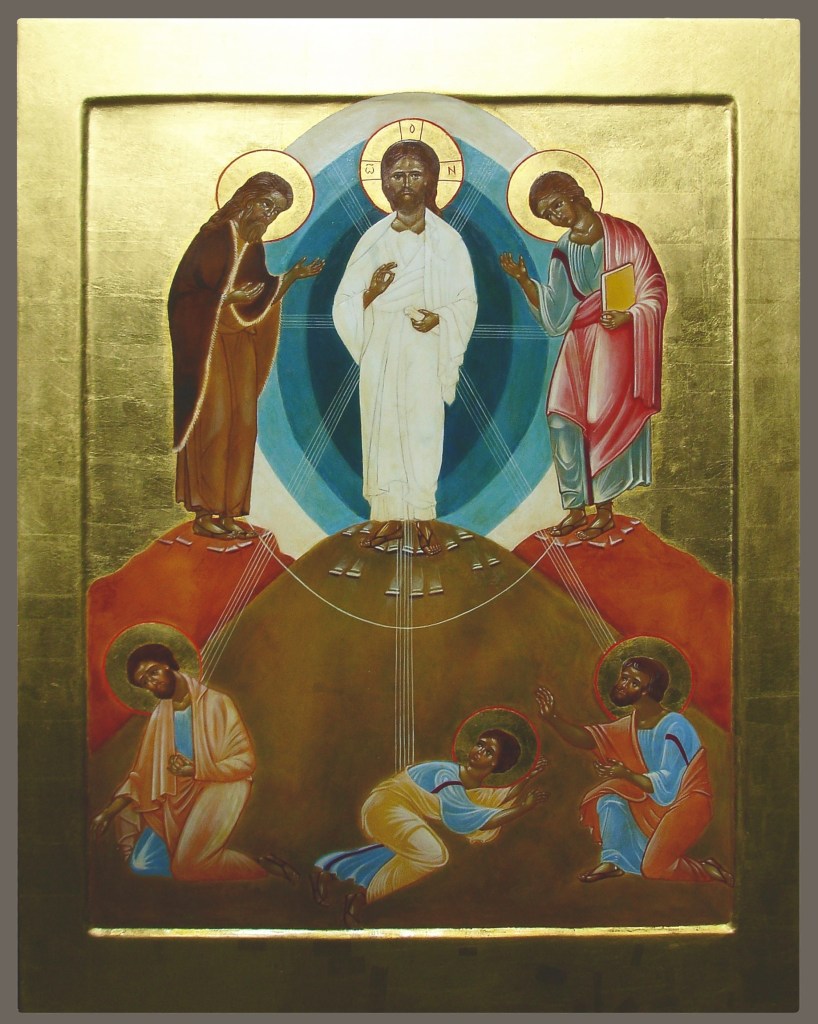
Icon of the Transfiguration. written by Sr. Irene of Le-Bec,
in the Chapel of the Transfiguration, Parish Church of St John the Baptist, Epping, Essex.

Sr Irène

‘Pray to your Father who is in secret’.  Matthew 6:6

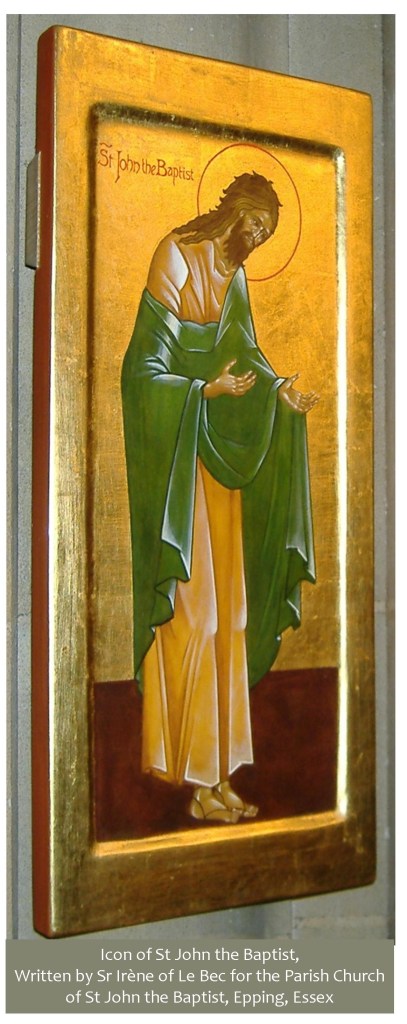
A number of years ago I was searching for an iconographer to write an icon of St. John the Baptist for a church dedicated to him in Epping, Essex.

On a visit to Bec-Hellouin in Normandy I arrived at a Convent which sold what appeared to be original icons. When I enquired about them, I was immediately introduced to Sr. Irène. By the end of our visit she was commissioned to write the icon for us. Not, however, without a small consultation! In the original icon, the figure of John was part of a triptych with our Lord and the Blessed Virgin Mary. He occupied the right hand panel. Because of where he would be positioned, with his hands facing the Blessed Sacrament, I needed him on the left! Sister Irène had to consult in prayer with St Tikhon, the original writer before it was agreed! She was to write three other icons for me. Two are of the Transfiguration and one of St. John.

Tonight we have just heard that Sister Irène died at Candlemass. I was so glad that I had been able to see her again last August.
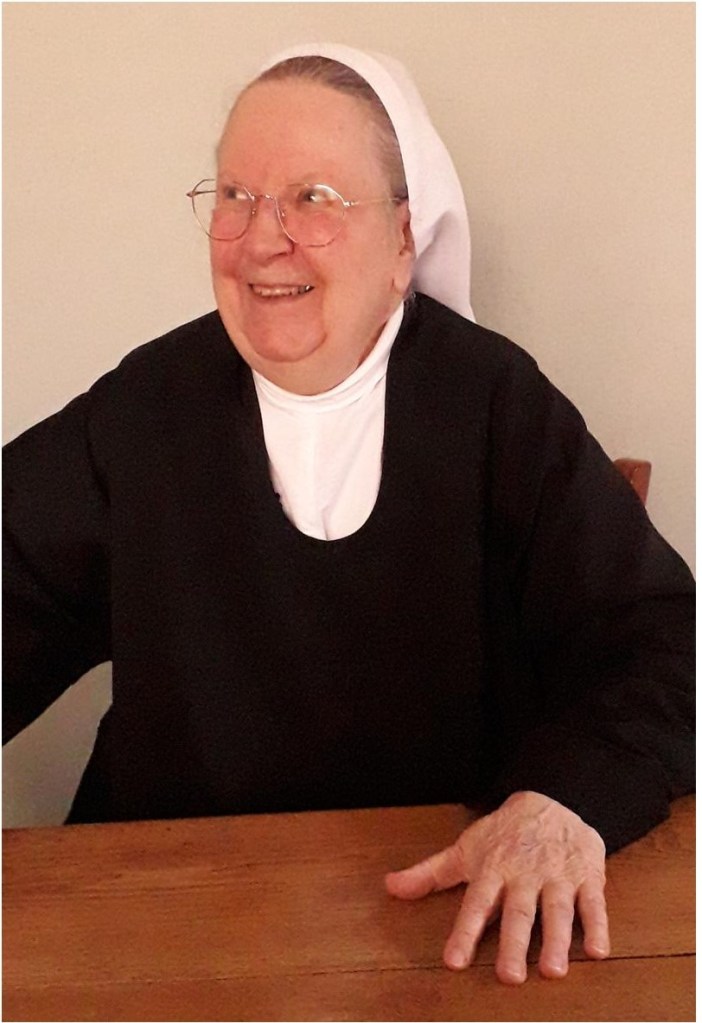
These notes are from Sr Marie-Patrick of the Community at Bec.

Of Burgundian origin, and an elder sister to three boys, Chantal Boillot – Sister Irène Marie – entered the monastery at the age of 38, after caring for her elderly parents. She joined a novitiate which was then numerous (9!) and which shook her up a bit… She made profession as an Oblate nun on the feast of St. Benedict, July 11, 1979, and was soon sent to our little foundation at Mesnil saint Loup, near Troyes. As life in Troyes proved difficult, she was transferred to our other foundation in Abu Gosh in the Holy Land, on 1 February 1984. She stayed there for a good eight years but was called back to Le Bec at the end of 1992, a decision that was painful for her and that she never explained.

Back at Le Bec, she was able to deploy her talents as an iconographer, and even organised a few training sessions in this art. Very cultured and quite original, her interventions were sometimes unexpected, always enriching, but you didn’t want to be in a hurry!

In recent years, she bravely faced serious health difficulties, with cancer spreading despite numerous operations. Heavy treatment – which exhausted her – proved necessary.  Recently, the nurse who came early to take a blood test found her struggling for breath and called the paramedics.  Taken to Evreux, to the department that was treating her for her cancer, she was quickly transferred to cardiology: her heart problem – which had remained in the background until then – had worsened! Under oxygen and perfusion, she did not know when she would have a heart operation; and on her last visit, Mother Prioress admired her confident state of peaceful abandonment:
“That’s what we’re here for, isn’t it? Sister Irene said to her with simplicity,
leaving us with an exemplary testimony of a profound life of faith of which she spoke little.
Her condition deteriorated rapidly despite the care of the clinic staff – whom we thank warmly – and she passed away at the age of the prophetess Anna, at the end of the first Vespers of February 2, (Candlemass), entering into that eternal Light to which she aspired with all her being.

If I were to try and sum her up, I would say that she was a person of deep holiness with a careful eye on the world.  A writer of Icons which she infused with prayer and which she treated with utmost reverence.  A woman of determination who served her Lord with dogged determination, not least through her long illness and sometimes in times of spiritual trial.  All this and more framed in a gentle face with twinkly eyes and a genuine smile. We have a new and caring friend in heaven. 

May she rest in peace and Rise in Glory!

Mr G.
[all photos by Mr G.]
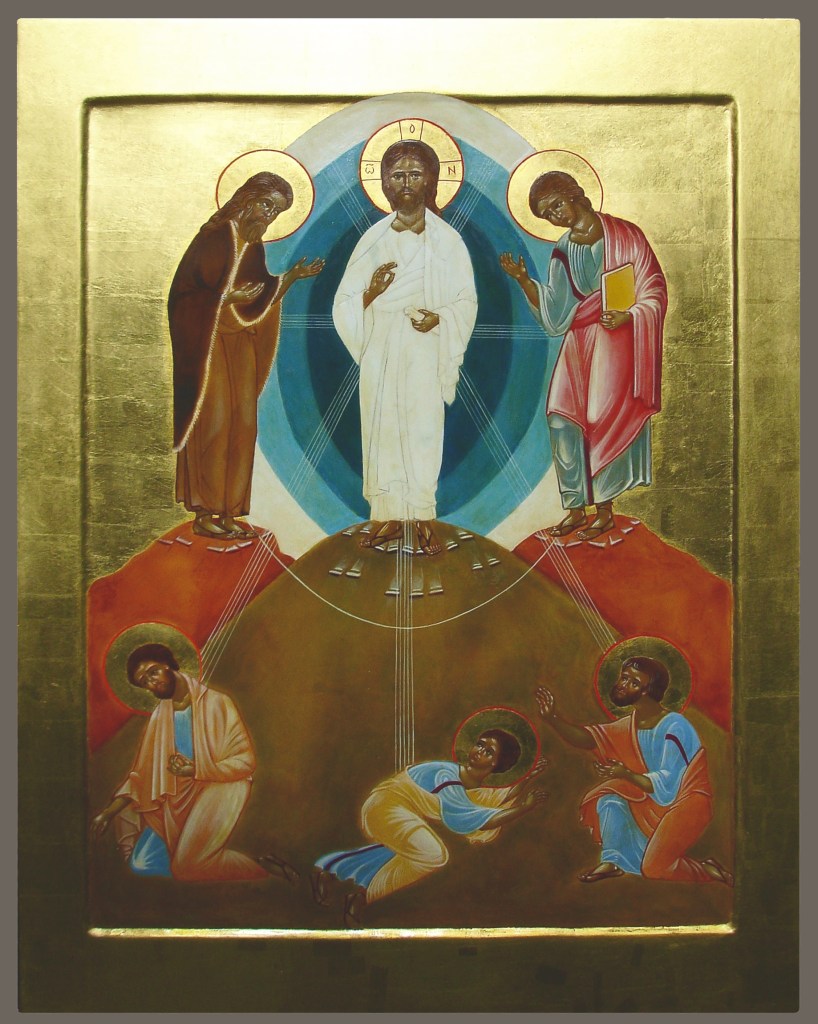
Transfiguring Love

This Icon of the Transfiguration was ‘written’ by Sister Irène-Marie of the Community at the Monasterie of Sainte-Françoise Romaine, Le Bec-Hellouin, Normandy. Sister wrote two Icons. One is in the Transfiguration Chapel in the Parish Church of St. John the Baptist, Epping. The other is a personal Icon blessing the home of Mr. G. Sister Irène-Marie used traditional methods to write the Icon undergirded by prayer.

Transfiguring Love 

Thoughts on the feast of the TRANSFIGURATION, August 6th

In the Transfiguration God gives us a snapshot of human glory – Christ transformed and it is as if God is telling us that this is what we can become if we follow his way of doing things. 

What follows the Transfiguration is the journey to Jerusalem and to our Lord’s death on the Cross.  There, Jesus absorbed all human pain, conflict and hurt and he became the instrument of our transfiguration.  He absorbed human sin and nailed it to the Cross and he did so out of sheer love for humanity and for the world. What transforms the Cross is love because the Crucifixion is God’s ultimate statement of His love for us.  “You can do this to me,” his actions say, “and yet I will go on loving and you cannot stop me for it is only love that transforms humanity.”

A young Russian priest was arrested when communism took over his country. For years he was held in a prison camp and there he was beaten and tortured. When he was eventually released his friends asked him what was left of him. ‘Nothing’ he said, “they have taken everything away. Only Love remains.”  

That priest had discovered the one thing that changes every human situation and disarms every human conflict – sacrificial self-giving love. It is through The Cross which Jesus took upon himself on our behalf that we can all be changed– and when we are changed, the world is changed.  Only Love remains – only love will conquer the human heart. Only love will Transfigure the world.  Perhaps we are unable to see that as a possibility in conflicts throughout our world and amidst the effects of Covid but there is one area where we can see this possibility and that is in our own lives and in our own dealings with others. Wars do not begin on foreign  battlefields far from home. They begin in our hearts – when we refuse to allow others dignity or understanding. When we refuse to accept and celebrate them for who they are. When we want what we want come what may and when we believe our own views to be the only right views – a sure way to begin oppression of others.

 That is not God’s Way.  As Mother Mary Clare of the Sisters of the Love of God put it so clearly, God’s way is to call us to stand at the place of the Cross – at that intersection where human pain, hurt and conflict meet and are held by the transforming love of God.

It is only when we stand in this place where God in Jesus Christ always stands – the place of transforming love – that we will begin to see the glory in each other. That is a lesson from the Transfiguration. If we do not grasp it then not only will we mistreat others, we will also diminish ourselves – and, more importantly, we will deny God and His saving love.

[Mr.G.]

Father in heaven,
whose Son Jesus Christ was wonderfully transfigured
before chosen witnesses upon the holy mountain,
and spoke of the exodus he would accomplish at Jerusalem:
give us strength so to hear his voice and bear our cross
that in the world to come we may see him as he is;
who is alive and reigns with you,
in the unity of the Holy Spirit,
one God, now and for ever.

The Message of an Icon

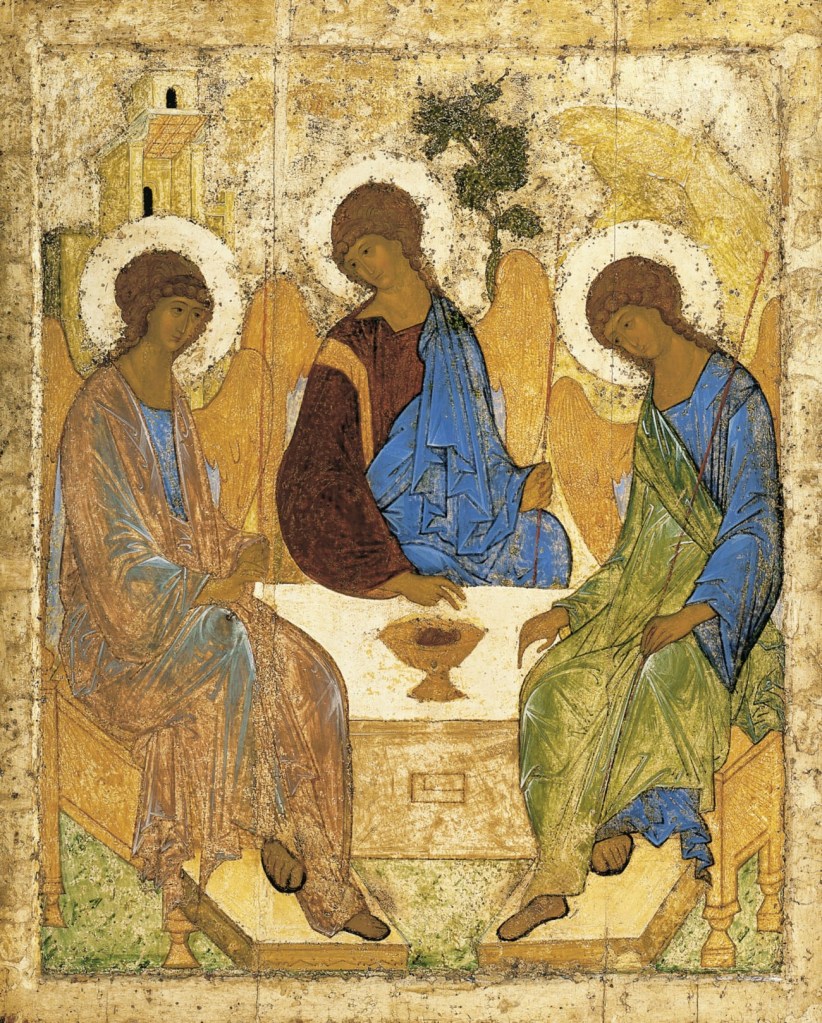
Andrei Rublev. (1360-1427 or 30) Icon of the Trinity.

The message of an Icon

Trinity Sunday is sometimes regarded by preachers as the most difficult Sunday in the year. They might agree with the late Revd. Professor Leonard Hodgson who said: ‘How many clergy, as Trinity Sunday draws near, groan within themselves at the thought that it will be their duty to try to expound this dry and abstract doctrine to congregations for whom they anticipate that it will have but little interest?’

Anyone familiar with the rather impossible ‘Athanasian Creed’ (see the Book of Common Prayer, especially on a sleepless night!) might be forgiven for being somewhat confused .What are we to make of: ‘the Father uncreate, the Son uncreate, the Holy Ghost uncreate” and all three ‘incomprehensible’ !!

God as Three in One is not an easy concept—when are three one and one three? Perhaps a simple mathematical formula could help. 1+1+1= 3 but 1x1x1=1. However, describing the very essence and nature of God by a trite mathematical formula isn’t really very prayerful or theological. It certainly doesn’t feel very loving!

The problem arises because too often it is seen as a doctrine rather than a way through which our life is enriched and given its true meaning.The Trinity is about ‘relationship’ – specifically the relationship of total love enjoyed by the Father, the Son and the Holy Spirit. Another way of seeing this is through three complementary roles which biblically the 3 persons of the Trinity have. The Father is Creator; The Son is Redeemer; the Spirit is Sustainer.

Applied to ourselves—our Father God creates us out of love; Jesus redeems us because of that love (He died and rose again so that we are caught up into eternal love) and the Holy Spirit enlivens us and awakens Godly love within us—thus sustaining us for our Christian journey through life which takes us beyond earthly death into eternal life.

If we begin to see the action of the Holy Trinity in our lives in this sort of way, then the ‘doctrine’ becomes more ‘personal’ and describes God’s relationship with us.

A famous Icon by the Russian icon-painter, Andrei Rublev, has long been seen as an Icon of the Holy Trinity. Painted around 1410 it shows the three Angels who visited Abraham at the Oak of Mamre (Genesis 18). The angels have come to represent the Trinity and they are seated around a table on which appears to be a chalice. The three angels are in a very strong relationship with each other and Rublev has managed to portray them in such a way that the viewer is drawn into the unity which exists between them. They are bound together with and in love. It is possible to draw a circle encompassing them in a loving relationship. That is why they have come to represent the Holy Trinity. But of significance is the fact that the icon not only draws you to this relationship of love, it actually invites you to share it. Rublev has painted them so that there is a space in front of them and it is done in such a way that you simply want to be there with them at the table.

So the relationship of love we see in The Father,Son and Holy Spirit isn’t exclusively between the three of them but rather an inclusive love which invites us to participate in it. We are invited by Love to join a loving relationship which if we accept it changes not only our perspective of who God is but also changes our thinking about ourselves. We are drawn by God’s love to become love.

The most exciting thing about Trinity Sunday is that it is the Festival of God in a way that no other festival is. We celebrate God in all His totality and we are invited to be part of the great mystery of Love which charges the world with a new grandeur—the grandeur of God which is glorified in human lives filled with love.

[Mr G]