Tag: Joyce Smith

There is another world

My friend, Joyce Smith, has sent me another of her Photo Tweets. The baby swans (cygnets) are beginning their life on earth so hopefully and with determination! Thank You, Joyce.

New Birth, new growth, new light are all signs that our natural world in the Northern Hemisphere just now is turning towards Spring.

Even the storms of the past ten days haven’t deterred the journey of Nature and that will be true of human conflict in the war Russia is waging at present, aided by Putin’s Puppet in Belarus.
Charlie Mackesy in his beautiful book, The Boy, the Mole, the Fox and the Horse, says that the best thing about storms are that they end.  As we are now living through the storm caused by Putin it’s something to cling on to. This storm will pass!  says Mackesy.

Maybe those words wouldn’t bring any comfort in the Ukraine right now nor for some time to come but history teaches us that despots and tyrants are, in cosmic terms, short-lived. The 20th century had a number of them – Hitler, Musolini, Stalin, Franco, Mao, Pol-Pot for example.  They created havoc and chaos for a while and destroyed peoples’ lives as they demand obedience to their warped and demonic ideas.
We remember them now for the evil they did and the destruction they left behind. This is the work of the devil and it prospers because we have lost any real sense of the demonic. I think it was possibly C S Lewis who maintained that the greatest victory the devil has is when we don’t believe he exists.
Mostly he is a mischief maker because, in truth, he is already defeated. Christianity maintains that defeat was by Jesus Christ who, sacrificially, poured out love as God’s way of defeating darkness, and sinfulness and unlove.
Even so, there are times when the devil can turn the minds of the weak and tortured. Analysts with far more skill than I have, are already delving into the character of Putin and some fascinating things are beginning to emerge.

He is supposedly a practicing Orthodox Christian. I wonder what his priest will be saying to him on Sunday? I think we can guess it won’t be controversial.

The ‘Storm’ will pass but not just yet so the Jewish Proverb has something important to tell us. We are encouraged to turn to God. As in the story of the Prodigal Son, we will then find God running to us.

The Novelist Patrick White in his novel, Solid Mandela quoted some words possibly by the French poet, Paul Éluard : There is another world, but it is in this one.

We find God in unexpected places and especially when we are surrounded by danger, filled with despair and almost paralysed by anxiety.
We do not know how the raging war against Ukraine will turn out and the aftermath is full of unhappy consequences and foreboding.
But in the midst of that desperate world, the other world continues to show signs of hope and of God.
As the lovely Jewish Proverb tells us; We should walk towards it – maybe only one step but enough to know that it illuminates our world with God’s and He rushes towards us to enfold us with His love.

So Joyce’s photo of the little cygnets is itself a message to us to try to trust in and cherish the tender signs of love which come to us from the heart of God’s world and from His Nature. A world of which we are always a part.  

[Mr G]
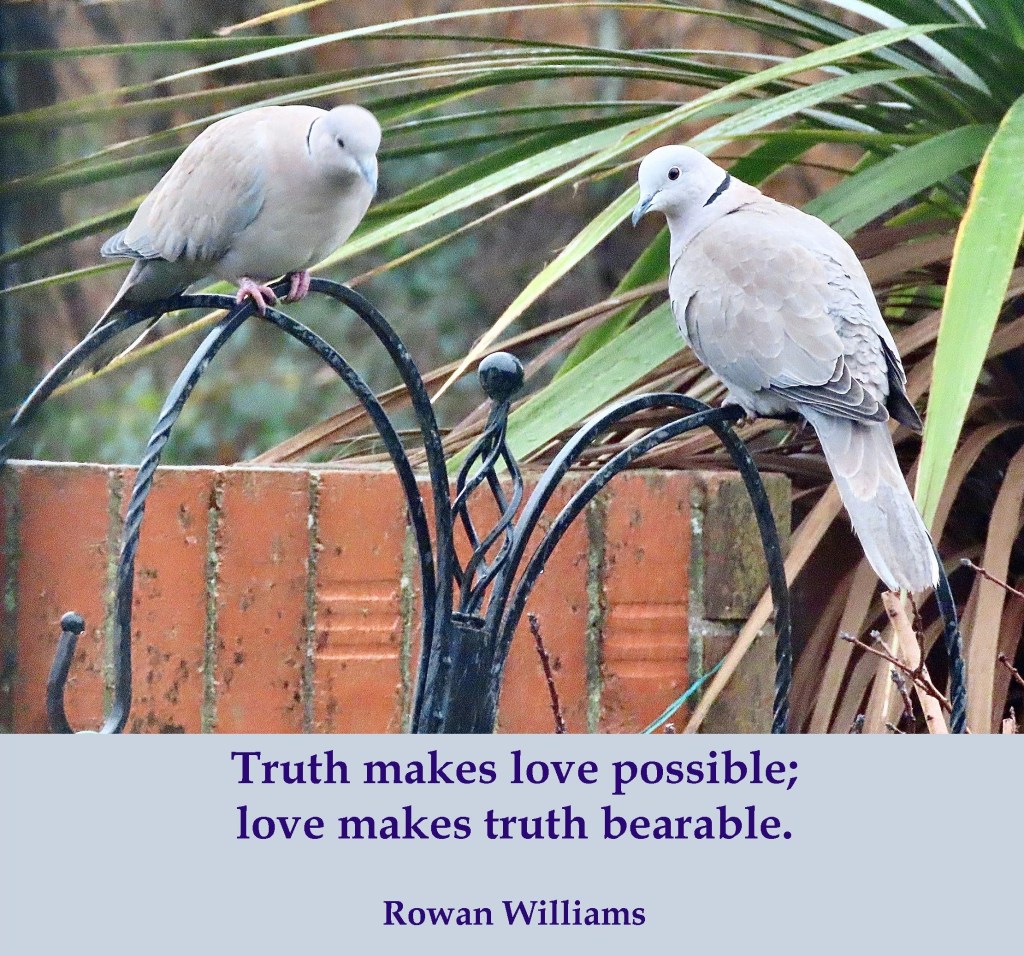
Delightful Collared Doves

Delightful Collared Doves. A photo tweet sent to me recently by my friend, Joyce Smith.

Collared doves can be seen just about anywhere, but often around towns and villages. They’re common visitors to gardens. But collared doves only came to the UK in the 1950s, after a rapid spread across Europe from the Middle East          [RSPB]

The Eurasian Collared Dove first bred in England in the 1950’s, in Norfolk.
Because their young like to wander, they could soon be found in more widespread places. It is said that they can travel over 600km from where they were born.

One lovely fact about them is that they are monogamous. Barring accident they keep their partner for life. They also share in bringing up their young equally so they are an example of real partnership.

The Dove, of course, has a deep spiritual meaning and in Christianity is a symbol of the Holy Spirit, the third person of the Holy Trinity.
In the Old Testament, it was the Dove sent out across the waters by Noah which returned with the Olive Branch as a sign of God’s forgiveness and love.
We use the phrase ‘holding out an olive branch’ whenever we seek reconciliation between people and nations who are at loggerheads with each other.
As a result the Dove has come to be known for its gentleness but it has a reputation for being tough and often seen in places of danger and where human striving is failing. The Dove is a much loved symbol of Peace.

It is also a symbol of love, which makes the quotation, chosen by Joyce, from Rowan Williams (former Archbishop of Canterbury) very apt.
For me, it is the partnership of collared doves which speak particularly of relationship and commitment and sharing together which are symbols of love.
Rowan Williams speaks of ‘truth making love possible and Love making truth bearable.  Rowan always puts things beautifully but also in a way that makes us ponder the depth of meaning. So to help me work out what he is saying, I turn to the image of the little Collared Doves. They are true to each other and they are together in a relationship which feels like love to me. That is what sustains them and should sustain us.
In a world of shifting relationships between people but also nations and within nations, where truth and love seem to be trivialized and discarded, the collared doves may well remind us of the vitality of truth and love, of comittment and the joy of friendship which makes our lives so rich. We have to work at it!

Where chaos longs to reign,
Descend, O Holy Dove,
and free us all to work again
the miracles of love. Amen

[Mr.G]

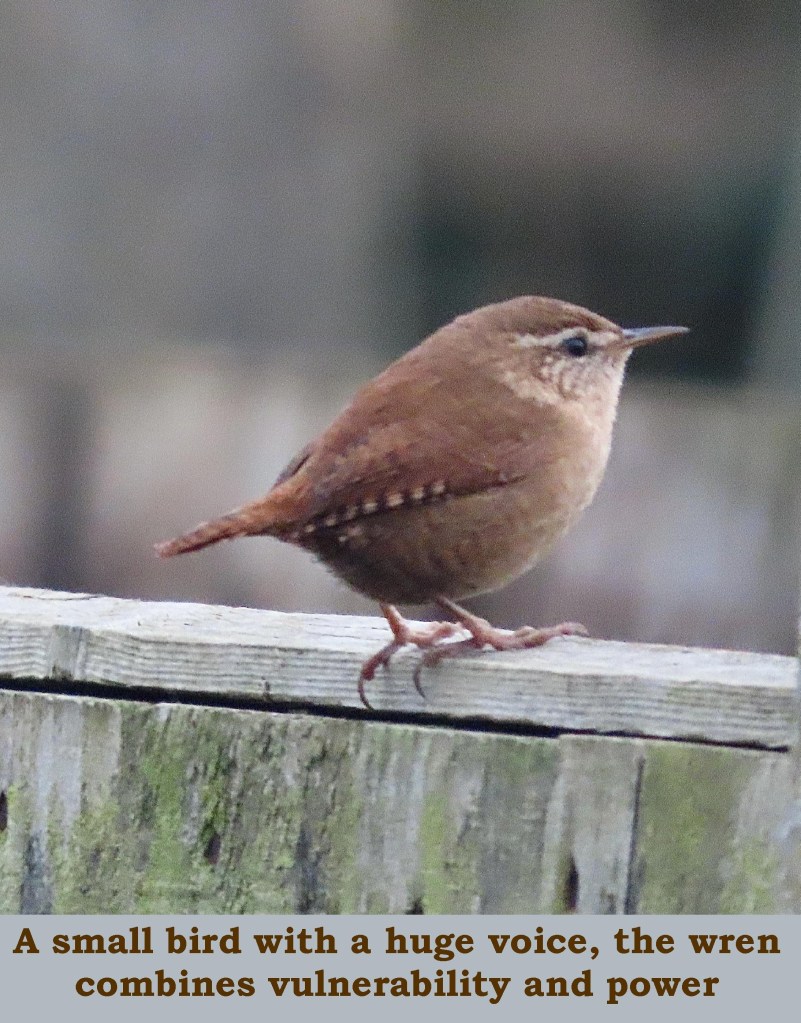
A bundle of delight.

Another picture reflection from my friend, Joyce Smith.

The  Wren is a sign to us of the joy of Creation. Thank you Joyce for sharing your Picture Tweet!

This tiny bird is often overlooked even though it has, as Joyce reminds us, a loud voice! Because they dart about, hopping from place to place, we may only become aware of them as a blur of motion. Yet, it is our most common bird. I’m told that there are about 8 million breeding pairs and you can find them everywhere in the British Isles.
Without realising it, we are rarely far from a wren.

Maybe we miss them because they aren’t flashy birds like the Robin Redbreast or the sleek blackbird or the woodpecker. Though noisy they aren’t raucous like the magpie! The wren appears unassuming and almost bashful except for its call.

Perhaps, too, the wren has learned to be elusive because history has not always been kind to it. Though in folklore, 13th century Jewish writing and among North American tribes, the wren was regarded as the king of birds which symbolized wisdom and divinity it was not always treated so.

My friend, Lynn Hurry, did a little research about the wren and discovered that Early Christians believed the wren had a pagan association and, in Ireland and on the Isle of Man, it was hunted on December 26. This was because it was said that St Stephen was betrayed to his persecutors by a noisy wren when he was hiding in the bushes. Dead or alive, a captured wren was put on top of a decorated pole and paraded round the community – the date was known as Wren Day. Live ones were stoned to death.

There are stories that even to this day on ‘Wren’s Day’ 26th Dec, a number of countries across Europe have a tradition consisting of hunting a fake wren and putting it on top of a decorated pole. Then crowds of mummers, or strawboys, celebrate the wren by dressing up in masks, straw suits, and colourful motley clothing. They form music bands and parade through towns and villages. These crowds are sometimes called wrenboys.

A rather nicer story from Ireland is that one day, all the birds gathered in a secret green valley on the south coast to discuss which one should be king. They agreed the one who could fly the highest would wear the crown. It was the eagle soared way above all the other birds – only to discover that a wren had ridden on its back and launched itself above him at the last moment!

In Wales the bird is considered sacred and in Scotland it was the Lady of Heaven’s Hen and killing it was considered extremely unlucky. Heed, therefore, that whoever tries to steal wren’s eggs or baby wrens could find their house struck by lightning and their hands shrivelled up!

Another warning comes from the poet, William Blake who in Auguries of innocence’ wrote:
He who shall hurt the little wren
shall never be belov’d  of men.

In an increasing dark world Joyce’s photo invites you to look to the natural world and discover a new delight and a new hope. God gives us glimpses of both these constantly. We just have to tune our hearts and truly open our eyes and see the signs. Often these are in little things and little creatures. It is so easy to miss what the poet, Frances Thompson, calls ‘the many splendoured  thing’.
Amongst which is most certainly  the little Wren!

[Mr G, with notes from Lynn Hurry and photo reflection from Joyce Smith]

Thank you for making me, me

Thank you to Joyce Smith forTweet 63 the little blue-tit turning up increasingly in our gardens.

The daily reflections by the Church of England this week were by The Rt Revd John Inge,
Bishop of Worcester.

On Friday he reflected on Matthew 22: 15-22. It was the encounter between Jesus and the Pharisees who were trying to entrap him. The meeting centred on the place of Caesar in the scheme of things and whether paying taxes to him went against one’s loyalty to God. Who was greater?

Jesus knew their hearts and so called them hypocrites but he willingly took up their challenge. Calling for a coin, he asked whose head was on it and whose title. ‘Caesar’s’ they answered. So, said Jesus, give back to Caesar what is Caesar’s  and to God what is God’s.

As ever there is more depths to Jesus’s answer and I thought about that when I received Joyce’s tweet this week. The caption has something very important to tell us and it begins its message in Jesus’s response to the Pharisees.

John Inge said that Jesus was able to assert the sovereignty of God over all things, while appearing superficially to support the emperor.

At another level, there is an unspoken message. John Inge went on to say that Caesar’s head is that of a human being. Human beings are made in the image of God.  Citing Genesis 1:27 : “In the image of God, he created them; male and female he created them and God blessed them.”

Thus, in a very subtle way Jesus told the Pharisees that all things (even them!) were God’s.
This important message reminds all of us that we reflect the image of God. Each one of us is ‘stamped’ with God’s image and likeness – even if sometimes we are not shining with that image as brightly as we could!

There is however, another implication. If we are all stamped with the image and likeness of God, we are all equal in God’s sight. He loves everyone, everything, that he has made.

According to the Genesis poem of Creation, God saw everything that he made and makes as very good. That’s very important for us to know. Of course, we don’t always believe nor act as if it is true. Life’s experience and circumstance can tarnish us and the goodness can fade. But it never goes completely away. It can be burnished very easily into brightness but we have to go to the maker to see to that. He has the polish to do it. It is called Love. We are rubbed by it in prayer, through conversation and study of His word and through the actions of Jesus and the Spirit. Also, we can polish each other with mutual love and encouragement. The image of God in us never goes away. God sees to that, though we do have to reach out to Him.

One of the great joys of the Gospel is that it’s about God being good to us.

So what’s this got to do with the little Blue-Tit?  Well, it seems she knows that she is secure in the love of God and, like all Nature and Creation reflects the beauty and love of God. This is why she’s not too bothered about comparing herself with others.
She’s just content with God loving her as she is.

Some of you will know the Butterfly Song which begins – If I were a butterfly.
The Chorus is worth turning into a little prayer.

For you gave me a heart and you gave me a smile
You gave me Jesus and you made me your child
And I just thank you Father for making me, me

[Mr G]