Tag: Joyce Smith

‘Friend of the Bridegroom’

St John the Baptist, detail. Banner attributed to G F Bodley.
Parish of St John the Baptist, Epping. [photograph Mr. G]

A traditional theme on the Third Sunday of Advent is that of St. John the Baptist.
His part in the Christmas story began at the Visitation of The Blessed Virgin Mary to Elizabeth.
When Mary greeted Elizabeth, St Luke records that the babe in her womb (John) leapt for joy.
After a time of preparation in the wilderness, possibly among the desert people known as the Essenes, John obeyed the will of God and left the desert to fulfill his part in the story of Jesus.
Calling the people to repentance he prepared them for the Christ, who is Jesus.
His own followers were to leave him when Jesus began his ministry of loving salvation . His own story was to end in his death at the hands of King Herod. His legacy was that he would for all eternity be known as the ‘forerunner’, the one who pointed people to Jesus and who fulfilled the prophecy of who Jesus is and what he does. The ‘last’ of the prophets he was the proto-disciple, the herald of the Good News. Orthodox Christians give him a much warmer title. He is the friend of the Bridegroom.
It is to this deep and joyful friendship that we are called. Like John we are encouraged to point away from self and towards God. The more people turn their lives to God and away from self-centredness, the better our world will be. John the Baptist gives us the words to live by:
I must decrease and He (Jesus) must increase.

My friend, Joyce, has produced a book of  Reflections for Advent to Epiphany. This is her reflection for December 9th.

He himself was not the light,
but he came to testify to the light.

John the Baptist,
not the Light,
but pointing to the Light.
Pointing away from himself,
to the one to come.

John the Baptist,
a faithful witness,
showing the way,
in spite of the cost.

John the Baptist,
a wild man for Christ,
pushing the boundaries
beyond convention.

John the Baptist,
searching for the truth,
speaking the truth to power,
dying for the truth.

God our Father, thank you for the
faithful witness of your servant John.
Help us to reflect your light, so that we too,
may bear faithful  witness to you.

Reflection by Joyce Smith
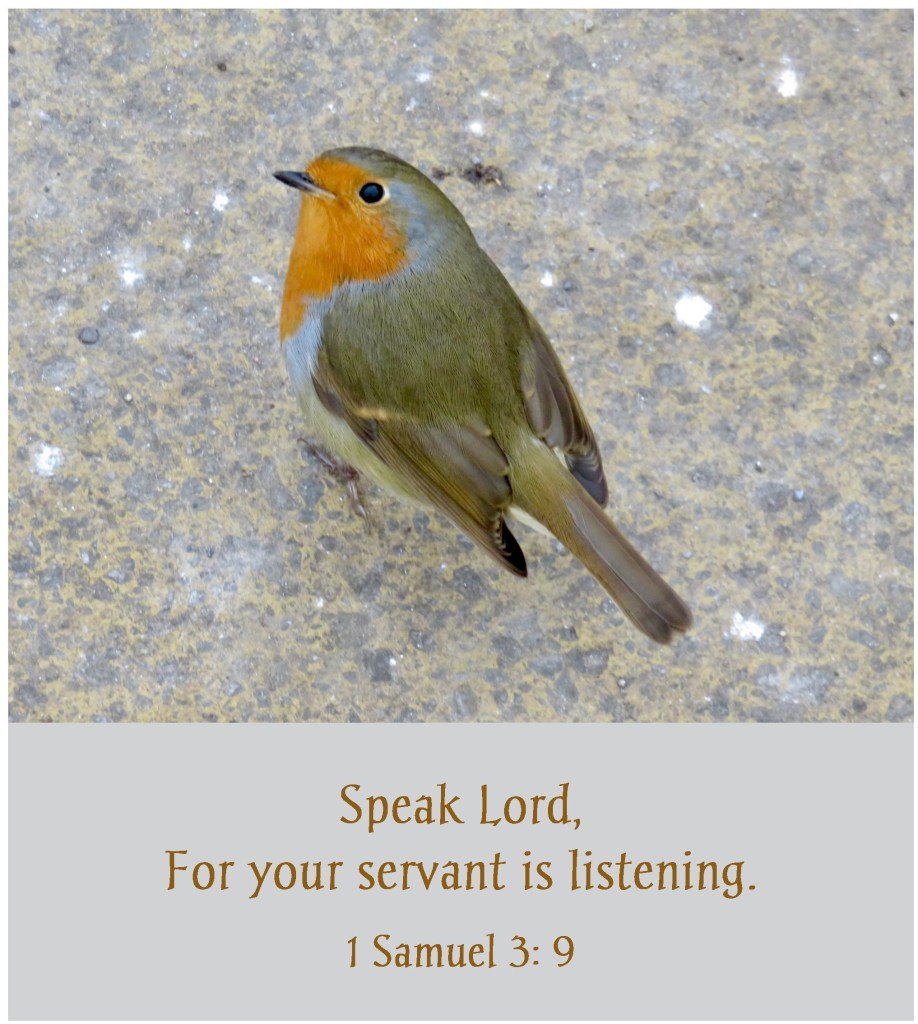
Speak Lord

My friend Joyce has sent a new Picture Tweet. This is what she says

Dear Friends,

Amidst all the different noises at this time of year, I often find it difficult to hear God’s voice, but this little robin showed me what it was like to just be still and listen for a few minutes before he flew away.

With my love and prayers,
Joyce.

Here’s a short reflection from Simon Tugwell OP

Be Still and know that I am God
enter into the chamber of your heart.

There is the Kingdom of God.
in the utter stillness within.
From that depth comes human joy;
human love; human activity.
Relax into the assurance of
His love,
His care.

He has provided for our every moment.

(Simon Tugwell)

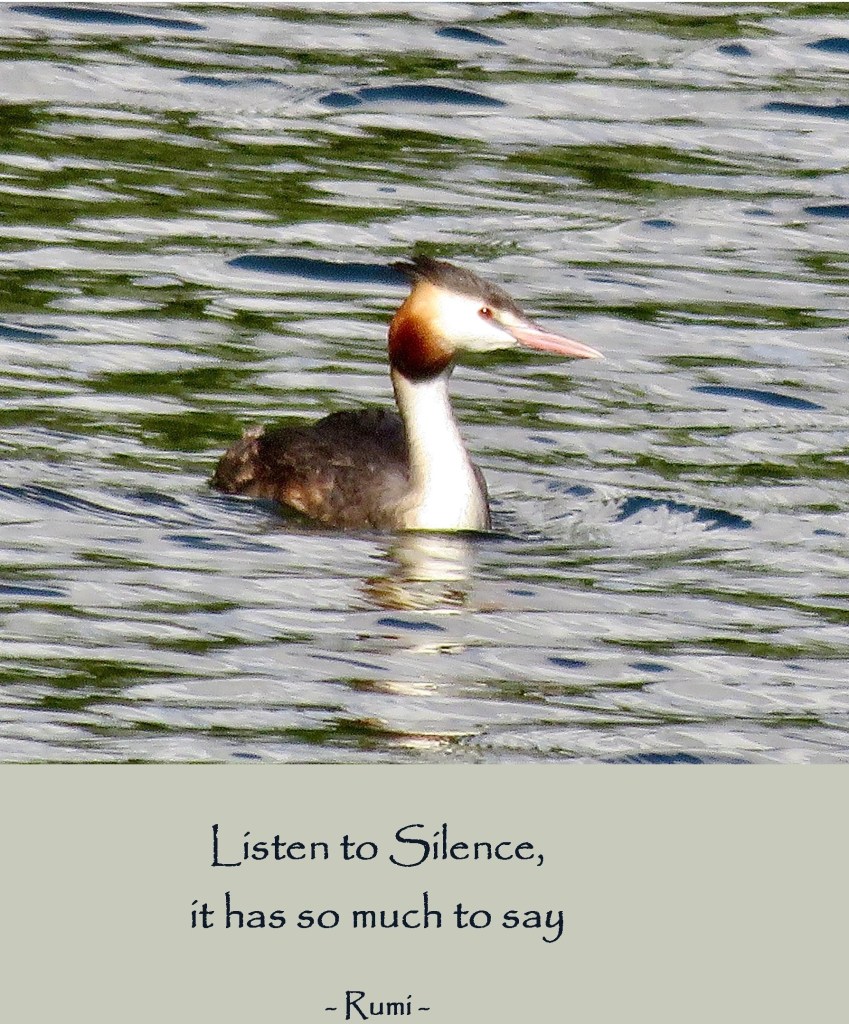
Listen to Silence

 My friend Joyce’s latest Tweet is of a Great Crested Grebe enjoying the silent stillness at Fishers Green.

The quotation she has chosen is by the Poet, Rumi – Listen to the Silence, it has much to say. As Christians enter the season of Advent once again, this is an appropriate prayer.

Jalaludin RUMI (1207-1273) was born in Balkh, Afghanistan which was then on the edge of the Persian Empire. In what sounds familar, the family was forced to flee from the invasion of the Mongol armies led by Genghis Khan. They settled in Turkey, at Konya, where Rumi lived for the rest of his life.

Here he began to write the poetry which was to influence so many, not least today. It is said that he is the most widely read poet in the English language.

God and Love are major themes in his work and combined with that is the communication we have with the Divine through Silence.
Many of his poems end with reference to silence. Coleman Banks, a scholar, poet and author of a number of works about Rumi says:
Rumi devotes a lot of attention to silence, especially at the end of poems, where he gives the words back into the silence they came from.

Rumi once wrote:

Close the door of words
that the window of your heart may open.
To see what cannot be seen
turn your eyes inward
and listen, in silence.

He maintained that Silence is the language of God. All else is poor imitation.

At the beginning of Advent we are invited to reflect and pray about the coming of God, as Rowan Williams puts it, as child, at Christmas. We do it liturgically through the Advent season by thinking in turn about the expectations of the Patriarchs, the Patriarchs, Prophets, John the Baptist and Mary but our reflections are bound up with our own expectations too. Advent is a time when we are invited to ponder God’s loving meaning for us. This is an invitation into silence. Being still so that we may know more truly and more personally who God is.

The problem is that we have to try and do this in a conflicting world which has differing values.

At the moment we are being assured by our Government and certain parts of the press, that Christmas is being saved. What I think that means is that the myth of a Christmas, driven by capitalism and the manufacture of a feel good factor, is being saved. I have considerable doubt that our Prime Minister and Government are the right people to bring any kind of salvation let alone a Christian one. (I also await the headlines that the Government is also saving Hannukah, Diwali, and Eid !)
I prefer to keep Salvation as a prerogative of God, in His Incarnate Son.

Another theme of Advent is that of Waiting. This brings excitement to the expectation. We are looking forward to celebrating the absolute joy of God’s  love which pours over us in the Christ-child of Bethlehem.

And our waiting is essential for our understanding of what that means for our world, our christian communities, ourselves. It is the poet R. S. Thomas who gave us the phrase: The meaning is in the waiting.

As the story of the birth of Jesus unfolds once again, we have to wait and watch and be still in case we miss what God is trying to say to us. We have to take Rumi’s words and act on them, Listen to the Silence – it has much to say.

In our busy, madly self-absorbed world, the Holy Family slip in at the silent pinnacle of the night. The stillness contrasts so much with the clamour of all those who speak but don’t listen; of those who write without thinking; of those who hurt and anger others into a position of mistrust. Our country and society are full of empty words and ill thought out solutions which change frequently and which endanger the world’s vulnerable.
Too many words!  Too little reflection!

So follow Rumi:

Close the door of words
that the window of your heart may open.
To see what cannot be seen
turn your eyes inward
and listen, in silence.

Those who listen and are still, even by snatching a few minutes, will hear the loving whisper of God. He has much love to share with us.

The Great Crested Grebe understands this. That is why she is still.

[Mr.G.]

As ever, Thank You, Joyce.

For those who would like to hear more from Rumi, try Rumi, Bridge of the Soul.’
(journeys into the music and silence of the heart poems translated by Coleman Bark with an introduction by him) published by HarperOne

Helping each other

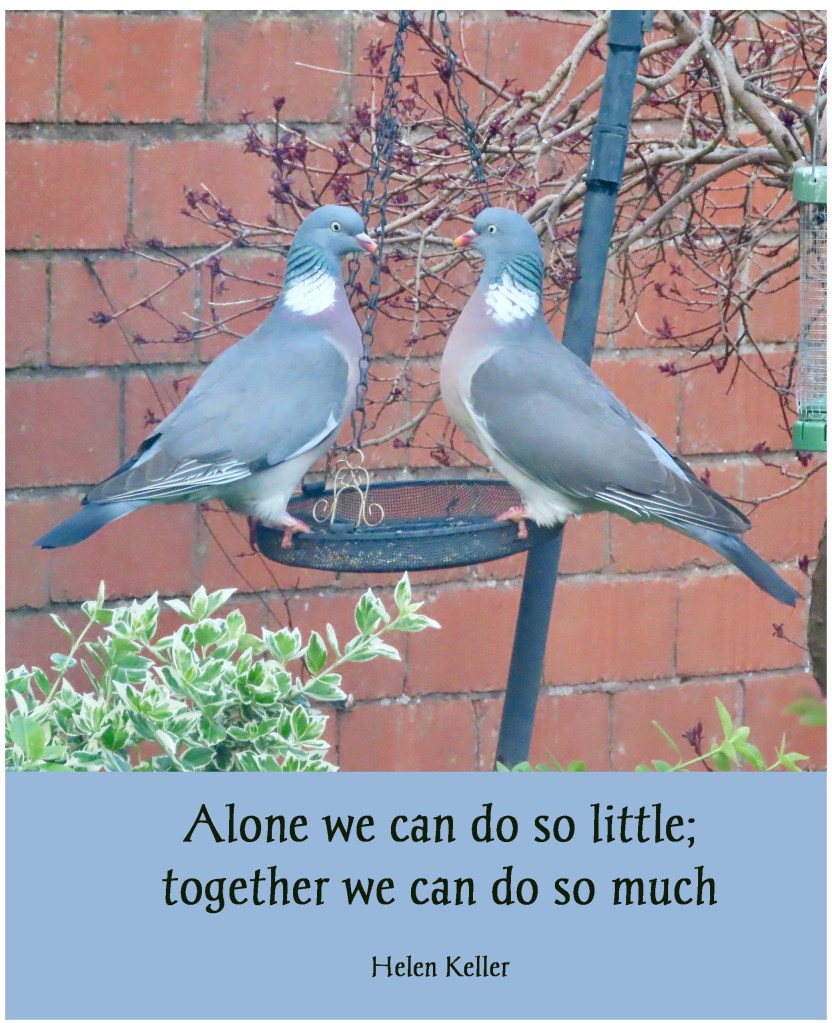
My friend Joyce sent me this tweet.

I came across this little story recently and when Joyce sent me her tweet of the two pigeons I thought it had a message.

What Joyce observed was that One of these wood pigeons landed on the bird feeder tray and tried to eat, but was having difficulty because the tray became unbalanced and was lopsided. When the second pigeon arrived, however, the tray was perfectly balanced and they could feed together!”

Here’s the story:
Once there was a small boy who belonged to a poor family. One day, he was crossing through the forest carrying some wood. He saw an old man who was very hungry.  The boy wanted to give him some food, but he didn’t have any food of his own.  So he continued sadly on his way.  Further on, he saw a deer who was very thirsty.  He wanted to give it some water, but he didn’t have water for himself.  So once again, he went on his way ahead.

Then he saw a man who wanted to make a camp but he did not have wood. The  boy asked his problem and realized that this time he could help. He gave the wood he was carrying to the man. In return, the man gave him some food and water.  Quickly, he went back to the old man and gave him some food and gave some water to the deer. The old man and the deer were very happy.  The boy then went happily on his way.

However, one day the boy was in the forest again and fell down a hill.  He was in pain but he couldn’t move and there seemed no one there to help him.  But, the old man who he had helped before saw him and quickly came and pulled him up the hill.  He had many wounds on his legs.  The deer, to whom the boy had given water, came and saw his wounds. She quickly went into the forest and brought some herbs.  After some time his wounds were covered.   All were very happy that they were able to help each other.

Acts of kindness and care have a way of making the world a better place. A place where, by helping and sharing with each other, becomes a more caring and happy place. Let’s learn from the pigeons, the boy, the old man and the deer. That would, I am sure gladden God’s heart.

[Mr G]