Tag: Manger & Cross

The Manger, The Cross and a drop of Beer!

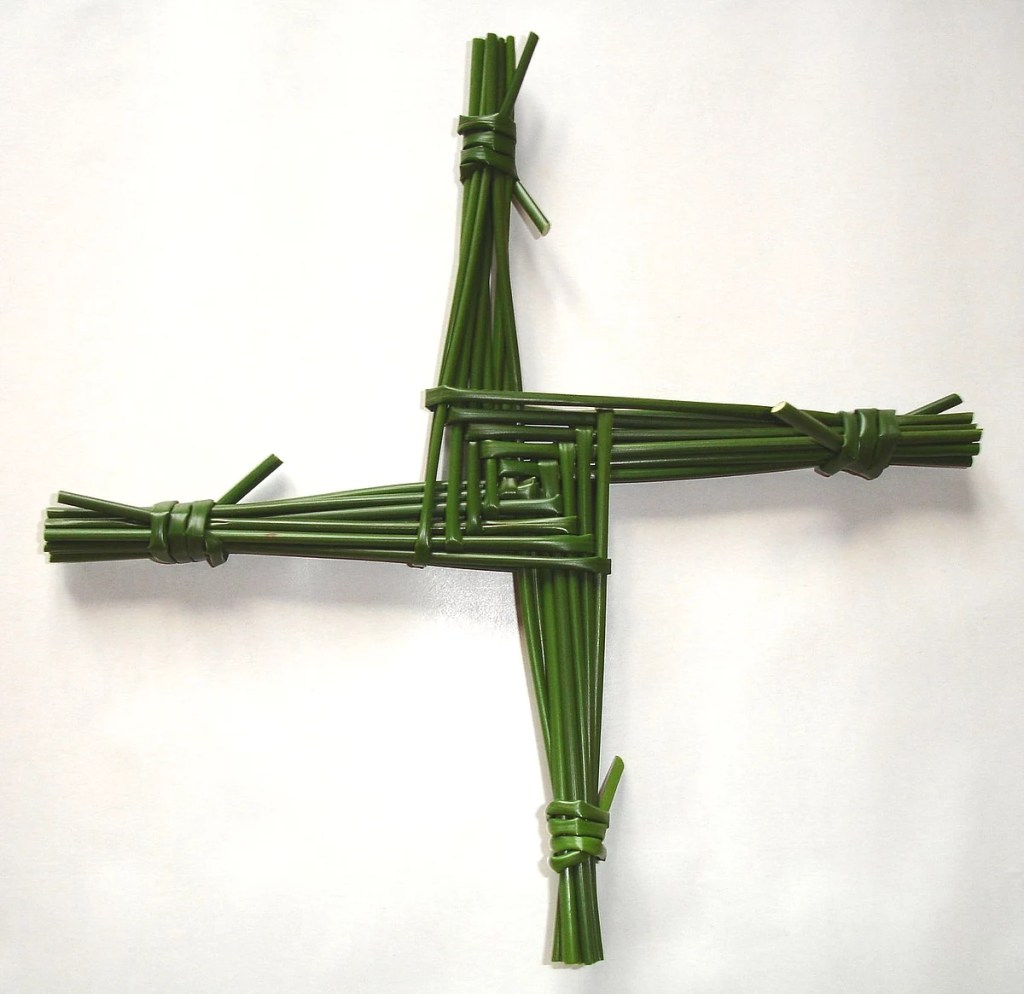
St Brigid’s Cross courtesy Wikipedia

The festival day of St Brigid (also known as Brigit, Bride, Brighid, amongst others) is an important day in Ireland because with St Patrick and St Columba, she is regarded as one of the Patron Saints of that fair isle!

She was born in the mid 6th century (about 451) and died in 525AD. Her father was a pagan chieftain  at Leinster and her mother was a Christian. It is said that her mother was born in Portugal and her arrival in Ireland was as a result of Irish pirates who kidnapped her to work as a slave. There is a similarity here with the story of how Patrick came to Ireland.

She was probably influenced in developing her Christian faith from her mother but it is also said of her that she was influenced by the preaching of St Patrick.
Despite strong opposition from her father she became a nun and soon established a reputation for compassionate care of the sick and those in need.
She became head (Abbess) of her convent at Kildare which, following an Irish tradition was known as a double monastery in that both women and men shared a common vocation and life together. Brigid was head of both.
When the Irish Christian influence spread to Northumbria, this practice was introduced there by the Saintly Abbess Hilda first at Hartlepool and then at Whitby.

As with many of the early saints, legends and stories became linked to them and Brigid was no exception.
One particular story is certainly true and it provided the Church in Ireland with a link between Christmas and Easter. It comes in the form of what is now  called St. Brigid’s Cross, a picture of which heads this article.

It’s a rather lovely story.
A pagan chieftain from the neighbourhood of Kildare lay dying. Christians in his household sent for Brigid to talk to him about Christ. When she arrived the chieftain was raving. As it was impossible to instruct this delirious man, hopes for his conversion seemed doubtful. Brigid sat down at his bedside and began consoling him. As was customary, the dirt floor was strewn with rushes both for warmth and cleanliness. Brigid stooped down and started to weave them into a cross, fastening the points together. The sick man asked what she was doing. She began to explain the cross, and as she talked his delirium quieted and he questioned her with growing interest. Through her weaving, he became a Christian and was baptized just before he died. Since then the cross of rushes has been venerated in Ireland.
There are, of course, several versions.
This one can be found on the website for St. Brigid’s School in Glasnevin in Dublin and gives a rich description of her background and life.

Christianity is often a faith of paradoxes and none more so than the connection of birth with death. At Candlemass, February 2nd, we complete our Christmas celebration of Christ the Light and then begin our journey towards Holy Week and Jesus’s death on the Cross. Yet there is nothing strange in this. Christ’s victory over the human heart and the darkness which so often besets our lives begins in the Christmas event but needs Calvary to complete it. There Christ’s love shone from the Cross as it had from the Manger and in the light of that love we can claim our place in God’s heart. 
Brigid’s cross, woven from simple straw became a sign of healing and of life. 
The straw of the Manger and the Wood of the Cross woven together are symbols of this healing and salvation linked to God’s Saving Love.

Another story connected with St. Brigid is without doubt highly popular in Ireland. It may be viewed as Ireland’s own version of Jesus’s miracle at Cana,

One day, while working in a leper colony, Brigid discovered to her horror that they had run out of beer. It’s important to understand that in those times, centuries ago, beer was consumed on a daily basis as a source of hydration and nourishment.
Back in those times many of the water sources close to villages and towns were often polluted to the point where consumption would likely result in illness or, worse still, death. Alcohol offered an (almost) germ free alternative.
So, to be faced with a beer drought was nothing short of disastrous.
Brigid knew exactly what to do. She asked God for help and He answered her prayer. The bathwater was miraculously turned into beer and not just any beer, but a genuinely brilliant beer that was enjoyed by one and all!

Obviously this secured her reputation, not least because she was fond of beer herself! Lest it be thought she acted as much out of self-interest as well as those in need, she is thought to have written a prayer/ poem about giving God his Divine Share!
The version we have here is from the 10th Century and some doubt that she wrote it but it’s always unwise to doubt a Saint, especially a lady one!

[Mr G]

St Brigid, Mary of the Gaels

Many years ago now, I made a pilgrimage around some of the sacred sites of Ireland. I saw some amazing places and towards the end I visited Kildare which was the holy site associated with St. Brigid.
Together with St. Patrick she is regarded as the Patron Saint of Ireland and was, in fact, baptized by Patrick in about 525AD
Her feast day is February 1st so she is the Saint who brings to a close the Christmas season and points us towards Lent and Easter.
Her festival day coincides with an earlier pagan festival – IMBOLC, the season which marked the coming of light after the dark days of winter.

Once again, the Christian Church displayed ingenuity and common sense in replacing a pagan festival with a Christian one, because Imbolc became the feast of Candlemass, the day when we celebrate Christ as the light of the World – the light which overcomes darkness, or to put it into the words of Simeon’s song, the Nunc Dimittis – the light to lighten the Gentiles (the world).
Brigid was herself a showing forth of Christ’s light in the darkened world of her times.

She was a gentle, caring soul who had a special love of the poor.
Before she became a nun and founded a monastery at Kildare she would regularly give possessions to the poor – not all of them her own! Her father didn’t take kindly to losing some of his goods and he complained to the King when he discovered that his sword was passed on to a leper.
He dragged his daughter before the King who asked her if she intended also to give all his property to the poor as well.
She told the King that if the whole of his kingdom was at her disposal she’d give the lot away!
The King gave her father a new sword on her behalf!
She regularly gave food to people.
Whenever she made butter she divided it into twelve equal pieces in honour of the 12 apostles and a larger lump in honour of the Son of God.

Here also was a clue to why she cared for those in need for she said,

“It was Christ and his Twelve Apostles who proclaimed the Gospel to the peoples of the world and it is in their name that I look after the poor, for Christ is to be found in the person of every faithful poor person.”

She believed it was her duty as Christ’s servant to lead people over the dangerous bridge of this life to the gleaming country of heaven.

This was the heart of her faith.  Brigid was a bridge between this world and the world of heaven. As such it is fitting that she occupies that point in the Christian Calendar which turns our thoughts and prayers from Christmas to Easter – from the wonderful joy of God coming to be amongst us in the Incarnation, saving us and the world from within to the completion of that salvation in the Glory of the Cross and through the Crucifixion.

An illustration of this bridging of the world by Manger and Cross, is through the Cross that is called after her – St. Brigid’s Cross.
It is said that it saw the light of day because, when  a pagan chief from the neighbourhood of Kildare lay dying, he sent for Brigid to come and to talk to him about Jesus.
By the time she got there, he was delirious and raving with fever. It was impossible to talk to her nor could she instruct him about Christ. Instead, she sat by his bed and gave him comfort.
As was usual, the floor was strewn with rushes for warmth and cleanliness. Brigid picked some  up and began to weave them into a cross as she talked.
His delirium quietened and he was able to ask her what she was doing. As she talked, she gently explained about Jesus, his Cross and the salvation he brought.
In that quiet moment, handing him the little cross she moved him gently from earth to heaven as she baptized him at the point of his death.
And to help her do it, she had taken symbolically, some strands of the Manger and turned it into the sign of the Cross – the Saving Sign.
The straw of the Manger and the wood of the Cross.

God uses what he finds and through the simplicity of nature and the ordinariness of our lives, as with Brigid, He moulds consecrated vessels to contain His grace so that He can touch others.
So it was with Brigid and it can be so for us.

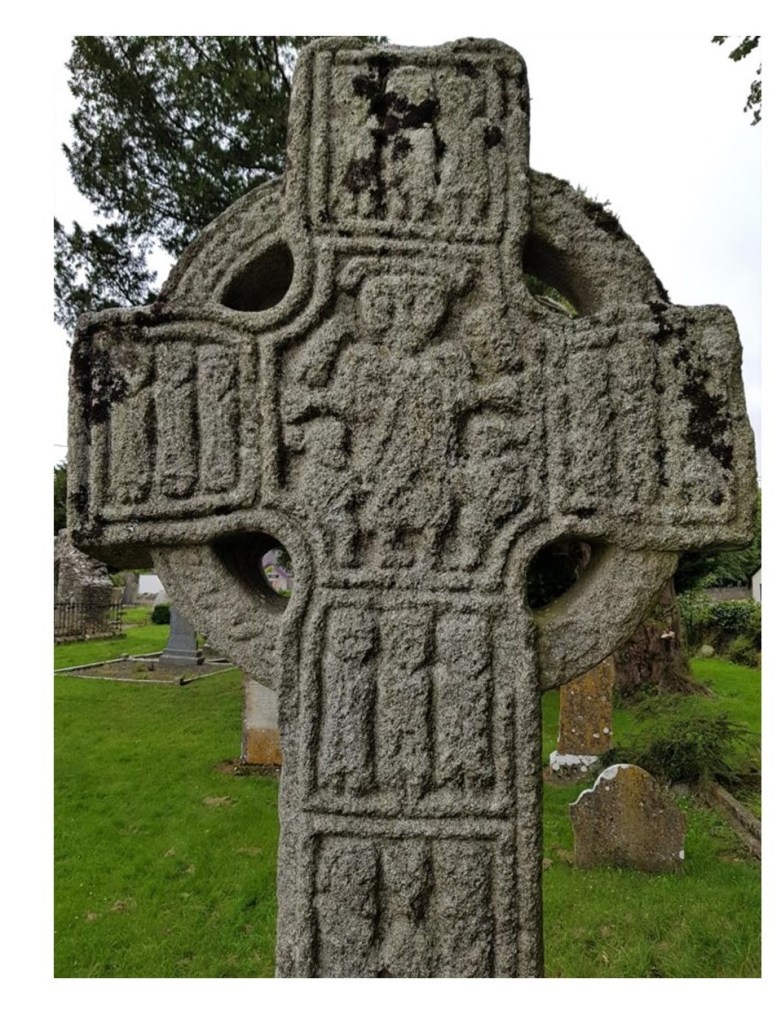
High Cross, detail. Kildare churchyard

Brigid

You were a woman of peace.
You brought harmony where there was conflict.
You brought light to the darkness. You brought hope to the downcast.
May the mantle of your peace cover those who are troubled and anxious,
and may peace be firmly rooted in our hearts and in our world.
Inspire us to act justly and to reverence all God has made.
Brigid you were a voice for the wounded and the weary.
Strengthen what is weak within us. Calm us into a quietness that heals and listens.
May we grow each day into greater wholeness in mind, body and spirit.

Amen.

a traditional Irish prayer about St Brigid.

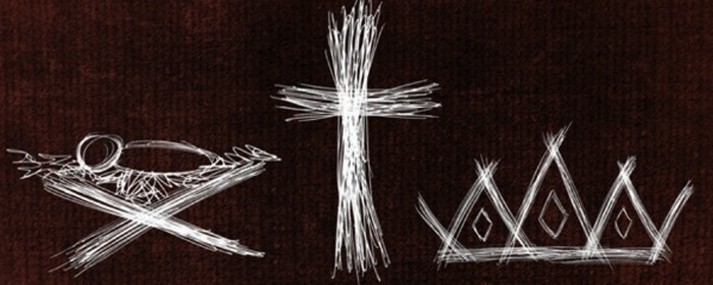
Manger and Cross

The Ballad of the Cross
Theodosia Garrison

My friend Jonathan sent me a present of a poem as an Epiphany gift.
It is named The Ballad of the Cross and is by Theodosia Garrison.

Though she wrote quite a number of poems and a few sacred songs, not a great deal is known about her.
She was born in Newark, New Jersey in 1874 and she married Frederic Faulks but continued to write under her maiden name.
She was on the staff of Life Magazine, resided in New Jersey and was a friend of the American poet, Ella Wheeler Wilcox. She died in 1944.
There are hints about her in a number of places but, apart from her published poetry being still in print, not a great deal more.

The poem Jonathan sent me is connected with today’s feast of Epiphany though it is called the Ballad of the Cross. The reason for this becomes evident at the end but, as a spoiler, it makes the connection between with the Crib/Manger of Christ and the Cross of Christ (hence the title). It reminds us that God’s work of Incarnation reaches its fulfilment in the Easter of Christ – his death and resurrection.

Here’s the poem.

Melchior, Gaspar, Balthazar,
Great gifts they bore and meet;
White linen for His body fair
And purple for His feet;
And golden things—the joy of kings—
And myrrh to breathe Him sweet.

It was the shepherd Terish spake,
Oh, poor the gift I bring—
A little cross of broken twigs,
A hind’s gift to a king—
Yet, haply, He may smile to see
And know my offering.

And it was Mary held her Son
Full softly to her breast,
Great gifts and sweet are at Thy feet
And wonders king-possessed;
O little Son, take Thou the one
That pleasures Thee the best.

It was the Christ-Child in her arms
Who turned from gaud and gold,
Who turned from wondrous gifts and great,
From purple woof and fold,
And to His breast the cross He pressed
That scarce His hands could hold.

’Twas king and shepherd went their way—
Great wonder tore their bliss;
’Twas Mary clasped her little Son
Close, close to feel her kiss,
And in His hold the cross lay cold
~Between her heart and His!

Comment on the text

The reference at the beginning of verse 2 to the Shepherd Terish,  may be simply a reference to the earlier visit of the Shepherds to the manger The origin of the name may be Persian, which could link it with the Magi who are believed to have come from the East – as in the carol, Three Kings from Persian lands afar. This is my conjecture. There are no notes  from Theodosia to help.

The second  is about the word ‘gaud’ (gaudy) in verse 4. It means something like a ‘trinket’ or ornament. Maybe jewels which would link into the ‘wondrous’  gifts of the Magi. This is followed by an obscure reference to ‘Purple Woof and fold. This is her second reference to  the colour ‘purple’. (see verse one,line four)
Purple in biblical times and also in the days of the Roman and Byzantine Empires is the colour of Kingship, and Royalty. As a mixture of red and blue, it is an expensive dye and therefore rare.  In the beginning of the poem it is one of the ‘great gifts’ from the Magi,‘and purple at his feet’.
This is the garment signifying  both king and  God. It is also linked with the theme of the poem because after his trial, Jesus was mocked by being dressed in a purple (kingly) robe. It is translated ‘scarlet’ in many Bibles but in the Greek it could be translated ‘purple.’ The important thing here is about the Kingly association between the babe of Bethlehem and his subsequent Crucifixion.

The word ‘woof’ and its link with ‘fold’ are connected with cloth. Woof here is the same as ‘weft’ – threads in a garment running crosswise as the warp runs lengthwise.
What Theodosia is saying is that though these costly gifts and fine garments are for a King and a God, the baby Jesus, turning away from them, indicates a very different destiny and throne.
The gift of twigs given by the Shepherd, became the Cross Jesus held in his tiny hand and pressed to him. This simple, inexpensive gift reminds of the carol,In the bleak Midwinter; ‘What can I give him, poor as I am’. The Shepherd’s gift is returned to us by Jesus as the true gift God gives to us. For now, as the Magi and the shepherd leave, the cross ‘lay cold’ until its time.

The Wood of the Manger and of the Cross are brought together as instruments of our salvation.

[Mr G]

Theodosia Garrison