Tag: Mary

The ‘With-ness’ of God

Enclosed hands. Image selected by Piers Northam

The With-ness of God, a reflection on Luke 2:41-52,
by The Revd Piers Northam.

The phrase that particularly strikes me in Luke’s account of Jesus, as a 12-year-old, in the Temple is:
His mother treasured all these things in her heart. It’s a phrase we hear at Christmas, when the shepherds come to Bethlehem and find Jesus lying in the manger:
When they saw this, they made known what had been told them about this child; and all who heard it were amazed at what the shepherds told them.  But Mary treasured all these words and pondered them in her heart. 
I love the way that Mary takes these words and events and turns them over, treasuring them and pondering on them.  There is the sense that she is slowly piecing together the real importance of her son.  Before his birth, she was told by the Angel Gabriel that her son, conceived by the Holy Spirit, was himself to be holy and to be the Son of God – but of course that’s still a lot to fully comprehend.  When Jesus is born, the shepherds arrive and tell his parents about the angels appearing to them on the hillside outside Bethlehem; later, Mary and Joseph will present their son at the Temple, and Simeon and Anna will speak strange words about him; then the Magi will come with their peculiar gifts – all these words and events hinting at the life her son will lead. 
And now, in this scene in the Temple when Jesus is twelve years old, we see him speaking strange words himself: sitting with the teachers and referring to the Temple as ‘my Father’s house’ – and so, by implication, specifically referring to God as his Father.  More mysterious things for Mary to take to her heart, to treasure and to ponder over…

Another word – or rather the name – that we hear at Christmas is Emmanuel. 
In Matthew’s account of Jesus’ birth we hear him quoting the prophet Isaiah:
All this took place to fulfil what had been spoken by the Lord through the prophet:  
‘Look, the virgin shall conceive and bear a son,   
and they shall name him Emmanuel’,
which means, ‘God is with us.’
 

God-with-us.  That’s the extraordinary and particular thing about the Christian faith.  Where other religions worship a god or gods who are other; who are distant and out there, far away, we believe that God who came to earth for us; and ‘lived on earth and went about among us’ to use that familiar phrase.  God – in Jesus – became human and so understands our lived experience intimately; and, in the Holy Spirit, continues to live with and in us.  That name Emmanuel is hugely important since it encapsulates what lies at the very heart of our relationship with God.

Ali’s story

Last week, a friend shared an article which reflects on the experience of Emmanuel / God with us.  It’s written by Ali Kendall, a nurse living in Hampshire who shares her family’s story and what she refers to as God’s With-ness – God’s being with them. Things haven’t been easy for Ali and her family.  She spent years nursing in London at the Royal Marsden before moving to Hampshire to start a family.  Initially, this was hard for them, but she and her husband Matt did have a first son, Joseph and all seemed well.  Then her husband started to have a series of what were to become regular seizures, which stopped his work as a teacher and completely changed their lives.  At the same time, they had tried for another baby and Zachary was born – along with the unexpected news that he had Downs Syndrome.
She writes:

I remember thinking ‘we were already meandering off script, but we are well and truly off-piste now’.  Life’s going to look different.  Very different.  It’s just gone from hard to harder.  My husband has a chronic illness and disability and now I have a newborn whose challenges are not yet known to me, but likely to be significant.’  A few years later Zachary was diagnosed with autism. 

Ali then goes on to say:
Life is beautiful and life is hard.  Beautiful-hard.  They both co-exist, like dancers, weaving themselves in and out of our lives.  The joy is that God is with us and others have joined in.  […] Our day to day is transformed by withness; when friends come along side us, and travel with us for a while at the slower pace that we’ve been forced to go, navigating the hurdles and the curve balls.

Matt’s seizures are debilitating.  The daily grind of a chronic illness is often lived in secret, behind closed doors, in the hidden places.  Parenting a child with special needs, while trying to be everything you want to be to your other child, is exhausting and can feel lonely.  On a bad day it can all feel crushingly hard, but on a good day it can feel like you are in on the most beautiful secret of watching your family do life differently with our challenges and unique way of being.

What strikes me the most about Ali’s account is the way that she has discovered those secret moments – moments that she has been pondering in her own heart – where she notices the beauty (even in the midst of the difficulty and the challenge); where she notices the withness of God…
She goes on to say:

Being with someone who is not finding life easy or is trying to live in a world not set up for them can take you to what I now call the “secret places”.  The places you might never have chosen to be in.  […]
Coaxing a child with autism to watch a Christmas show you have paid good money to enjoy.  Our seats, surrounded by people and lots of noise, make it all too overwhelming for Zachary.  So we sit in the quiet, on the stairs, where no-one pays to sit, watching the show from our secret place.  We hug and cuddle quietly as the show goes on and it feels somehow almost a sacred moment.  These secret hidden moments are where the gold is really forged.  Where the love grows deep.  Withness blesses the person being held and the person holding. 

Withness, as she puts it, blesses both the person who is being accompanied and the person who is sitting with them or holding them or offering their support.  Because in doing so, they are being Emmanuel to them. And Ali fully acknowledges that this is hard and costly – but ultimately, but it’s a cost that is worth it:

[…] it’s hard.  Beautiful and hard.  But being with people mattered enough for Jesus to come to earth to embody “Emmanuel”.  And you get taken to those secret places you might not have ever seen had it not been for the journey the other takes you on.

‘Being with’ takes you to those secret moments which become sacred.

Paul, in his letter to the Colossians, says, ‘Let the Word of Christ dwell in you richly.’   
He’s inviting us to treasure Christ’s words and ponder them in our hearts, for living them out brings unexpected riches and secret joys.  As I reflected on the 12-year-old Jesus, sitting with the teachers in the Temple, holding his own with a wisdom beyond his years, I was struck by the final part of Ali’s story:

[Joseph,] my eleven-year-old, has heard me say so many times “we are with you” to Matt as his body shakes into another seizure.  Matt is usually unable to speak, often he looks afraid, and his usually strong body is jerking with such strength we need to keep him safe.  But “I am with you” has become what I say.  And I mean it.  It’s all I can offer in those moments.  I can’t take it away, but I can sit with him in the pain and disappointment of another disrupted plan, another unfinished conversation, another fun trip cut short, another day where we watch the world bustle on as we crumple to the floor.

My Joseph has learnt the art of being with.  He will often silently take my husband’s hand, and my heart melts when I hear the strength and tenderness in his words, “I am with you Daddy.  We are here.”
As Jesus showed his Emmanuel to me, and the beauty and peace that brings, we can show it to each other.

‘I am with you…’  Young Joseph has heard those words and they now dwell in him… 
Richly…

Ali’s story has moved me profoundly – I find my thoughts returning to her and her family and I sense they will continue to do so.  Above all, it is the way that she has pondered on her experiences and has noticed Emmanuel / God-with-us in both the joyous times and the hard ones.  She has found those secret moments and treasured them in her heart.
It’s something that God invites us all to do, so I pray that we will all take time to ponder and to notice Emmanuel/ God-with-us in our own lives – and at times to respond to the call to be God-with-us to others… 
God is always with us – but we have to take the time to notice where – and in whom – He is to be found…

Piers Northam
29 December 2024

[ You can find Ali’s story in full at thebeautifulwithness.com/the-secret-places ]

He has lifted up the lowly

Adapted from an Advent sermon preached by Piers Northam at St Mary-at-Latton.

On this fourth Sunday of Advent we’ve just lit the fourth candle in our Advent Ring – saving the central, white candle for Christmas when we will light it to acknowledge the birth of the Christ-child, the Light of the World. 

Each week through Advent, as we’ve lit the four smaller candles, we’ve remembered figures from Scripture who have pointed to God and to the coming Messiah.  In the first week, we gave thanks for the Patriarchs (the likes of Abraham and Moses) who long ago answered calls from God and drew the people to him.  In the second week it was the Prophets, who point us to God but who also warn us of things to come, who call us to account and have visions and messages for us.  Last week it was the turn of John the Baptist – the voice in the wilderness calling people to prepare the way for the coming Messiah.  And this week it is Mary herself – the God-bearer – who will bring Christ into the world.

As I was thinking about these candles, it struck me that the first two tell us about where we have come from – the heritage that we have in the Patriarchs and the Prophets – whilst the second two, in the persons of John and Mary, point us how we should be. 

John proclaimed the Good News, called people to repent – to turn around so as to come closer to God – and, more than anything else, he pointed to Jesus; led people to Jesus.  Think of this morning’s story of Mary’s visit to her cousin Elizabeth: even before he was born, John was pointing towards Jesus, for didn’t his mother Elizabeth came to understand the importance of the child that Mary was carrying because John leapt in her womb?  And of course we are called to follow John’s example: to share the Good News, to turn ourselves to God and to point people to Jesus…

And then we see Mary, the expectant mother who carried Jesus inside her, filled with the Holy Spirit and speaking prophetically in her great song, the Magnificat.           

But this story is also about two ordinary women called by God to extraordinary things – chosen by God to help play out his plan.  Elizabeth and Zechariah, like Abraham and Sarah so many centuries before, were childless, but in their advancing years, God gives them the surprising gift of a son who is destined for important things.

And then he sends Gabriel to Mary and, in the words of a poem by Denise Levertov,

‘God waited.
She was free to accept or refuse, choice integral to humanness.’  [1]

Mary has the choice – and has sufficient faith and trust in God to say yes.  But for me, the fact that Mary, whilst clearly exceptional, is an ordinary human being – that she’s not some immaculate, semi-divine super-woman – is really important: because it says so much about the way that God involves himself in our lives. God chooses a simple, young girl to be the mother of his Son; to bear God in her womb.  As Mary herself says: ‘The Mighty One has done great things for me, and holy is his name.’ [2]

She affirms that in his Holiness God can do great things for us.  She may be talking of herself, yet what she proclaims can be true for everyone who engages with God.  The Mighty One can do great things for us – and I would want to add that he can do great things, through us…  Mary’s experience is one of working with God so that together they can bring Jesus into the world.  And we see a similar approach in the way that Jesus later entrusts his mission to that motley band of friends and followers: women, tax collectors, fishermen and the like whom he gathers around himself; and how that mission, in turn, is entrusted to us.

Mary’s song begins by telling us how the Mighty Lord has brought blessing on her life, but then she goes on – in the vein of the prophets – to tell us about the nature of God and of his topsy-turvy vision for the world. And this is the radical stuff; the counter-intuitive stuff that normal society wouldn’t recognise as she talks of the values of the Kingdom:
– She speaks of God’s mercy to those who fear him; for those who see their need of God. 
– She speaks of his faithfulness down the generations. 
– She speaks of how he lifts up the lowly, the poor, the dispossessed; the humble and meek – her message is Good News for all those on the margins; those who are excluded and side-lined; but her words are also a warning for those who misuse worldly power; who are proud and rich.  To all those who turn a blind eye to the poverty and struggle that surrounds us.
– She speaks of how he feeds the hungry with good things; and is concerned for those who need protection – this is where his heart is…
– And finally, she speaks of how he keeps his long-held promises; promises made to the people of Israel, but which, in Jesus apply to all humanity…

These powerful, radical words are spoken by a young woman in first century Palestine – not your classic mouthpiece.  I’m guessing that such words, spoken by a young, poor Middle Eastern woman today, wouldn’t get much exposure on the world stage.  Our society seems more set on condemning such people to live in refugee camps or letting them drown in the Channel than listening to what they might have to tell us.  Yet even if they aren’t saying such things in so many words, doesn’t the simple fact that so many live in such fear and misery on our very borders and hidden in our societies shout the message loud and clear?

Mary’s words resonate as an urgent warning:

He has scattered the proud in the thoughts of their hearts.
He has brought down the powerful from their thrones and lifted up the lowly; he has filled the hungry with good things, and sent the rich away empty… [3]

Her words put me in mind of those words from Isaiah which Jesus reads out in the synagogue and which we have taken as our inspiration for the Good News Project here at Latton:

‘The spirit of the Lord God is upon me,
    because the Lord has anointed me;
he has sent me to bring good news to the oppressed,
    to bind up the broken-hearted,
to proclaim liberty to the captives,
    and release to the prisoners’ [4]

This is the promise held in the Christ-child, but also in those who follow him.  These words hold the same challenge to question the values of society and to turn things around.  Powerful stuff…

There’s a danger at Christmas that Mary becomes this sweet, but rather meek, mute, Christmas card figure – all pretty and adoring and dressed in blue; but this morning we see her, filled with the Holy Spirit, proclaiming radical, dangerous, political words… 

This is anything but chocolate-box.  Mary is being both prophet and God-bearer; radical in her speech as she is nurturing in her motherhood. And we need these uncomfortable words to challenge us out of our complacency; to bring us up short and stop us coasting along on autopilot; to help us see beyond our own lives to where God’s concerns lie. 

Mary experienced the mystery of the Incarnation – God becoming human in Jesus – in the most intimate and physical of ways.  But we are each of us called to be God-bearers.  To carry God within ourselves; allowing him to shape our view of the world; giving us the courage to stand up, like Mary, and speak truth to power; to sing her prophetic and radical song and to shine with the light of Christ, so that, with him, we can bring God’s values and vision to bear in the world.

That’s the real challenge – the living gift at the heart of Christmas.

Piers Northam
19 December 2021


[1] Annunciation – Denise Levertov

[2] Luke 1:49

[3] Luke 1:51-52

[4] Isaiah 61:1

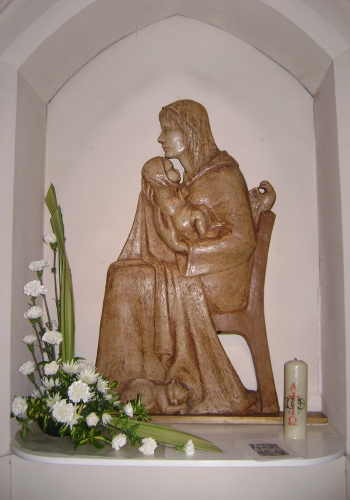
Mary’s Advent and ours

photo: Mary with Jesus, dove and cat! bas-relief statue by Josefina de Vasconcellos
commissioned for the Lady Chapel of St. John the Baptist Parish Church, Epping

A sermon for the Fourth Sunday of Advent, preached by my friend, The Revd Beth Joss-Pothen in St. Mary-at-Latton, Harlow.

May God be in all our heads, in all our minds, in all our hearts, and in all our understanding. Amen

I’m going to start, much as we often start proceedings as a church, with a confession. I wrote a lot of notes for this sermon. Notes about hope, and resilience, about the bravery of Mary and the dawn of Christmas that we are just beginning to see peeping through the darkness and anticipation of Advent. I even had an admittedly tenuous Taylor Swift reference lined up and ready to go.

However, then 4pm yesterday rolled around. We were all introduced to the brave new world of Tier 4, scuppered Christmas plans, I suspect many tears and fresh, acute, crushing disappointment, at the end of a year that has dealt a so many people so many blows in such quick succession. Reminiscient of the first lockdown back in March, there is fear and uncertainty about what lies ahead of us, frustration, despair, worry and anger. It felt and still feels difficult to offer the hope of Advent, and of Christmas, into this. Optimism, hope, a light at the end of a tunnel have to be searched for that bit harder.

So here I am to offer you my own version of that search,  that dig into ourselves we all must do sometimes to find the will to go on, and forage for the light with uncertain prospects.  And who better to help us with that than Mary? She is arguably our resident expert in how to make the best of a new, terrifying, confusing situation. And she is not alone, everything about the Gospel story of the Annunciation has shared properties with the prophetic calls of the Old Testament. In this, Mary joins the illustrious company of Abraham, Moses, Isaiah, Jael, Miriam and others, being moved to say and do what the Lord commands. The words ‘The Lord is with you’ has echoes of these very same people, prophets and warriors and visionaries, being told to do various things, go and liberate, go and preach, go and strike through the head with a tent peg. Maybe not that last one!

And yet Mary’s call as described to us here is distinct. We hear how Gabriel offers no qualification for Mary’s favour, only that she has it, that it is of God. She already has everything that God requires, all that is needed is her acceptance, her choice, to become the God-bearer. We hear how Gabriel painstakingly lays out what her acceptance would mean for her people. We hear how, for all the shock and confusion, there is also gentleness and patience, as Mary is told of another, her cousin, who may be able to shed light into her situation and offer her love and solace in the magnitude of what has taken place.

And finally, we hear her yes. ‘Here I am, a servant of the Lord. Let it be with me according to your word.’ Her response rings with the response of Isaiah 6, of Moses at the Burning Bush, and yet it is different through its unconditionality. Her response is radical not just because she agrees, but because she agrees after hearing what will happen, rather than before. She hears Gabriel out, realises the task is vast, almost beyond comprehension and will cost her greatly, but accepts nonetheless. She does not object or change her mind, as Isaiah and Moses both did at various points, she continues, steadfast and dignified. Gabriel leaves, our reading ends. But for Mary, all at once, everything is different. The world is a changed place. In a very real sense, that moment marked the beginning of her own unique solitude. Forever afterwards, she bore a son only she and God would fully understand. Only she knew what it was to carry Him, nourish and love him.

I often wonder what she did in the liminal, fragile space immediately afterwards. Did she run outside? Feign going to the well so she could be alone with her thoughts? Did she long for a friend? Did she run to the Temple and pray? We will never know, we can only imagine, but the image remains. What do we do in the aftermath of such news? What did Mary do in what could only be considered her own personal Advent? One thing is for certain, life was never the same, and the biggest step had already been taken. In a very real sense, Mary’s yes was the ultimate experiment in not fully reading the terms and conditions, the biggest gamble in all of human history. A yes, offered with thought, but with no other foundation other than faith in God to see her through.

Perhaps we read this and think we could never do such a thing, that we aren’t brave enough, but I’ll warrant in some way we have all had those moments of pure courage, stalwarted by faith in God. Marriage and partnership or indeed leaving a marriage or partnership, becoming a parent or guardian, moving home or job. These are all gambles that we sometimes hold together and follow through on with little else other than our faith to anchor us. We cling on as best we can, and say to God in our own way; Here I am, let it be with me according to your word.’

Mary was no different. Much of Western art and indeed a lot of Western theology around Mary centres around her perfection, her purity, her unblemished-ness. She is rarefied, held aloft as an example of perfect womanhood, perfect motherhood. Some writers have even proclaimed that angels helped her with housework and chores, such was the level to which she was no longer preoccupied with the human things of life after birthing Christ! But I think this is erroneous. After all, just as those prophets and visionaries before her, Mary, remained an ordinary human woman, called to a life she didn’t fully understand, and like the rest of us, feeling our way through with faith. Only her son, Emmanuel, God with us, Jesus Christ, fully knew the depth of what it was to be both human and divine.

I started off today by saying that all my notes about hope and resilience and the dawn of Christmas felt harder to deliver than ever. And I promised to offer up the results of my own digging, my own confusion and searching. So here goes:

I have concluded that getting a blessing is not the same as getting a present. God’s favour doesn’t always feel good, and whilst following our callings in life will change our circumstances and who we are surrounded by, faith will not protect us altogether. For this, Mary is our example. Whilst her faith and her favour led her to bravery, and the world to salvation, I imagine she may not have felt all that blessed when Joseph planned to leave her, when she laboured on a stable floor, or when she watched Jesus die.  

Our own struggles of hope and optimism does not mean that hope or optimism cease to exist. If anything, what Advent and Christmas ought to teach us is that God is constantly present. Remaking, renewing, rebirthing. What we celebrate every year is this reappearance into the world, and the reminder that no matter what, the dawn is coming. In many ways this whole year has felt like an Advent . We are waiting, in the wilderness, in the darkest part of the night. Anticipating a dawn that we are getting glimmers of but cannot yet see our way with. We know it’s there, but there is still a road to go, and it’s rocky and bleak. More and more is being asked of us emotionally, physically, at work or at home, and perhaps we are increasingly running on less and less. Where usually the harder days of life are buoyed and padded by moments of joy and connection, special occasions and days together, this year has meant a lot less is keeping us emotionally afloat. And the background to this toil are tales of unprecedented hardship, woe, and devastation.

And still into all this, our yesses to God, to renewal, to carrying on, to life itself, to the miracle of the incarnation must still resound. May it resound for all of us here today, with those we love and who we cannot be with, and especially today as we prepare to admit our own wonderful Cliff and Ruth to baptism. What joy and what happiness this is, that we are still permitted. What an admission of hope and life in Christ, foretold by John, brought to birth by Mary and baptised with water and the Spirit.  

May you know the truth, that as Gregory of Nyssa wrote ‘ What was achieved in the body of Mary, will happen in the souls of all who receive the Word.’

Amen

Beth Joss-Pothen

Theotokos

Anne and Joachim knew you were gift, precious,
a blessing to be blessed.
Gifted back to God,
waiting for the opportune time.

God waited for you,
readying you, shaping your womb,
carefully.
You would carry not only His child
but His dreams:
vision for a world He formed, brooded over, loved and despaired of.
You would bring into the world not just a child but a hope.
‘I’m counting on you’, breathed God expectantly, apprehensively,
scarily.

God waited,
knowing the power of rejection,
knowing what He was asking:
well aware that your child would be destined
for the rising and falling of many
and would know the power of rejection.
He too would burden some with His hope and love
and they would turn
as we might turn.
‘It is too hard for us.’

It was hard for you too.
Prophecy sent a sword straight into your heart.
Yet you bore it as you bore everything because you were God-bearer –
Theotokos – carrying the child of God into the world.
Your ‘Yes’ always ‘Yes’.

And gently, beautifully, as you looked on Jesus,
you look on us:
on each theotokos
bearing God today.

GC – 8 September 2020