Tag: Mr G

Votive Offering

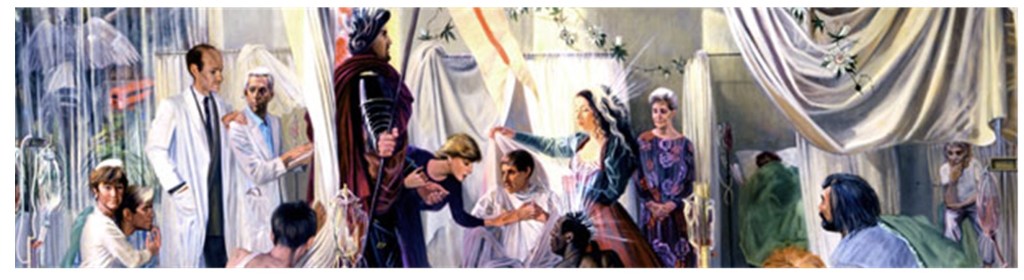
Votive Offering by Andre Durand, painted for CRUSAID AIDS Charity 1987 – detail

Votive Offering
Thoughts on World AIDS Day. December 1st, 2023

When Sunnye Sherman, a 35 year old legal secretary in America, was dying of AIDS she was visited by Canadian artist, Andre Durand. He was deeply moved and vowed to dedicate a painting as an offering, a prayer for salvation from the disease. Therefore, he called the painting, Votive Offering which by tradition is an intercession or petition which asks a special favour from God. In particular it invokes God’s goodness to heal.

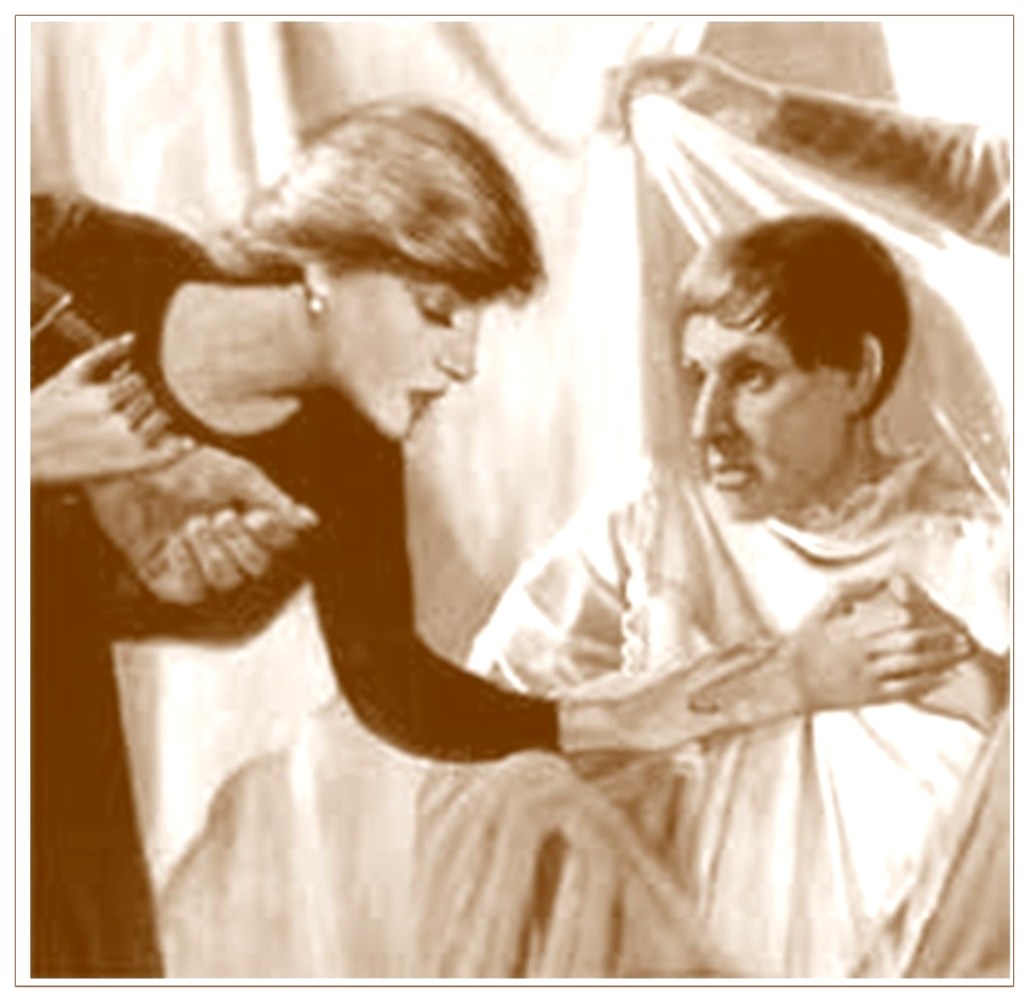
It was a very special painting – not only because it was an enormous canvas full of symbolism, but also because at the centre of it is Sunnye herself and she is being touched by Princess Diana. Votive Offering was an ex voto painting inspired by Sunnye and dedicated to her memory.
It also commemorates the visit of Her Royal Highness The Princess of Wales to the Broderip Ward of the Middlesex Hospital on 9 April 1987. Of the fifteen life-size figures in the composition, ten, including Princess Diana are portraits of people involved in the battle against AIDS. Votive Offering depicts Sunny being ‘touched’ by Her Royal Highness invoking the tradition of the healing touch of royalty.
Votive Offering was formerly unveiled and blessed by the Very Revd. Alan Webster, Dean of St. Paul’s Cathedral on All Saints Day, 1 November 1987 at St. James’s, Piccadilly. Recalling an ancient tradition, it then made a pilgrimage of great churches and cathedrals of Britian including St. Martin-in-the-Fields, St. John’s Church, Hyde Park, Peterborough Cathedral, Wells Cathedral, and Liverpool’s Roman Catholic Cathedral. The pilgrimage ended at St. Mary’s Episcopal Cathedral, Edinburgh in September 1988. During the pilgrimage many extra visitors went to the cathedrals to see Votive Offering and gave donations, flowers and said prayers. Parties of school children were taken to see the painting by teachers who realized the educational power of Votive Offering.
I experienced it personally St Mary’s Scottish Episcopal Cathedral. During the Edinburgh Festival special services were held, including an All Night Prayer Vigil using the painting as the focus for prayers for healing in a city were AIDS was devastating so many lives, including young mothers and babies through drug-related causes as well as gay people.

Andre used  artistic licence because Diana never met Sunnye but it was known that the Princess had a special concern for those dying of AIDS. She was a great supporter of the AIDS Charity CRUSAID and she regularly visited AIDS victims in London hospitals.
By introducing the Princess of Wales into his painting, Durand was also keying into a tradition which is known as the ‘Royal Touch of Kings’.
In earlier times in Europe, on special holy days, the Monarch would hold a special service during which those in need of healing would come to be touched by the King and prayed over, usually with the words: ‘The King touches you, God heals you.’ In England, the saintly Edward the Confessor, known today for his building of Westminster Abbey, exercised this ministry of touch, as did Charles II who, during his reign is said to have touched over 90,000 people in this way. Henry VIII, Queen Elizabeth the First, James and Queen Anne were known to have touched with prayer their subjects and an early edition of the Book of Common Prayer in 1549  included a special service to accompany the action with the Scriptural invocation: “He lay his hands upon them and healed them.’

One of the effects of exhibiting the painting in churches is that the Church felt strengthened in its ministry towards a section of society for whom there was, in the late 1980’s,fear, mistrust and moral judgement but it had a wider implication.
It was a call to acknowledge that within the Christian tradition there was a Gospel imperative to a ministry of healing which, at its heart, offers the love and compassion of Christ to all.
It was a challenge to proclaim the Kingdom of God’s love – a love which is not exclusive, reserved for an elect of those who believe they are specially chosen but which is open to  all who turn towards Christ and out of their need cry out to him to touch their lives with his healing.
This challenge has been at the heart of the Church’s response to the needs of a broken and vulnerable society.
It has inspired Christians to respond in many different ways and, as it were, to make of their lives a Votive Offering – a vow to serve their fellow humans as an act of self-offering in the name of Christ. These are people who really do make a difference to society – who really do meet the brokenness of others and identify with it.
What was powerful about the painting Votive Offering is that the artist brought the carer and the cared for into direct contact with each other. The Royal Touch of Kings demanded contact between the Sovereign and the one who came for healing. For Christians, the Gospel demands the same.
Jesus does not act remotely. One of the consequences of Incarnation of Jesus is that God doesn’t stand on the sidelines of the world and direct its destiny from afar. He is involved.
He touches and identifies with those who need him. That is one of the most important messages of the Cross and of Jesus’ suffering. Through his self-offering, God becomes accessible to us. This is a dynamic encounter with one who knows where we are coming from.
Here is the context for all Christian healing and it is what makes it distinctive.

We are not agents of some divine social agency put on earth to do good to others. We don’t dispense healing like some spiritual ambulance driver wandering round the world looking for the wounded – we share healing which we have experienced within ourselves. What we offer to others stems from that. If we tryto divorce our own experience of the healing love of God from what we offer to others then we shall be false and our falseness will be recognised and rejected by those who need us to be true.
Sometimes that experience is caught up in struggle. Being a Christian is not always about having answers to every problem and a glib, watertight faith can be quite unhelpful to others. When, for example we are faced with bereavement or pain or incurable disease we are often at a loss for words and platitudes will not do.
When the Jew, Elie Weisel wrote a book, Night, about his experiences in a Nazi concentration camp, he took the manuscript to the French writer, Francois Mauriac. He confessed to him that he felt abandoned by God. Mauriac, who believed that God is love, pondered how he might answer the young Jew. His instinct was to speak of that other Israeli, his brother, whose Cross had conquered the world. In the end he could not speak at all. He could only embrace him, weeping.
Yet it was, in that moment, the answer. Mauriac recognized that words were inadequate. He turned instead to touch and in that touch he was, in some way, Christ.

When I read what Mauriac wrote I felt that he had done something far more important than offer a theological justification for what Weisel was going through. He had done what Andre Durand tried to convey in his painting of Sunnye Sherman – he had brought to that young man the Divine touch of the King of Kings and whatever came of it, it was pure prayer.
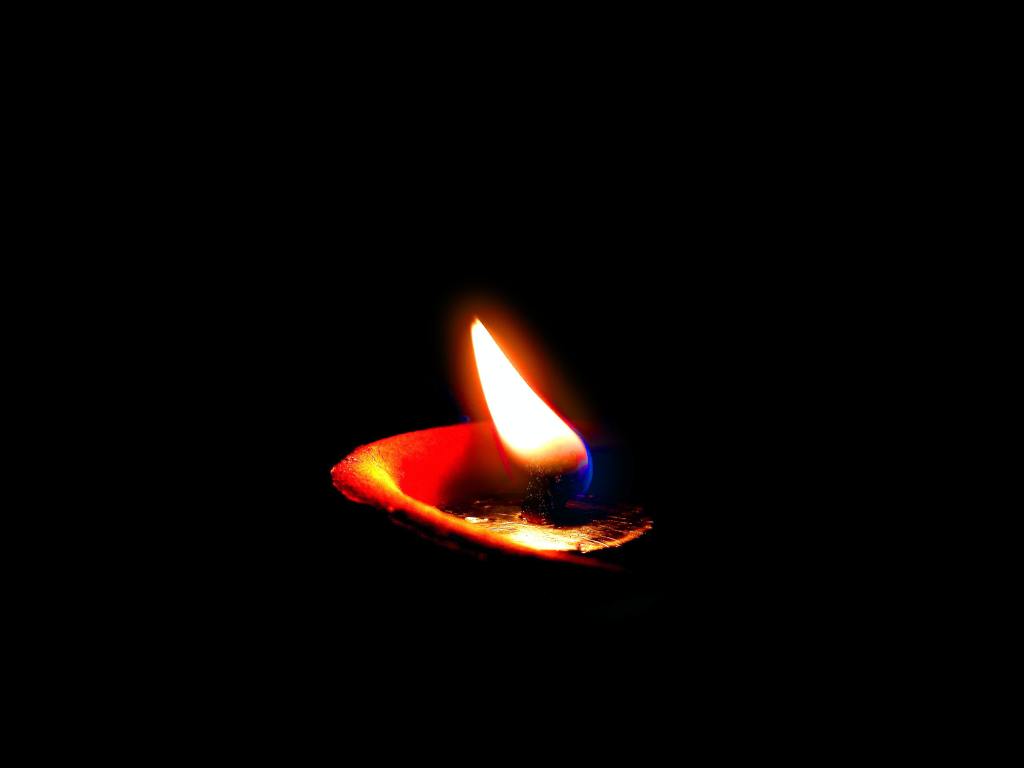
What Jesus asks of us is simply to be there and to let him reach out through our inadequacy, uncertainty, perplexity. A touch, a quiet prayer, a hug, the laying on of hands, anointing with oil, the lighting of a votive candle are all actions which bring Christ rushing to be a strength in our brokenness.
For me this is, like Mauriac’s action, something to do with prayer. It isn’t magic. It’s about placing ourselves into the arms of God.
That is not always an easy thing for those who are suffering. I am writing this just after I received news about a poorly baby, I and friends have been praying for. Sadly, after a very difficult operation, she has died.
I don’t think that her parents will feel like placing themselves into the arms of God. So some of us need to become the arms of love around them.
I take both comfort and instruction in words by Mother Mary Clare of the Sisters of the Love of God,( now with God in heaven).  She spoke of the importance of Christians standing and praying
at that point of intersection where the love of God and the tensions and sufferings we inflict on each other meet and are held to the healing power of God.”

When others are in desperation and broken apart, being a channel to hold their pain up to God’s healing love is not a last resort – rather, it is about the most positive thing we can do. Out of this will flow love, compassion and hope; all of which is used by God as our votive offering, a candle-light of love which embraces them and weeps with them but also holds them.

[Mr G. 1st Dec 2023. World Aids Day)

Not all sleeping

photo: Mr G

Cecilia, patron of music

Organ Case by Charles Eamer Kempe
Parish Church of St. John the Baptist, Epping, Essex.

It was St Augustine of Hippo who coined the phrase: “Those who sing pray twice”.
The reference is mainly to hymns, spiritual songs and religious musical pieces.
I was reminded of this saying on Wednesday when the Church kept the festival of St. Cecilia. (born in Rome about 2000, beheaded 230). She is the Patron Saint of Music.

Her claim to be so rests on quite flimsy evidence.
She was called to be a martyr to the Christian faith when, as a young Christian, she opened her home for Christians to meet together. At this time she had married a pagan, Valerian, whom she converted to Christianity along with his brother. Unfortunately they took it upon themselves to bury the bodies of Christians who had been killed for their faith. When the Roman authorities came to hear of this, they were both arrested and put to death.
Cecilia continued in her own witness, her life an example of fortitude, steadfastness and faith.
The authorities, however, decided that it was time to act against her.
On November 22nd, in the year 230, she was martyred.
The chosen method was that she was burned in the fire but here, hagiography takes over.  Her body remained intact and unburnt despite the ferocity of the flames and she is even said to have continued preaching the Gospel until it was decided to behead her.
These are the main facts but her life was so inspirational to other Christians that more was said about her.
As with many saints, particularly those who witnessed in the early centuries of the Christian Church, their ‘lives’ where written ‘up’, in which more was claimed than could be proved. That doesn’t mean that it was a pack of lies. There is a kind of Christian writing which is known as hagiography. It isn’t a straightforward biography but rather a piece of writing which introduces legends or stories that praises a particular saint and treats their life with reverence. It honours not just them but what their life stands for. Many hagiographies were written to encourage Christians, especially in times of darkness or persecution, to hold on and live deeply in love for Jesus Christ and His Good News for the world.

It is in this area of legend that the association of St Cecilia with music can be found.It is suggested that on her wedding day, as the musicians played, she sang with all her heart to the Lord. Similarly, as she was martyred in the fire, her soul again, sang to the Lord.
This was enough to declare her to be the Patron Saint of Music and musicians.
It was finally declared when, in 1584 the Academy of Music was founded in Rome. She was made the patroness of the Academy and this was enough to make sure her veneration became widespread throughout the world.
Ever since, Cecilia has been an inspiration to musicians
Musicians such as Handel and Benjamin Britten became inspired by her legend and even  in literature she was recognized. Geoffrey Chaucer used her as the basis for his 2nd Nuns Tale in the Canterbury Tales.
It is probably more about music that we relate to her less, these days, than martyrdom. 
Cecilia stands for that other kind of witness which comes through Music

The enquiry into the response to Covid-19 which is happening in England right now, will not be looking at the loss we experienced of not being able to be absorbed by the arts in all their fullness. Live Music became impossible to hear.
For Christians, and many others the ban on singing hymns in Church was particularly hard. This was part of a huge loss for all who played and sang music and those who simply love to hear it. Our lives were diminished and our need unfulfilled through a loss of music, of hymns, of spiritual songs.
It’s true, of course, that we rarely appreciate the value of something until we lose it and now, when we can freely sing, hear music, contemplate words of hymns and make them an essential part of our prayer and spirituality, we must not take it all for granted.
Music and singing help to root our meditations and open poetry into our souls. Perhaps, like me, you catch yourself singing when you are still or in the shower or at odd timers of the day. That is when you use best the instrument God gives most of us, the human voice.
Better to sing than to shout; better to lend your voice to the music of heaven which surrounds us; better to praise than destroy; better to let God use the music of the soul to enfold people in love.

Whatever the true story of St. Cecilia is, the legacy of her patronage continues to fill our hearts and minds with musical words that can inspire us, especially in this very dark world. We can be uplifted and affirm the great truth that music is a powerful force for good. It can celebrate and rediscover beauty in our world and, most of all, it pours out praise to God. In all our current global unrest, music has a special part to play.

[Mr G. St Cecilia 2023]

Forgiveness as part of Remembrance

When the Ravensbruck Concentration Camp in Germany was liberated at the end of the Second World War, a prayer was found on a scrap of paper in the camp, and it is often used today in acts of remembrance for the Holocaust victims. Both the Jewish and the Christian faith teach followers not to seek revenge, but to pray for their ‘enemies’, for those who hurt them, or who make them suffer in some way. In Islam, pardon and forgiveness are seen as better than revenge. Although many Jews, Christians and Muslims,  and those who follow other faiths,  find this extremely hard, there are always some who astound us by their love and generosity.

In the Bible, God’s judgment is seen as something positive, something to look forward to.
Psalm 96 talks of the earth rejoicing and trees singing for joy when God comes to judge the earth. God’s judgment is seen as the time when wrongs will be put right, when those who suffer injustice or oppression will be rescued. But God’s judgment is also seen as merciful. Christians believe God’s judgment will rescue the perpetrators from their wrongdoing, as well as their victims.

Here is the Ravensbruck Prayer. It is moving, amazing and deeply generous. It is born out of compassion and mercy.

[Mr G Remembrance Day 2023]