And the Lord said to us: ‘Come and I will separate you and judge you for how much or how little you have loved’.
I put before you the suffering ones, the desperate ones. the hungry; the thirsty; the homeless ones. Some cast from their homes when despots, shadows of men, ruthless power-seekers moved against their own people: those they had pledged to care for. Instead they sucked the life from their souls, souls that belong to me.
You left them ruined, afraid, unwanted, empty – but you could not take away their dignity. You tried to rob them of the one gift that I gave them which you cannot touch: their humanity – made in my image. An image that dazzles ever brighter, the more you try to stamp it out.
Despairing bodies shuffle, clutching rags and children and anxiously walk the Indo-European Way – that trek which your ancestors made long ago.
They come to you in hope. They come as refugees and seekers of shelter. You utter your political platitudes. You blame it on the traffickers. But you fail to look in a mirror.
For these people are your test. How much do you love? How much do you care? Do you see them for the glorious humanity they are?
They come to you simply, humbly, hopefully; Looking for baptism into a new life through your love.
And you, what do you do? You allow them to drown in the deep, chill waters of death. Where others have failed, you succeed in taking their lives after all.
You must leave me now. There is little room for you in God’s heart.
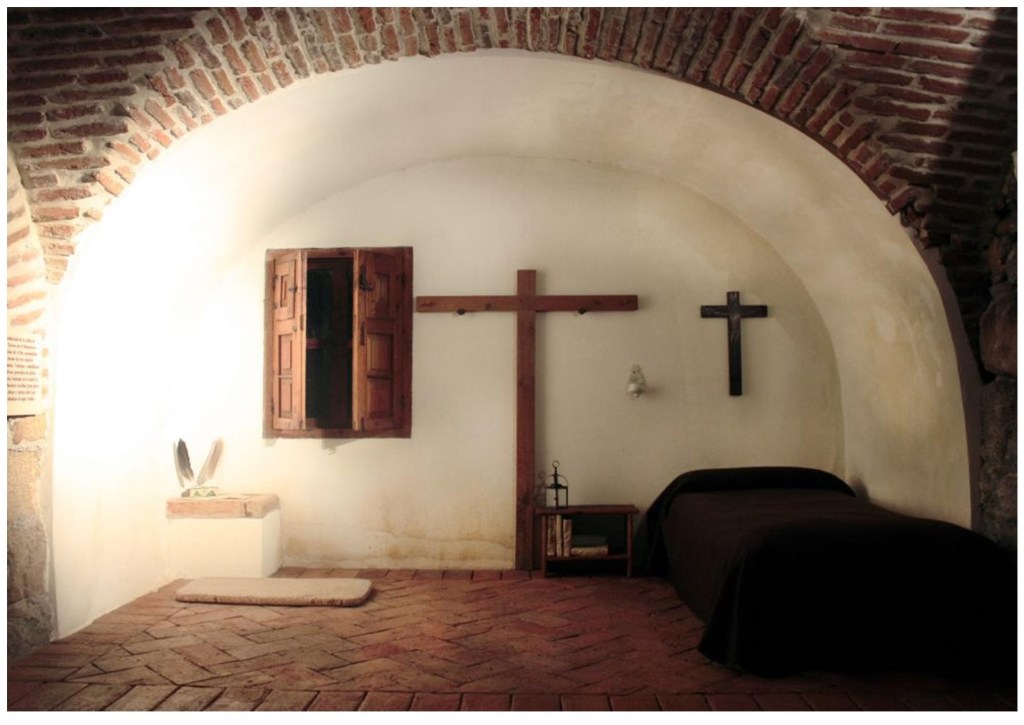
St. Teresa’s Cell, Convent of the Incarnation, Avila.
St Teresa of Avila : God is found in our ordinary lives. A reflection for her festival Day, October 15th.
TERESA of Avila was often referred to as God’s Gadbout because she spent a lot of her energy in founding convents of nuns throughout Spain in the 16th century. She was forever on the move and yet she is remembered best for her teaching about Prayer and particularly about Contemplative prayer which requires stillness. No matter how busy she was – and she was very busy – she made sure her heart was constantly fixed on God, whom she referred to as Your Majesty. God for her was very near. Indeed she coined a famous phrase – ‘God walks among the pots and pans’. We find God in the ordinariness of life, and if we train ourselves to recognize that, we shall meet Him in the everyday events of our lives and in the people we meet. This is about finding Heaven in Ordinary.
Teresa believed that God was within us as well as beside us, and here she took up our Lord’s own teaching that the Kingdom of God is within us. We encounter Him in the silent depths of our hearts.
You know that God is everywhere, she says, which is a great truth; wherever God dwells there is heaven, and you may feel sure that all which is glorious is near His Majesty.
Then she refers to St Augustine who sought God in many places and at last found the Almighty within himself.We don’t need to go to heaven to find God,she says, We are not forced to take wings to find Him, but have only to seek solitude and to look within ourselves.
She calls this seeking God in solitude within ourselves, the prayer of Recollection – or Contemplation. In her work Interior Castle she develops this using the imagery of a King in his Palace.
Let us realize that we have within us a most splendid palace built entirely of gold and precious stones – in short, one that is fit for such a Lord – and that we are partly responsible for the condition of this building, because there is no structure so beautiful as the soul full of pure virtues, and the more perfect these virtues are, the more brilliantly do the jewels shine
What we find in this Palace is the mighty King who, she says, has deigned to become your Father and Who is seated on a throne of precious value, by which I mean your heart.
Realizing this took her quite a while.:
Had I understood always, as I do now, that so great a King resided in my soul I should not have left Him alone so often, but should have stayed with Him sometimes and not kept His dwelling place in such disorder.
For Teresa, then, it is when we enter into silence and spend a little time with God in our hearts, that the soul makes progress in the prayer. God becomes the centre of our being, always to be found when we still the voices of the world that claim so much of our attention!
Teresa says that it is only through silence that we can encounter the love of God and receive it into our hearts. God is very near. We should seek him within. He is much closer to us than we might imagine. We are not ordinary to Him who loves us and who calls us to be near to His heart. Of course, it is when we recognize this that we can actually discover that we are quite extraordinary!
St Teresa’s Cell looking out.
The two photographs could represent our looking inwards to God as the heart of our prayer (top) and looking out as we inhabit the world with God’s love. We are sent out to find God in the ordinary or, where we find it lacking, we can take note of what Teresa’s great spiritual friend, St John of the Cross once said: “Where there is no love, put love in and you will draw love out.”
[Mr. G]
A Prayer of St Teresa
(often known as Teresa’s bookmark. It was found in her prayer book after her death)
Let nothing disturb you. Let nothing frighten you. All things are passing; God only is changeless. Patience gains all things. Who has God wants nothing.
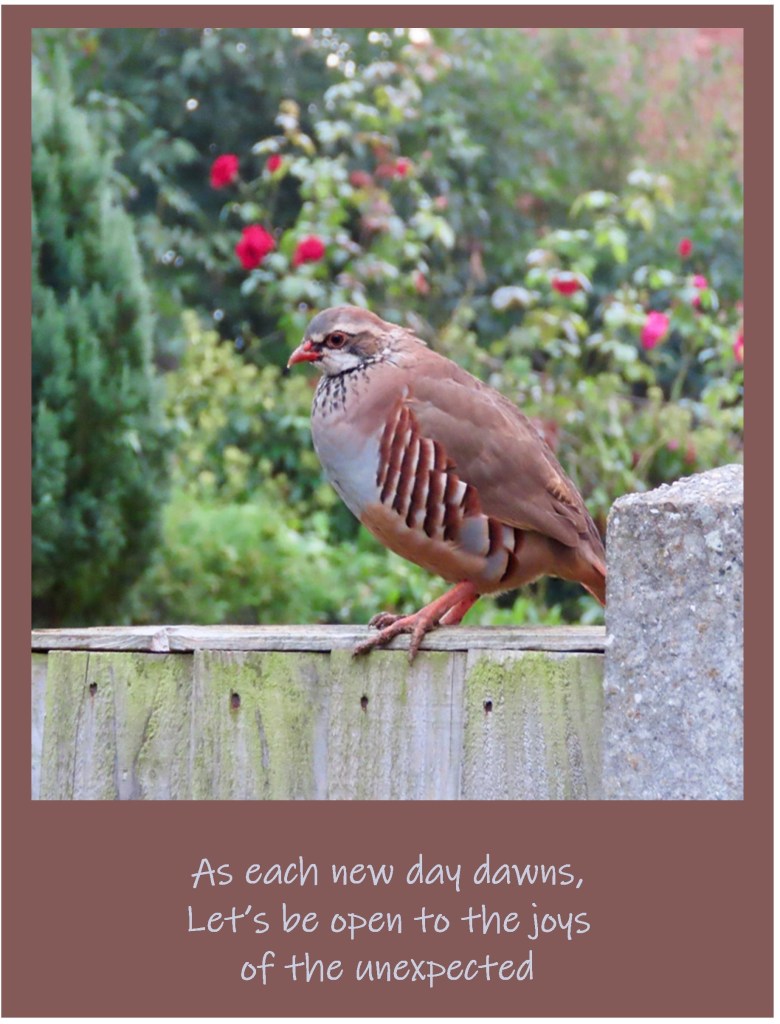
This Photo is from my friend Joyce Smith. “Here is a picture of my unexpected visitor who arrived on my garden fence the other morning. My books suggest she is a red-legged Partridge who may have flew down from Upshire. With my love and prayers. Joyce. Joyce notes that it is a rare visitor to her garden so an unexpected surprise.
Her chosen caption is As each new day dawns, let us be open to the joy of the unexpected. Reflection on this took me into the area of hospitality, both in the giving and receiving of it. My natural starting point for this is the Rule of St. Benedict in which he wrote: All visitors who call are to be welcomed as if they were Christ, for he will one day say: I was a stranger and you took me in (Mt 25).
Benedict then sets down how guests should be received and how they should be treated. Others in the monastic tradition have similar approaches to receiving guests as reflections of Jesus. No doubt they were mindful of what the epistle to the Hebrews calls entertaining angels unawares – without knowing it. (Hb 13:1)
By extension the seeing of Christ in others is commended to all of us who profess the Christian faith (and is something other religions express too, in their own way). The general thought is that we are to see Christ in each other because we are striving to be Christ-like and so reflect him in who we are.
That’s not always easy to do. The red legged Partridge is very beautiful and we can easily see that she is a reflection of the breathtaking beauty of Creation. I’m think that if she had been a magpie (or even worse, a wasp!) I might have found it more difficult. It’s the same with some humans too, though those who seek to find goodness and beauty in people will no doubt succeed.
It was a short hop in my thinking to consider the plight of the refugees. At present because of the conflicts in our world, there are many seeking shelter and safety. Through absolutely no fault of their own they are arriving in other places from their own countries. They have lost everything. They are, our unexpected visitors. How do we welcome them?
The numbers are overwhelming and it is hard for us not to be fearful and protective of our way of life. They are different in some ways in culture and even have differing values though we can all learn so much from each other if we but listen and share love. The immediate group of ‘visitors’ , are the boat people, crossing the channel in dangerous and life-threatening conditions.
When I was thinking of their plight, other ‘boat people’, who fled their own country came to mind. They too travelled across a difficult sea, seeking a less harsh way of life. I speak of the flood of Irish immigrants to America and England in the 18th and 19th centuries, either driven out by the Great Famine, or political upheaval. Amongst them were some direct relatives of mine.
Other ‘boat people’ were the Windrush generation, much more recently. Actually, because we live on an Island, most of our ancestors came by boat to dwell here. They were either conquerors like the Romans, Vikings, Danes or they were part of the great trek which brought tribes in waves along the Indo-European trail. (I draw a veil over the many lands which have been harshly occupied by others who thirsted for dominance, exploitation and power!)
Today, of course it is Syrians, Lebanese, Afghans, people from Yemen as well as some Africans, who are on the move. Our planet has always been a nomadic place and few of us can say that our ancestors and even our compatriots were settled people. The people who can claim true British descent are probably only those in Wales, Scotland, Ireland, Cornwall and that area from which we take our name, Brittany.
Somehow the rest of us sort of landed up here as unexpected visitors. Sadly, many asre currently unwanted. I’m just grateful, on behalf of my family past and present, that we didn’t have people in authority whose treatment of the various boat people has little to show St Benedict and others that we really do welcome people as if they were Christ.
So I thank Joyce for giving me some hope. Her unexpected visitor can serve to open our hearts to another, more kind and caring approach. Joyce welcomed this stranger with Joy. There was also delight because, like all visitors the Partridge brought a gift. She came with a beautiful reminder of the joy of God’s creation. We even see the pinky-red flowers behind her which forms a nature-filled welcome. If we pause, embrace the moment, give thanks for the ‘otherness’, then we might just catch a glimpse of what the poet Gerald Manly Hopkins calls the grandeur of God.
If we seek to find that grandeur of God, maybe dazzlingly, maybe dimly, we will take a step towards meeting Him in others and in Nature. That perception can itself mightily change our world. I say ‘our’ world but I end with saying: Thank You to the red-legged Partridge for popping by to share her World with us.
Here is another photo reflection from my friend Joyce Smith.
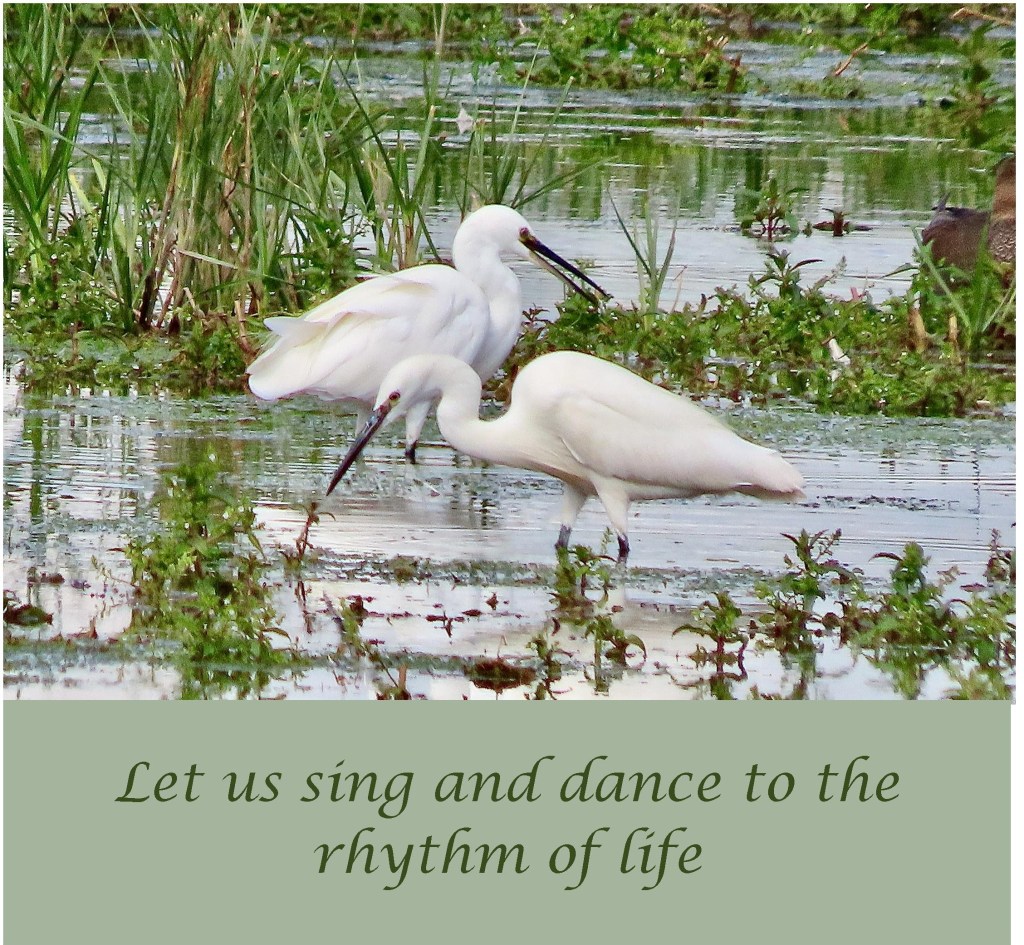
She comments: These little egrets certainly seem to move with the rhythm of nature and life.
Egrets are part of the Heron family. The RSPB describes them as having white plumes on crest, back and chest; black legs and bill, yellow feet. They were first seen significantly in 1989 and first bred in Dorset in 1996. They can be seen on a number of south coast sites where they breed. Some are also winter visitors.
The photograph which Joyce sent is very compelling and I found it particularly important to spend time with it. As I sat in silence, looking at it, words like Grace, Stillness, Beauty, Purity and Peace came to mind.
The background of lush, verdant grasses and plants, paints a background of nature embracing and framing the quiet poise of the two birds, patiently waiting to catch their next meal (always fish). Yet they are almost statuesque. The water laps around them and, behind , becomes an oasis-like pool in which they can wade.
Joyce invites us to sing and dance to the rhythm of life and there is a strong sense that the photo records a balance of nature to our own, often unbalanced and frenetic lives. The message seems to be that we were never meant to live the way we do. It’s an idealistic message, of course, for those whose reality of life is different. Life isn’t that easy for us, especially at the moment, but let’s also remember that in the natural world of the egret things are tough too.
But in the photo there is a what I like to call a ‘Pause moment’ .
We are invited to be still, to pause, to breathe, to re-balance our lives, if only for a few minutes. We are gently challenged to become part of who and what we are in God’s eyes and maybe we might learn a little to sing and dance to the rhythm of life – real life as God longs it to be for us.
But this contemplation shouldn’t leave us dissatisfied. There is nothing ‘if only’ about this. A companionable moment with a friend is never futile or wasted. It is a time to be still and maybe wait.
Bird-watchers are, I believe, very patient people. Holding their breath as the egret or some other bird, circles and lands. There is a thrill of expectation about to be fulfilled.
As I sat in companionable silence, quietly watching the egrets I knew what I was waiting for.
My companionable God. He comes so easily in quiet. Which is why the egrets remind me that I must cherish this moment as a Godly re-balancing.
The symbolism of the egret is said to be about being at peace with oneself and with the world. This is a state of balance and calmness. When, even if only for a moment, we reach this level of spirituality and of peace with our Creator, then we can discover ourself as a more balanced and integrated person, full of life and of God. This, of course, is a mirror. This photo holds itself up for us to see the One for whom it is most true – He who invites us to sing and dance with the joy of life – Jesus.
[Mr.G & Joyce with a little help from Revd. Lynn]
*** RSPB = Royal Society for the Protection of Birds



 Mr G's Ponderings