Tag: Mr G

There is another world

My friend, Joyce Smith, has sent me another of her Photo Tweets. The baby swans (cygnets) are beginning their life on earth so hopefully and with determination! Thank You, Joyce.

New Birth, new growth, new light are all signs that our natural world in the Northern Hemisphere just now is turning towards Spring.

Even the storms of the past ten days haven’t deterred the journey of Nature and that will be true of human conflict in the war Russia is waging at present, aided by Putin’s Puppet in Belarus.
Charlie Mackesy in his beautiful book, The Boy, the Mole, the Fox and the Horse, says that the best thing about storms are that they end.  As we are now living through the storm caused by Putin it’s something to cling on to. This storm will pass!  says Mackesy.

Maybe those words wouldn’t bring any comfort in the Ukraine right now nor for some time to come but history teaches us that despots and tyrants are, in cosmic terms, short-lived. The 20th century had a number of them – Hitler, Musolini, Stalin, Franco, Mao, Pol-Pot for example.  They created havoc and chaos for a while and destroyed peoples’ lives as they demand obedience to their warped and demonic ideas.
We remember them now for the evil they did and the destruction they left behind. This is the work of the devil and it prospers because we have lost any real sense of the demonic. I think it was possibly C S Lewis who maintained that the greatest victory the devil has is when we don’t believe he exists.
Mostly he is a mischief maker because, in truth, he is already defeated. Christianity maintains that defeat was by Jesus Christ who, sacrificially, poured out love as God’s way of defeating darkness, and sinfulness and unlove.
Even so, there are times when the devil can turn the minds of the weak and tortured. Analysts with far more skill than I have, are already delving into the character of Putin and some fascinating things are beginning to emerge.

He is supposedly a practicing Orthodox Christian. I wonder what his priest will be saying to him on Sunday? I think we can guess it won’t be controversial.

The ‘Storm’ will pass but not just yet so the Jewish Proverb has something important to tell us. We are encouraged to turn to God. As in the story of the Prodigal Son, we will then find God running to us.

The Novelist Patrick White in his novel, Solid Mandela quoted some words possibly by the French poet, Paul Éluard : There is another world, but it is in this one.

We find God in unexpected places and especially when we are surrounded by danger, filled with despair and almost paralysed by anxiety.
We do not know how the raging war against Ukraine will turn out and the aftermath is full of unhappy consequences and foreboding.
But in the midst of that desperate world, the other world continues to show signs of hope and of God.
As the lovely Jewish Proverb tells us; We should walk towards it – maybe only one step but enough to know that it illuminates our world with God’s and He rushes towards us to enfold us with His love.

So Joyce’s photo of the little cygnets is itself a message to us to try to trust in and cherish the tender signs of love which come to us from the heart of God’s world and from His Nature. A world of which we are always a part.  

[Mr G]

Love comes Himself

LOVE DOES NOT SEND
ANOTHER….

A Star

Announces the Light
which has come into the world;
The Light of Truth.
The Light of Love,
which coming into our world
of darkness cannot be extinguished.
It is a Candle flickering in the wind of the night,
and the darkness cannot destroy it.
Its constant flame is our guide.
It is the Light which attracts
all people of Truth,
all people of Love

In humility
we bow low to the Light,
full of wonder;
and marvel at the power of so simple a thing
which overpowers and transforms everything.
and the light, entering our hearts, shines in us,
and the dark world is subdued.

Rejoice, Love has come into the world
for Love does not send another,

      …..HE COMES HIMSELF.

[Mr G December 1973 revised 2005]

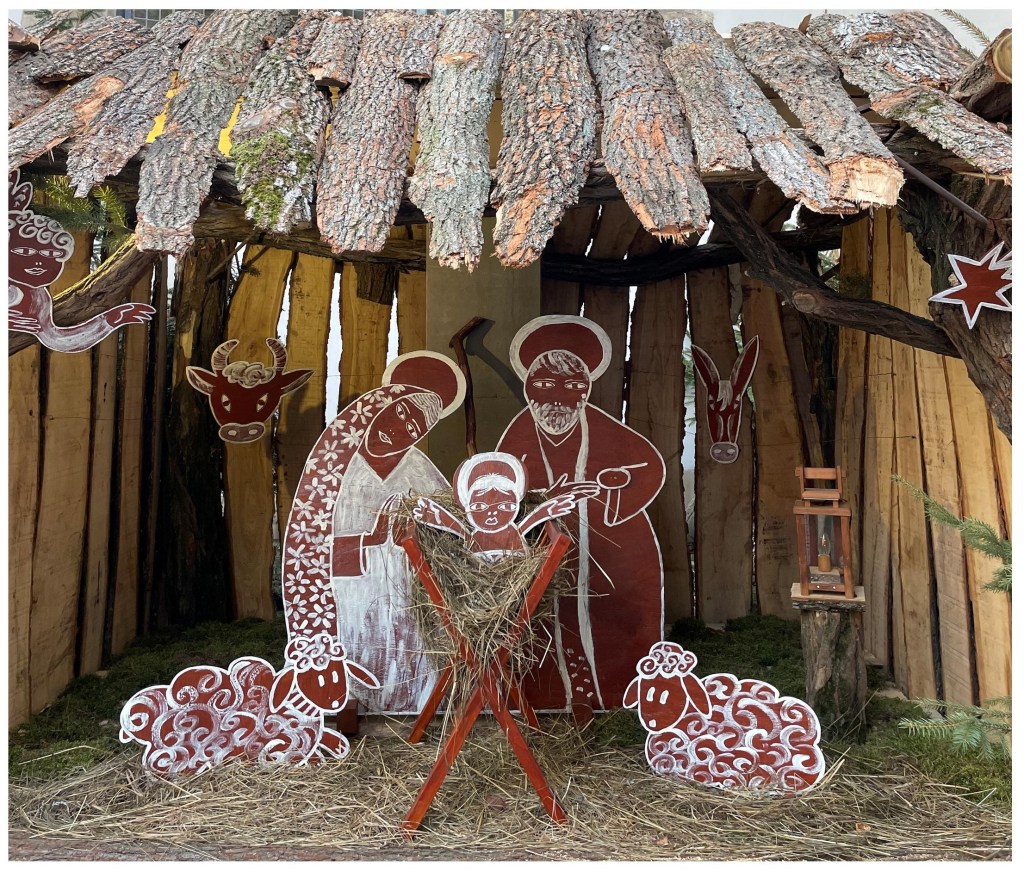
Photo: Outdoor Crib at Bethlem Chapel, Prague
Photo taken by Gill Henwood

They came to you in hope

And the Lord said to us:
‘Come and I will separate you and judge you
for how much or how little you have loved’.

I put before you the suffering ones, the desperate ones.
the hungry; the thirsty; the homeless ones.
Some cast from their homes when despots, shadows of men,
ruthless power-seekers moved against their own people:
those they had pledged to care for.
Instead they sucked the life from their souls,
souls that belong to me.

You left them ruined, afraid, unwanted, empty –
but you could not take away their dignity.
You tried to rob them of the one gift that I gave them
which you cannot touch:
their humanity –  
made in my image.
An image that dazzles ever brighter,
the more you try to stamp it out.

Despairing bodies shuffle, clutching rags and children
and anxiously walk the Indo-European Way
– that trek which your ancestors made long ago.

They come to you in hope.
They come as refugees and seekers of shelter.
You utter your political platitudes.
You blame it on the traffickers.
But you fail to look in a mirror.

For these people are your test.
How much do you love?
How much do you care?
Do you see them for the glorious humanity they are?

They come to you simply, humbly, hopefully;
Looking for baptism into a new life through your love.

And you, what do you do?
You allow them to drown in the deep, chill waters of death.
Where others have failed,
you succeed in taking their lives after all.

You must leave me now.
There is little room for you in God’s heart.

[Mr G]

God is very Near

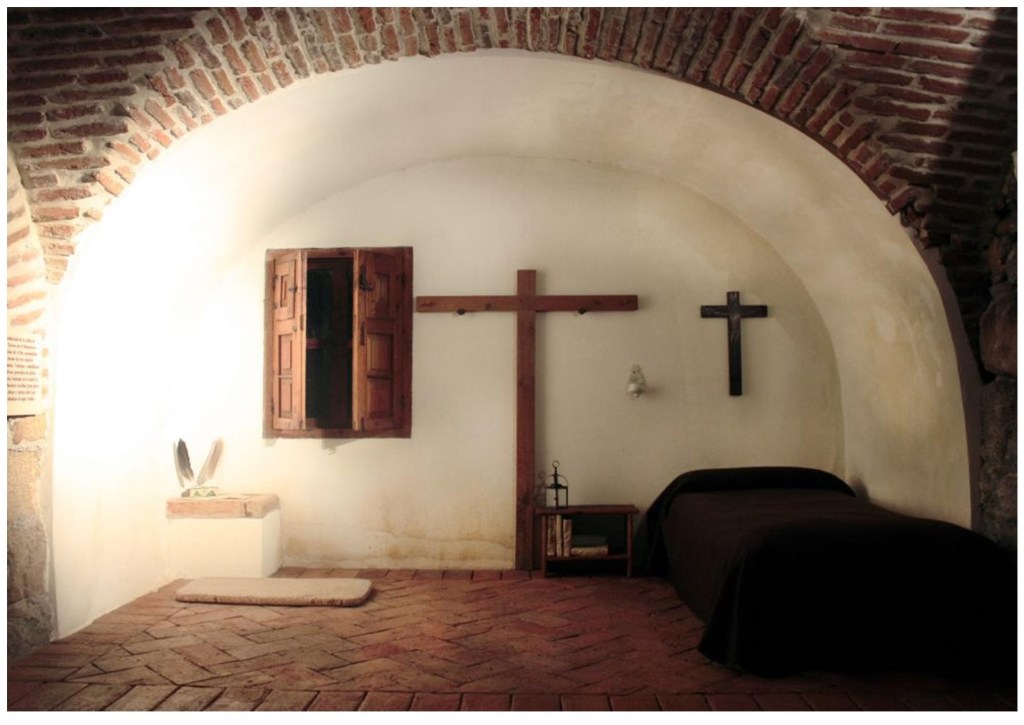
St. Teresa’s Cell, Convent of the Incarnation, Avila.

St Teresa of Avila   :  God is found in our ordinary lives.
A reflection for her festival Day, October 15th.

TERESA of Avila  was often referred to as God’s Gadbout because she spent a lot of her energy in founding convents of nuns throughout Spain in the 16th century.  She was forever on the move and yet she is remembered best for her teaching about Prayer and particularly about Contemplative prayer which requires stillness.  No matter how busy she was – and she was very busy – she made sure her heart was constantly fixed on God, whom she referred to as Your Majesty.  God for her was very near.  Indeed she coined a famous phrase – ‘God walks among the pots and pans’. We find God in the ordinariness of life, and if we train ourselves to recognize that, we shall meet Him in the everyday events of our lives and in the people we meet.  This is about finding Heaven in Ordinary.

Teresa believed that God was within us as well as beside us, and here she took up our Lord’s own teaching that the Kingdom of God is within us.  We encounter Him in the silent depths of our hearts.

You know that God is everywhere, she says, which is a great truth; wherever God dwells there is heaven, and you may feel sure that all which is glorious is near His Majesty.

Then she refers to St Augustine who sought God in many places and at last found the Almighty within himself.  We don’t need to go to heaven to find God, she says, We are not forced to take wings to find Him, but have only to seek solitude and to look within ourselves.

She calls this seeking God in solitude within ourselves, the prayer of Recollection – or Contemplation.  In her work Interior Castle she develops this using the imagery of a King in his Palace.

Let us realize that we have within us a most splendid palace built entirely of gold and precious stones – in short, one that is fit for such a Lord – and that we are partly responsible for the condition of this building, because there is no structure so beautiful as the soul full of pure virtues, and the more perfect these virtues are, the more brilliantly do the jewels shine

What we find in this Palace is the mighty King who, she says,  has deigned to become your Father and Who is seated on a throne of precious value, by which I mean your heart.

Realizing this took her quite a while.:

Had I understood always, as I do now, that so great a King resided in my soul I should not have left Him alone so often, but should have stayed with Him sometimes and not kept His dwelling place in such disorder.

For Teresa, then, it is when we enter into silence and spend a little time with God in our hearts, that the soul makes progress in the prayer.  God becomes the centre of our being, always to be found when we still the voices of the world that claim so much of our attention!

Teresa says that it is only through silence that we can encounter the love of God and receive it into our hearts.  God is very near.  We should seek him within. He is much closer to us than we might imagine.
We are not ordinary to Him who loves us  and who calls us to be near to His heart.
Of course, it is when we recognize this that we can  actually discover that we are  quite extraordinary!

St Teresa’s Cell looking out.

The two photographs could represent our looking inwards to God as the heart of our prayer (top)
and looking out as we inhabit the world with God’s love.
We are sent out to find God in the ordinary or, where we find it lacking, we can take note of what
Teresa’s great spiritual friend, St John of the Cross once said:
“Where there is no love, put love in and you will draw love out.”

[Mr. G]

A Prayer of St Teresa

(often known as Teresa’s bookmark. It was found in her prayer book after her death)

Let nothing disturb you.
Let nothing frighten you.
All things are passing;
God only is changeless.
Patience gains all things.

Who has God wants nothing.

God alone suffices.