They come; those Viking spirits on the lapping ancestral waves of memory and myth. They conquer hearts for the day, proclaiming a time for turning. Torchlight gives way to flame, which turns to fire, transforming heat with real warmth, licking upwards, giving light. flickering sign of a turning world looking forward now to lengthening days as Lent, the Springtime of the year, draws us forward with new expectation.
[Mr G]
This poem is inspired by the annual festival of Up Helly Aa, held at Lerwick on Shetland , each year on the final Tuesday of January. It marks the end of the Yule, or Christmas, season which was kept, under the old Julian Calendar at this period of the year. According to an article in Wikipedia, Up Helly Aa means, literally Holy Day. The Festival draws from the link between the Shetland Islands and Norway of which it used to be a part. So it centres on a replica of a Viking Longship. It is ‘crewed’ by locals dressed as Vikings knows as Guizer Jarls (pr. Yarl) with a head Guizer presumably as warrior captain. Each Guizer is dressed in a figure from Norse legend. This year for the very first time, these include women and girls, though a few have slipped in many years ago disguised by costume! After a day of festivity, as night falls, the replica Longship is dragged through the streets of the town in a procession led by torchbearers. The Longboat is circled by the torchbearers who then sing a traditional song associated with the Festival. They then cast their burning torches into the ship which lights up the night with fire. Once the ship is just embers, another song is sung and then it’s party time as the people sing and dance the night away.
The following day is a holiday or ‘hangover’ day!
The Festival marks a transition from Winter Festival towards the season of Lent. In Christian terms this is also a turning point as we begin to prepare for the Passion, death and Resurrection of Jesus at Eostre, Easter. Lent itself is Old English for Spring. It is a time of growth as the earth gives birth to new growth. This growth is both spiritual as well as physical. It carries new hope and new expectation for each of us and for our world. And don’t we need it!
[There are a number of informative and entertaining sites about Up Helly Aa on the web. The photo is from one of the official sources]
God walks among the Pots and Pans – a reflection on St Teresa’s day October 15th
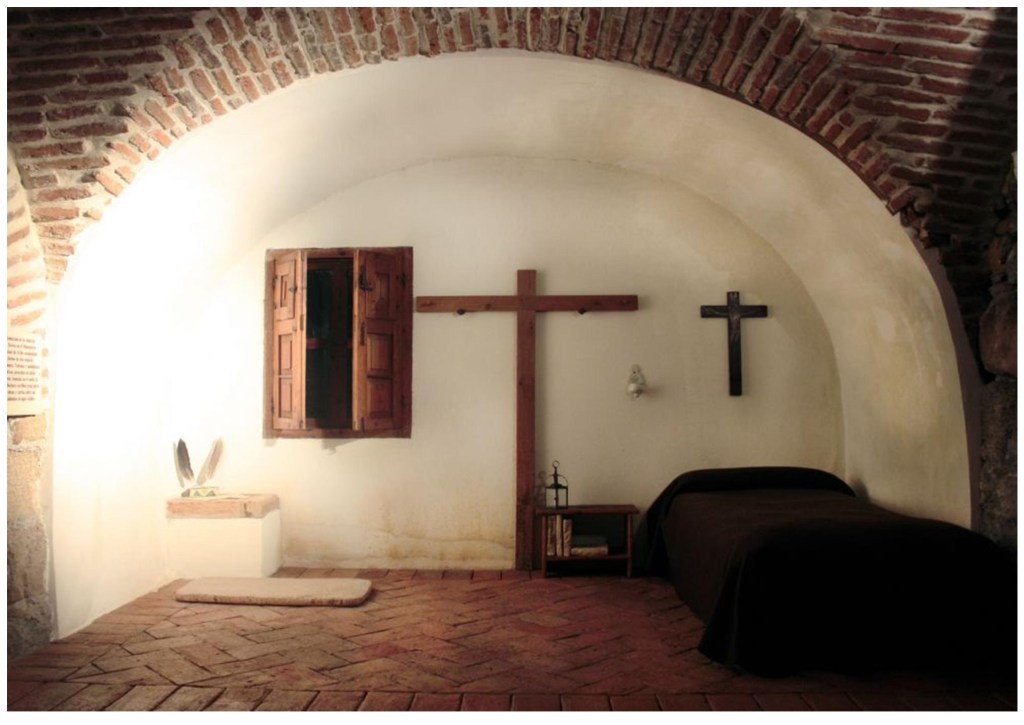
Teresa of Avila believed that God could be found in everyday and rather ordinary activities as well as in the silence of prayer in church or some special place. Though she herself had experienced deep mystical experiences she was down-to-earth and practical. When it was reported to her that a sister was having an extreme religious experience which threatened to overwhelm her, Teresa advised that she should eat marmalade. (she knew the importance of sugar balance!) Another sister in a similar state was told, quite sharply, that she was there to do the dishes! Though she was granted a particularly great spiritual experience of God, known as the Ecstasy of St. Teresa, which she described as a “complete transformation of the soul in God,” she firmly believed that God was to be found and experienced in everyday ways.
Most of the time, our journey of faith is really quite ordinary. Yet it is in the midst of ordinariness that God opens Himself to us and warms our hearts. I’ve always liked what St. Teresa of Avila said—God walks among the pots and pans. He’s can be found in the ordinary things that we do and the tasks we perform, like cooking and cleaning the dishes. Whilst experiencing Jesus in church worship and in the sacramental life, God is always near us. If our hearts are tuned to him we shall recognize him in the mundane, the unexciting, the ordinariness where Jesus is constantly waiting to meet us.
Teresa was born in the 16th century and her feast day is on Tuesday. At an early age she was fired up by the lives of the saints and she was particularly taken by the martyrs and their complete self-offering to God. When she was about 12 she decided that she would leave home and travel to where there were enemies of Christ who would, she confidently believed, behead her! Then she would immediately enter heaven. She took her younger brother Rodrigo with her but fortunately for them, they were apprehended by an uncle before they had reached the outskirts of the town. He noted that the ever-practical Teresa had remembered to pack sandwiches.
Though she failed to receive the martyrs crown she responded to the call from God which was to be total and life-long. Entering a Carmelite convent at the age of 21, she was to be dogged by ill health for many years, even to the point of death. It was when she experienced a mystical visitation from God which left her heart trembling that she was “left completely afire with a great love for God.” She knew then that her soul would “never be content with anything less than God.”
At this time in Spain, the convent life was one of luxury. Nuns even had their own personal maids! Teresa received a call from God to restore a sense of sacrifice and simplicity to the Carmelite order. With thirteen other nuns, she left the security of her convent and for the rest of her life she founded a different sort of convent. Throughout Spain she introduced reforms, some of which she had to argue for in front of prelates and even a Pope but she was not afraid of anything that she saw as standing in the way of God. Simple convents for a simple God-centered way of life. The nuns went barefoot as they trod gently but purposefully towards God and His Kingdom.
Teresa rushed all over Spain founding such convents, and earning the nickname as ‘God’s Gadabout’. But in the midst of all this activity was a soul stilled into prayer. She remained close to God in the silence of true prayer. She never ceased to find him in the ordinariness of her daily life.
Sometimes she met Jesus in ways she would have preferred not to! On a particularly rainy day, the ox-cart in which she was travelling got stuck in the mud. Seeking to help in some way, she jumped from the cart into mud almost up to her knees, whereupon she shook her fist towards heaven and is supposed to have said, It is no wonder that your Majesty has such few friends, the way you treat us!’ She was to write many fine words about prayer but surely none would come straight from her heart as that did!
Her spiritual guides insisted that she wrote down her thoughts about prayer and they are, to this day, among the great spiritual classics. They reflect her holiness, wisdom and sense of humour. Through them she has become a favourite teacher of prayer to many, many people. Her teaching was recognized by the Church, when shortly after her death she was made a saint who was truly a ‘teacher of the faith’
Her words, her teaching, her example, have given us a rich treasury from which to discover how to both accept and give the love of God; a love through which we grow faithfully and in the knowledge that God is always close to us. In everyday ways and everyday words Teresa helps us to open our hearts more fully in peace and trust to the one she always called Your Majesty, and lived close to in deep friendship and love. So might we.


 Mr G's Ponderings